The interesting thing about a disclosure programme that publishes on a rolling basis is that it eventually publishes something on a Friday afternoon in August, when nobody is looking, and the something turns out to be the best file of the lot.
On 7 August the US Department of War posted its fifth tranche of declassified UAP records: 41 documents, images and videos, the oldest from 1950, the newest from this year. Most of the coverage led on a colossal triangle over Afghanistan and a 1963 cable about a dead man in a spacesuit. Both are good copy. Neither is the story.
The story is a routine-looking intelligence information report about a gunship, a flare, and roughly twenty-five things that did not behave like anything the crew had a name for.
What actually landed
The release comes under PURSUE — the Presidential Unsealing and Reporting System for UAP Encounters — the interagency declassification effort running since May under an executive order President Trump signed in January, and supported by the Office of the Director of National Intelligence. Pentagon spokesman Sean Parnell confirmed it in the usual language: the Department is publishing its fifth release of declassified and historical UAP files, and “will release additional files on a rolling basis.”
The records come from the Department of War, the FBI, the CIA, the State Department and the Executive Office of the President. That mix matters, because it is the first structural thing PURSUE has done that older UFO document dumps did not: it pulls from agencies that have historically never appeared in the same folder.
For scale: tranche one landed on 8 May with 162 files covering more than 400 incidents. Tranche two followed on 22 May with 64 files, 51 of them video. Tranche three arrived on 12 June and took the running total to roughly 300. Tranche four, on 10 July, was the archival one — Project Sign and Blue Book material, 1955 CIA sighting analyses, the 1949 Los Alamos green fireballs conference, the 2015 Pantex incursion report, and three photographs from the shuttle Columbia. Friday’s 41 push the five-tranche total past 350.
The Gulf of Oman, in the report’s own words
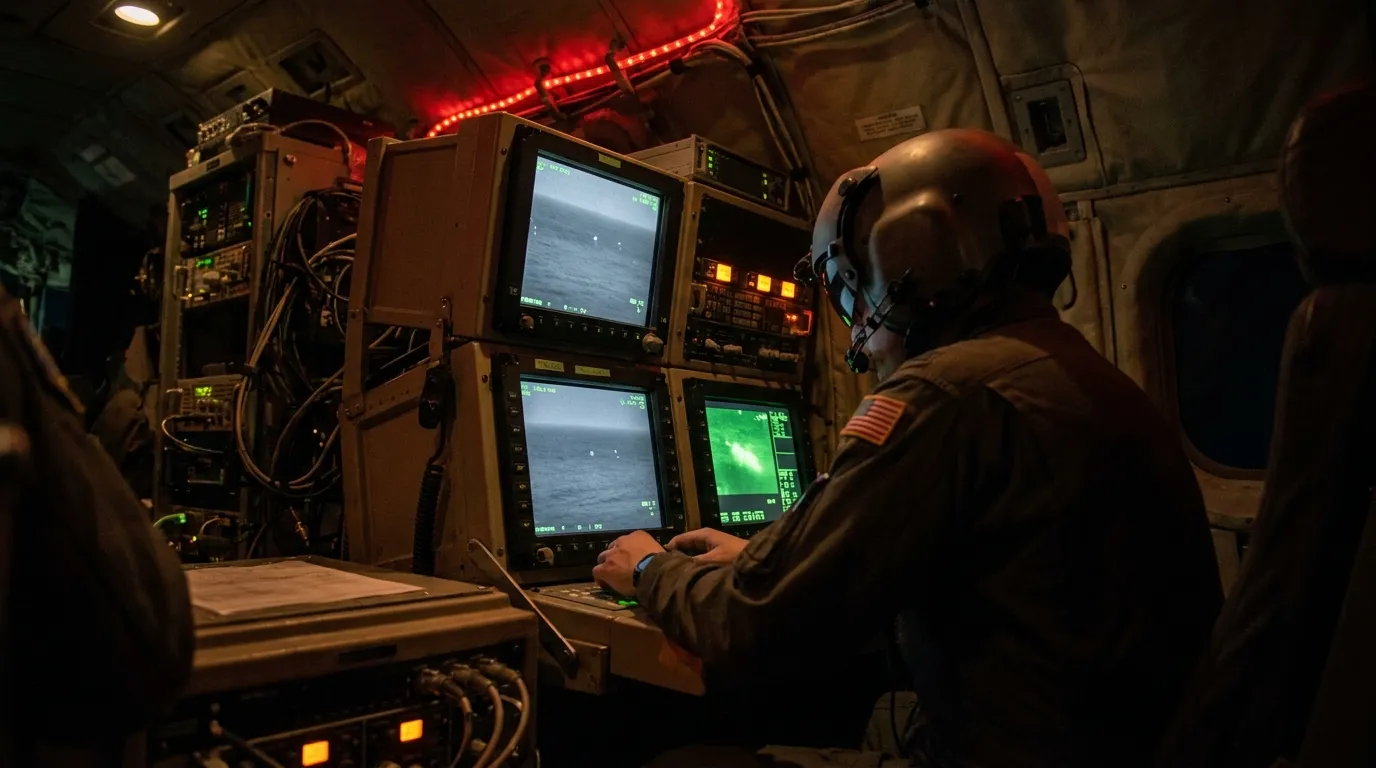
On 8 September 2021, a US Special Operations Forces AC-130J gunship was running a live-fire exercise over the Gulf of Oman. The crew dropped a water-activated flare to serve as a mock target, and a crew member turned the aircraft’s infrared camera onto it to watch the fall of shot.
What he saw, per the report, were two roughly four-foot-diameter “cold orbs” hovering about twenty feet above the flare.
Over the course of the exercise the crew logged approximately 25 separate instances of unidentified objects. They are described as cold orbs at low altitude, moving between 250 and 1,300 mph, shifting between formations, and manoeuvring aggressively. And then the detail that has done the rounds since Friday: the objects appeared to react to the aircraft firing its main cannon. When the gun spoke, the report says, the object departed rapidly out of the sensor’s field of view — without changing altitude.
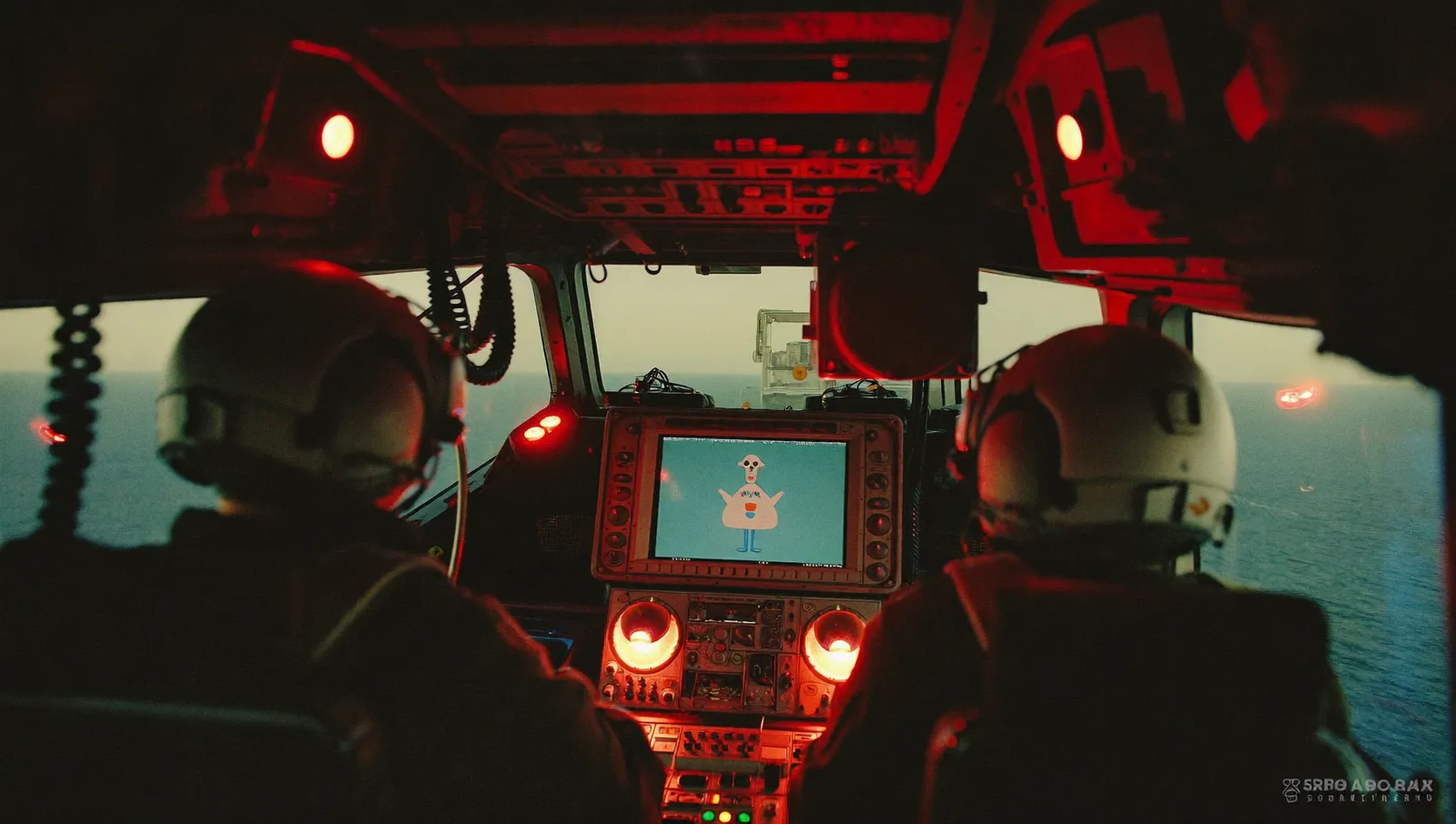
Six of the 41 files are video of this one incident, from different angles. AARO, the Pentagon’s UAP investigative office, was unable to resolve the case.
Why “cold” is the load-bearing word
Before anyone reaches for the word “propulsion”, sit with the thermal description for a moment, because it cuts in two directions at once.
An infrared sensor does not see objects. It sees temperature differences, rendered as bright or dark depending on which polarity the operator has selected. A “cold orb” is a signature that reads cooler than its surroundings — which, over a warm sea at night, is a slightly strange thing for a solid object to be. It is stranger still if that object is genuinely moving at 1,300 mph, because something crossing the air at that speed acquires heat rather than shedding it.
There is a tidier reading. Angular speed is not speed. An object’s apparent velocity across a sensor frame depends entirely on how far away it is, and nothing in an infrared feed tells you that. A cool, slow, nearby thing — the flare’s own smoke, spray, debris, birds working a lit patch of water — can produce every number in that report if you assume it is far away when it is not. This is the single most persistent flaw in the entire UAP video canon, and it is exactly the problem three cameras over Las Vegas were built to fix.
It is also worth noting that “orb” is now the single most-reported morphology in this archive, and one atmospheric chemist has proposed an actual physical mechanism for it — burning meteor dust, magnetically confined — which is currently in open peer review. That model does not obviously stretch to twenty-five objects in formation, but it is the first serious attempt to say what an orb might be made of.
Two things stop that from closing the case. The first is the reaction to the cannon: whatever the range, “it left when we fired” is a correlation of behaviour with an event, and smoke does not do that. The second is that the crew reported roughly twenty-five instances in formations, not one ambiguous blob — the same feature that makes the unresolved swarm off the Virginia coast hard to file away.
The chain of custody is, once again, terrible
Here is the part that should genuinely annoy you.
The six videos are not sensor data. They are cellphone footage of the gunship’s screens — someone in the back of the aircraft filming a monitor. Every number that could settle this argument lives in the underlying telemetry: slant range, angular rate, aircraft heading, sensor field of view, the polarity setting. Filming the display throws all of it away and leaves a compressed video of a video.
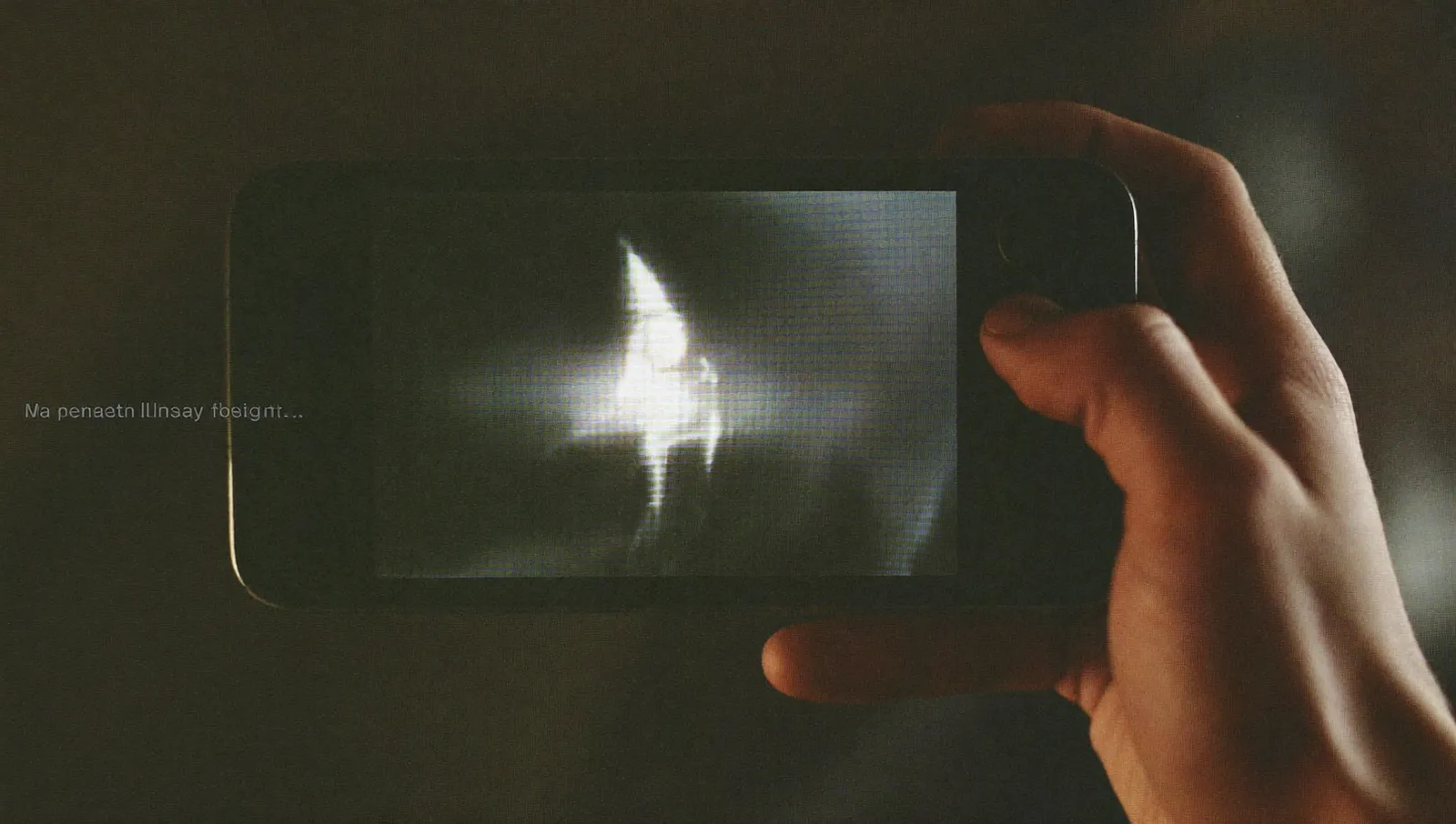
We wrote almost this exact paragraph a week ago about the Columbia photographs, which were published with their identifying captions stripped. It is becoming the signature of this programme: the picture is released, the metadata is not. Whether that is classification caution or institutional habit, the effect is identical — a resolvable question is converted into a permanent argument.
The triangle over Bagram
The headline case in most write-ups is genuinely arresting, and much weaker.
A former military pilot told the Pentagon in 2024 about a night in 2002. At around 4:30am local, over Bagram, he noticed the stars going out. Something huge passed overhead west to east: an equilateral triangle, silent, no lights, holding a consistent altitude at perhaps 150 knots. He put it at 500 feet across, while conceding he could not fully make out its shape. Another pilot with him saw it too, and as it passed said, “Did you see that?”
Take it seriously as testimony and it is a good one — two trained observers, immediate corroboration, no obvious motive. Take it seriously as evidence and the gap is a chasm: a 22-year delay between event and report, at night, with no sensor, no photograph, and no contemporaneous incident log made public. Silent black triangles are also the single most reported UAP shape in modern history, from the Belgian wave onwards, which cuts both ways — either a real class of object, or a very well-established thing for the human visual system to construct out of a dark sky and a few reference points.
The file that debunks itself
Then there is Brazil, 1963, which is the most instructive document in the whole tranche and not for the reason it is being shared.
A telegram to the Secretary of State on 14 November 1963 relays a local news report of a “large metal manned balloon” found with a “dead crewman aboard wearing uniform or spacesuit with strange markings”, and a four-metre-deep crater at the impact point. It reads exactly like the smoking gun a certain kind of researcher has spent forty years hoping for.
Six days later, the same embassy cabled again to say the report was fabricated. A second cable records that Brazil’s Ministry of Aeronautics categorically denied any strange object at all.
All three documents were released together. That is what a declassified file actually is: a record of what someone in a building reported at the time, not a verdict on whether it happened. A cable describing a dead alien is not evidence of a dead alien — it is evidence that a wire service in Brazil ran a story, which is roughly the evidentiary tier of the Varginha creature. Anyone circulating the 14 November cable without the 20 November one is not disclosing anything. They are editing.
What the last batch got turned into
The risk here is not that the files are fake. It is what happens between the file and the headline.
Jordan Flowers, executive director of the Disclosure Foundation, told CBS News that the Office of the Director of National Intelligence had run a successful “luring operation” — deliberately drawing unidentified objects over a sensitive US facility. The underlying material is real enough: a helicopter crew watching orange orbs for around an hour in late 2025, objects splitting, keeping pace with fighter jets, forming a “T” and then a triangle, with 24 night-vision photographs taken by ground personnel and supplied to AARO by the FBI.
What the Department of War published was the imagery. “Luring operation” is Flowers’s interpretation of it, and those images went out on 8 May, in tranche one. Three months later the claim is circulating as though it were Friday’s news, and as though the government had confirmed the intent. It has not. That distinction is the entire job.
The sceptics have not moved
Worth remembering who said what, and when. When the first tranche landed in May, Sean Kirkpatrick — physicist and AARO’s founding director — said there was “nothing unexpected in their release”, and that without analysis or context it “will only serve to fuel more speculation, conspiracy and armchair pseudoscience.” Mick West, the field’s most rigorous debunker, found “nothing really interesting” in it: “More dots, more parallax.”
Ron James of MUFON, who is not a sceptic, was blunter still — the material had “been in public domain for years”, and the approach of releasing a great deal of inconclusive material and inviting the public to make up its own mind was “extremely disappointing.”
The most useful line came from Christopher Mellon, former deputy assistant secretary of defense for intelligence, who called the sheer scale of the archive a revelation in itself, then added the caveat that has aged best: “data alone is not disclosure. Releasing raw files without context may confuse more than clarify.”
Three months and four tranches later, none of them has had much cause to revise.
The UAP Times take
We rate this Credible, four out of five on our scale, and the rating is about the documents rather than the objects. The release is real, official and published at a government URL you can read yourself, which is as good as provenance gets. The Gulf of Oman file is a formal intelligence report, multi-witness, multi-instance, with imagery, an unusual behavioural correlation, and an official finding of unresolved. That is a genuinely strong case by the standards of this subject.
It is not a 1 because of the chain of custody. Six cellphone recordings of a monitor, with no telemetry and no range, cannot support the speeds in the summary — and the summary is doing the work in every headline written since Friday. Given a slant range, this case either becomes remarkable or becomes birds over a lit flare, and the file as published cannot tell you which.
Which leaves the pattern. Five tranches in, PURSUE has proved it can publish. It has not yet shown it will publish the one thing that would let anybody outside the building settle an argument: the numbers behind the pictures. The government has an enormous amount of evidence about UAP and has now made a real start on handing it over. It is handing it over with the measurements taken out.
Further reading: the intelligence community’s new duty to report UAP runs through this same PURSUE machinery. Also: what the 2026 Pentagon UAP report actually found and why nobody has ever known how far away a UFO was. And for the administration’s own read on all this, the Secretary of State’s “they’re not ours”. One file from this same tranche has since been turned into a time anomaly: we read the “time warp” FD-302. And two scientists have now checked every clip in this archive for the numbers this file lacks: none of the 112 PURSUE videos can measure a speed. And the public verdict on five tranches of redacted paperwork is now measurable: a record 78% of Americans think the government is still holding something back. And for the records the department is buying rather than publishing, AARO wants a subscription to North America’s largest private UFO archive. Two clips in the first tranche were shot near Japan — which has collected its own reports since 2020 and released none of them.
Follow the file
Every new dispatch from the UAP desk, in your inbox. Sourced, sceptical, and no more than one email a week.