
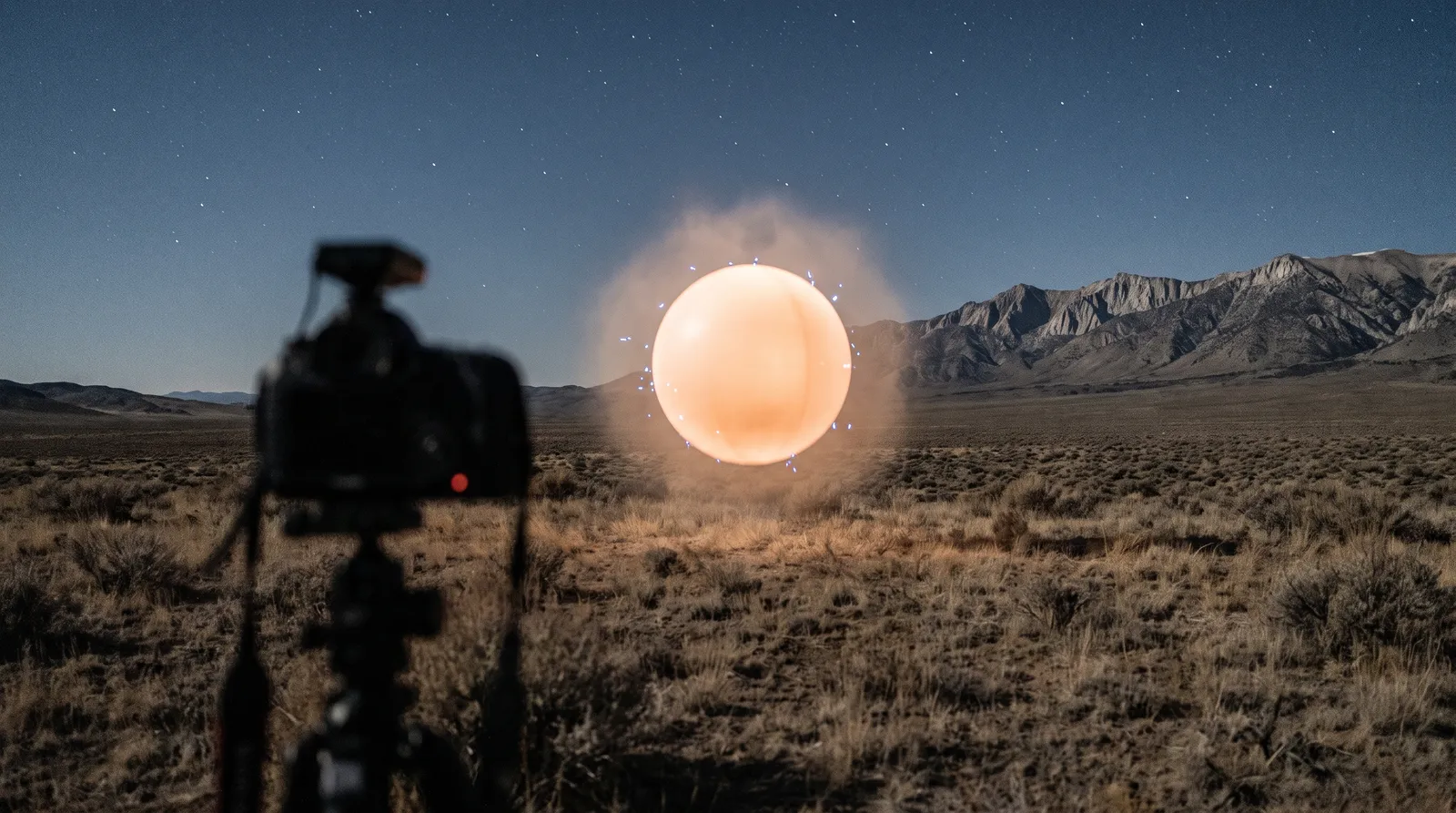
Strip out the disc, the triangle and the cigar, and the shape that dominates modern UAP reporting is embarrassingly plain: a glowing ball. Orbs are in the Pentagon’s newest file releases, in AARO’s annual report, in the airline incident logs, and in tens of thousands of civilian sightings. They are also the one category nobody has ever offered a mechanism for. Not an identification — a mechanism. What, physically, would a self-luminous sphere hanging over a field for an hour actually be made of?
There is now a paper attempting to answer that, sitting in open peer review, with a DOI, an author you can email, and a comment box underneath it that anyone can post to. Its thesis is that a good fraction of orbs are burning meteor dust holding itself together with its own magnetism.
Who wrote it, and why that matters
The author is John W. Birks, of the Department of Chemistry at the University of Colorado Boulder. He is not a UFO researcher. In June 1982 he published a paper in Ambio with the atmospheric chemist Paul Crutzen — later a Nobel laureate — titled “The Atmosphere after a Nuclear War: Twilight at Noon”. It calculated that smoke from burning cities could block the bulk of incoming sunlight. Eighteen months later a group including Carl Sagan modelled the climate consequences and gave the idea the name it still carries: nuclear winter. Birks did not coin the phrase, but he is one of the reasons there is one.
That doesn’t make him right about orbs. It does mean the paper arrives with a track record for taking an unfashionable atmospheric mechanism seriously and being vindicated — a rarer credential in this field than it sounds.
The finding that started it
Birks went through the National UFO Reporting Center’s public archive — over 160,000 filings since 1995 — and restricted himself to reports from 2000 onwards that came with photos or video, on the reasonable grounds that imagery lets you throw out the planets, rockets, Starlink trains and camera artefacts. Of the reports he examined, 508 survived as probable orbs: unexplained luminous spheres, no solid structure, almost all at night. Of those, 408 were in the United States.
He then asked a question nobody appears to have asked before. Do orb sightings cluster in time with fireballs — bright meteors, logged independently by a completely different set of citizen observers at the American Meteor Society?
They do. Across 2020–2025, 94 of the 408 US orb reports had at least one AMS fireball logged in the same state within a window running three hours before to four hours after. The excess is concentrated tight around the sighting: 60 fireballs inside the hour either side, against an expected background of 17.8 ± 2.9. Birks derives that background two ways — from the same clock windows on the day before and the day after each sighting, and independently from the raw 2025 AMS rate of 10,443 fireball events across 51 states — and gets 17.8 and 17.1. A conditional binomial test returns Z = 2.99, a one-sided p of about 0.006.
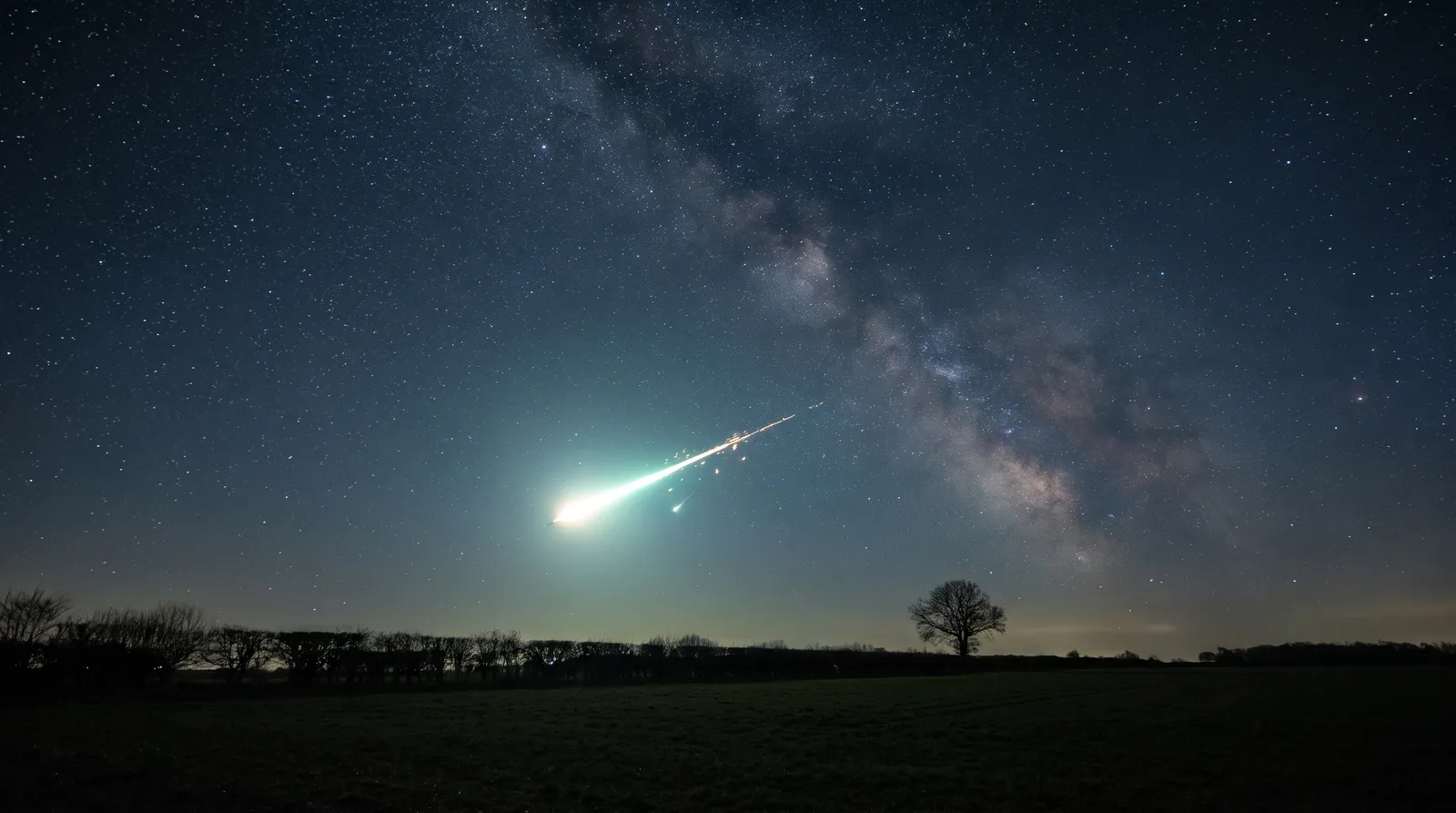
That is a real result. It is also, precisely, a three-sigma one, and physicists do not call three sigma a discovery. Hold that thought.
The mechanism, in one breath
Here is the model. A meteor terminates low in the atmosphere and vaporises. As the fireball cools through 3,000–5,000 °C, iron, nickel and silicates condense into nanoparticles. Passing down through their Curie temperatures — 770 °C for iron, 583 °C for magnetite — those particles lock in permanent magnetisation.
Magnetised nanoparticles do not disperse. They snap head-to-tail into chains, and the chains cross-link into a three-dimensional dendritic scaffold, bonded at only a few multiples of thermal energy, so it constantly breaks and reforms rather than clumping and falling out of the sky. That is the confinement problem solved without invoking exotic fields.
Energy comes from the iron itself. Fine iron and nickel powders are pyrophoric — they oxidise, exothermically, on contact with air. Birks estimates an orb needs roughly 400 to 2,000 watts to stay buoyant like a hot-air balloon, and slow oxidation of surviving metal supplies it; the light needs only about 0.16 W to match Venus at a kilometre. Convection and the constant rebuilding of the scaffold generate triboelectric charge — the carpet-and-doorknob effect — which discharges at sharp points as a corona of microdischarges, exciting nitrogen in the surrounding air (the blue-white) and metal atoms in the dust (iron for yellow-orange, sodium yellow, calcium red).
Run that list against what witnesses actually describe and the fit is uncomfortable in its neatness: spheres of roughly 1–3 metres, lasting minutes to hours, silent, drifting with the wind, ringed by a fuzzy corona, flickering through colours, occasionally splitting or merging, sometimes blinking out entirely.
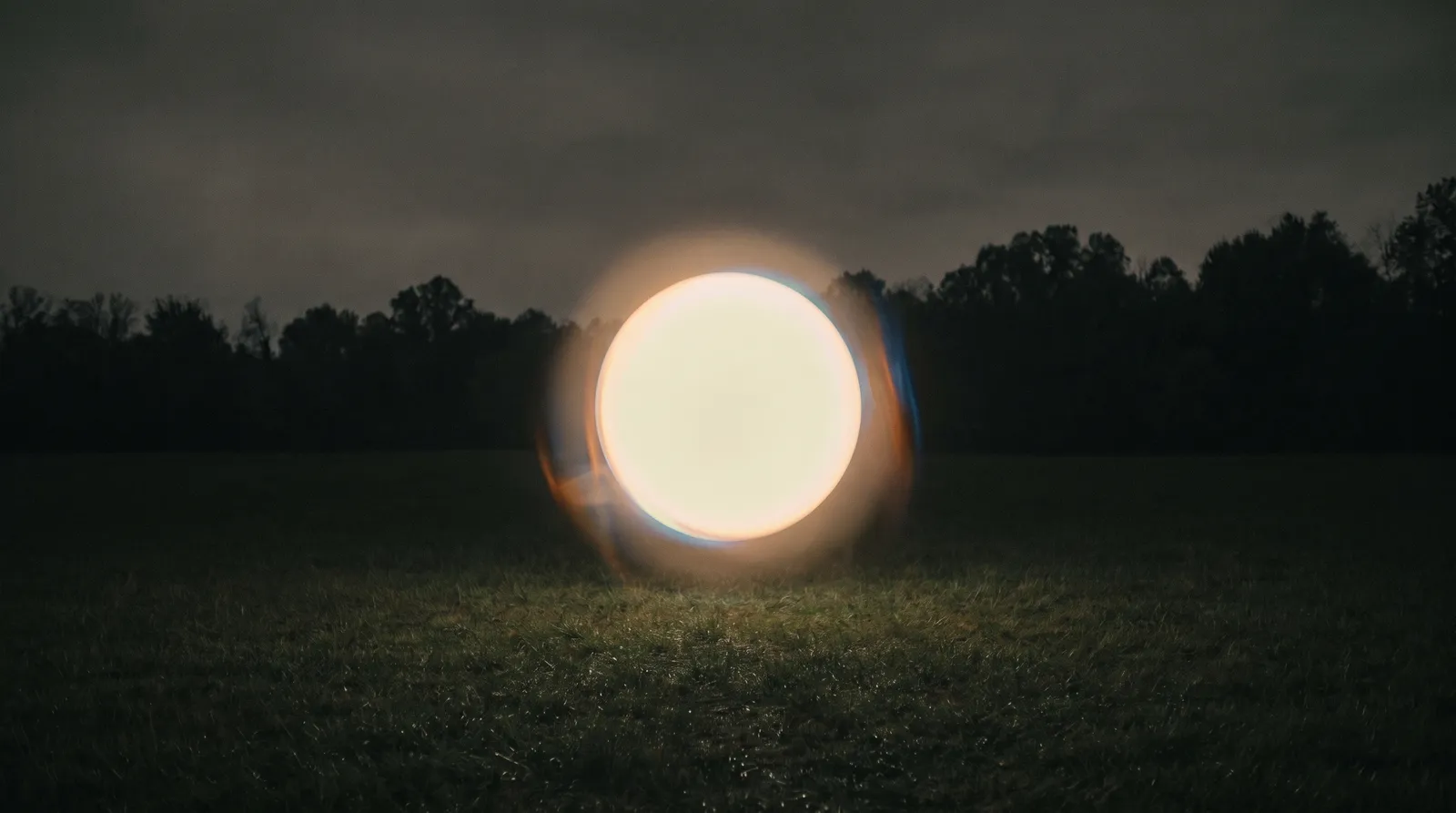
The prediction that reaches past orbs
The paper’s most interesting paragraph is almost a throwaway. Everything above concerns nocturnal, self-luminous objects — and the same cloud in daylight, Birks notes, would look entirely different. At the particle densities his model needs, an orb would be optically thick: not a glowing ball but an opaque one, white, grey or silvery. And a cloud held by weak, constantly reforming magnetic bonds would deform in wind and convection — spherical when quiescent, lenticular or elongated when it isn’t. Shape-shifting included.
He has, in other words, proposed a mechanism that would throw off several classic daylight UAP morphologies as a side effect. Whether that is elegant or over-reaching is what peer review is for.
Where a referee will go first
Here are the weak points, stated bluntly, because the paper’s supporters are not always going to.
The three-sigma problem. Birks controls carefully for time of day, which is the obvious confounder — both orbs and fireballs are reported in the early evening, by people who are awake and outdoors. What his day-before/day-after control cannot fully remove is weather. A single clear night in a cloudy week produces more of everything anyone can see, orbs and fireballs alike, with no causal link between them. That is the first question a referee should ask, and the paper does not yet answer it.
The sky lanterns. Buried in the methodology is a genuinely load-bearing decision. NUFORC’s own annotators had flagged a number of these reports as likely sky lanterns. Birks reassigned most of them as orbs. Sky lanterns are orange, drift with the wind, appear in groups, rise and sink, and go out. If a meaningful slice of the 508 are Chinese lanterns at a wedding, some of the correlation and a lot of the phenomenology goes with them.
Nothing has been built. There is no laboratory orb — Birks says only that it may be possible to make one from iron nanoparticles, which is an admission that nobody has. Every figure in the energy budget is an order-of-magnitude estimate, several flagged as uncertain.
He has already corrected himself in public. On 13 July, five days into the discussion, Birks posted a correction to Equation 2 and Table 2 tightening his own “Goldilocks” window for meteoroid size — still permitting objects up to 10–20 centimetres — and conceded that the paper does not explain how meteoric dust reaches sufficient concentration to clump in the first place. A follow-up is promised. That gap is not a detail; it is the first step of the whole chain.
And the acknowledgements are worth reading. Birks discloses that ChatGPT assisted throughout — deriving equations, running feasibility calculations, analysing images, generating two figures. Declaring that is exactly right, and more than most authors currently manage. It also means the derivations deserve harder scrutiny than usual.
The alliance backing it is the odd part
The paper has been pushed by two people who agree on almost nothing.
Michael Shermer wrote it up for Skeptic on 9 July, filing it alongside the Second World War foo fighters and framing it as science behaving properly: a testable hypothesis, offered for critique, refined or discarded on the evidence. Predictable enough.
Less predictable is Avi Loeb, who covered it on 6 July and now chairs the UAP Science Advisory Council advising the White House and the Pentagon. The field’s most prominent advocate for taking the extraterrestrial hypothesis seriously is promoting a paper that would explain a large slice of his own subject matter as burning space dust. He has separately floated a second prosaic candidate for orbs near military ranges — the Pentagon’s Laser-Induced Plasma Effect programme, which makes plasma balls in mid-air with paired femtosecond lasers.
His caveat is the one that matters: neither mechanism, he argues, accounts for multi-hour radar tracks, long-range detections or coordinated behaviour. He is not conceding the field. He is doing the thing this field almost never does, which is subtracting cases from his own column.
What it doesn’t touch — and the case it fits best
Test the model against the current headline cases and the results cut both ways. The Virginia coast swarm — roughly 100 airborne objects plus two apparently uncrewed surface craft, the single maritime case in AARO’s FY2025 report — is not a hundred simultaneous meteor remnants. Nor are the 25 objects manoeuvring around an AC-130J gunship in the Gulf of Oman file, unless coincidence is doing an enormous amount of work.
But then there is Cheyenne Mountain. In October 2023, six federal law-enforcement agents near Colorado Springs reported orange “mother orbs” that appeared for a second or two, released clusters of two to four red orbs, and vanished. AARO checked flight logs, radar and ADS-B, and left roughly 40% of the activity unexplained. That case is routinely cited as among the most inexplicable in the declassified record — and it is, awkwardly, the one Birks’s model handles most comfortably. Orbs splitting into smaller orbs of different colours is a specific prediction of his dendritic scaffold. So is a red orb sitting stationary above a ridgeline for several hours: very hard to reconcile with any flare, drone or aircraft, and not hard at all to reconcile with a slowly burning cloud of iron dust in a stable nocturnal boundary layer.
That is not a comfortable result for anyone. It is what a real hypothesis does — it takes the cases you expected it to fail, and fails different ones instead.
The experiment that would settle it
The best thing about this paper is that it can be killed. Birks specifies the emission signature his model requires: molecular nitrogen bands, metallic lines from iron, nickel, sodium and calcium, and a broadband thermal continuum, varying across the object’s surface.
Get a spectrum of an orb and you have your answer in an afternoon. Nitrogen and iron lines and the case is close to made. A clean blackbody, or the sodium doublet of a streetlight reflection, or nothing at all, and it collapses.
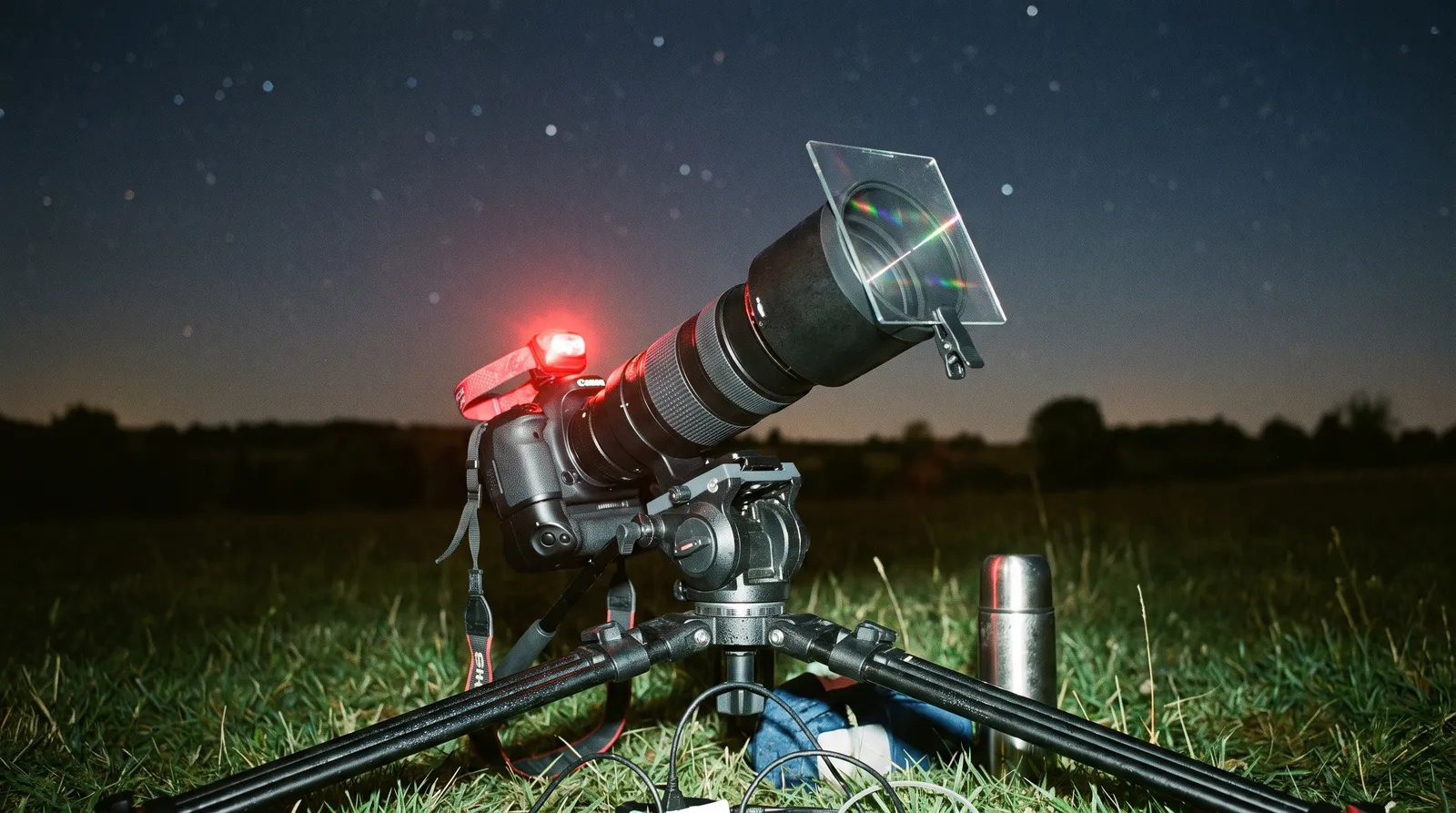
He also notes, correctly, that this needs no national laboratory — just a diffraction grating held in front of a camera lens, standard amateur-astronomy practice, recording the object and its spectrum in the same frame. This is the rare UAP question where the decisive instrument costs less than a tank of petrol, and where the range problem that wrecks most sighting analysis doesn’t apply: a spectrum tells you what something is made of without your knowing how far away it is.
The Field Kit
Some links are Amazon affiliate links. As an Amazon Associate, UAP Times earns from qualifying purchases — at no extra cost to you.
- AMZN_LINK_DIFFRACTION_GRATING — a slot-in diffraction grating filter turns any camera into the instrument that tests this paper. It only works on something genuinely bright, and you need the object in frame long enough to focus.
- Nikon Coolpix P1000 — the 125x zoom people film the Moon with → — reach and manual exposure control, which is what night work needs. Heavy, slow to focus, and a tripod is not optional.
- Celestron SkyMaster 15x70 — the sensible first buy → — for settling with your own eyes whether the thing has a corona or is three lanterns in a row. Too heavy to hand-hold for long.
The full kit list lives on our Field Kit page.
The UAP Times take
We rate this Credible, four out of five on our scale, and it is worth being exact about what the rating covers. Everything factual here is verifiable: the preprint exists at a DOI, under open discussion at Atmospheric Chemistry and Physics until 6 September; the author’s credentials are a matter of public record; and the central statistical result can be recomputed by anyone with the two public databases and a free weekend. It is not a top mark because the hypothesis itself is unproven — three sigma, no laboratory orb, an admitted gap in the formation step, and a sky-lantern reassignment that needs justifying.
What lifts this above the usual run of orb content is the structure of the claim. For eighty years the argument about UAP has been conducted between people asserting things and people asserting the opposite, with the evidence stuck at “look at this footage”. Birks has put forward a mechanism specific enough to be wrong, published the data behind it, corrected his own equation in public within a week, disclosed his tools, and named the cheap experiment that would falsify him.
He may well turn out to be wrong. Referees have until September, and if the weather confounder holds up, the correlation anchoring the whole thing weakens considerably. But a field that has spent decades demanding to be taken seriously by science has just been handed the thing it kept asking for, and it looks like this: unglamorous, quantitative, partly self-refuted before the first referee report, and testable with a diffraction grating.
The interesting question is no longer whether orbs are real. It is what they are burning.
Further reading: for the panel now advising the White House on exactly this question, see Avi Loeb’s UAP Science Advisory Council; for the other UAP result currently being refereed in the open, the Palomar plates and the nuclear-test correlation; for why measuring an object matters more than filming it, see How a Targeting Pod Actually Sees a UFO and our field guide to the orb. For the instrument that would test this paper’s emission lines directly, see Harvard’s proposed orb imager; and for the rival mechanism now being proposed for the same orbs, what a warp drive would actually look like overhead.
Follow the file
Every new dispatch from the UAP desk, in your inbox. Sourced, sceptical, and no more than one email a week.