

Somewhere in the western United States earlier this year, two men sat in a truck in the dark and watched red lights move over a mountain ridge. Hours later, one of them looked at his wristwatch and found it was twenty-five minutes fast.
That last detail has now travelled further than the lights ever did. It has been written up as a “time warp”, a “time dilation event”, and — by way of a Harvard physicist’s weekend blog post — as possible evidence of technology of non-human origin. It is, on the evidence actually filed, a wristwatch.
The document is real, it is official, and it is more interesting than the headline it produced. We pulled it off the Department of War’s own server and read all two pages.
What is actually in the file
The record is an FBI FD-302 — the Bureau’s standard form for writing up a witness interview — published on 7 August in the fifth tranche of the PURSUE disclosure programme, the 41-file release we covered at the time. The copy on war.gov is filed as FBI-UAP-D040_FD-302_Multiple-Red-Lights_2026. The interview was conducted by telephone. Names, dates, unit and location are all blacked out; the year, 2026, survives.
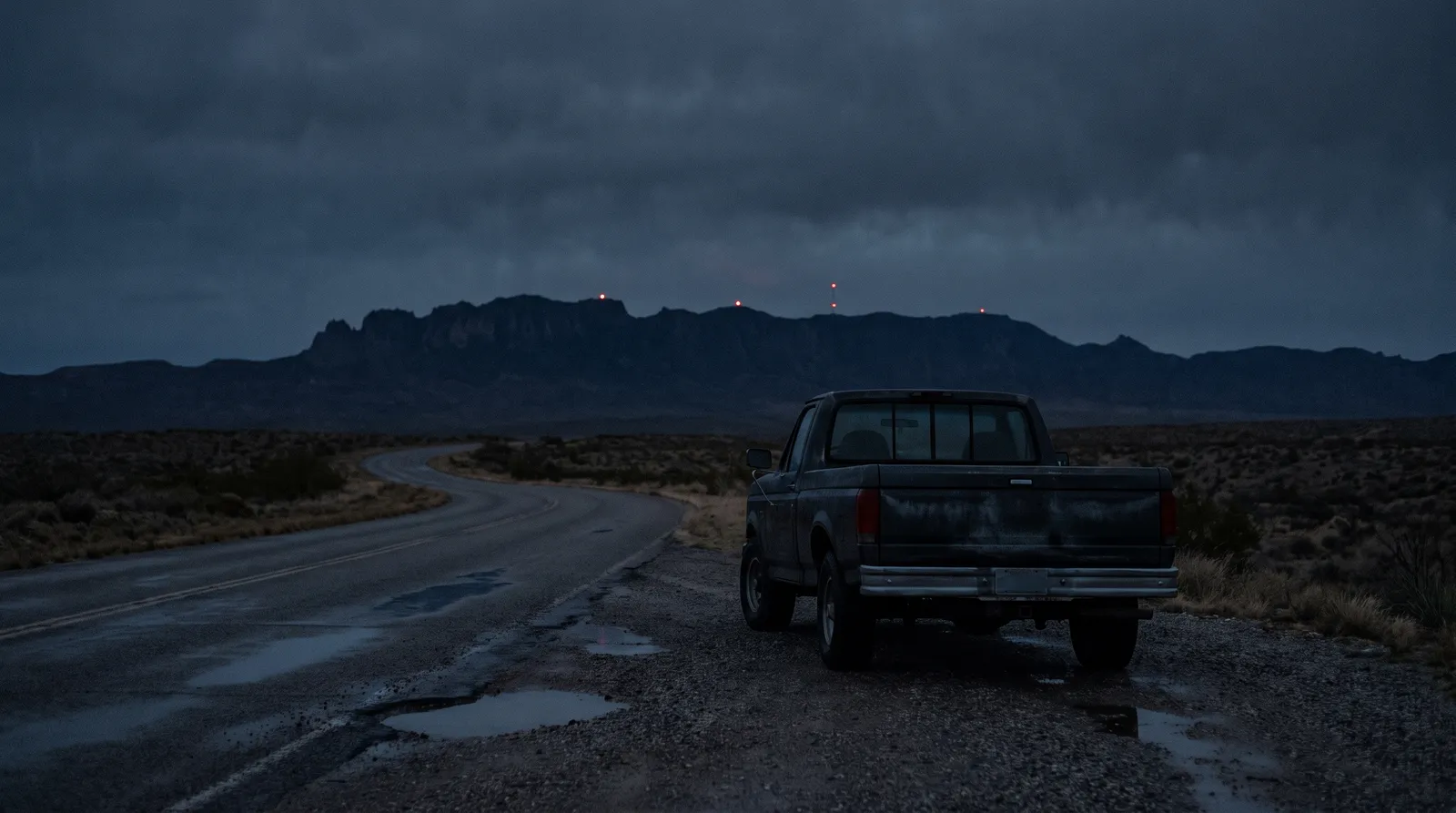
The account runs like this. Two men arrived at a gate at around 2100 for what the file calls area reconnaissance, waited out heavy rain, then drove north. At roughly 2200, some 25 miles on, one noticed a red light at the crest of the mountain range to their west and pulled over. He initially took it for something on the mountain, until it began moving east.
He put the range at about 5,000 feet and the cloud base at about 7,000, and reasoned the light was somewhere between the two. After about fifteen minutes, six to ten more lights appeared directly overhead. They appeared to “sync up” and moved off east-southeast. One dropped what he estimated at 1,000 feet and vanished. The rest followed.
At about 2350 the pair saw two more lights on or near the ground to their east — visible only through night optical devices — which closed to within 200–300 metres before disappearing. The cloud cover, the file notes, was heavy enough that no stars were visible.
The detail that travelled
Afterwards they drove east to find the spot, failed, came back, parked and got out. Then, in the file’s own flat prose, one man “walked back to the truck to check his phone and give his eyes a break”, asked his colleague the time, and was told his watch was 25 minutes fast.
Here is the part almost nobody quoted. The second man was wearing a digital watch, which showed the same time as their two cell phones and the vehicle’s clock. The FD-302 spells it out: the analogue watch “was the only analog/non-digital clock and was the only clock that was different.”
So the score is three or four independent digital timepieces in agreement, and one analogue watch out on its own. There is a word for the reading that disagrees with every other reading, and it is not “evidence”.
Which direction does the anomaly run?
Avi Loeb, the Harvard theoretical physicist behind the Galileo Project, wrote the case up as one of the “remarkable anomalies” in the fifth tranche. He is right that relativity is not the answer, and says so plainly: a time dilation of that size cannot come from spacetime curvature, because the gravitational tide required would have flattened rather more than a watch.
But his conclusion goes somewhere odd. “The only way to explain this time difference,” he writes, “is by an electromagnetic effect on the digital clocks which was ineffective on the analog clock.”
Read that again with the file in front of you. To make it work, an electromagnetic pulse must have knocked two mobile phones, a digital watch and a truck’s dashboard clock off by an identical twenty-five minutes, in the same direction, while leaving the analogue one untouched — and the phones must then have failed to notice, despite the fact that a mobile phone silently re-syncs to network time the moment it has a bar of signal. The simpler reading, that one watch gained twenty-five minutes, requires no new physics and no coincidence at all.
To be fair to Loeb, his post ends with the caveat that none of these accounts “can be resolved without additional quantitative data, recorded by well-calibrated sensors” — exactly right, and the sentence that didn’t make the aggregators. He has form for revising downwards when data arrives, as he did when four telescopes listened to 3I/ATLAS and heard nothing. The headlines built on him rarely extend the same courtesy: “Harvard Is Blaming Alien Technology” is a real one.
There is also a discrepancy nobody has picked up. Loeb catalogues the case as FBI-UAP-D037 and describes a twenty-minute gap — 1:00am against 12:40am. The file we retrieved is D040, and says twenty-five minutes. A story whose central quantity is a number ought to be able to keep the number still.
What actually makes a watch gallop
If you want a mechanism, watchmakers have had one for a century, and it is magnetism.
A mechanical movement keeps time with a hairspring that coils and uncoils. Magnetise that spring and the coils cling together, shortening its working length, so it oscillates faster and the watch runs fast. Not slow — fast. Depending on the field and the movement, a magnetised watch can gain anything from half a minute to twenty minutes a day, sometimes more. It is one of the commonest faults in the trade, it is caused by everyday objects — a speaker, a laptop, a magnetic clasp, a phone left face-down on a dashboard — and a watchmaker reverses it in seconds with a demagnetiser. Twenty-five minutes is comfortably inside that envelope.

The honest caveat: the FD-302 never records the make, model, or whether the movement was mechanical or quartz. “Analogue” only tells you it had hands. That omission is not a small one — it is precisely the datum that would let anyone test the boring explanation, and it is missing. Which is the same complaint we keep filing about this entire disclosure programme: the measurements are the bit that gets left out.
“Squared away” is not a calibration certificate
The file’s stated reason for trusting the watch is worth quoting, because it is the whole evidential foundation. His colleague “relayed that he had known [him] for years and described him as ‘squared away.’ Having an inaccurate watch or faulty gear was not something he would let happen.” And the man himself had been checking the watch all day, and it had been right until then.
That is a character reference and a recollection. It is not a log. Nobody wrote the time down before the sighting, nobody photographed the dial, and the discrepancy was found by comparison afterwards — which tells you nothing about when it arose. A watch that gained twenty-five minutes over a rainy day of driving is indistinguishable, at the point of discovery, from one that gained it in an instant.
The file adds something that sits awkwardly with any powerful-field hypothesis: he “did not have any physiological reactions/effects during or after the above-described events.” No heat, no nausea, no burns. Compare a case where interference was the story — Levelland in 1957, where engines and headlights died across a whole county — and the contrast is stark. Whatever this field was, it skipped four devices and two men, and stopped at one hairspring.
The bit that isn’t about the watch
Strip the timepiece out and there is still a decent observational report here, and it contains the most telling line in the document.
The lights, at first glance and through night optical devices, appeared as a single point of light. It was only “upon closer observation, or while ‘squinting,’” that each resolved into three lights in a triangular or diamond-shaped pattern, moving in tandem as though fixed to one object.
That is backwards from how seeing works. Structure that appears when you squint and disappears when you look properly is not structure — it is your own optics. Squinting introduces astigmatism and diffraction across the eyelashes, and a bright point source smears into exactly the sort of small geometric cluster described. Mick West has spent years documenting the camera version of this, where out-of-focus point lights take the shape of the lens aperture and produce perfect triangles on video. The mechanism in an eyeball is different; the lesson is identical. The shape arrived when the optics got worse.
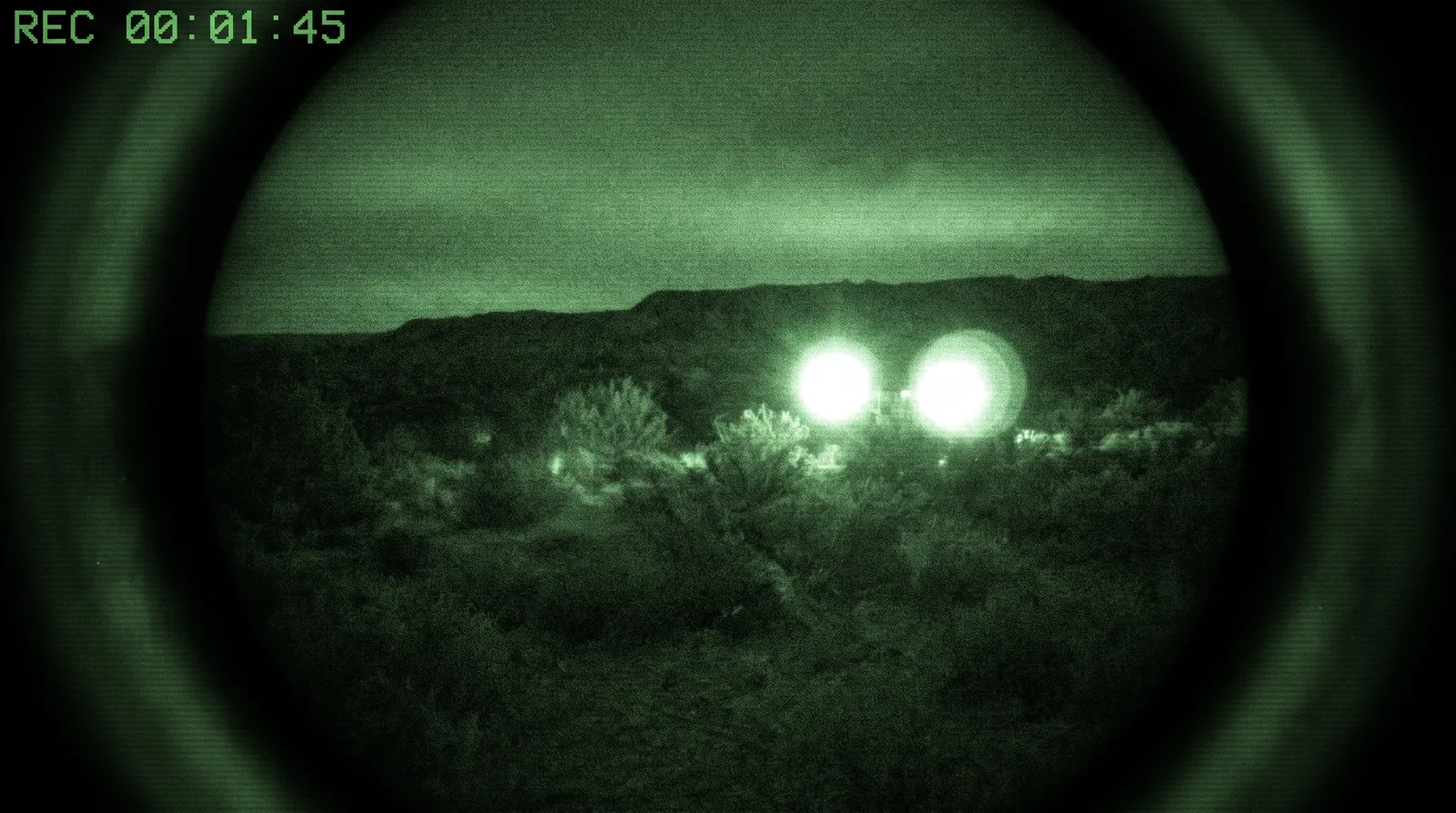
Meanwhile: red lights, beneath a 7,000-foot ceiling, moving in formation, one descending and departing east-southeast, on a night with no stars visible. Red is the colour of an aircraft’s port navigation light and of anti-collision beacons. The two ground-level lights visible only through night vision, closing to 200–300 metres, are consistent with infrared illuminators — which is to say, with other people using the same kit on the same range. None of that is proof either. It is just what the file looks like before anyone adds a Harvard quote.
The Field Kit
Some links are Amazon affiliate links. As an Amazon Associate, UAP Times earns from qualifying purchases — at no extra cost to you.
- Night vision monocular — scan the dark sky properly → — genuinely useful for spotting what the naked eye misses, and a standing lesson in this article’s point: point sources bloom into discs and blobs through image intensifiers, so treat every “orb” you see through one as a shape your kit made.
- Rite in the Rain field notebook — log it before you forget it → — the single cheapest upgrade to any sighting report. Write the time down from two sources when it happens, and a story like this one becomes testable instead of arguable.
The full kit list lives on our Field Kit page.
The UAP Times take
The provenance here is impeccable and the claim built on it is thin, which is an unusual combination and worth separating carefully. An FBI agent really did take this statement, the Department of War really did publish it, and two apparently experienced men really did report something they couldn’t place. That deserves to be in the record, and PURSUE deserves credit for putting it there.
What does not survive contact with the document is the time anomaly. One analogue watch disagreed with three digital clocks; the mundane explanation is a century-old, thoroughly documented fault that produces gains of exactly this size; and the file omits the one detail — the movement type — that would let anyone check. Everything above that is inference, and the load-bearing inference belongs to a physicist who himself said the case can’t be resolved without calibrated sensors.
So it earns a Thin rating, two out of five on our scale: real document, real witnesses, single self-reported anomaly with an ordinary cause sitting unexamined in front of it.
The frustrating part is that the same two pages contain a much better story about how observation actually fails — a man who saw a triangle only when he squinted, on a night when the cloud hid the stars. That is a genuinely instructive account of the limits of eyes and image intensifiers in the dark, and it went out to the world as a time warp instead.
Further reading: for what the fifth tranche actually contained, see A Gunship Fired Its Cannon and the Orbs Moved; and for why the sensors themselves lie to you long before the witnesses do, see How a Targeting Pod Actually Sees a UFO.
Source: FBI FD-302, US Department of War PURSUE Release 05
Follow the file
Every new dispatch from the UAP desk, in your inbox. Sourced, sceptical, and no more than one email a week.