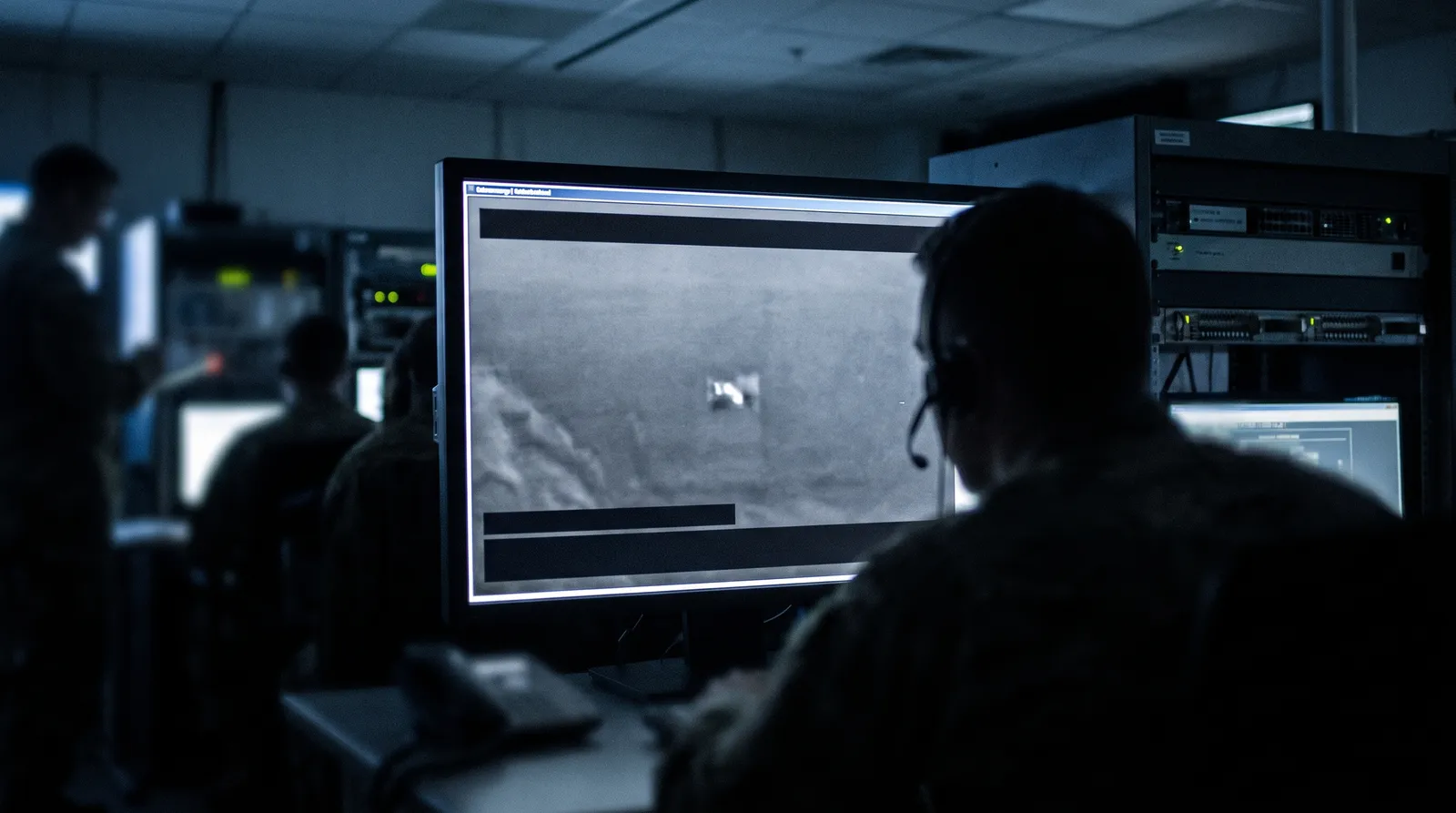
Somebody was eventually going to sit down and watch all of them. Not clip the good bit, not slow it to quarter speed and gasp — watch all 112, with a calculator, asking the only question that actually matters.
Two scientists have now done it, and their answer is a genuinely awkward one for everybody. On 12 August, Jacob Haqq-Misra of Blue Marble Space and Ravi Kopparapu of NASA’s Goddard Space Flight Center posted a preprint titled, with no attempt at drama, Limits on Velocity Recovery from the PURSUE Sensor Videos. It works through every sensor video the Department of War has released since 8 May under the Presidential Unsealing and Reporting System for UAP Encounters, looking for the handful of numbers you need to convert something moving across a screen into something moving through the air.
The count of videos containing all of them is zero.
The arithmetic nobody wants to do
Here is the problem in one line, and it is not a new one — it is just that somebody has finally applied it to the government’s flagship transparency programme rather than to a single famous clip.
A camera does not record speed. It records angles. An object crossing your field of view at some number of pixels per frame gives you an angular rate, and that rate is compatible with a fly on the lens or a fighter jet twenty miles away. To get from one to the other you need four things: the range to the object, the velocity of the platform the camera is bolted to, the aspect angle between the object’s path and your line of sight, and the field of view of the sensor itself.
Miss one and the sum does not close. Miss the range in particular — which the paper describes as the single most important missing quantity — and you have not narrowed anything down at all, because velocity scales directly with distance. Double how far away you think it was and you have doubled how fast it was going, for free, without acquiring a single new fact.
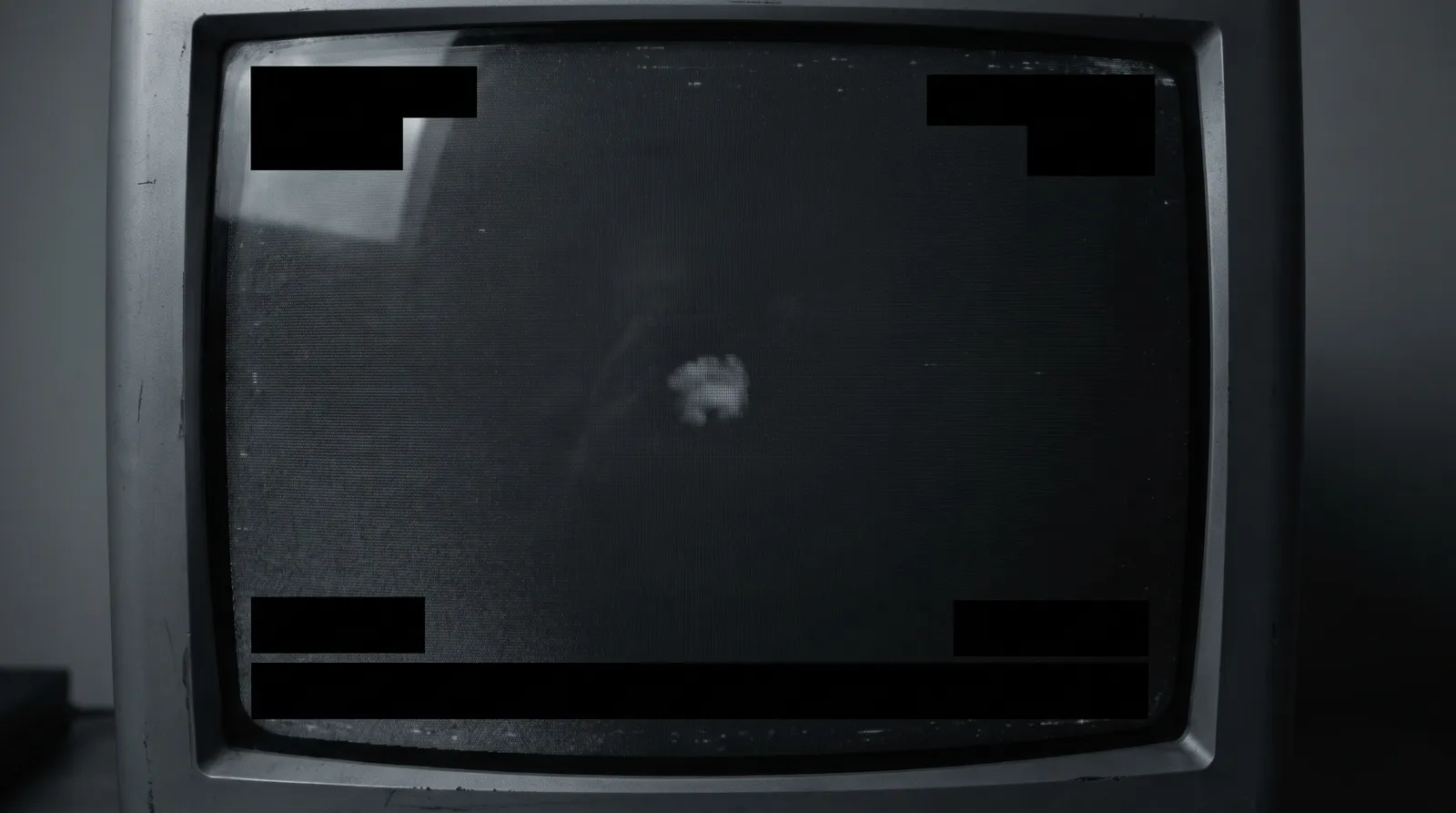
This is the same wall that every famous piece of UAP footage runs into, and we have walked through the sensor physics behind it before. What is new is the scale of the audit.
Two clips got closer than the rest
The paper does not simply throw its hands up. It picks the two best cases in the corpus — the ones where the footage accidentally hands you a bit of geometry — and shows exactly how far you can get.
The first, catalogued as DOW-UAP-PR113, is an infrared clip from the western United States in 1996. It has something almost none of the others do: a depression-angle graticule burned into the display, which lets you reconstruct the camera’s field of view. An object streaks across it in roughly a tenth of a second.
That reconstruction is real work, and it buys you a real constraint. It just isn’t a useful one. As the authors put it, even this clip cannot distinguish between a bird flying past the sensor at close range and a large craft travelling at Mach 5 a kilometre away. Both fit the pixels. The footage does not choose.
The second, DOW-UAP-PR149, is infrared imagery from the Middle East in 2023, and it works better for a mundane reason: there is a ship in the frame. A carrier hull of roughly known length — call it 150 to 200 metres — is a ruler. Measure the object’s transit in ship-lengths per second and you can put a ceiling on how fast it was going.
The ceiling is Mach 0.4. Subsonic. And that is the upper bound, valid only if the object and the ship happen to be about the same distance from the camera; if the object was higher up, it was slower still.
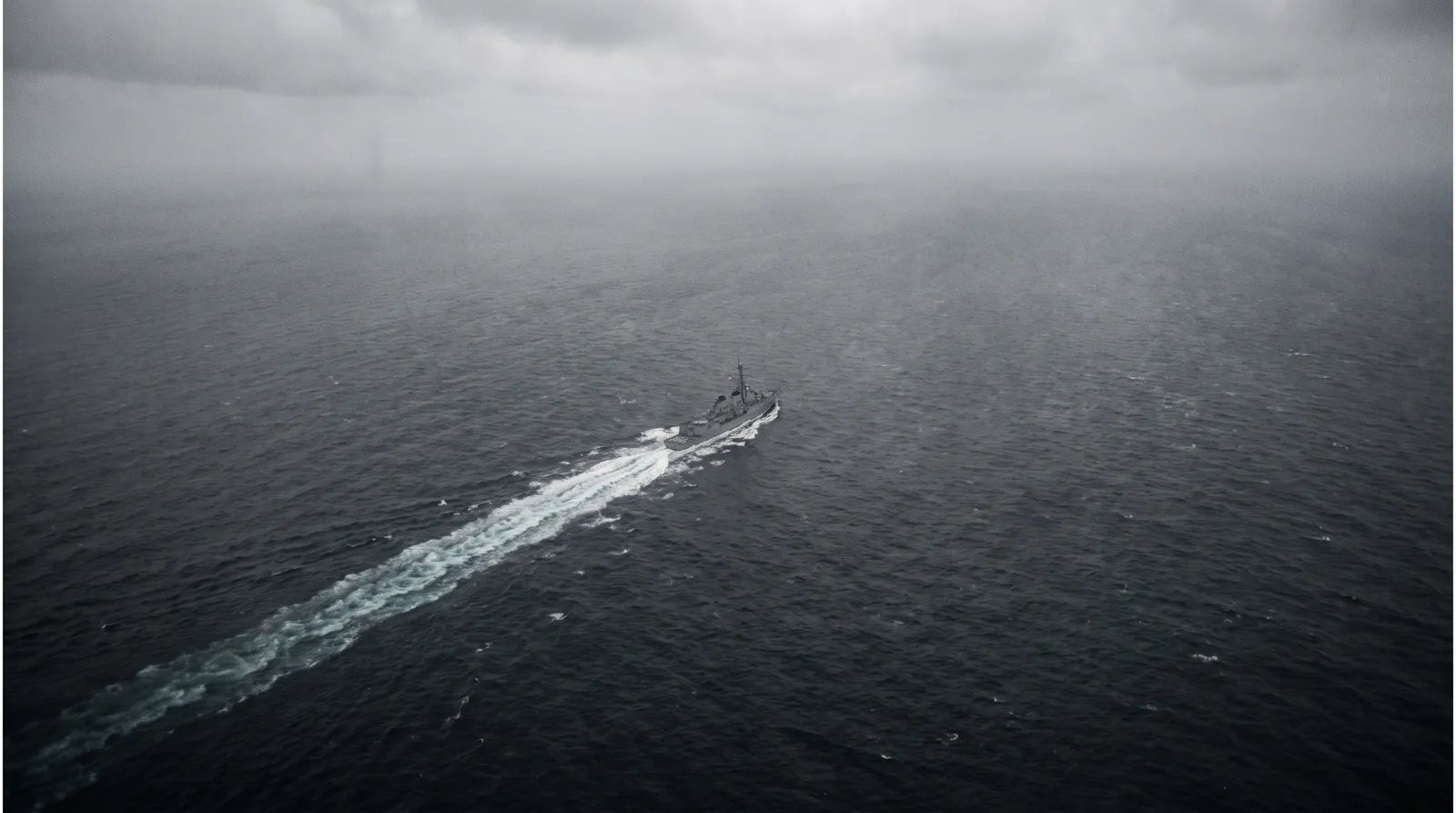
It is the best-constrained object in the Pentagon’s entire video release, and it is moving slower than a passenger jet.
GoFast is the proof the method works
The obvious objection is that this is just scepticism dressed up in equations. It isn’t, and the reason is that the method has already produced an answer — once.
When AARO published its resolution of the Navy’s GoFast video in February 2025, it did the sum properly, and it could only do so because the clip carries azimuth and elevation telemetry on screen, frame by frame. Read those, add the aircraft’s own motion, and the apparent speed collapses into parallax: an object drifting with winds of around 69 mph at 13,000 feet, with an implied speed somewhere between about 5 and 92 mph. AARO assessed with high confidence that nothing anomalous had happened. Mick West and the amateurs at Metabunk had reached much the same conclusion from the same on-screen numbers seven years earlier, which remains one of the more quietly embarrassing facts in this field.
That is the whole argument. Telemetry turned a spectacular clip into a settled case. And the paper’s central observation is that the very information AARO used to solve GoFast is, in its words, either redacted or unavailable in all of the PURSUE sensor videos.
The programme releasing the footage has removed the thing that made the last piece of footage answerable.
The redactions are the story
It is worth being precise about what is and isn’t being alleged here, because this is exactly the point where a story like this usually gets bent into a shape it won’t hold.
Nobody is claiming the black bars are hiding a saucer. Sensor telemetry is genuinely sensitive: field of view and pointing angles tell a capable adversary what your kit can see and from how far, and platform velocity and position tell them where you were. There are real reasons a defence department redacts that, and the authors do not pretend otherwise.
But the consequence stands regardless of motive. A release stripped of range, platform velocity and camera geometry cannot settle an argument about speed, no matter how many files are in it or how striking they look. Five tranches have now landed — 8 May, 22 May, 12 June, 10 July and 7 August — and the pattern has not changed. When the fifth batch produced the Gulf of Oman gunship file, the headline figure of orbs moving between 250 and 1,300 mph came from the narrative intelligence report, not from anything measurable in the footage. The video was six phone recordings of a monitor.
This is also the second time in a month that the same structural problem has surfaced from a different direction. The FAA now has a UAP reporting rule and an order that deletes the underlying radar after 45 days. The measurements keep being the part that goes missing.
Neither side gets to keep its trophy
The reason this preprint is worth your attention is that it is symmetrical, and almost nothing in this subject is.
It takes away the disclosure movement’s evidence: you cannot point at a PURSUE clip and say look at the speed, because the speed is not in the file. But it takes the same weapon off the debunkers, and the paper is explicit about it — the videos, in its words, can neither demonstrate nor exclude anomalous kinematics. “Unremarkable-looking” is not a finding either. An object you cannot measure is not thereby a balloon.
Kopparapu has been careful about this in public, cautioning against both extraordinary conclusions and outright dismissal, and noting that something can look extremely anomalous when you are seeing only a small part of it. That is not fence-sitting. It is the correct description of what an unconstrained measurement licenses, which is: very little.
Both authors sit on the UAP Science Advisory Council, the panel the Office of the Director of National Intelligence assembled and then declined to give clearances to. There is a certain grim consistency in a body asked to resolve the UAP question publishing, as one of its members’ first substantial contributions, a paper explaining why the public material cannot resolve it.
The fix is boring, cheap and specific
To the paper’s considerable credit, it does not stop at complaint. It names what the Department of War would have to add, and none of it requires declassifying a programme.
Platform velocity, recoverable from flight logs. Sensor metadata — field of view, line-of-sight pointing angles. Range records, or the correlated radar tracks that would supply range indirectly. Release those alongside the clips, even at reduced precision, even case by case, and a large fraction of this corpus becomes analysable by anyone with a laptop.
Longer term, the authors make the same argument the instrument-builders have been making for years: stop trying to reverse-engineer physics out of gun-camera footage recorded for other purposes, and deploy sensors designed for the job — infrared, visible, radar, radio and audio on the same target at the same time. That is precisely the bet the Galileo Project made when it built a triangulating observatory to supply the one number nobody has ever had.
One caveat, plainly: this is a preprint. It has not been through peer review, and it may yet be sharpened by referees. But its central claim is not a hypothesis about the world — it is an audit of what is and isn’t in a public archive, checkable against public files by anyone who wants to spend a weekend on it.
The UAP Times take
We rate this Well-sourced — five out of five on our scale — and it is worth saying exactly what that covers. The primary document is public, we have read it, and the corpus it examines is the US government’s own release. The finding is a negative one about data completeness, which is the easiest kind of claim to check: either the telemetry is on screen or it is redacted, and nobody disputes which. The preprint status is a caveat about polish, not about whether the black bars are there.
What it does not tell you is what any of these objects were. That is the point, and it is a more useful point than a fresh mystery would have been.
Five tranches in, PURSUE has proved the government will publish pictures. It has not yet shown it will publish the numbers that turn pictures into evidence — and a transparency programme that releases the footage while withholding the measurements is, functionally, releasing an argument nobody can win. Two scientists have now put a figure on the cost of that choice. It is 112 videos, and none of them count.
Further reading: for the sensor physics underneath all of this, see how a targeting pod actually sees a UFO; for the hardware being built to supply the missing range, see nobody has ever known how far away a UFO was, and for the instrument meant to supply the missing composition, the proposed orb imager; for what the missing measurements have done to public trust, see Gallup’s first UFO poll of the disclosure era; and for a hypothesis that lives or dies on the velocity nobody can supply, a warp drive would light up the sky like a second sun.
Follow the file
Every new dispatch from the UAP desk, in your inbox. Sourced, sceptical, and no more than one email a week.