
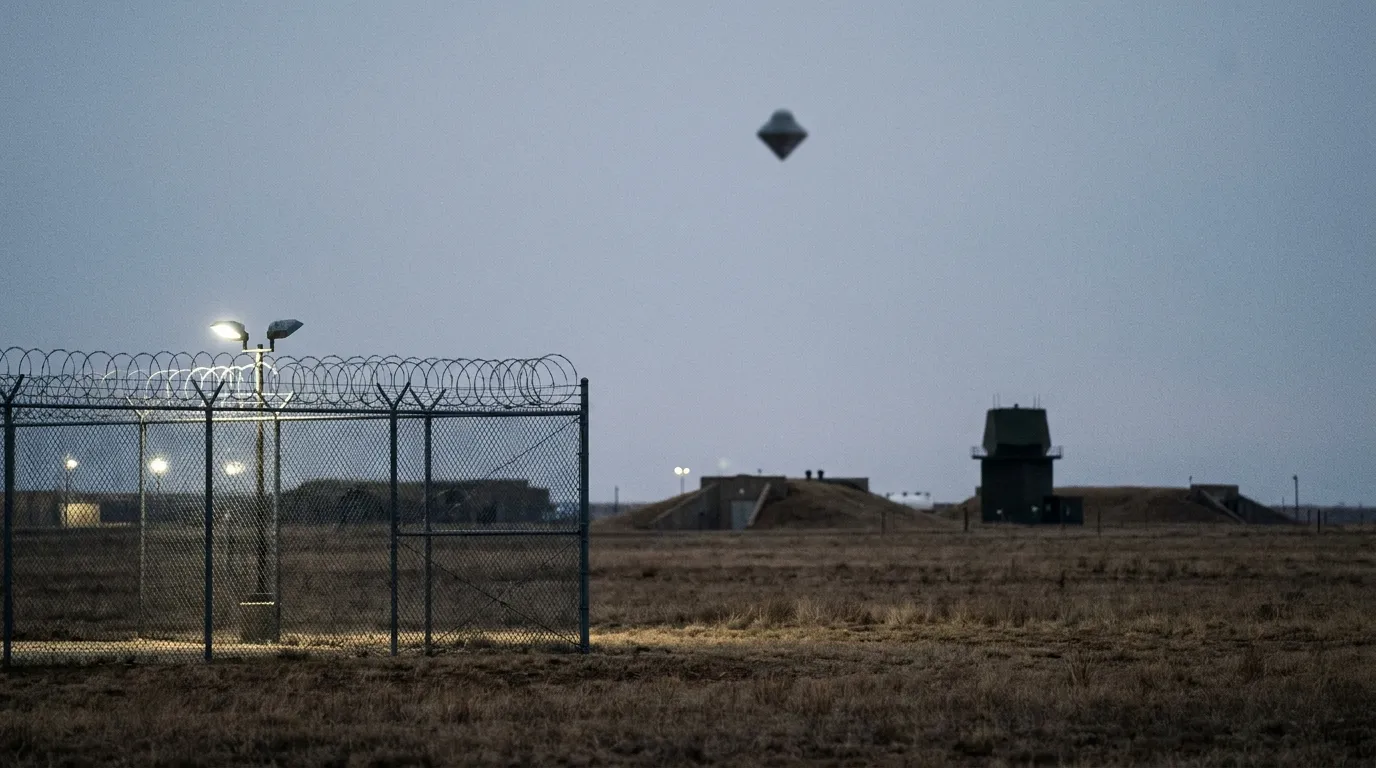
Just after seven in the morning on 1 September 2015, a ground surveillance radar on the flat grassland north-east of Amarillo, Texas, picked up something it could not account for. The return sat roughly 1.75 miles south-west of a Pantex Plant facility and was tracking north at an estimated ten to fifteen miles per hour.
Pantex is where the United States puts its nuclear weapons together and takes them apart. It is the only site in the country that does the job, and it holds thousands of plutonium pits pulled from dismantled warheads in earth-covered magazines behind some of the most heavily policed fencing on the continent.
The plant went into lockdown. Two security officers got into a vehicle and gave chase.
What they were chasing, according to the Department of Energy’s own incident report, was about four feet tall and two feet wide at the base. They described it as a diamond type-shape, more rounded at the top. It made no sound. Through binoculars, they could not identify any means of propulsion. They followed it for several miles until it went out of sight, stopped the vehicle, got out, and stood in the Panhandle listening to nothing at all.
That report has now been made public three separate times, by three separate routes — each version a little less redacted than the one before it. The most recent came on 10 July, in the fourth batch of files published under the current disclosure programme. And in every version, the same pages are blacked out: the ones showing what the national laboratory’s analysts concluded when they enhanced the photographs.
That, rather than the object, is the story.
What the document actually says
Strip out the excitement and it is a dry piece of security paperwork, which is what makes it useful.
The sequence begins with radar, not eyeballs — a ground surveillance system flagging an unknown track at low speed and low altitude near the perimeter. Officers were then directed, in the report’s phrasing, to follow the object and obtain as much information about it as possible. The site was locked down while they did. Someone at a radar tower photographed it.
The physical description is unusually specific for this genre. It is also, tellingly, not unanimous: witnesses disagreed about the colour, some saying black, others reporting silver, red and blue. That divergence is not a red flag about the witnesses. It is the ordinary signature of several people looking at a small object near the limit of what the eye can resolve, in different light, from different angles.
One wrinkle in the record is worth flagging rather than smoothing over. The earlier FOIA-released version has been read by researchers as describing an event on 2 September 2015; coverage of the July release, working from the fuller document, places it on 1 September. Both dates are in circulation, nobody official has clarified which is right, and anyone citing this case should know that.
What the report does not contain is any claim of exotic performance. Nothing accelerates impossibly. Nothing vanishes on camera. An object drifts north at cycling speed, silently, and security cannot catch it or identify it. That is the whole of the anomaly, and it is worth being honest about how modest it is.
Why four feet matters here
It would be easy to read “four feet tall, fifteen miles an hour” and file the whole thing as a non-event. That is a mistake, though not for the reasons the more excitable corners of this subject tend to give.
Pantex is a National Nuclear Security Administration site whose security apparatus exists to detect and interdict things approaching it. In September 2015, something small approached, was detected, was pursued by trained officers in a vehicle, and got away clean. You do not need the object to be from anywhere unusual for that to be a serious finding. The mundane reading is arguably the more alarming one: if a small surveillance drone can loiter over the plutonium stockpile, be seen, be chased, and simply leave, the perimeter has a hole in it that has nothing to do with physics and everything to do with procurement.
It is the pattern that runs through the whole documentary record — objects over nuclear infrastructure, and the institutions responsible unable to close the file. It is there in the 1949 Los Alamos conference where Edward Teller and Lincoln LaPaz could not agree on what the green fireballs were, released in the same July tranche as this Pantex material. It is there in the 1967 Malmstrom missile shutdown. It is here in 2015, in a report written by the people whose job was to stop exactly this happening.
The document that keeps being released
The publication history is the genuinely novel part of this case.
The report first reached daylight through the Freedom of Information Act, obtained by the independent journalist Dustin Slaughter, who publishes at The UAP Register. That version was heavily redacted — enough to establish that an incident had happened and roughly what officers said they saw, not much more. Slaughter has worked the Department of Energy angle persistently; in December 2024 he filed an appeal with the department’s Office of Hearings and Appeals, case number FIA-25-0008, after a broader request for DOE intelligence assessments on unidentified anomalous phenomena went nowhere.
Christopher Sharp of Liberation Times then put the obvious questions to the NNSA. Could the agency confirm whether the object had ever been formally classified as a UAP? It could not. Could it confirm whether the then Energy Secretary, Ernest Moniz, was told that America’s warhead assembly plant had gone into lockdown over an unidentified intruder? It could not. Did it hold anything beyond what had already gone out under FOIA? A spokesperson said no.
Then the government released it itself. On 22 May 2026 the second PURSUE tranche included an item catalogued as DOE-UAP-D001, “Enhanced PANTEX Imagery” — two pages of surveillance-derived material including a frame from the radar tower and images enhanced by Sandia National Laboratories. The most informative portions were redacted.
On 10 July it appeared a third time, in a batch of forty files — fourteen documents, nineteen videos, four audio files and three images, drawn from the Pentagon, NASA, the CIA, the FBI and the Department of Energy. This version carried additional narrative detail and additional imagery, and is the source of the propulsion-and-binoculars line that made most of the headlines. The three images in that batch were NASA’s, and they carry the same signature defect as the Pantex file: published pictures, withheld analysis.
Three releases, each with a little more of the page visible. A useful reminder that “declassified” is not a binary state, and that the version of a document you are reading may simply be the version somebody has got round to unblacking.
The part that is still blacked out
The object was photographed. The photographs went to Sandia National Laboratories — a first-rank technical institution with people who do image forensics for a living — and Sandia enhanced them and, one assumes, wrote down what they thought it was. That assessment has never been released. In the most recent version the imagery and its accompanying analysis remain withheld, on the stated grounds that they constitute unclassified controlled nuclear information.
That category is real and not obviously abusive. UCNI exists to stop people reverse-engineering the security posture of nuclear sites from public documents — sightlines, sensor coverage, camera placement, response timings. A photograph taken from a radar tower at a weapons plant plausibly gives away more about the tower than about the object.
But the effect is the same either way. The one piece of evidence capable of settling what this was is the piece the public does not get. We know how fast it went, what shape the officers thought it was, that the site locked down and that two men in a truck lost it. We are not permitted to know what the laboratory made of the pictures.
It is the structural problem we flagged in the Pentagon’s own annual UAP accounting: a case can sit in the “unresolved” column not because the evidence is baffling but because the part that would resolve it is held somewhere the analysis cannot reach.
The sceptic’s read, which is strong
Take the report entirely at face value and the mundane explanations remain in excellent health.
The most developed of them lives on Metabunk, where contributors have worked the case as a probable coaxial drone and put forward the IT-180, built by the French firm Exail (formerly ECA Group), as a shape match. It is a real machine with a real reason to be near this sort of site: its advertised roles include aerial surveillance and radiological detection around nuclear facilities. A coaxial rotor design is compact, roughly the right proportions, and from a few hundred metres away through binoculars on a bright Panhandle morning, “no identifiable propulsion system” is a statement about optical resolution rather than about aerodynamics.
There is an even simpler candidate. Ten to fifteen miles per hour on a steady northward heading is, near enough, a light breeze. A silent four-foot object with no visible means of propulsion, drifting in a straight line at wind speed and impossible to overtake on plant roads, is a serviceable description of a balloon — and balloons are, as Mick West has argued at length across this field, among the most consistently under-credited sources of eyewitness UAP reports, precisely because slow-moving objects are so hard to size and range by eye. The colour disagreement fits that reading rather neatly too.
Nothing in the released report rules either out. Nothing in it even attempts to. The document is a security incident log, not an investigation, and treating “the officers could not identify it” as equivalent to “it is unidentifiable” is the oldest error in this subject. It is the base-rate trap we set out over the apparent surge in commercial pilot sightings: an unknown is only interesting once the known has been properly exhausted, and nothing published here shows that work being done.
The pattern nobody will confirm
Where the case gets harder to dismiss entirely is that it does not stand alone.
Through FOIA work published by The Black Vault, run by John Greenewald Jr., there is now an official paper trail of repeated unmanned-aircraft incursions over Pantex — including an October 2022 report of a drone crossing onto plant property from the north at around 120 to 150 feet before turning south-west, and further events logged in 2023. These are not mysteries. They are documented, acknowledged and unambiguously man-made, and they establish that the airspace over America’s nuclear assembly plant is routinely violated by small aircraft the site records but does not stop.
Separately, and on a very different evidential footing, the journalists George Knapp and Jeremy Corbell have reported a late-2013 Pantex event in which a “jellyfish”-shaped object was captured on thermal cameras moving between high-security areas of the plant. That footage has not been publicly released, the account rests entirely on their sourcing, and it should be treated as unverified until the video surfaces. We flag it because it is part of why Pantex has the reputation it does, not because it can currently be checked.
The honest shape of the situation, then: a confirmed pattern of aerial incursion over the site; one confirmed incident in which the intruder was never identified; and a body of unverifiable claim wrapped around both, which the continued redactions do a great deal to sustain.
The UAP Times take
We have rated this Credible, four out of five on our scale, and the rating is doing two different jobs.
The document is close to a 1. It is a real Department of Energy incident report, obtained by a named journalist under FOIA and since published twice by the government itself. Nothing about the lockdown, the pursuit, the radar track or the description depends on anyone’s testimony being taken on trust.
The interpretation is nearer a 3. There is no positive evidence of anything anomalous beyond the fact that trained officers could not identify a small, slow, silent object and a laboratory’s opinion of the photographs has been withheld. A coaxial drone fits. A balloon fits better. Neither has been excluded, and that failure to exclude is the entire mystery.
To anyone inclined to read this as a smoking gun: it is something more useful than that. It is a fully documented instance of the security apparatus around nuclear weapons being unable to identify or intercept a four-foot object in broad daylight. That is worth a congressional question whether the object came from Amarillo or Andromeda — and it is one instance of a much broader failure to attribute what crosses American military perimeters.
The reasonable ask is small and specific. Release the Sandia assessment, or a summary of its conclusion with the security-sensitive imagery still withheld. If the laboratory decided in 2015 that it was a drone, say so and close the case; the public interest in knowing that a mundane object breached the perimeter is, if anything, higher than the interest in a mystery. If it could not decide, say that instead, and let researchers see why.
Eleven years is a long time to keep the answer in a drawer and the question in the newspapers. Every year it stays there the file gets released again, slightly less redacted, and the story gets slightly bigger — and none of that is anybody’s doing except the people holding the pictures.
Follow the file
Every new dispatch from the UAP desk, in your inbox. Sourced, sceptical, and no more than one email a week.