Here is a fact that ought to be embarrassing, and somehow never is. In eighty years of people photographing strange things in the sky, almost nobody has ever measured how far away one of them was.
Not estimated. Not inferred from an assumed size. Measured.
This is not a small gap. It is the gap. And a Harvard astrophysicist with a rooftop in Las Vegas has spent the last two years building the most direct attempt yet to close it.
The single number that breaks every famous video
Point a camera at a light in the sky and you record two things: a direction and a brightness. You do not record a distance. Without distance, you cannot derive size, speed, or acceleration — because all three depend on how far away the thing is.
Run the arithmetic and the problem becomes obvious. A one-metre object drifting at 30 mph half a mile away and a fifty-metre object moving at 1,500 mph fifteen miles away produce an identical smear across a sensor. They are the same image. Nothing in the pixels distinguishes them. The only way to tell them apart is to know the range, and a single camera never does.
This is why the debunking of UAP footage so often collapses into an argument about parallax, glare and camera artefacts rather than about the object. It is also why the most credible case in the modern canon still wobbles under scrutiny. The 2004 Nimitz “Tic Tac” encounter has multiple trained witnesses and cross-sensor corroboration, yet its most-repeated performance figures — the plunge from 80,000 feet, the impossible acceleration — rest on interpretation rather than a clean instrument log. The witnesses may well be describing exactly what they saw. The numbers are still soft. It’s the same defect that runs through Gimbal and GoFast, the two other famous targeting-pod videos: without a measured range, an infrared blob can’t tell you its own size or speed.
The same defect runs through the official record. AARO’s annual reporting resolves cases as balloons, birds and drones where the data allow, and leaves the rest in an “insufficient data” pile that is not evidence of anything except insufficient data. And the surge in commercial pilot reports measures the reporting system at least as much as it measures the sky. It applies just as ruthlessly above the atmosphere: the 1996 shuttle photographs the Pentagon has now filed as unresolved were released without the timing or scale data that would let anyone work out whether the object is metres or kilometres away.
Every one of those problems has the same root. Nobody has the range.
What Loeb has actually built
Avi Loeb founded the Galileo Project at Harvard in July 2021 with the chemist and entrepreneur Frank Laukien, on roughly $2 million in private donations and a deliberately unfashionable premise: rather than argue about other people’s blurry footage, build instruments that generate data good enough to settle arguments.
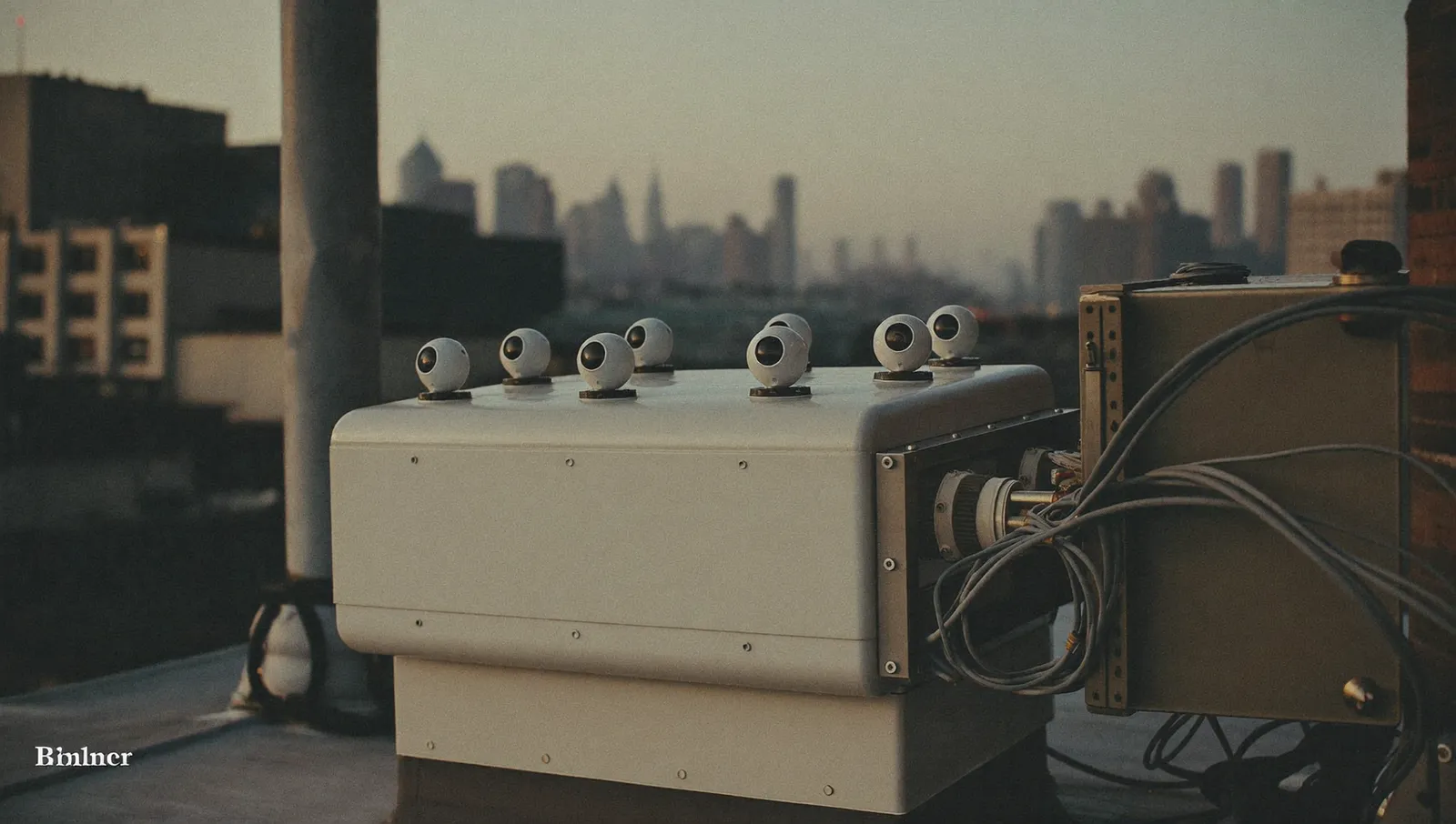
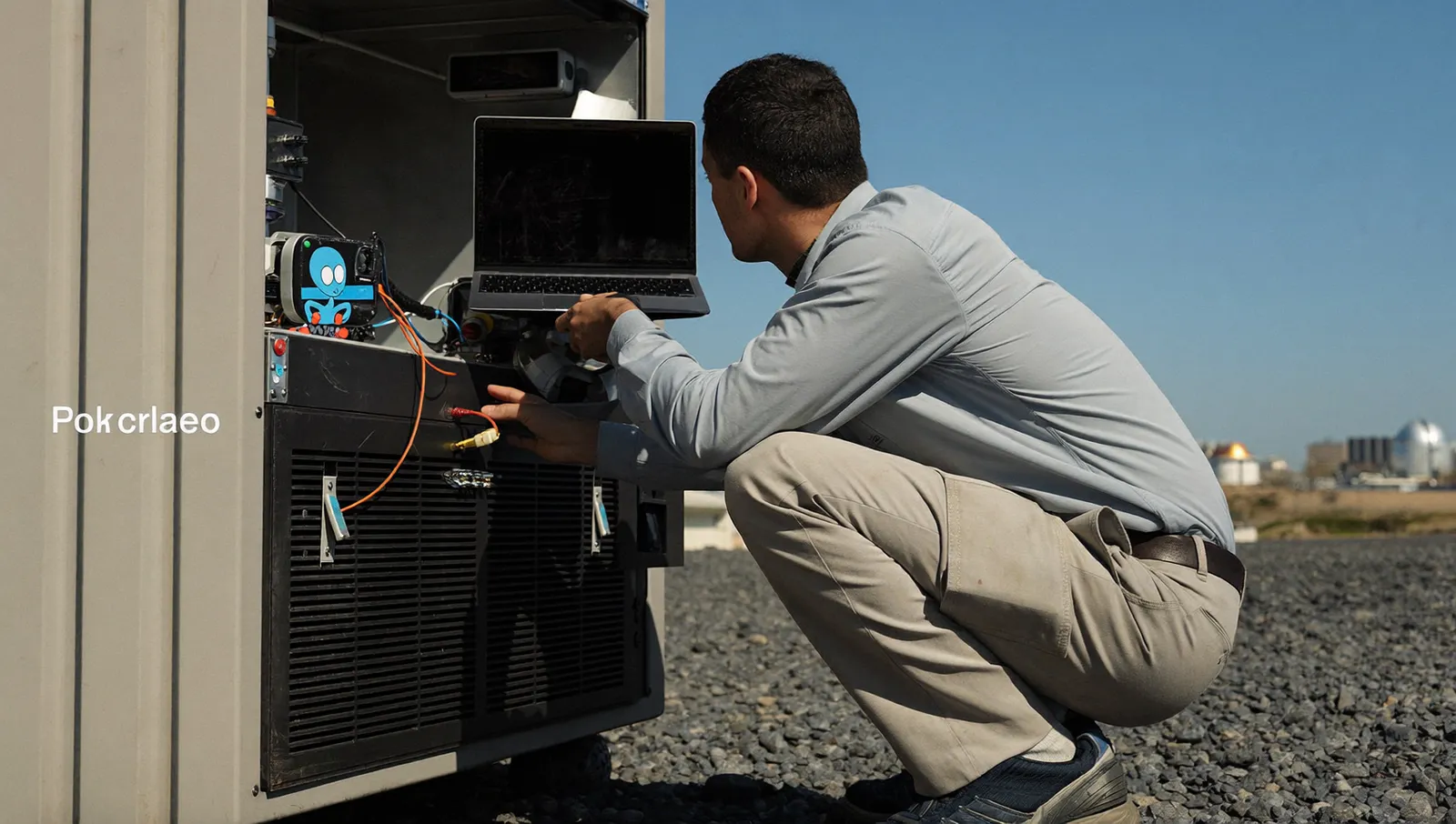
The project now runs observatories in Massachusetts, Pennsylvania and Nevada, with a fourth planned for Indiana. Each monitors the whole sky continuously across infrared, visible, radio and audio bands. The Massachusetts prototype’s all-sky infrared array — an eight-camera rig of uncooled long-wave FLIR Boson 640 units, cheerfully named Dalek — has been the workhorse.
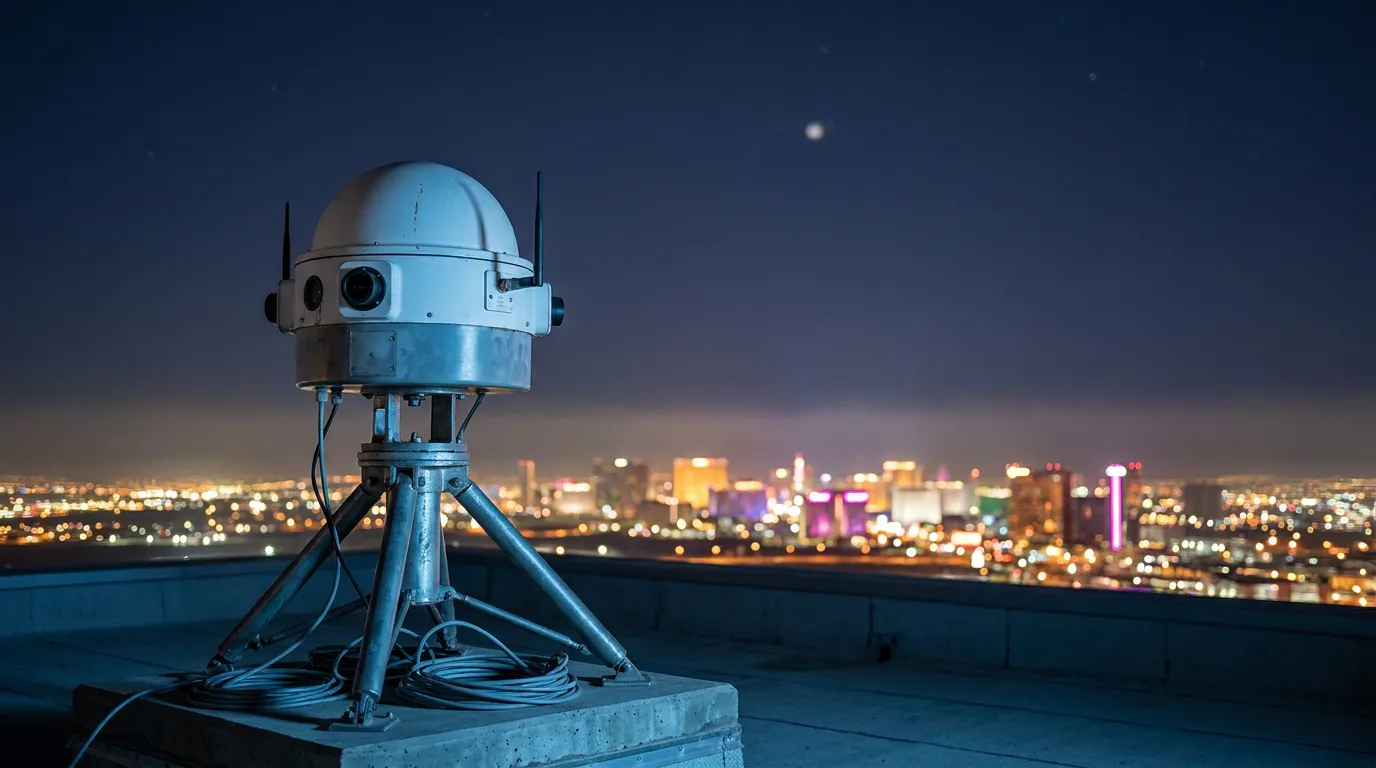
The Nevada installation is the one that matters here, and it exists because of an approach Loeb did not solicit. In September 2024 he was contacted by James Dolan, chief executive of Sphere Entertainment, and Jane Rosenthal of Tribeca Enterprises, with an offer to mount an observatory on top of the Las Vegas Sphere. Dolan travelled to Loeb’s home in Boston to green-light the installation above the venue’s LED exterior.
Two more identical units were then installed roughly ten kilometres away. The three — labelled, with no ceremony whatsoever, sphere, hideout and wildhorse — form a near-isosceles triangle with legs of 10.2, 10.1 and 2.0 kilometres.
That geometry is the entire point. Three widely separated units observing the same object simultaneously see it against different backgrounds from different angles. Trigonometry does the rest. Loeb’s stated performance figure is distance, velocity and acceleration recovered to better than 10% accuracy, across a system projected to log a few million objects a year.
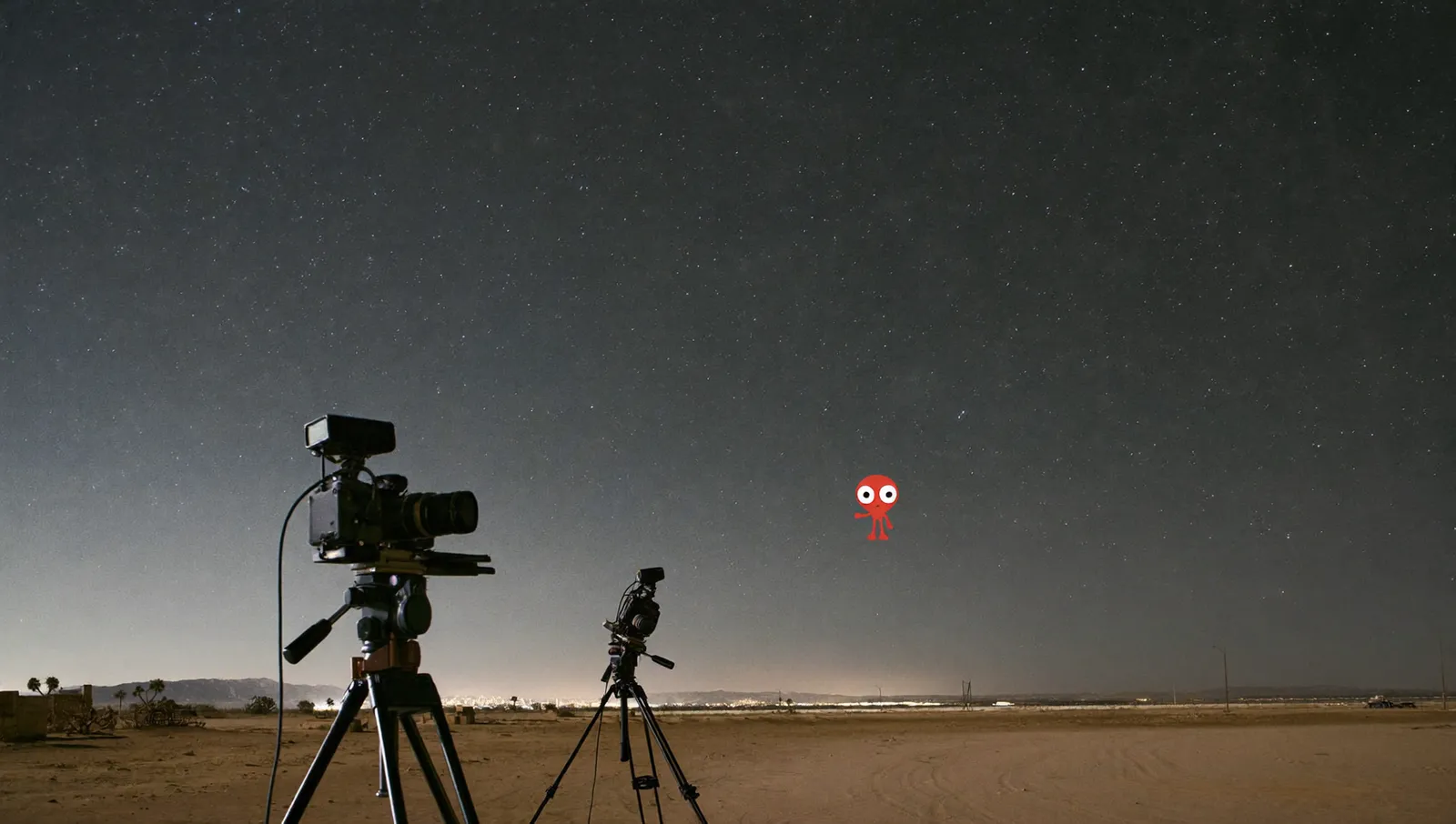
If that holds up, it is the first time anyone has pointed a purpose-built, calibrated range-finding instrument at this question and simply left it running.
The half-million-object dress rehearsal
We are not obliged to take the capability on trust, because the project has already published what its prototype produced — and this is where the story gets genuinely interesting.
The commissioning paper, with Laura Domine as first author, posted to arXiv in November 2024 (2411.07956) and has since entered the peer-reviewed literature. It covers five months of continuous observation, January to May 2024, from the Harvard-based infrared array. Roughly half a million objects crossed the sensors.
After automated processing and manual review, the number of trajectories that remained ambiguous — objects the team could not resolve, while noting they were most likely mundane — was 144. About 0.03% of the sample. The paper then does the thing that distinguishes science from advocacy: rather than parade those 144 as candidate UAP, it folds in systematic uncertainty and derives a statistical upper limit of 18,271 outliers for the five-month window at 95% confidence.
Read that sentence again, because it is the opposite of what you would expect from a project routinely accused of chasing aliens. It is a negative result, expressed as a bound. It says: here is the most anomalous activity our instrument could possibly have missed, and we are not claiming any of it is real.
Why a boring answer is the valuable one
The instinctive reaction to “144 ambiguous smudges out of 500,000” is disappointment. That reaction is wrong, and understanding why is the most useful thing in this story.
A detector that finds nothing anomalous is only worthless if you already knew the answer. If you did not, a well-characterised null result is information — it converts “people see strange things” into “at this sensitivity, over this sky, for this long, the strange-thing rate is below X.” That is a measurement. The field has produced vanishingly few of them, though the year-long technosignature hunt for a transmitter aboard 3I/ATLAS has since added several more.
It also, quietly, disciplines everyone. Ambiguity is the sea this subject swims in, and an instrument that reports its own uncertainty in numbers rather than adjectives makes a certain kind of arm-waving much harder to sustain — in both directions. It is the same standard we applied to the White House UAP Science Advisory Council that Loeb chairs: the most valuable output a scientific body can produce here is a dull answer it is willing to sign. The other measurement worth chasing needs no triangulation at all: a spectrum, which is the experiment that would confirm or kill the meteor-dust theory of orbs inside an afternoon.
The contrast with that council is stark. It has fifteen distinguished members, no budget, and access only to files the government has already chosen to release. The Galileo Project has cameras, a triangulation baseline, and permission to point them wherever it likes. One is a reading group. The other is an experiment.
The sceptic’s read, which is sharper than usual
The critique of Loeb is well-rehearsed and does not need this site’s help. He is accused of anomaly hunting — fixating on statistical oddities in enormous datasets while the vastly larger population of non-oddities goes unremarked — and of running, in the phrase that has followed the project since 2021, a classic fishing expedition: cast the net, see what turns up, without having thought hard enough about what different outcomes would actually mean.
The first charge is real as a risk and largely answered by the published method. A paper whose headline output is an upper limit is not anomaly hunting; anomaly hunting produces 144 exciting case studies, not a confidence bound.
The second charge lands harder, and the most incisive version of it comes from Mick West, the field’s most rigorous debunker, writing about the Vegas array. He allowed that the triangulated sensors “may be a great clarifier for ufology” — then noted that, projected to measure a few million objects a year, “they probably won’t find anything unambiguously anomalous,” and asked the question that actually matters: What will that change?
It deserves an honest answer, which is: probably very little, for the people whose belief was never data-driven to begin with. A null result from Las Vegas will be met with the argument that the phenomenon does not perform on demand, does not appear over casinos, and is not obliged to fly through anyone’s baseline. That argument is unfalsifiable, which is precisely its appeal.
But “it won’t persuade the committed” is a fact about people, not about instruments. In twenty years there will either be a calibrated public dataset of what actually crosses the sky above a major city, or there will not.
There is also a fair objection about venue. An observatory on top of an entertainment palace, celebrated on podcasts and photographed next to visiting film stars, invites the suspicion that the science is downstream of the spectacle. That suspicion is reasonable, but it is not an argument about the data — and the way to test it is to read the papers, which are published, numbered, and considerably less thrilling than the rooftop.
What would actually count as a result
Three tests, in ascending order of difficulty.
Does the distance capability get demonstrated, not just claimed? “Better than 10%” is a specification until it appears in a paper with a calibration campaign behind it — known aircraft at known ranges, cross-checked against ADS-B. Loeb has said further papers are coming this summer. That is the one to read.
Does the project publish its nulls as prominently as its anomalies? The commissioning paper did exactly this, which earns real credit. The test is whether that survives the first genuinely weird triangulated object, when the incentive to lead with the smudge will be enormous.
Does anyone else replicate it? One network run by one charismatic figure is a proof of concept. The measurement only becomes robust when a second group, ideally one that finds Loeb irritating, builds a comparable array and reports comparable numbers.
The UAP Times take
We have rated this Credible — four out of five. The claim here is not “aliens” and not even “something anomalous has been detected” — it is that a privately funded network of triangulating observatories now exists, that its prototype has published five months of data on half a million objects, and that its headline finding is a statistical upper limit rather than a discovery. All of that is on the public record, in numbered papers you can read. The four rather than our top mark reflects the parts still resting on the project’s own account: the better-than-10% accuracy figure has been stated more often than it has been demonstrated in print.
What strikes us is how thoroughly this inverts the usual shape of a UAP story. The normal article reports an extraordinary claim and then spends its length hedging. This one reports an unextraordinary finding — 144 smudges, most likely mundane, none claimed as anything — and the finding is more valuable than the claim would have been.
For eighty years this subject has been starved of the one number that would make any of its other numbers mean something. Somebody has now built the instrument that supplies it, pointed it at the sky above Las Vegas, and reported — carefully and in public — that it had found nothing much.
That is what it looks like when the question finally gets asked properly. The answer may well stay boring for years. Boring, measured and repeatable would still be the biggest upgrade this field has ever had.
Further reading: the same problem at amateur scale — the kit that lets you rule things out yourself, and the craft shapes those smudges keep getting sorted into. For what happens when a case has no calibrated measurement at all, see the Pentagon’s “time warp” wristwatch. The same missing number has now been audited across all 112 of the Pentagon’s PURSUE videos. The project’s own scientists have since taken apart the year’s biggest technosignature claim. The next observatory in the series is designed to answer a different question entirely: what the orbs are actually made of.
Follow the file
Every new dispatch from the UAP desk, in your inbox. Sourced, sceptical, and no more than one email a week.