
There is a particular kind of government silence that tells you considerably less than people think it does, and a great deal of this story is made of it.
Since August the claim circulating in the UAP world has run roughly thus: the President personally authorised the American military to stop merely watching unidentified objects and start shooting them down, with directed-energy weapons, at White Sands Missile Range in New Mexico — with a view to recovering the wreckage. If true, it is comfortably the biggest story the subject has produced in a decade.
Last week it acquired the thing such stories usually lack: a date, a deadline and an official no-show. Liberation Times, which has been putting questions to the Department of War about a related operation since July, reports that on 22 September the White House press office asked the outlet to set a deadline for a response. One was set — 5pm Eastern on 25 September. It elapsed. Nothing came.
That is not a confirmation. It is not a denial either, and the gap between those two facts is where this entire piece lives.
What was actually claimed, and by whom
The reporting is Ross Coulthart’s, on NewsNation’s Reality Check, sourced to people he has not named. Stripped of framing, his account runs as follows.
President Trump authorised the Department of War to engage unidentified objects rather than simply catalogue them. The operation is run out of the White House by his most senior intelligence advisors — deliberately, Coulthart says, to route around what he calls the “legacy program”, the alleged decades-old recovery effort disclosure advocates believe has been sitting on physical material. Secretary Pete Hegseth has been tasked with establishing what the objects are and capturing one. Directed-energy systems at White Sands have been used against craft displaying the so-called Five Observables. And objects have been brought down inside the United States and across the border, near Juárez in Mexico.
One of the weapons, Coulthart told his audience, is a “high pulse microwave” system — a burst of electromagnetic energy travelling at light speed that penetrates an aircraft and fries its electronics.
That detail cuts both ways. High-power microwave weapons are real and have been fielded against drone swarms. But the term of art is HPM — High Power Microwave. “High pulse microwave” is not a phrase anybody inside that community uses. It is the kind of small error you get when a term has been passed along a chain of people rather than read off a document, and it may be the most informative detail in the whole account.
The documentary floor underneath it
Here is the part that is not anonymous, and it matters, because it is why this story is being taken seriously at all rather than dismissed outright.
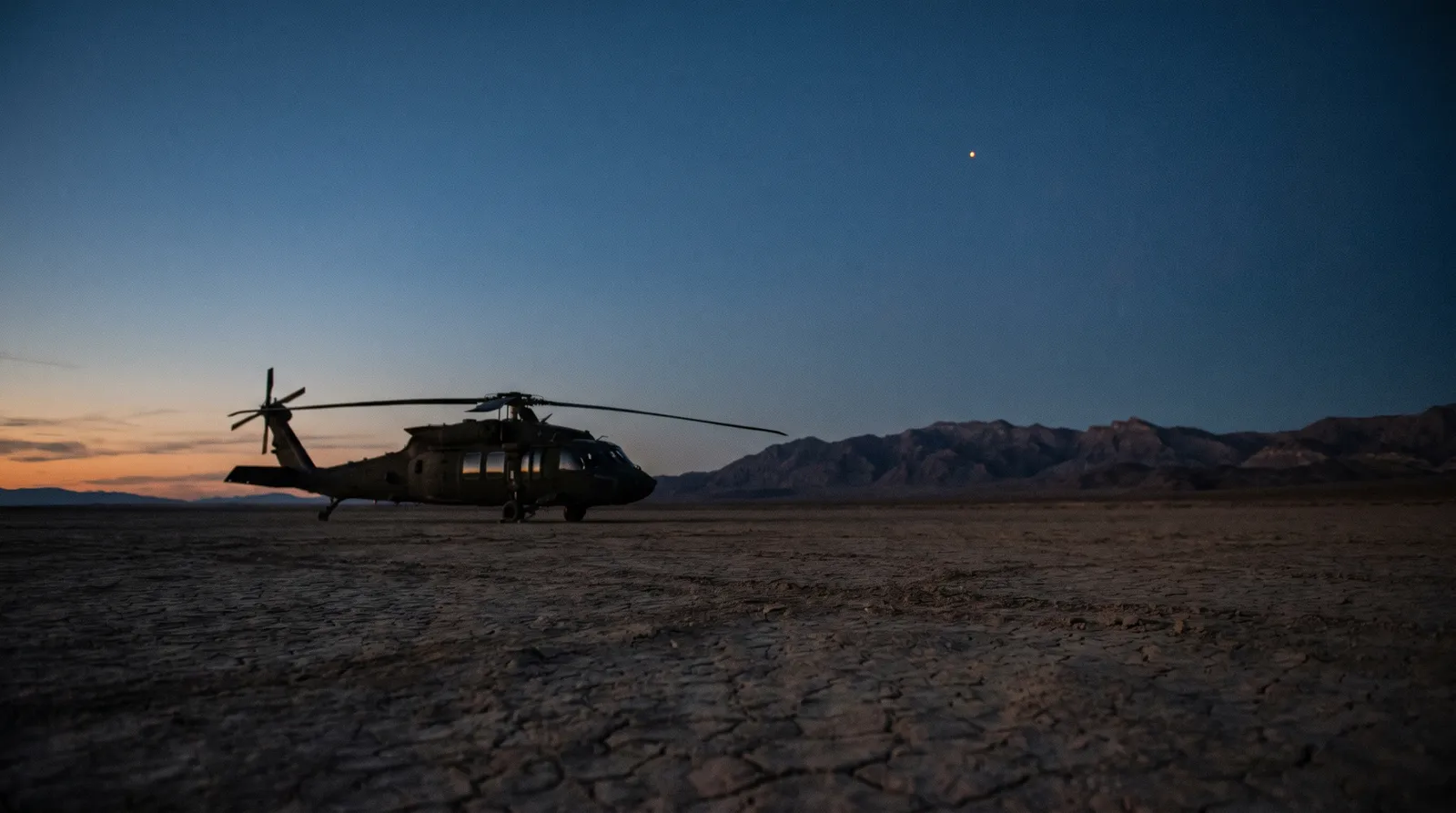
In PURSUE Release 02, published in May, the Department of War put out a two-page narrative written by a senior US intelligence officer. It describes a helicopter mission over a test range in the southwestern United States in late 2025: loud thuds in the surrounding mountains, UAP reported over the preceding nights, a ground team on FLIR, radar direction from a Joint Operations Center, and a crew watching orange orbs through night-vision and with the naked eye — orbs that held position for roughly an hour, split into separate objects, kept pace with fighter jets and shifted from a “T” formation into a triangle. Ground personnel took 24 night-vision photographs; the FBI supplied them to AARO. There was an FBI interview, a personal statement from a senior ODNI official, and a classified congressional briefing.
None of that is disputed. The government published it.
What the government did not publish is any statement of intent. The reading that this was a deliberate luring operation — that someone drew the objects there on purpose — came from Jordan Flowers, executive director of the Disclosure Foundation, speaking to CBS News. We covered that distinction when the files landed: the imagery is real, “luring operation” is somebody’s interpretation of it, and the Department of War has never endorsed the phrase. The FBI interview at the centre of it is the same genre of document that produced the Pentagon’s much-hyped “time warp” case, which turned out to rest on one analogue wristwatch.
So the floor is solid and the storey above it is anonymous. The documented event is a sighting. The shootdown is a claim about what was done after it, resting entirely on sources who have not been named and have not been corroborated.
What the Department of War did say
Not quite nothing. Asked about footage of the alleged incident, the Department replied that it “did not find any footage pertaining to the alleged sighting in question.”
Read that carefully. It is a statement about a records search, not about events. It does not say no engagement happened, and it does not say one did. It is the answer a press office gives when it would rather not be quoted taking a position, and anyone presenting it as vindication or as refutation is reading in something that is not there.
The White House has been asked directly about both the alleged lure operation and the shootdown claim, and has answered neither — having asked for, and received, a deadline of its own choosing.
The sceptics are not being subtle about it
Brian Dunning, of Skeptoid, has been about as blunt as it gets. He describes Coulthart as “formerly a respected Australian journalist, but in recent years he has joined the many who have gone all-in on the UFO fantasy world — he believes everything, he constantly reports dumbfounding discoveries but can’t give you the details or provide any evidence because reasons.” His test for the White Sands story is that you should accept it only “if you believe unevidenced anecdotes from people who have cried ‘Wolf!’ more times than I can count.”
That is harsh and it is not baseless. Coulthart’s credentials are genuinely serious — multiple Walkley Awards for work that had nothing to do with this subject — which is exactly why the pattern matters. The question is not whether he can report, but whether this claim has been nailed down to the standard the rest of his career was built on. On the public record, it has not.
Dunning also notes where the story drifted once in circulation: NewsNation’s coverage picked up the suggestion that the private group Skywatcher — Jake Barber’s outfit, which claims to summon UAP using “psionic” operators and a “dog whistle” emitter — had called the objects in to be shot at. Michael Shermer’s verdict on Skywatcher’s summoning claims, when they surfaced, was one word long: delusional. Grafting that on makes the composite less credible, not more.
The checks nobody has been able to run
Three things ought to leave a trace, and none has.
The first is diplomatic. An engagement that brought something down near Juárez would be American military action on or adjacent to Mexican soil. There is no Mexican government statement, no protest, no acknowledgement. Sovereignty incidents of that kind do not usually stay quiet.
The second is precedent. America has shot at unidentified objects over North America before, and it was not remotely secret. After the Chinese surveillance balloon came down on 4 February 2023, fighters downed three further unknowns on the 10th, 11th and 12th — off Alaska, over the Yukon and over Lake Huron, where the first Sidewinder missed. NORAD briefed it. The President addressed it. Within weeks the official assessment was that they were most likely benign commercial or research balloons. That is what an American shootdown of an unknown looks like: loud, fast and quickly deflated.
The third is institutional. AARO’s director, Jon Kosloski, told the Senate this year that across more than 2,000 investigated reports his office has found no verifiable evidence of extraterrestrial beings, activity or technology. If a White House-run programme is downing anomalous craft and keeping the pieces, either AARO does not know — which would make it the decorative screen its critics allege — or the testimony is wrong. Both matter. Neither is evidenced.
Loeb’s conditional, and why it is the useful part
Avi Loeb has written twice about the claim, and how he has written about it is instructive. He does not assert that orbs were downed. He asks what would follow if they were — arguing that an object’s response to being engaged, and the chemical and isotopic composition of any material recovered, would test the alien-technology conjecture far more sharply than another decade of archival files. The UAP Science Advisory Council, which he chairs, could run that analysis if the operation is real.
The “if” is doing enormous work there, and to his credit he leaves it visible. It is also a reminder of the structural problem: Loeb’s council exists, and has been handed essentially no data. Meanwhile AARO has quietly built a procedure for receiving recovered UAP material while maintaining there is none to receive. A government that was genuinely downing craft and wanted the science done has an obvious and unused mechanism for doing it.
The question that survives either way
Set the shootdown aside and something awkward is still standing. Orange orbs did hold station over a sensitive American test range for about an hour in late 2025, in front of a helicopter crew, a ground team, radar and fighter jets, and a senior intelligence officer wrote it up.
Which raises the question we keep arriving at from different directions: when something unidentified parks itself over a military installation, whose job is it to act? The Pentagon’s own Inspector General had to tour ten bases to establish that commanders did not know — an authority gap nine years in the making. A President reportedly running an interception programme out of the White House, around his own department, would be a symptom of that gap, not a solution to it.
The UAP Times take
We have rated this Thin, two out of five on our scale, and the rating is about the shootdown claim specifically — not the sighting underneath it.
The sighting is documented and would rate considerably higher on its own. The engagement is not. It rests on unnamed sources relayed by a single reporter, carries a terminological slip suggesting the chain of transmission is longer than the chain of evidence, and has produced no diplomatic trace in Mexico, no NORAD statement, no releasable record and no acknowledgement from the office statutorily charged with investigating exactly this. The strongest thing in its favour is the White House declining to say anything at all — and an unanswered press query is not evidence. Governments fail to answer awkward questions about things that are not happening about as often as about things that are.
What would change our mind is dull and specific: a named official on the record, a contract or tasking document, a Mexican diplomatic note, or AARO being asked about White Sands under oath and declining to answer. Any one of those moves this story. Another month of silence does not.
And if it turns out that nobody shot at anything, we are still left with orange orbs holding position over a test range while four separate sensor systems watched, and nobody in the chain of command certain whose problem that was. That one is in the file already.
Further reading: for the release that put the underlying sighting into the public record, see the Pentagon’s fifth UFO file drop; and for why nobody seems to know who is allowed to act when something flies over an American base, the authority gap.
Update, 3 October: a professor of global law published a commentary the day before this story broke, asking whether firing on an unidentified object is lawful at all — the case against shooting down a UAP.
Follow the file
Every new dispatch from the UAP desk, in your inbox. Sourced, sceptical, and no more than one email a week.