

Three of the most-watched UFO videos ever released — Gimbal, GoFast and FLIR1, the trio the Pentagon officially confirmed as genuine in April 2020 — were not shot on cameras. They were shot on a weapon.
Specifically, on the AN/ASQ-228 Advanced Targeting Forward-Looking Infrared pod, a piece of kit designed to find a target, keep a laser on it, and get a bomb to hit it — not to produce a clean photograph for the public to pore over years later. That mismatch between what the sensor was built to do and what millions have since asked it to prove is the real story behind all three videos. Before arguing about what’s in the frame, you have to understand what kind of instrument produced it. Almost nobody arguing about these clips online has done that. This is the explainer that does.
An infrared camera isn’t a camera
The single biggest source of confusion in this entire debate is that people watch FLIR footage and read it the way they’d read a photograph. It isn’t one, and the differences matter.
A targeting pod’s sensor doesn’t record visible light bouncing off a surface. It records heat — mid-wave infrared radiation, gathered by a “staring” focal-plane array that measures temperature difference across the scene rather than colour or texture. The image is a false-colour rendering of that temperature map, and the operator can flip its polarity: white-hot, where warmer things glow bright, or black-hot, where warmer things go dark. Most of the famous clips run black-hot, which is exactly why the objects in them read as solid, featureless black ovals — that shape is a thermal silhouette, not a photograph of a hull.
That has a blunt consequence lost in every viral repost: an infrared sensor cannot show surface detail, colour, or “structure” unless temperature varies sharply across the object itself. No windows, no rivets, no visible means of propulsion is not evidence of an exotic craft — it’s the default output of the instrument for almost anything at range. A bird, a balloon, a distant airliner’s engine nacelle and a genuinely anomalous vehicle all render as the same featureless blob if their temperature is roughly uniform. The absence of detail tells you about the sensor, not the object.
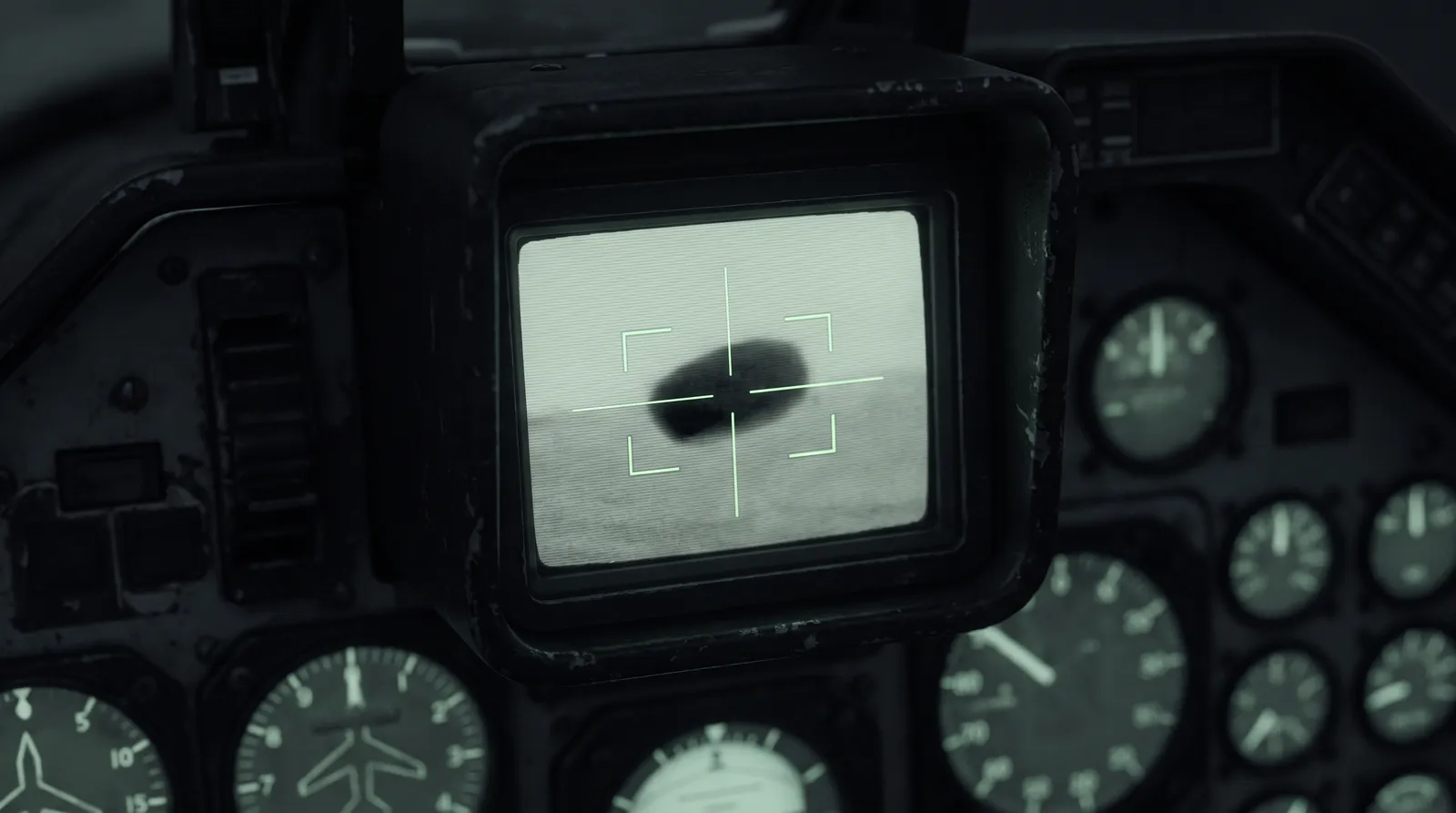
Why the pod itself keeps moving
The pod is also not a fixed camera bolted to the airframe. It’s a gimballed sensor head, gyro-stabilised so the image stays locked on target while the jet banks and turns underneath it — and that stabilisation has a mechanical limit. As the line of sight swings toward directly below or behind the aircraft, the gimbal can run out of travel in one axis, a problem sometimes called gimbal lock, and the pod’s software compensates by rapidly rolling the sensor head, then digitally “de-rotating” the image so the horizon still looks level. Most of the time this housekeeping is invisible. Occasionally it isn’t, and the artefacts it leaves behind have become load-bearing evidence in exactly the case you’d expect.
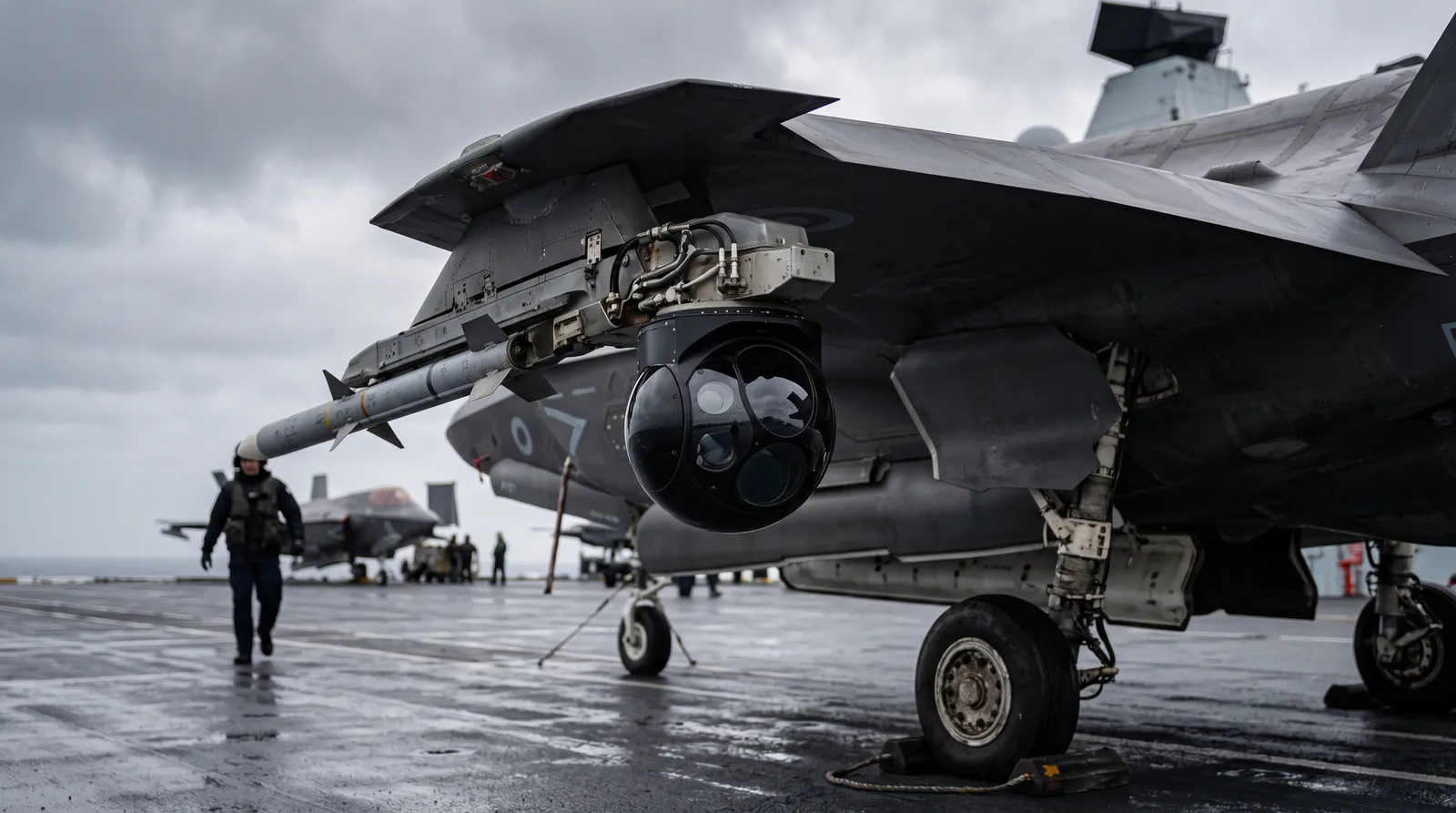
Case one: what is Gimbal actually rotating?
The January 2015 “Gimbal” video, filmed off the Florida coast by a Navy F/A-18F, shows a dark oval object appear to physically rotate 90 degrees as the jet’s targeting pod tracks it. For years this was presented as the video’s single strongest piece of evidence — an object rotating in a way no aircraft or optical artefact should.
The sceptical case, built out in detail by the researcher Mick West on the Metabunk forum, argues the rotation is the pod’s, not the object’s. His analysis holds that the object is very likely the infrared glare of a distant conventional jet’s engine exhaust, viewed nearly head-on — at that range and aspect, an engine’s heat can overwhelm the sensor and bloom into a shape unrelated to the aircraft’s actual outline. As the pod approaches its gimbal limit and rolls to compensate, West argues, the glare blob rotates with it even though nothing in the sky is actually turning, pointing to background cloud motion that appears to rotate in sync as corroboration. It’s a serious, technically literate argument — and not the only one in the room.
“Our results support that the Gimbal object exhibited anomalous flight characteristics.”
That’s the conclusion of a 2023 paper by Yannick Peings and Marik von Rennenkampff, presented at the AIAA Aviation Forum, which reconstructed potential flight paths using the range and altitude the aircrew provided at the time. Their point is narrower than it sounds: they don’t dispute that glare could account for the object’s shape or apparent rotation. They argue its motion — a deceleration from several hundred knots, then an abrupt reversal in the vertical, apparently at low airspeed and high altitude with no visible means of lift — is a separate question the glare explanation doesn’t automatically settle. A 2019 kinematic analysis by the physicist Kevin Knuth and colleagues reached similar conclusions about Nimitz-era cases, though it has been criticised for assuming too much about unmeasured range.
Hold both halves at once: the visual debate over Gimbal — solid craft or engine glare — has a genuinely strong prosaic answer. The kinematic debate — did whatever produced that glare move the way the aircrew’s own data suggests — remains open, and it’s the harder question by some distance.
Case two: GoFast and the oldest trick in the sky
If Gimbal is a dispute about rotation, the 2015 “GoFast” video — filmed by a different Navy jet off the Atlantic coast the same year — is a dispute about arithmetic, and it’s much closer to settled.
The clip shows a small object skimming low and fast over open ocean, close enough to the wave tops that the apparent speed feels visceral. West’s analysis, grounded in the range readout the pod itself displays, argues this is a textbook case of parallax: an object’s apparent speed depends entirely on how far away it is, and a slow object seen up close produces the same visual streak as a fast object seen from a distance. Working through that displayed range and the geometry of the shot, his reconstruction puts the object closer to 13,000 feet up rather than skimming the water, moving at perhaps 30 to 40 knots — consistent with a high-altitude wind-borne balloon, not a low-altitude high-speed craft. The clue that seals it, on this reading, is thermal: the object reads colder than the ocean beneath it, which fits a balloon cooled by thin high-altitude air and not a jet-powered craft moving fast at low level.

This is also the one of the three where the official record has caught up with the sceptical case. AARO’s own public assessment states the GoFast object does not exhibit anomalous flight characteristics — a rare instance of a Pentagon conclusion and an outside sceptic’s independent reconstruction landing in the same place by different methods. That convergence is worth more than either verdict alone.
Case three: the video that everyone conflates with the other two
The 2004 “Tic Tac” encounter off the USS Nimitz produced a third video, FLIR1, shot by Lieutenant Commander Chad Underwood on his own jet’s ATFLIR pod — and it’s routinely bundled with Gimbal and GoFast as if all three tell the same story. They don’t. Gimbal and GoFast are 2015 East Coast videos with no connection to the Nimitz encounter beyond sharing the same model of pod. FLIR1 shows roughly 76 seconds of an oval thermal shape against a cold sky before it darts abruptly out of frame, and has attracted far less rotation-and-glare forensic work than Gimbal, because there’s less in the frame to examine. What makes FLIR1 evidentially different isn’t the pixels; it’s the corroborating radar track and multiple aircrew testimony alongside it — a case built on witnesses and sensors together, not a video carrying the argument alone. Underwood himself, notably, has never claimed the footage shows anything conclusive — restraint worth remembering whenever someone else insists it proves more than he does.
The one number none of these videos contain
Here is the thread connecting every one of these disputes, and the same one running through nearly every UAP case ever filmed: range.
An ATFLIR pod can display a range figure when its laser rangefinder is actively lasing the target — which West’s GoFast analysis relies on directly — but for most of these clips, most of the time, the sensor is simply pointing at a thermal blob with no independent measurement of how far away it is. Without range, you cannot derive true size, speed or acceleration from footage alone, because all three depend on distance in ways the pixels can’t disclose. A slow, distant, large object and a fast, close, small one produce an identical shrinking dot on an infrared sensor. This isn’t a flaw specific to these three videos; it’s the structural limitation the Galileo Project’s triangulating camera network was purpose-built to fix, by putting multiple instruments a known distance apart on the same sky so range stops being a guess.
It’s also why the loudest arguments about these videos are, more often than not, arguments with the wrong tool. A targeting pod is exceptional at putting a laser-guided weapon on a target whose range is already known from other sensors. It is a poor instrument for settling exactly the question the internet keeps asking it to settle alone.
What a targeting pod is actually good at telling you
None of this makes ATFLIR footage worthless — it makes it a specific kind of evidence, good for some questions and bad for others. It reliably tells you an object was present with a real, moving thermal signature, ruling out pure sensor noise in most cases. Combined with a locked laser range, as in GoFast, it can support a rigorous distance-and-speed reconstruction. Combined with independent radar and multiple trained witnesses, as in FLIR1, it becomes one strand in a much stronger rope. What it cannot do alone is confirm an object’s true size, speed, surface structure, or — least of all — its origin. Every “impossible” claim attached to these three videos turns out, on inspection, to be an inference piled on the footage rather than something the footage itself contains.
The UAP Times take
We’re rating this explainer Credible — four out of five on our scale. The sensor physics is documented in open technical literature and isn’t seriously contested; the competing analyses of Gimbal and GoFast come from named researchers working from published data, reasoning shown rather than asserted. It falls short of the top mark only because the hardest question — whether Gimbal’s underlying flight path was genuinely anomalous once you set the glare debate aside — remains a live, unresolved dispute between credentialled people working from the same limited dataset.
The pattern extends well past these three clips. An infrared targeting pod is not a truth machine, and it isn’t a hoax machine either — it’s a purpose-built military sensor being asked, after the fact, to answer questions it was never designed to answer alone. GoFast shows what happens when someone does the arithmetic properly: a dramatic clip resolves into a slow-moving balloon. Gimbal shows what happens when the arithmetic runs out: the glare explanation is strong, the kinematic question isn’t, and both things can be true at once. Understanding the box the footage came out of matters more than staring harder at what’s inside the frame.
Further reading: for the encounter that produced FLIR1 and the radar-and-witness case built around it, see The Tic Tac Encounter, Explained; for the instrument now being built to solve the range problem these videos all share, see Nobody Has Ever Known How Far Away a UFO Was. And for what happens when this same arithmetic is run across all 112 of the Pentagon’s released clips, see the study that found none of them can measure a speed.
Follow the file
Every new dispatch from the UAP desk, in your inbox. Sourced, sceptical, and no more than one email a week.