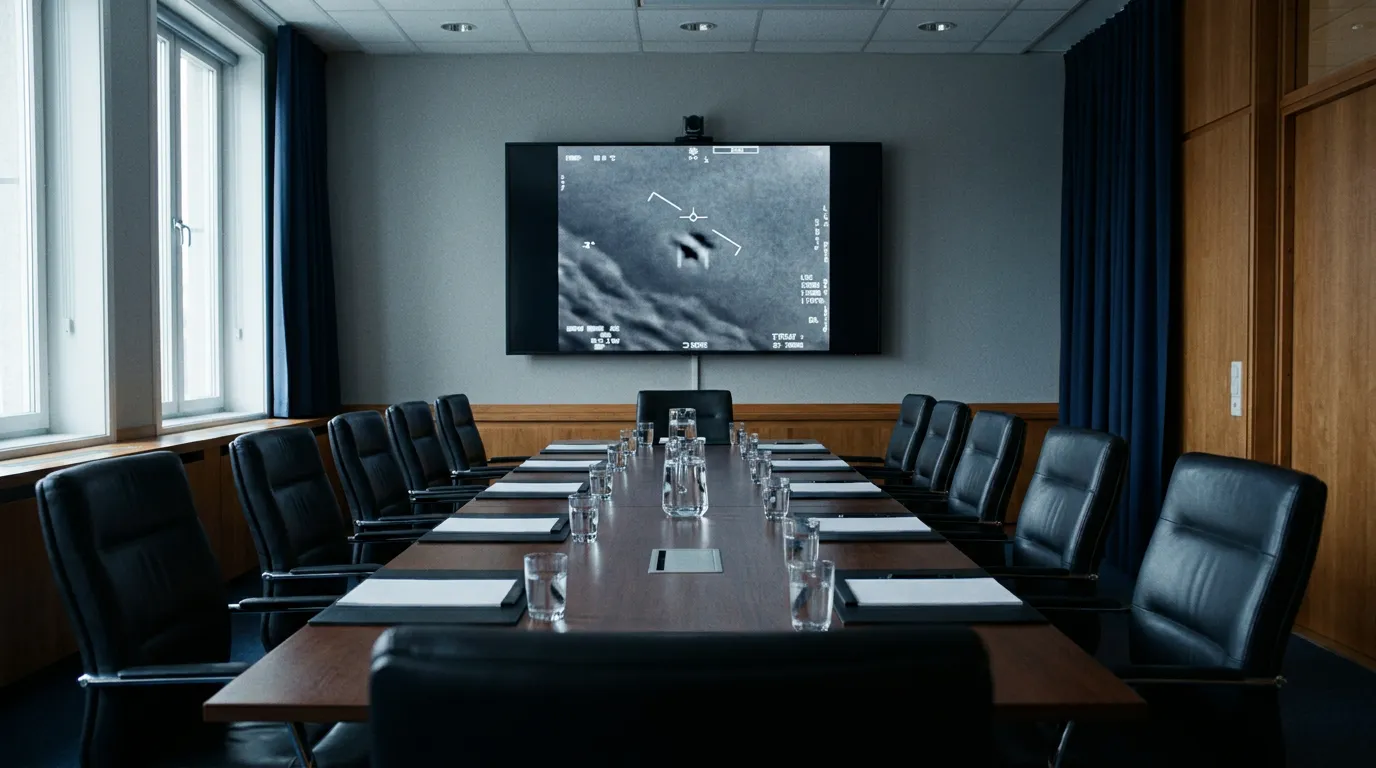
Somewhere in the long history of this subject, somebody was always going to try the obvious thing: hand the problem to scientists and ask them to sort it out. That has now happened. In June, an official from the Office of the Director of National Intelligence approached Avi Loeb, the Harvard astrophysicist best known for arguing that the interstellar object ‘Oumuamua might have been artificial — and who has since spent a year making a similar case about 3I/ATLAS, to a similar reception — and asked him to assemble a panel of experts to help the US government work out what it has been looking at.
The result is the UAP Science Advisory Council. Its public website went live on 1 July. It has around fifteen members, it has already filed a request for more than fifty items of information, and it is advising — on paper — the White House, the Pentagon’s All-domain Anomaly Resolution Office, ODNI, the FBI and the wider intelligence community.
It is the most serious-looking scientific body ever pointed at this question. It also cannot see a single classified file. Both of those facts matter, and the second one matters more.
What was actually created
Precision first, because the coverage has been loose. This is an advisory council, not an investigative office. It has no statutory authority, no subpoena power, and no place in the chain of command. It advises; agencies may listen.
It also sits within the broader transparency push that has produced the PURSUE declassification tranches and, more recently, a directive waiving nondisclosure agreements for former personnel, now formalised in written ODNI guidance — the same machinery we examined when the House adopted its UAP records amendment last week.
Loeb has been notably careful about what the invitation implies, while still drawing a conclusion from it. “The fact that they are reaching out to scientists like myself indicates, in my mind, that they are baffled by what they are seeing,” he told Fox News, “and they think that maybe it’s not human-made.”
Read that slowly, because it is doing more work than it appears to. The verifiable part is that the government asked an astrophysicist for help. Everything after “indicates, in my mind” is Loeb’s inference about the state of mind of the people who asked. It is a reasonable inference. It is not a finding. Governments also convene expert panels to close questions down, to absorb political pressure, and to be seen to have done something.
Who is actually on it
The membership is the strongest thing about the enterprise, and it is not the roster of cranks the framing might lead you to expect. Alongside Loeb: Liberty Vittert Capito on data analysis and statistics; Carol Cleland, a philosopher of science whose speciality is precisely the epistemics of anomaly identification; Richard Cloete on AI-driven data analysis; Omer Eldadi on data management, AI and social psychology; retired Rear Admiral Tim Gallaudet, an oceanographer and former head of the National Oceanic and Atmospheric Administration; Kevin Knuth on physics and instrumentation; the economist Robin Hanson on statistics and incentives; Ross Howard on communication; and Ben Lamm on oceanography and biology.
Two things stand out. The first is the weight given to measurement rather than interpretation — statisticians, instrumentation physicists, data-management specialists. Somebody assembling this list understood that the binding constraint in this field is sensor quality, not imagination. That is a genuinely encouraging signal, and it is the same diagnosis this site keeps arriving at: the recurring failure in AARO’s annual reporting is not a shortage of cases but a shortage of usable data.
The second is Cleland’s presence. A philosopher of science on a UFO panel sounds like a punchline until you remember that the central question here is not “what is it?” but “what would it take to know?” That is her actual field.
Loeb, for his part, has already started using the chair to promote work that cuts against his own reputation — including a physics paper explaining orbs as burning meteor dust, currently in open peer review. Subtracting cases from your own column is not the behaviour of a man running a publicity exercise.
The two constraints that define the whole thing
Here is the part that has been buried under the headlines about the White House going all in on aliens.
The council has no access to classified UAP material. Its work is confined to archival and public material — principally the PURSUE tranches already released. Per Scientific American’s reporting, that is the arrangement.
The council has no budget, beyond some reimbursement of members’ travel expenses. Fifteen senior specialists, working unpaid, on documents anyone can download.
Sit with that. The stated purpose is to help the government resolve what its own sensors recorded. The most valuable thing the government holds is the raw, calibrated, multi-sensor data behind those incidents — the radar tapes, the telemetry, the instrument logs. That is exactly the material the council may not see.
What it can see is the processed, redacted, agency-selected residue. And we have a decent idea of what that residue supports, because the sceptics went through it first: Sean Kirkpatrick found “nothing unexpected” in the opening tranche, and Mick West found “nothing really interesting” in the second. A panel of statisticians handed the same files is not going to extract a signal that isn’t in them. You cannot statistics your way out of a missing instrument log.
Which is presumably why Loeb’s other venture takes the opposite approach entirely: the Galileo Project simply builds its own instruments and generates data nobody has to be granted permission to see.
So the council’s most useful output may not be an answer at all. It may be a precise, credentialed, publicly documented account of exactly which data it asked for and did not receive. That request for fifty-odd items of information is, in this light, the most interesting thing it has done — not because of what it might yield, but because the refusals will be on the record.
Putting a sceptic in the room
The appointment that generated the most noise was Michael Shermer, founder of Skeptic magazine and for decades one of the most prominent debunkers of exactly this subject. He has, by his own account, a standing bet that disclosure will never happen.
Shermer’s stated position on joining is one this site has some sympathy with: that science advances by investigating anomalies with curiosity, scepticism and methodological rigour, and that he intends to keep the panel anchored to established scientific consensus. He has also been generous about his chairman, saying Loeb strikes the right balance between naive gullibility and dogmatic scepticism.
Not everyone was charmed. The investigative journalist Ross Coulthart raised an objection that is worth quoting because it draws the right distinction: “I don’t think there’s any harm in having a skeptic, so long as they are a skeptic and not a debunker.” His specific complaint concerns Shermer’s past remarks about the whistleblower David Grusch, which Coulthart characterised as pejorative and snide, and which Shermer subsequently deleted and apologised for.
The apology is a point in Shermer’s favour, however grudgingly some received it. But Coulthart’s distinction stands independently of the personalities involved. A sceptic follows the evidence and can be moved by it; a debunker has already reached the verdict and is working backwards to the argument. Both look identical on a membership list, and the only way to tell them apart is over time, by watching whether anyone’s position ever changes.
For what it is worth, having Shermer inside the tent is a design choice we would defend. A panel of believers examining ambiguous imagery would produce exactly the result you would expect, and nobody outside the field would credit a word of it.
The objection that lands hardest
The most substantive criticism does not come from the UFO world at all. It comes from Sean Kirkpatrick, the physicist who ran AARO and who therefore knows precisely what this job involves.
Kirkpatrick’s charge is twofold: that Loeb is not viewed favourably within the scientific community, and — the sharper point — that he lacks national security experience, with the composition of the team suggesting more interest in fringe theories than in hard science.
Handle the first half with care. “Not viewed favourably by his colleagues” is an argument about reputation, not about method, and it has historically been said about people who turned out to be right as often as about people who turned out to be wrong. Loeb’s actual sin, in most tellings, is publicity rather than error.
The second half is harder to wave away. Resolving military UAP cases is not primarily an astrophysics problem. It is a problem of understanding sensor architectures, classification regimes, adversary drone programmes and the specific ways military reporting chains distort what reaches the top. That is craft knowledge, it takes years to acquire, and there is not much of it on this council. A panel that cannot see classified data, and does not contain many people fluent in how that data is generated, is doubly disadvantaged.
Kirkpatrick is also not a disinterested party — he ran the office this council implicitly critiques, and left it under sustained attack from the disclosure community. That does not make him wrong; it means his objection deserves testing rather than either automatic deference or automatic dismissal.
What would actually count as a result
Three tests, in ascending order of difficulty.
Does it publish its information requests and the responses? The council has committed to sharing its analysis publicly. The real test is whether it publishes what it asked for and was refused. That is the one output no agency can produce on its own behalf.
Does it get read-in? If the government genuinely wants this question resolved, granting clearances to a handful of council members is trivially within its power. Continued refusal, over months, is itself a finding — and a rather louder one than anything the panel could conclude from public files. It is also the documented, boring version of the controlled-disclosure argument the field usually prefers to conduct through accusations about individuals.
Does it produce a negative result and say so plainly? The most valuable thing a scientific body can do here is close cases. If the council examines the Virginia maritime swarm or the Pantex incursion and concludes the data cannot bear the weight being placed on it, and says so in public despite the audience it would disappoint, that is a functioning scientific process. If everything it touches stays tantalisingly open, that tells you something too.
The UAP Times take
We have rated this Credible, four out of five on our scale. The claim being made is not “aliens”, nor even “the government is baffled” — it is that a scientific advisory council now exists, chaired by Loeb, with fifteen members, no budget and no access to classified material. That is documented in on-the-record reporting from DefenseScoop, Scientific American and PBS, and on the council’s own site. What we cannot verify is the framing, in either direction: Loeb’s inference about official bafflement is an inference, and the suggestion that the whole thing is a public-relations exercise is equally unproven.
The honest summary is that this is a real improvement in form and an unresolved question in substance. Getting statisticians, instrumentation physicists and a philosopher of science into the room is exactly right. Putting a committed sceptic among them is better still. Then handing that group only the files an agency has already chosen to release, and asking them to work for nothing, converts a promising instrument into a reading group.
We would rather this succeeded than failed, and we will judge it on the third test above — the willingness to publish a dull answer. The field has never suffered from a shortage of people prepared to find something. It has always suffered from a shortage of people prepared to find nothing, and put their name to it.
Watch what they are refused, not what they conclude.
Follow the file
Every new dispatch from the UAP desk, in your inbox. Sourced, sceptical, and no more than one email a week.