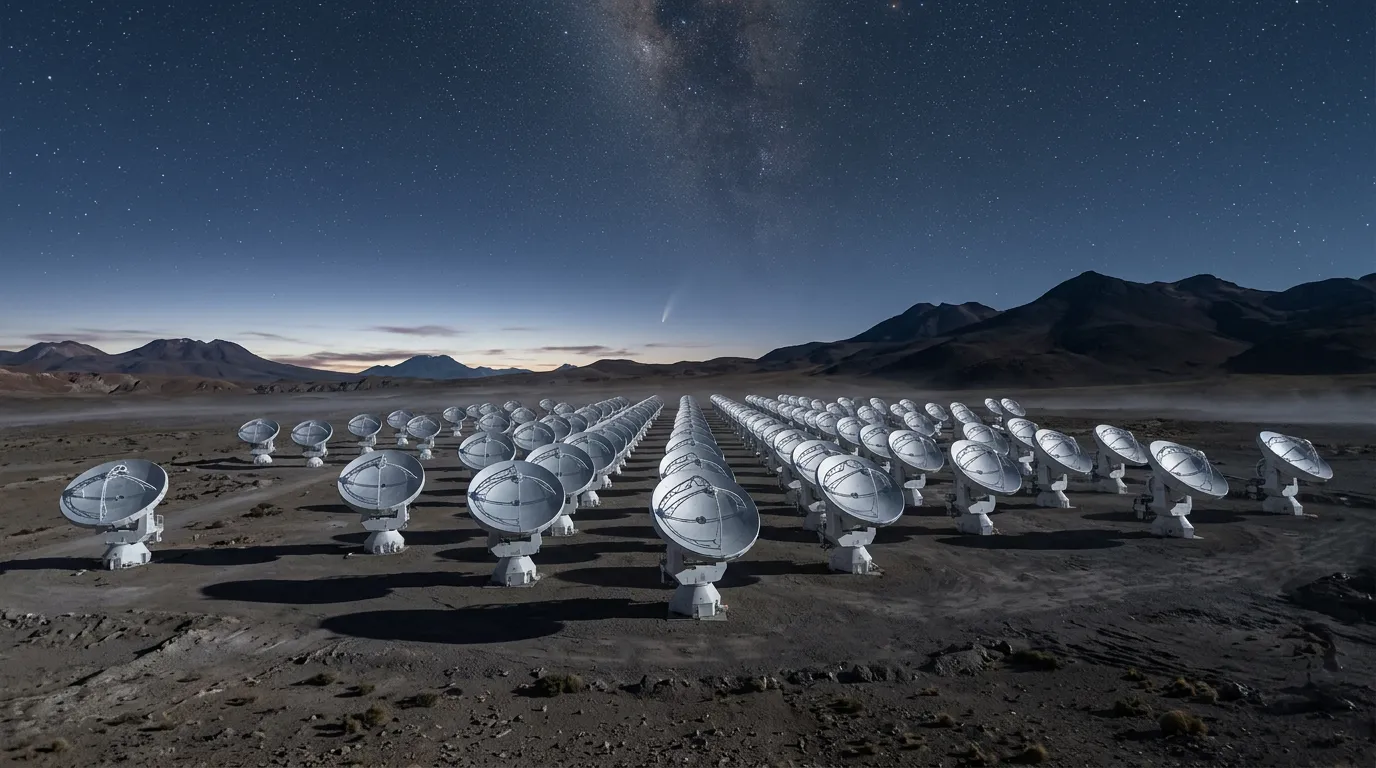
On 1 July 2025, a survey telescope in Río Hurtado, Chile — a NASA-funded instrument built to spot asteroids that might hit us — logged a moving smudge and filed it as A11pl3Z. Within days the orbit solution came back hyperbolic. The object was moving at roughly 221,000 km/h and on a path that no amount of solar gravity could have produced. It had come from somewhere else, and it was leaving.
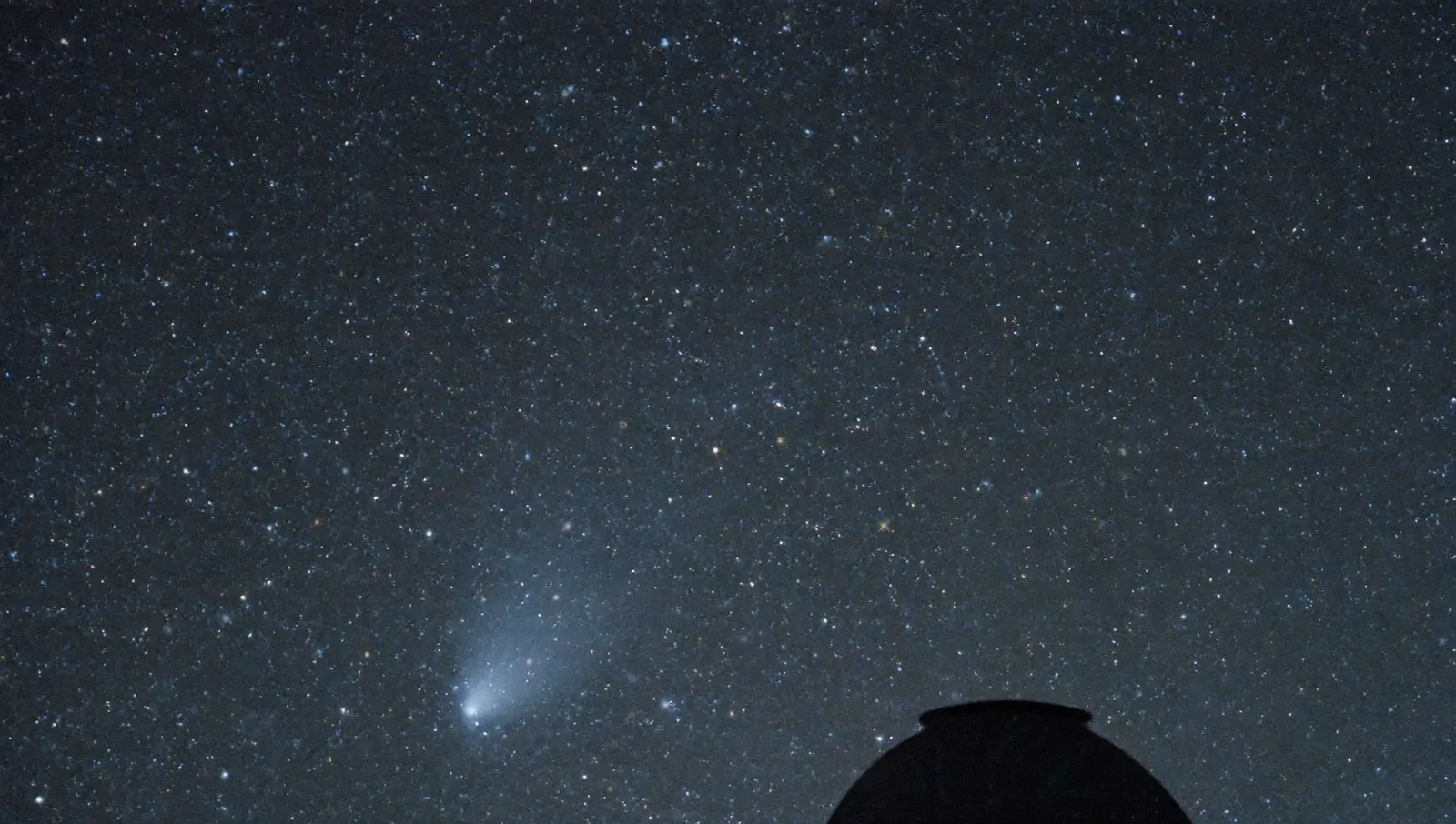
It became 3I/ATLAS: the third interstellar object ever identified, after 1I/ʻOumuamua in 2017 and 2I/Borisov in 2019.
A year on, it is out past Jupiter in the constellation Gemini, fading through magnitude 15 on its way back to the dark. And this month the last of the major searches for a transmitter aboard it was accepted for publication. The result, like every result before it, is nothing.
Which is worth telling properly, because “nothing” is a more interesting number than it sounds.
What actually arrived
Strip away the noise and 3I/ATLAS is the best specimen this field has ever been handed. It reached perihelion around 30 October 2025 at about 1.4 astronomical units — just inside the orbit of Mars — and never came closer to Earth than roughly 1.6 au. On 16 March 2026 it passed Jupiter at some 53.6 million kilometres. Nowhere on that itinerary did it threaten anything.
What made it valuable was its age. Work by astronomers at Oxford placed its origin in the Milky Way’s thick disk and its likely age at around seven billion years — meaning it had been drifting between the stars for roughly three billion years before the Sun existed.
And the instruments found genuinely odd chemistry. The ratio of carbon dioxide to water in its coma came in at roughly 8 to 1; in our own comets that figure typically sits near 0.12 and is rarely observed above 0.3. Its gas was unusually rich in nickel relative to iron, at temperatures where metal has no business vaporising — the leading explanation being nickel bound up in carbonyl-type molecules that fall apart easily in sunlight. JWST picked up methane. Very Large Telescope observations, written up in Nature Astronomy, found carbon and nitrogen isotopic ratios consistent with formation in the outer disk of an older, low-metallicity star.
3I/ATLAS is, in short, strange — strange in exactly the way a seven-billion-year-old comet from a different and poorer star system ought to be.
Four telescopes, one question
The strangeness was enough to make the technosignature community do something it rarely gets to do: point everything at a single target and listen.
The SETI Institute’s Allen Telescope Array at Hat Creek in northern California, in a campaign led by the technosignature research scientist Sofia Sheikh, observed the object for over seven hours across 1 to 9 GHz. The raw haul was nearly 74 million narrowband hits. Systematic filtering — terrestrial interference, satellite downlinks, artefacts from the comet’s own motion — reduced that to roughly 200 candidates. None survived inspection. The paper appeared in The Astronomical Journal.
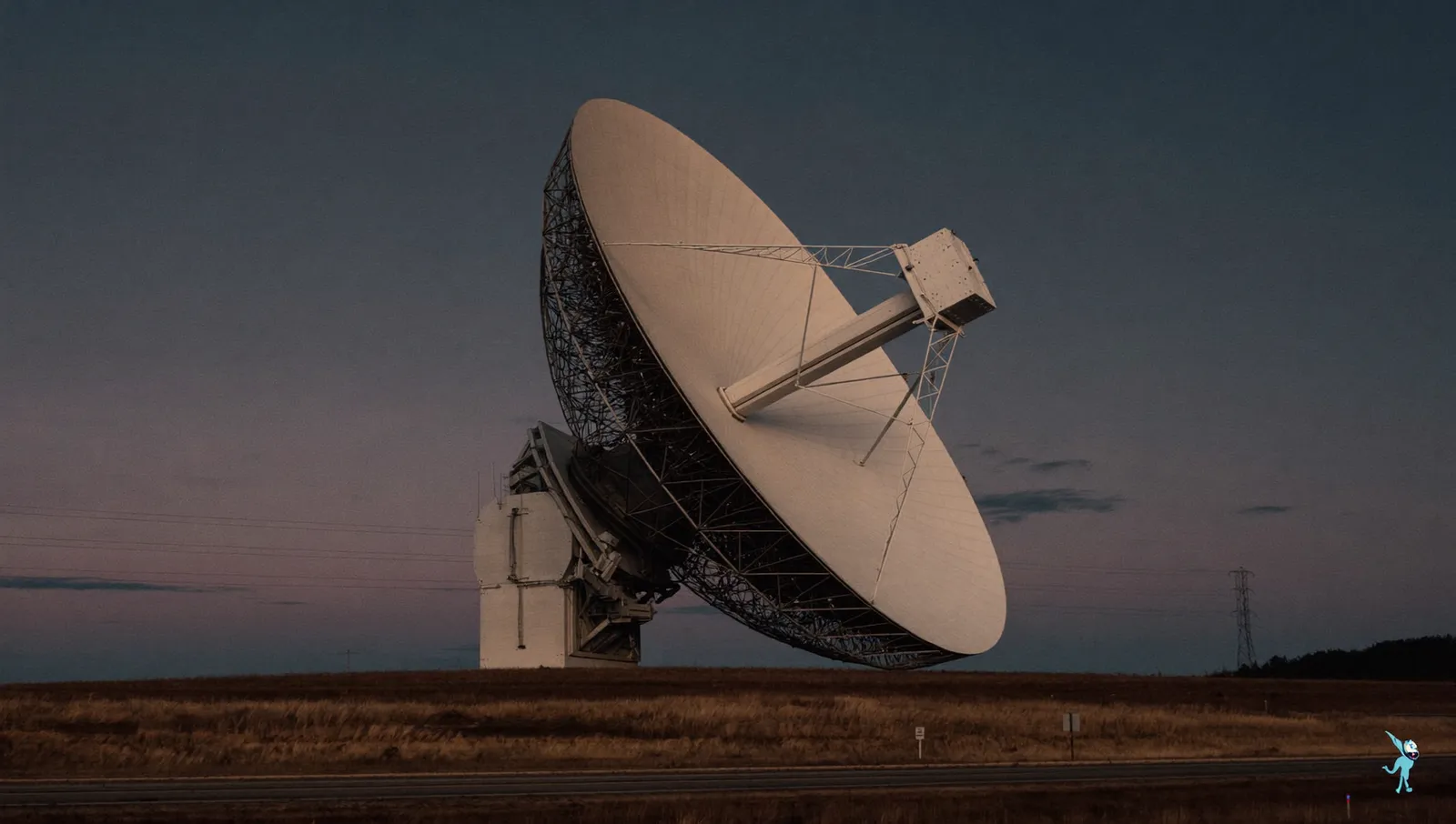
Breakthrough Listen took the 100-metre Green Bank Telescope to it on 18 December 2025, covering 1 to 12 GHz. No candidate signals. Their published constraint is the one worth memorising: no isotropic continuous-wave transmitter above about 0.17 watts across the 900–1670 MHz range.
MeerKAT, in South Africa’s Karoo, detected radio emission from 3I/ATLAS — and it was hydroxyl, the molecule you get when sunlight breaks water ice apart. A comet doing comet things. Nothing of technological origin.
And FAST, the 500-metre dish in Guizhou, ran two campaigns. Jian-Kang Li, Zhen-Zhao Tao and Tong-Jie Zhang published a narrowband search covering October 2025 to January 2026, finding nothing credible and constraining transmitters to below about 2.9 milliwatts. Then, on 2 July this year, the same group with Men-Quan Liu posted the follow-up: a search for periodically modulated signals — a beacon rather than a carrier tone — using canonical polyadic decomposition to separate genuine centre-beam sources from multibeam interference. Accepted by The Astronomical Journal. No credible artificial periodic technosignature above 0.146 watts.
Four independent groups. Four instruments on three continents. Nine months of observation. Nothing.
What “nothing” is actually worth
Here is why those wattages matter. A mobile phone is, near enough, an isotropic continuous-wave transmitter operating at about one watt. The Breakthrough Listen limit sits at roughly a fifth of that; the FAST periodic limit at about a seventh. What these papers collectively establish is that if 3I/ATLAS had been carrying a radio transmitter no more powerful than the handset in your pocket, and it had been radiating anything like isotropically, we would have heard it.
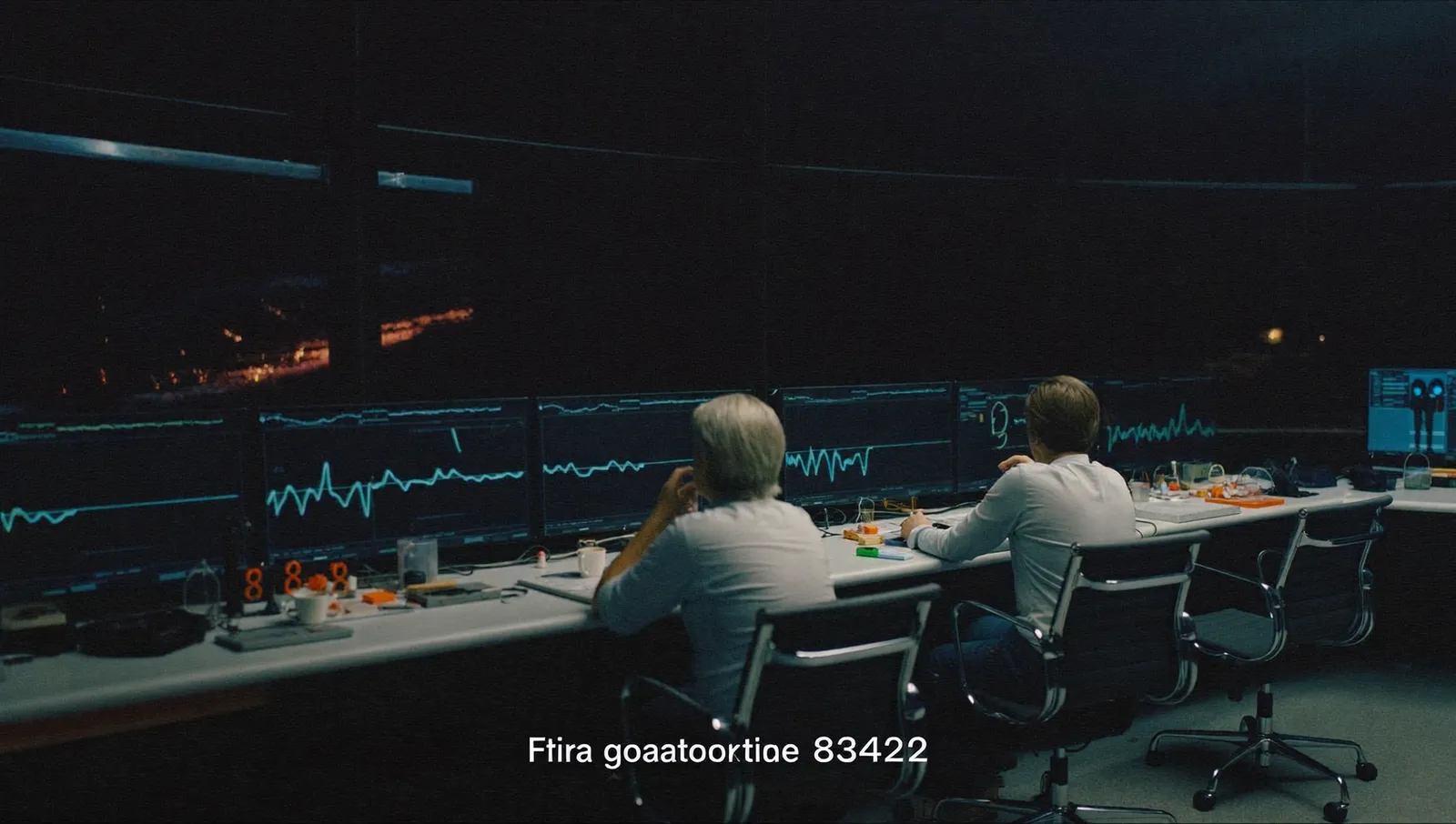
That is not a failure to find aliens. It is a measurement, taken at a sensitivity nobody could have delivered a generation ago, aimed at the most interesting target available and reported with its error bars showing.
It is the same logic we set out when the Galileo Project published an upper limit rather than a discovery from half a million tracked objects. A well-characterised null converts “we don’t know” into “below this threshold, over this window, there was nothing.” Compare that with the pile of unresolved cases in AARO’s annual reporting, where “unidentified” so often means nothing more than “the sensor wasn’t good enough.” The difference between an unexplained case and a measured non-detection is the entire distance between folklore and science.
The anomalies, and who has been counting them
None of this happened quietly. Roughly two weeks after the discovery, Avi Loeb — the Harvard astrophysicist who made the same argument about ʻOumuamua — co-authored a preprint suggesting the object’s characteristics were consistent with disguised, possibly hostile technology, and placed it at 4 on his own Loeb Classification Scale, which runs from 0 (ordinary natural comet) to 10 (alien technology posing a major threat).
He then began cataloguing anomalies, and has kept at it for a year: the list has grown from nine to fifteen to eighteen and, in his most recent essay as the object fades, to twenty-two. The recurring stars of it are the sunward “anti-tail” — a jet apparently extending some 400,000 kilometres towards the Sun rather than away from it — a triple-jet structure at regular angular separations that emerges from Hubble frames of 7 January 2026 once a Larson–Sekanina rotational filter is applied, the nickel-to-iron ratio, and the improbable alignment of the trajectory with the plane of the planets.
Be precise about what this material is. Almost all of it has appeared on Loeb’s personal Medium page rather than in a refereed journal. That does not make it wrong — several of the underlying observations are real, drawn from genuine Hubble and ground-based data — but the anomaly count is one man’s tally rather than a community consensus, and should be read as such.
The sceptic’s read, which is unusually well-argued
The rebuttals have come from named working astronomers, and they are specific.
Jason Wright, the Penn State astrophysicist who blogs at AstroWright and is himself a technosignature researcher — not a debunker by temperament — has gone through the list item by item. His central point is that 3I/ATLAS displays every characteristic of a comet: a coma, a tail, outgassing water, carbon dioxide and carbon monoxide. The proportions differ from our own comets, which is exactly what you would expect from something assembled around a different star. He is fond of the old planetary-science line that comets are like cats — they have tails, and they do exactly what they want. No two behave identically, and building a case from “this one is unlike the others” ignores how wide the others already range.
On the trajectory statistics, Wright cites the mathematician Héctor Socas-Navarro’s objection, which is the sharpest single point in the whole affair: computing the probability of a specific orbital alignment after you have observed it is a textbook post-hoc fallacy. Any trajectory is astronomically unlikely once you specify it to enough decimal places. The odds only mean something if you named the target first.
And on the anti-tail, the Arizona State planetary scientist Steve Desch has argued that the underlying physics in Loeb’s model is simply wrong — that it fails to account for solar radiation pressure on dust, which is on the order of a thousand times stronger than solar wind ram pressure for the particles that respond to it. Get that wrong and sunward features stop being mysterious.
This is the same failure mode we flagged in the surge of commercial pilot reports: an anomaly is only anomalous against a properly understood base rate, and we have observed precisely three interstellar objects. A sample of three has no meaningful “normal” to deviate from.
The quiet climb-down
To his considerable credit, Loeb has moved. Having held the object at 4 through its perihelion and its Jupiter encounter, he has since revised it down to 3 on his own scale, and has stated plainly that 3I/ATLAS is most likely a natural object. His position now is that its ordinary cometary behaviour is accompanied by unexplained features worth continued study — which is a defensible thing for a scientist to say, and a very long way from the hostile-probe framing of July 2025.
That revision has received a fraction of the coverage the original claim did, which is the structural problem with the whole genre: the extraordinary claim travels and the correction does not. It is the mirror image of the exercise we ran on Bob Lazar’s account, where the checkable parts turned out to be the mundane parts — with the notable difference that here the man who made the claim is the one walking it back, in public, on the evidence.
It is also fair to note what the year bought. Loeb’s noise is a substantial part of why four observatories committed serious time to a target mainstream cometary science had already largely settled. The searches happened partly because someone insisted loudly that they should — which is not nothing, even if the reason turns out to have been wrong.
The UAP Times take
Total up the year and the ledger is not empty. We have the chemical fingerprint of a body that formed around another star before the Sun existed, isotopic ratios pointing to a cold, metal-poor birthplace in the galaxy’s thick disk, the first serious technosignature campaign ever mounted against an interstellar object, and a demonstration that when something genuinely novel arrives the global observational apparatus can be turned on it within weeks. What we do not have is a signal — and no reason to expect that will change, since the object is receding, dimming, and will not be back.
We have rated this Well-sourced, five out of five on our scale, which is unusual for us and entirely down to the paper trail. Every load-bearing claim above sits in The Astronomical Journal, Nature Astronomy, or a numbered arXiv preprint you can read this afternoon. The one component that does not — Loeb’s running anomaly tally — we have flagged as self-published, and it is not what the story rests on.
The temptation is to file this as a let-down. A visitor from another star, a year of headlines about alien probes, and the answer is a comet. But look at what got built along the way. For the first time, the question “is that thing transmitting?” was asked of a real interstellar object by four independent teams and answered with numbers rather than opinions. The next one — and there will be a next one, probably within a few years as the survey telescopes get deeper — arrives into a field that now knows how to interrogate it and has this run’s limits to compare against.
The most useful thing about 3I/ATLAS was never going to be whether it was alien. It was the dress rehearsal. Four telescopes listened hard to the most interesting object in the sky and heard a seven-billion-year-old lump of ice doing precisely what physics said it would.
That is not the story anyone wanted. It is the one that will still be true in fifty years, and it is the only kind this subject has ever been short of.
Follow the file
Every new dispatch from the UAP desk, in your inbox. Sourced, sceptical, and no more than one email a week.