Most scientists who touch this subject do so quietly, from behind a firewall of caveats. Avi Loeb walked straight through it. A former chair of Harvard’s astronomy department and one of the most prolific theoretical astrophysicists alive, he decided that the scientific establishment’s refusal to seriously entertain the possibility of alien technology was itself an unscientific prejudice — and then did the one thing the field almost never does: he built instruments to look. That combination of impeccable credentials and unfashionable conclusions has made him the most argued-over scientist in the subject, admired and winced at often by the same colleagues.
He belongs in this file because he embodies its central tension in its purest form. On method, Loeb is very often right: gather data, test the hypothesis, don’t dismiss what you haven’t measured. On conclusions, he has a persistent habit of reaching the most exciting reading of ambiguous evidence and saying so loudly, before the data can bear it. Both things are true at once, and the honest account has to hold them together.
The real scientist
Loeb’s eminence is not in question, and it should be stated up front because it is what makes him interesting rather than dismissible. Born in Israel in 1962, he built a major career in mainstream astrophysics: long-time chair of Harvard’s astronomy department, founding director of its Black Hole Initiative, an adviser to Breakthrough Starshot, and the author of many hundreds of peer-reviewed papers on cosmology, black holes and the early universe. This is not a fringe figure who wandered in from the cold. It is one of the discipline’s productive insiders who chose, mid-career, to point his credibility at a question his peers considered beneath them.
‘Oumuamua, and Extraterrestrial
The turn came in 2017, when astronomers detected ‘Oumuamua — the first known interstellar object to pass through our solar system. It behaved oddly: an extreme elongated shape, an unexplained non-gravitational acceleration as it left, no visible cometary tail. Most astronomers reached for exotic-but-natural explanations. Loeb reached for a bolder one, arguing in papers and in his 2021 bestseller Extraterrestrial: The First Sign of Intelligent Life Beyond Earth that the simplest fit for the anomalies might be an artificial object — a thin light sail of alien manufacture.
The scientific reaction was fierce, and much of it fair: the natural hypotheses (a nitrogen-ice fragment, a fluffy hydrogen iceberg, an unusual comet) were not exhausted, and “aliens” is a conclusion that should survive every mundane alternative before it is aired. But Loeb’s underlying complaint had a point too — that the reflex to rule out the artificial hypothesis without measuring was a prejudice dressed as rigour. He was almost certainly overreaching on the answer. He was not wrong that the question deserved instruments.
The Galileo Project
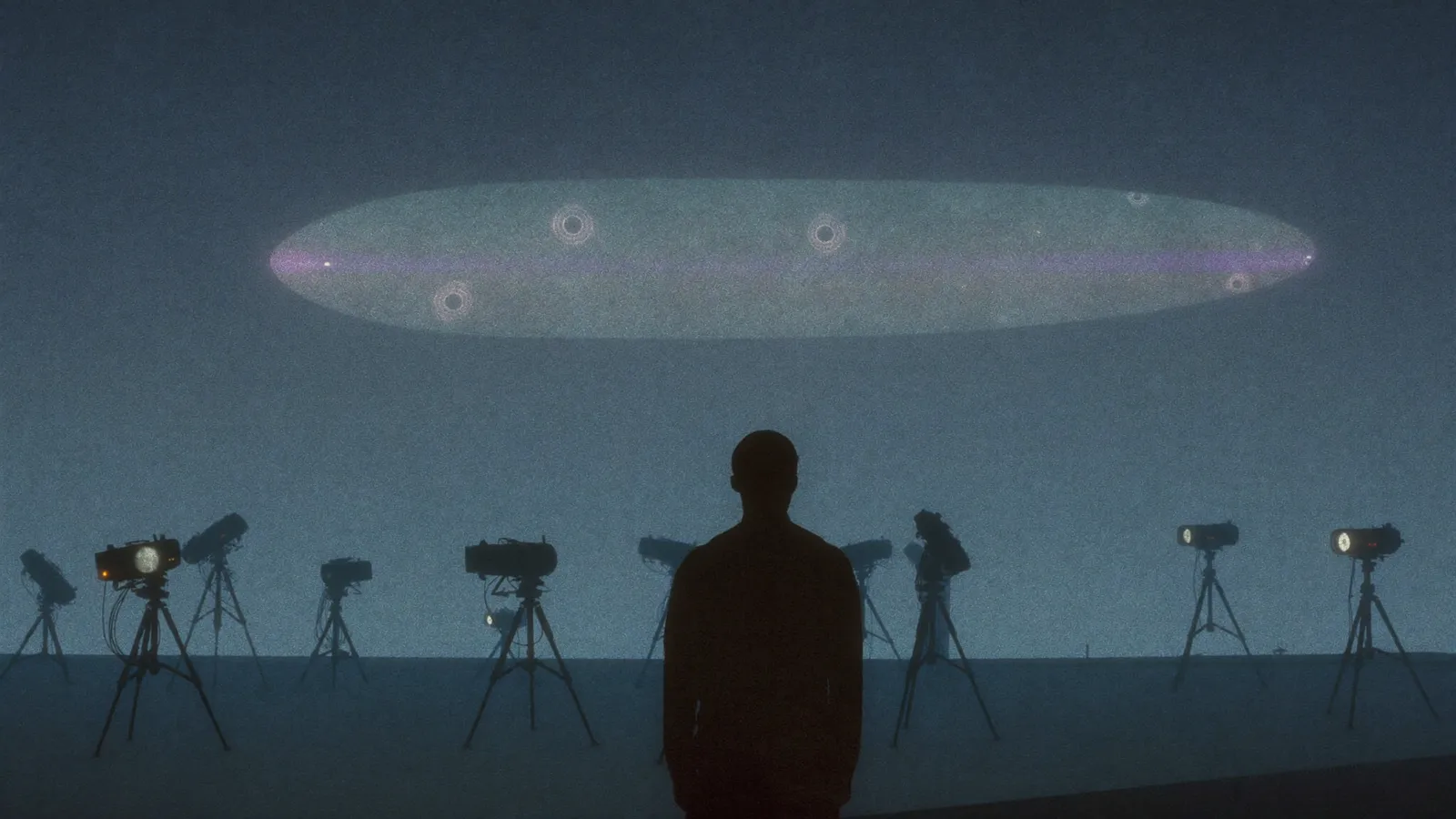
That is exactly what he built next, and it is the part of his record this desk most admires. Founded in 2021, the Galileo Project is a systematic, instrument-first search for technosignatures and anomalous objects — purpose-built observatories with cameras and sensors that generate their own open data, rather than begging classified footage from a government. It is the correct response to a field starved of measurement, and it is the same conviction the scientist Jacques Vallée argued for decades earlier: stop debating anecdotes and go collect data nobody has to grant you permission to see. The project has its technical growing pains, but its philosophy is unimpeachable.
The same instinct sent Loeb to the Pacific in 2023, dredging the seafloor off Papua New Guinea for tiny spherules from the meteor IM1, which he argued might be interstellar and conceivably technological. Here the criticism bit harder: other scientists disputed both the object’s interstellar origin and the interpretation of the recovered spheres, and the episode became a case study in his pattern — real, rigorous effort, paired with a public conclusion that outran what the material analysis could support.
Publicity, not error
The fairest critique of Loeb, and the one this desk has made before, is that his sin is usually publicity rather than error. He does not fake data or hide method; he lays it all out, then attaches the most thrilling interpretation and broadcasts it. His more recent musings that the interstellar object 3I/ATLAS might be technological drew exactly the reception ‘Oumuamua did, for exactly the reason.
But the caricature of him as a publicity machine doesn’t quite hold, and it is only fair to say why. As chair of the White House UAP Science Advisory Council he has promoted work that cuts against his own reputation — including a physics paper explaining glowing “orbs” as nothing more than burning meteor dust. Subtracting cases from your own column is not what a man running a hype operation does. Loeb wants the answer to be aliens; he also, visibly, wants the method to be honest — and when the two conflict, he has more than once let the method win.
The sceptic’s read
The deflationary account is well-rehearsed by his own colleagues: that Loeb reliably picks the most sensational reading of underdetermined data, that “extraordinary claims require extraordinary evidence” is a standard he applies to others more than to himself, and that his prominence rests as much on media appetite as on results. There is truth in it. The sharpest version, though, tends to overreach in the other direction — “not viewed favourably by his peers” is a statement about reputation, not method, and it has been said about plenty of scientists who turned out to be right. The honest sceptical position is narrow: Loeb’s instruments and data are sound and welcome; his headline interpretations are consistently ahead of them, and should be read as provocations to measure rather than conclusions to accept.
The UAP Times take
Avi Loeb is the most credentialed scientist to throw himself fully at this subject, and his contribution is genuinely valuable in a way that survives every eye-roll his conclusions provoke: he insisted the alien hypothesis is a testable one, and then built the instruments to test it instead of just asserting it. Weigh him on method and he is close to exactly what the field needs — data over deference, measurement over mockery, and a refusal to let “that’s absurd” stand in for “we checked”. Weigh him on conclusions and the caution writes itself: ‘Oumuamua, the IM1 spherules and 3I/ATLAS are all cases where the most exciting reading was announced well before the evidence could carry it. The best way to hold both is the one his own council models: back the search, fund the instruments, read the results — and treat every Loeb headline as a hypothesis to be measured, which is precisely how he’d tell you to treat it on his better days.
Sources and citations
For readers who want his own case:
- Avi Loeb, Extraterrestrial: The First Sign of Intelligent Life Beyond Earth (Houghton Mifflin Harcourt, 2021).
- The Galileo Project at Harvard, his instrument-led search for technosignatures.
- His papers and commentary on ‘Oumuamua, the IM1 meteor spherules, and 3I/ATLAS, and the mainstream astronomical responses to each.
- Our own coverage of the UAP Science Advisory Council he chairs.
Further reading: the scientist who made the same “bring data, not anecdotes” argument a generation earlier, Jacques Vallée; Loeb’s own Galileo Project and his 3I/ATLAS case; and what happens when a supposedly exotic sample reaches a national laboratory.
Follow the file
Every new dispatch from the UAP desk, in your inbox. Sourced, sceptical, and no more than one email a week.