
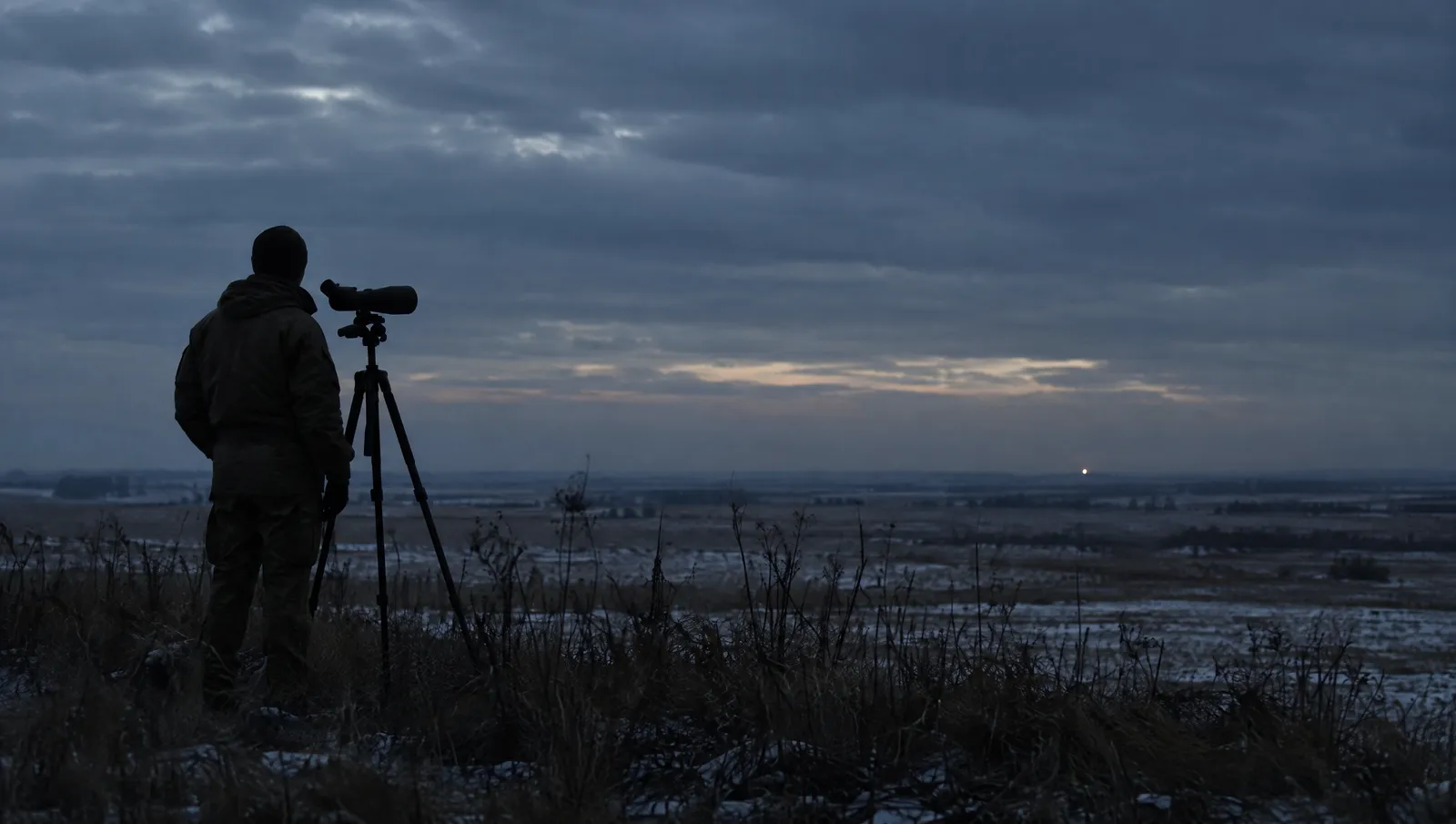
Every few weeks this year, the Department of War has put another few dozen UAP files on a website and the world has spent a fortnight arguing about them. Six tranches, 447 documents, an enormous amount of redaction and a steady supply of headlines.
Meanwhile, a graduate school run by the US Navy quietly published an entire academic journal issue about unidentified anomalous phenomena — with the director of the Pentagon’s UAP office sitting for an interview in it — and as far as we can tell almost nobody wrote a word about it.
It is called Combating Threats Exchange, it carries an ISSN, and it is hosted on nps.edu where anyone can download it. If you have been following the Pentagon’s declassification drip and wondering when the subject would start behaving like a research field rather than a records-release exercise, this is closer to an answer than anything in the tranches.
What the Naval Postgraduate School actually published
The Naval Postgraduate School in Monterey, California is where the US military sends officers to do master’s degrees and doctorates. CTX is its professional journal, run out of the NPS Global ECCO programme; the UAP edition was put together with the school’s Center on Combating Hybrid Threats and published as the Spring 2026 Special Issue under the title Unidentified Anomalous Phenomena: Science and Analysis.
The stated remit is unromantic, and deliberately so. The issue is framed around the work led by the All-domain Anomaly Resolution Office to improve data collection, standardise reporting requirements and mitigate whatever risk to safety and security UAP actually pose. Not what they are. How you would find out.
The contents list runs roughly like this: a letter from the guest editors, a foreword, a CTX interview with Dr Jon Kosloski, the AARO director, and then the papers — one on data vetting and accessibility for the study of UAP, one on event-based sensing for detection, tracking and characterisation, one from Ukraine, and, charmingly, a practical photography guide for everyday observers trying to capture a UAP event.
That last one tells you something about the register. This is not a disclosure document. It is a defence school working through the same problem the rest of us have: the data is rubbish, and somebody needs to say so in print and then propose a fix.
The AARO director, on the record, at length
Kosloski is a quantum-optics specialist who came to AARO from the National Security Agency in 2024, and he has given congressional testimony and the occasional podcast since. A long-form interview in a military school’s own journal is a different sort of artefact: it is aimed at officers and analysts rather than at cameras, and it sits alongside papers that can be argued with.
We would flag the obvious limit: an interview conducted inside the institution AARO answers to is not adversarial journalism, and AARO’s relationship with Congress has been rocky enough this year that the House task force on declassification has openly called its answers inadequate. A friendly venue is still a venue.
But it matters in the other direction too. AARO’s core complaint since it was stood up has been that it is handed reports without the data underneath them — no range, no calibration, no raw sensor feed. Putting that complaint in a journal, next to a paper on sensor architecture, is how a complaint turns into a research programme.
The Ukrainian paper
The one that made us sit up is titled Ukrainian Military Observations and Analysis of Aerospace Objects and Phenomena during Defense against the Russian Federation. It is by Dr Artem Bilyk and Dr Kyrylo Nikolaiev, both associate professors at the Defense Intelligence Research Institute in Kyiv.
Their framing is a threat framing rather than a mystery one. Unidentified objects, they argue, matter because they may collide with aircraft and because their light, radiation and electromagnetic emissions can affect technical systems, people and the environment. What is observed may be the product of human technical activity, of natural processes, or of unknown objects not made by humans with abnormal characteristics.
That third category is doing a lot of work in one sentence, and it is worth being precise about what it is and isn’t. It is a taxonomy — a list of buckets an analyst is permitted to sort things into. It is not a claim that the third bucket has anything in it.
What makes the paper worth reading anyway is who is writing it and from where. Ukraine’s sky is, by some distance, the most continuously watched volume of air on the planet: acoustic sensor networks, mobile fire groups, radar, thermal optics and a civilian population that has spent nearly four years learning to identify aircraft by sound. If anywhere on earth has a dataset, it is there.
Why a war zone is the hardest place on earth to call a UAP
And yet Ukraine may also be the single worst place to try to identify anything.
The sky over a contested front line is full of objects engineered to be hard to see, hard to classify and hard to attribute: loitering munitions, decoys, reconnaissance quadcopters, terrain-following cruise missiles, glide bombs, spoofed navigation, flares, chaff and burning debris. Every one of those produces sensor returns a peacetime analyst would find genuinely anomalous.
This is the same wall that Germany ran into, and the reason the Leipzig drone that failed to explode was worth more than a year of sightings: attribution turned out to be a physical process involving an object and a laboratory, not a matter of candour. Ukraine has plenty of objects. What it does not have is spare capacity to put the ambiguous ones through a lab while the unambiguous ones are still arriving.
Sceptics will say — fairly — that a war zone is therefore a source of noise rather than signal, and that the base rate of prosaic explanations there approaches one. We would put it slightly differently. A war zone is the ideal place to find out how good your classifier is, precisely because almost everything in the sky has a known answer. If your UAP methodology cannot reliably sort a Shahed from a weather balloon, it was never going to sort anything else either.
The last time Ukraine did this, its own academy took it apart
There is a cautionary tale here, and it is Ukrainian too.
In 2022, Boris Zhilyaev and colleagues at the Main Astronomical Observatory of the National Academy of Sciences of Ukraine published preprints describing two classes of object over Kyiv: cosmics, luminous and brighter than the sky, and phantoms, dark objects of variable contrast. Using two meteor stations — one in Kyiv, one at Vinarivka to the south — they reported objects at altitudes of 620 and 1,130 kilometres, moving at 256 and 78 kilometres per second, and estimated sizes above 100 metres.
Those numbers went round the world. They should not have. An object 1,100 kilometres up is in low Earth orbit; 256 kilometres per second is roughly eight times solar escape velocity at Earth’s distance.
The debunking was swift and came from people who normally disagree. Mick West, at Metabunk, went through the images and argued the objects were consistent with insects photographed close to the lens — which is exactly what a badly-ranged bright smudge looks like. Avi Loeb, not a man famous for ruling things out, judged that the team had likely miscalculated the distances by about a factor of ten, and agreed the dark objects were most plausibly insects, since they changed speed in a way artillery shells do not.
The most damaging verdict came from the observatory itself. It noted the results had not been reviewed or discussed internally before the preprint went out, and that the imagery had been captured in test mode during scheduled meteor observations. A seminar was convened on 15 September 2022 with Zhilyaev present; the conclusion was that the observations were original but that the processing and interpretation had been done at an inadequate scientific level, with significant errors in determining the distance of the objects. Ukraine’s national science agency went further still, with language — pseudo-scientific in form and content — that you rarely see one institution use about another.
The failure mode was not credulity. It was range. Every quantity that made those objects extraordinary was derived from an assumed distance, and the distance was wrong. It is the same hole that sits under almost every famous UAP video, and the reason three cameras over Las Vegas triangulating a boring answer is more scientifically interesting than any amount of declassified infrared.
What has changed, and what hasn’t
So: a 2022 Ukrainian UAP paper was repudiated by its own academy, and in 2026 a US Navy school has published a Ukrainian UAP paper by different authors from a different institution. Those two facts are not in tension, but the second only means something if the first was learned from.
What is genuinely different is the setting. The 2022 work was a preprint that bypassed internal review and went straight to the world’s press. The 2026 paper sits in an edited issue, next to a paper on data vetting and another on sensing architecture, in a journal whose readership is professionally obliged to be difficult. That is not peer review in the Nature sense — CTX is a professional defence journal, not a refereed physics one — but it is a room with other experts in it, which is more than the last attempt had.
What has not changed is the underlying problem. Nobody in this field can yet tell you reliably how far away the thing was. Until they can, taxonomies and threat framings are scaffolding around an empty plot.
The UAP Times take
The story here is not that Ukraine’s military has UFOs. Nothing in the published material claims that, and we would be doing exactly what the 2022 preprint’s boosters did if we implied it.
The story is that the US Navy’s own graduate school has decided UAP is a research problem worth a journal issue, has put AARO’s director in it on the record, and has invited two Kyiv defence-intelligence researchers to describe what four years of the most heavily instrumented airspace on earth looks like from the inside. That is a more meaningful institutional shift than another tranche of redacted PDFs, and it got a fraction of the attention.
It earns a Credible rating, four out of five on our scale. The issue, its ISSN, its contents and its authors are all on the Naval Postgraduate School’s own servers — that part is as documented as it gets. What holds it off a five is everything downstream of that: the interview is conducted in-house rather than adversarially, the papers present frameworks rather than findings, and the last high-profile Ukrainian contribution to this literature was taken apart by Ukraine’s own National Academy of Sciences within weeks. A good venue is not the same as a good result.
Read it anyway. It is free, it is dull in the way real research is dull, and it treats the measurement problem as the whole problem.
Further reading: for the missing number underneath all of this, see the Galileo Project’s triangulating observatory. For what identification looks like when you actually have the hardware, see the Leipzig drone that didn’t go off. For the tranche this issue was overshadowed by, see the Pentagon’s sixth UAP release. And for the sensor physics that makes so many of these images unreadable, see how a targeting pod actually sees a UFO.
Follow the file
Every new dispatch from the UAP desk, in your inbox. Sourced, sceptical, and no more than one email a week.