
The best-evidenced UFO paper of the last two years has spent this month being pulled apart in public. The people doing the pulling are not debunkers with a podcast. They are the scientists who built the Galileo Project’s telescopes.
That distinction is the whole story, and it is worth sitting with before we get to the statistics. For eighty years this subject’s standard complaint has been that mainstream science will not engage with the data. Somebody finally put the data in Scientific Reports — and the people who went through it line by line, found the arithmetic wanting and published the takedown in a proper journal were, almost to a person, UAP researchers themselves.
What is actually on the plates
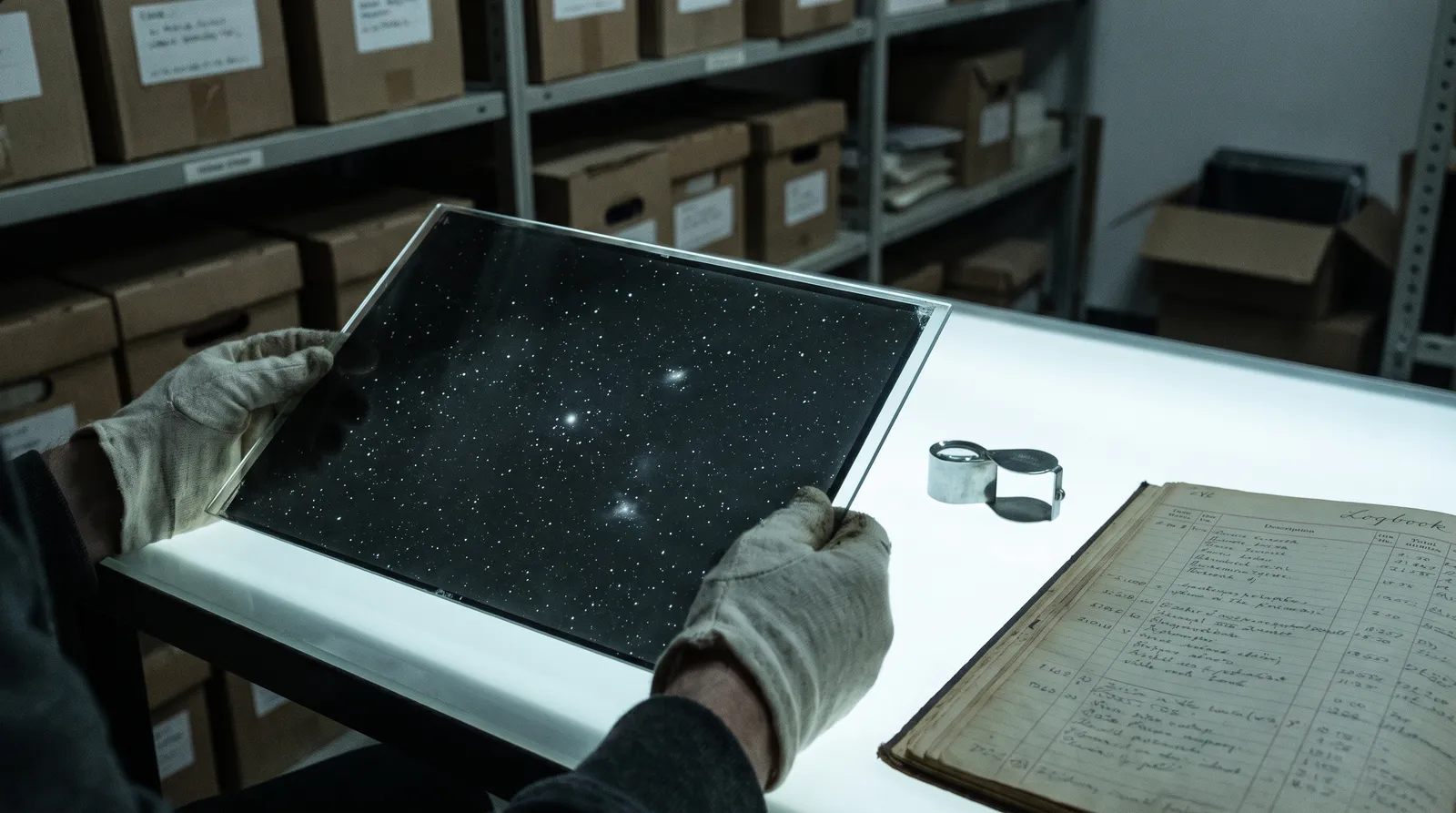
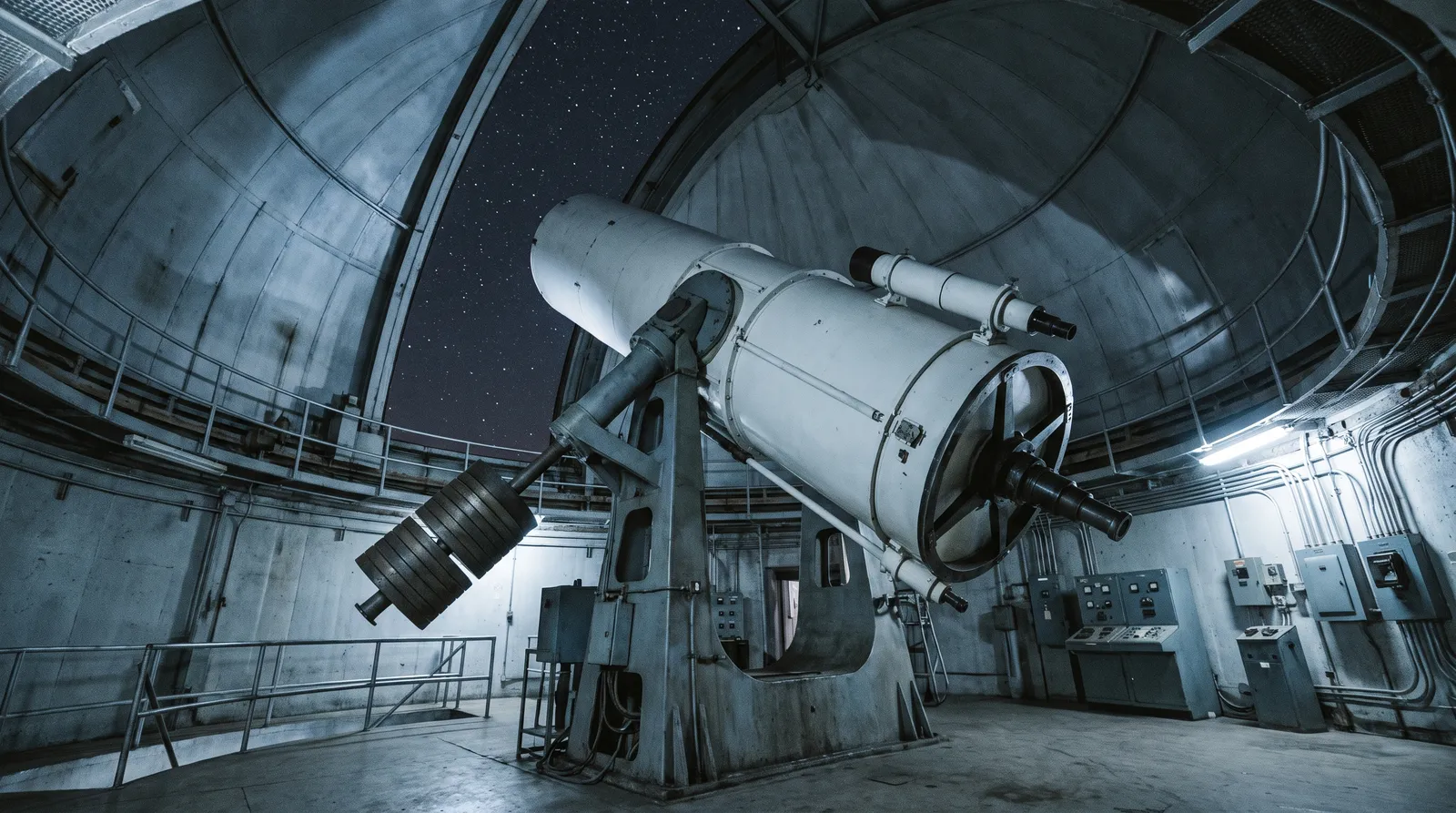
Between 1949 and 1958, the 48-inch Schmidt telescope on Palomar Mountain photographed the northern sky onto roughly 2,000 glass plates. This was the first Palomar Observatory Sky Survey, POSS-I: the reference atlas of the pre-Sputnik heavens, made before there was a single artificial object in orbit to confuse anybody.
That last point is the reason astronomer Beatriz Villarroel, of the Nordic Institute for Theoretical Physics in Stockholm, has spent a decade combing through the scans. Her VASCO project — Vanishing and Appearing Sources during a Century of Observations — hunts for points of light that appear on one plate and are gone from the next. In a sky with no satellites in it, a glint that behaves like a satellite is genuinely interesting.
VASCO’s automated pipeline flagged more than 107,000 such candidate transients. What Villarroel and her collaborators then did with them is where the argument starts.
The three claims that got everyone’s attention
In October 2025, two papers landed within weeks of each other. Villarroel and Stephen Bruehl, of Vanderbilt University Medical Center, published on aligned multiple-transient events in Publications of the Astronomical Society of the Pacific. Bruehl and Villarroel then published the headline finding in Scientific Reports: that the transients cluster around dates of above-ground nuclear testing.
The numbers, as reported by Scientific American’s Jonathan O’Callaghan, were arresting. Transients showed up on about 19% of days falling within 24 hours of a US nuclear test, against roughly 11% of other days. Days carrying a documented UAP sighting report showed an 8.5% bump. And there appeared to be a roughly 30% deficit of transients inside the Earth’s umbral shadow — which is what you would expect if the specks were sunlight glinting off objects in orbit, since an object in shadow has no sunlight to glint.
Three independent-looking signals, all pointing the same way. Villarroel has always been careful not to say the word “aliens” in print, and the papers do not. But the implication was clear enough that the rest of the field understood it immediately.
The critique: it is the observing schedule, not the bombs
The rebuttal is Critical Evaluation of Studies Alleging Evidence for Technosignatures in the POSS1-E Photographic Plates, by Wesley Andrés Watters of Wellesley College, Laura Dominé, Sarah Little, Cameron Pratt, Kevin H. Knuth of the University at Albany and Matthew Szenher. It went onto arXiv on 29 January 2026, was revised twice, and was accepted by Publications of the Astronomical Society of Australia, appearing online on 23 July.
Its central argument is unglamorous and, if it holds, fatal. The nuclear-test correlation depends entirely on what you divide by.
Palomar did not observe every night. Weather, moonlight and scheduling meant the survey’s plates were exposed on a few hundred nights spread across nine years. If you treat the survey as spanning every calendar day in that window and then ask how often transients coincide with test dates, you are not measuring a correlation with bombs. You are measuring a correlation with the nights the telescope happened to have its shutter open. Watters and colleagues report that once the timing is normalised against actual observing nights, the association “becomes insignificant”.
They go further. The Earth-shadow result, they argue, rests on an assumption that the specks are spread uniformly at random across each plate — and that assumption is demonstrably false. Feature density climbs steadily towards plate corners and edges. There are empty strips. There are geometric clusters. These are the fingerprints of a scanning and emulsion process, not of a population of orbiting objects. They also report finding catalogue stars and scan artefacts sitting inside the candidate lists, and accuse the original work of a circular argument: using the outcome of the statistical test to justify the claim that the features are real objects in the first place.
Watters, quoted by IBTimes UK on Friday, put the epistemics rather than the arithmetic at the centre: “If you are unwilling to let your beliefs be broken by better data and better maths, you are not really doing science any more. You are doing something else entirely.”
Who wrote it matters
Read the author list again. Watters, Little, Dominé and Szenher are Galileo Project people — the Harvard-based effort, founded by Avi Loeb, that has been building multimodal sky observatories precisely because it thinks UAP deserve instrumented study. Kevin Knuth is vice-president of UAPx and a Galileo research affiliate. These are researchers who have staked their professional reputations on the proposition that this field is worth doing properly.
Which is exactly why they are the right people to have written it. A dismissal from someone who thinks the whole subject is silly costs nothing and persuades no one. A dismissal from the people building the telescopes is expensive, and it is the sort of thing a healthy discipline does to itself routinely. We have made a similar point about the Galileo Project’s own Las Vegas triangulation work, whose headline result was a statistical upper limit rather than a discovery — and was more useful for it.
Villarroel’s answer: you tested the wrong catalogue
She is not conceding. Villarroel, with Alina Streblyanska, Bruehl and Stefan Geier, posted a formal response to arXiv in February, revised on 1 May. Its core complaint is one of substitution.
Watters and colleagues, she argues, did not test the 107,875-candidate transient catalogue. They tested a much smaller subset — around 4,866 candidates — drawn from an older, aggressively filtered list originally assembled for a different job entirely: the hunt for vanishing stars. That filtering deliberately discards short-lived events, which are the very population under discussion. Cutting a sample that hard, her team calculates, would knock the significance down to roughly 1.6 sigma on its own, before any question of normalisation arises.
On the observing-schedule point specifically, Villarroel says her team ran the calculation the critics asked for. Restricted to 370 confirmed observing nights, at least one transient appeared on 84.2% of dates inside the nuclear-test window against 72.8% outside it. She puts the properly coverage-corrected effect at 7.6 sigma, not the 22 sigma of earlier reporting, and the shadow deficit at about 0.46% observed against 1.4% expected.
Then, on 10 August, VASCO published again in Scientific Reports: Bruehl, Doherty, Streblyanska and Villarroel trained a machine-learning classifier to separate plausible optical events from plate artefacts and ran it across all 107,875 candidates. The patterns, they report, did not go away.
The plate-defect problem will not go away either
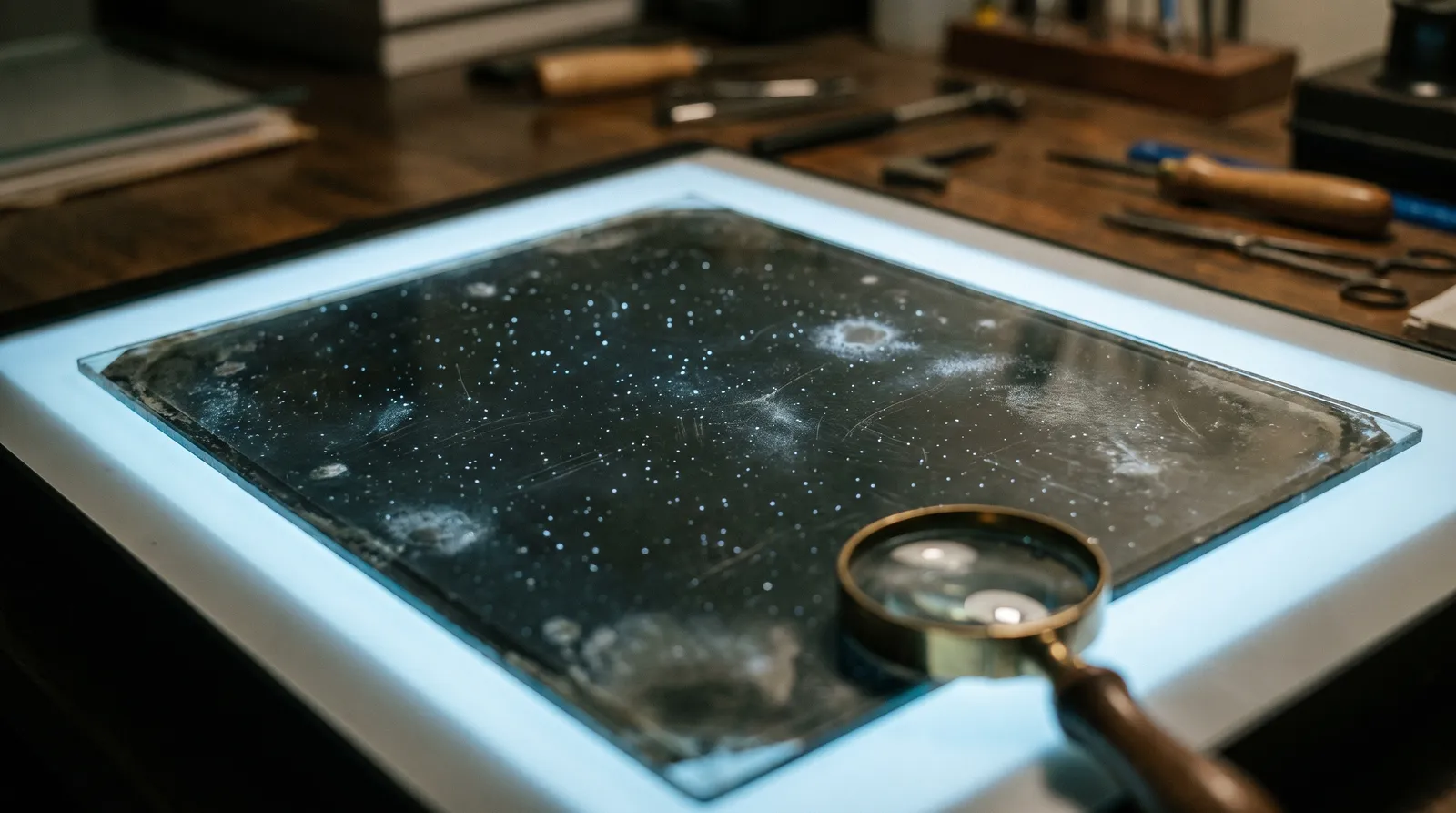
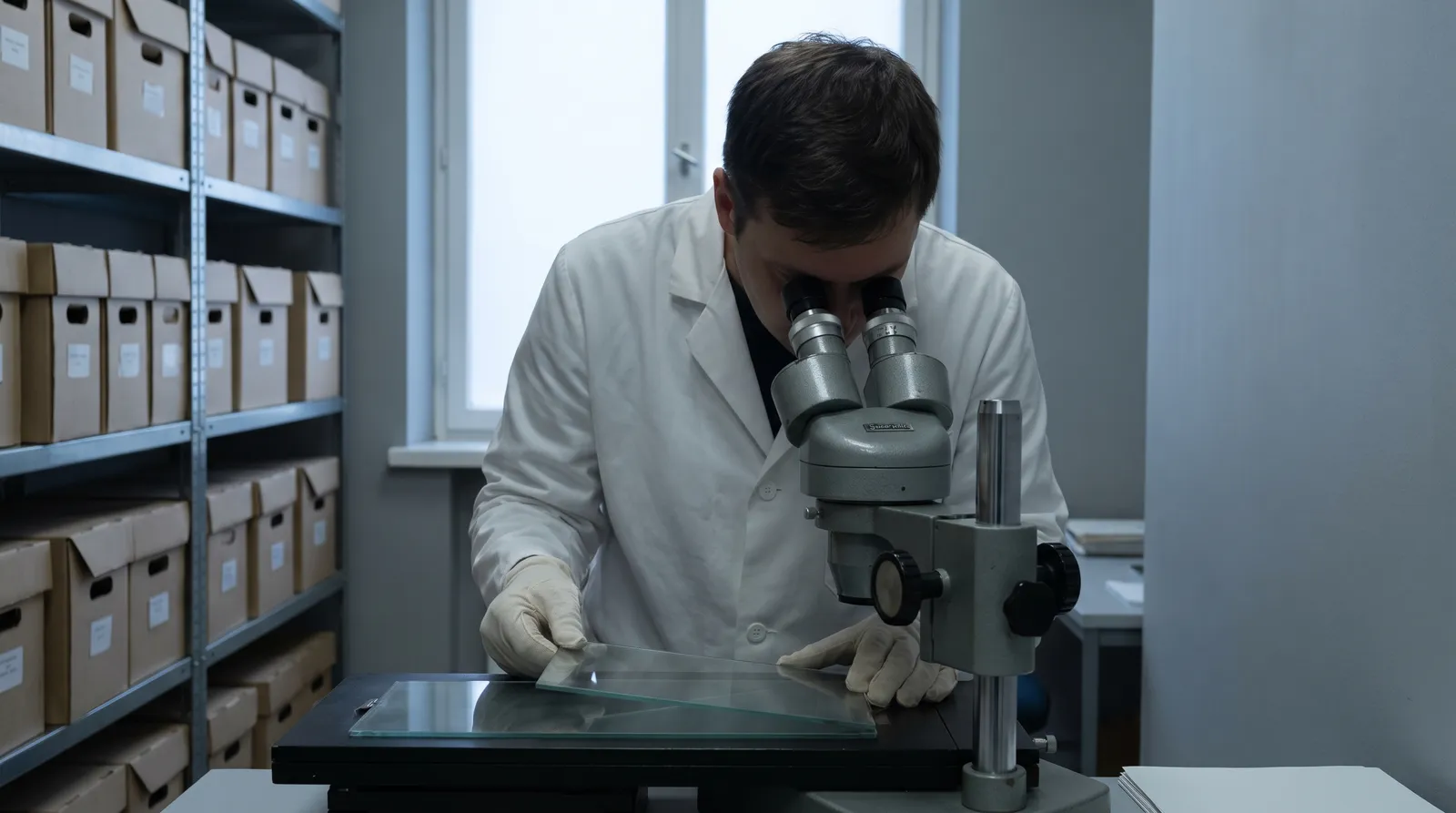
Beneath the statistical exchange sits an older and more stubborn objection, and it belongs to Nigel Hambly of the University of Edinburgh, who has said plainly that these things look like dust, scratches and emulsion flaws, and that the way to settle it is to go and look at the original glass under a microscope rather than argue about scans of it.
He is not alone. Princeton’s Robert Lupton has questioned the significance, noting drily that in astronomy “things go bang and vary all over the place”. Michael Wiescher, a nuclear astrophysicist at Notre Dame, has floated atmospheric effects from the tests themselves. Sean Kirkpatrick, the former director of AARO, suggested solar-flare radiation or high-altitude monitoring balloons and called for validation testing. Eliot Gillum of the SETI Institute wants the whole method run against other plate archives, which is the obvious and decisive experiment: if the effect is real, Palomar cannot be the only place it lives.
Adam Frank, the University of Rochester astrophysicist whose Big Think column carried a sharp write-up of the critique on 27 August, has been consistent since the original papers appeared. Extraordinary claims, he keeps saying, require extraordinary evidence — and he has been notably supportive of the investigation being run in the open, which is not the same thing as being convinced by it.
The UAP Times take
We rate this Well-sourced, five out of five on our scale, and we want to be exact about what earns the mark. It is not the aliens. It is the paperwork.
Everything above is checkable by anyone with a browser. The original claims sit in Scientific Reports and Publications of the Astronomical Society of the Pacific. The critique is a peer-reviewed accepted manuscript in Publications of the Astronomical Society of Australia, with a DOI. The response is on arXiv under its authors’ names. The machine-learning follow-up is peer-reviewed and three weeks old. Every scientist named here is named, institutionally affiliated and quotable. There is no anonymous insider anywhere in this story, which for this beat is close to miraculous.
What we cannot tell you is who is right. The honest position on 29 August 2026 is that a serious statistical dispute is live, that the normalisation objection is a strong one, that Villarroel’s rejoinder about the substituted catalogue is also a strong one, and that neither has yet been settled in the literature. If we were forced to bet, we would bet on the plates — dust, scratches and a scanning pipeline are a mundane explanation with an extremely good historical record in this exact type of research. But betting is not knowing, and Hambly’s microscope test and Gillum’s other-archives test would both produce an answer rather than another exchange of sigmas.
What we will say is that this month has been a better advertisement for UAP science than any hearing. Nobody leaked anything. Nobody claimed a body. A group of researchers made a big claim with their data attached, another group of researchers — from inside the same field — took it apart in a journal, and the first group answered in public with the numbers on the table. That is not the disclosure fight; that is just science, being slow and unsatisfying and self-correcting in the way it is supposed to be. After the year this subject has had, it is almost restful.
Further reading: for the other UAP claim currently being refereed in the open, see the orb’s first physics paper; for what America’s atomic scientists made of strange lights over their own laboratories in exactly this era, Teller and the green fireballs of 1949. And for the general problem of instruments that produce convincing anomalies all by themselves, why radar sees ghosts.
Follow the file
Every new dispatch from the UAP desk, in your inbox. Sourced, sceptical, and no more than one email a week.