Every argument about UAP orbs, and there have been a great many of them this year, is an argument conducted without the one piece of evidence that would end it.
Nobody has ever taken a spectrum of one.
Not a photograph. Not a thermal signature. Not another two minutes of grainy sensor footage of a bright dot doing something interesting. A spectrum — light split into its constituent wavelengths, the way every other object in the sky has been interrogated since the 1860s, which tells you not what a thing looks like but what it is made of.
Avi Loeb has now proposed building the instrument that would take one. In an essay published this month, the Harvard astrophysicist set out a design for the Galileo Project’s next observatory, and it is aimed squarely at the orbs.
What he has actually proposed
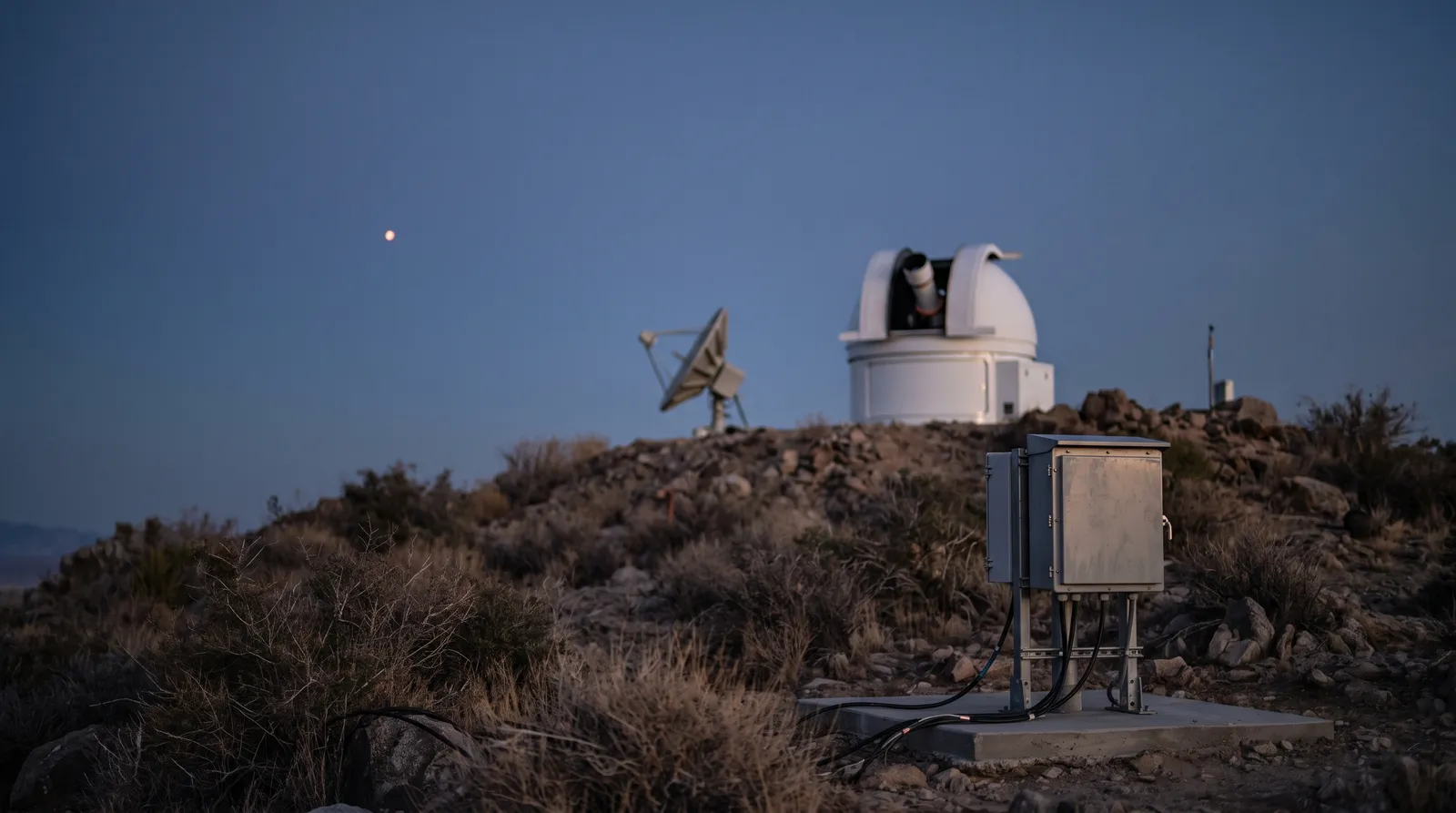
The concept is deliberately unglamorous. A radar system watches the sky and flags objects of interest, generating a position. A telescope slews to those coordinates and takes a high-resolution image. And — this is the part that matters — the telescope carries a spectrograph, so that alongside the picture you get the object’s spectrum, and from the spectrum, its material composition.
Loeb calls it an orb imager. Radar cues, optics resolve, spectroscopy identifies. Each of those three steps is standard astronomical practice; what is new is pointing the combination downwards and sideways rather than up, at things a few kilometres away rather than a few billion.
That is the whole idea. It is not a claim about aliens, and to Loeb’s credit he has not dressed it up as one. It is a claim that the field has been collecting the wrong kind of data for eighty years, and that the fix is an instrument rather than an argument.
Why the orbs, and why now
Because the orbs are what is left.
The US government’s rolling declassification programme — PURSUE, the Presidential Unsealing and Reporting System for UAP Encounters — has published five tranches since May, on 8 May, 22 May, 12 June, 10 July and 7 August. Between them they contain a great deal of material that resolves on contact with a competent analyst, and a stubborn residue that does not. The residue is disproportionately orbs.
The second tranche carries a senior intelligence officer’s account of an hour-long observation of orange orbs in 2025, which left him, in his own words, virtually speechless. The fifth carries a helicopter crew’s report of an orb swarm over roughly an hour, including two larger objects described as oval, orange, with a white or yellow centre, emitting light in all directions. And the case we thought was the most interesting file in that fifth release involved roughly 25 objects manoeuvring around an AC-130J gunship over the Gulf of Oman in September 2021.
None of these are resolved. That is not the same as saying they are exotic — unresolved means unknown, which is a statement about the data rather than the object. But it does mean the orbs have earned an instrument.
The reason a spectrum beats another video
We have laboured this point before and will keep labouring it. A camera records a direction and a brightness. It does not record a distance, which is why nobody has ever known how far away a UFO was, and without distance you cannot derive size, speed or acceleration. Two scientists recently went through all 112 PURSUE sensor videos looking for the four quantities needed to turn pixels into a velocity, and did not find a single clip that contained the full set.
A spectrum sidesteps that problem entirely, because it does not care how far away the source is. The wavelengths at which a thing emits or absorbs light are a property of its atoms, not its range. A sodium line sits at 589 nanometres whether the sodium is in a street lamp two hundred metres away or a plasma two kilometres up.
So while a distance measurement tells you how big and how fast, a spectrum tells you what — and “what” is the question every orb argument has actually been about all along.
The paper it would adjudicate
Here is where the proposal becomes genuinely interesting, in a way Loeb’s essay does not quite spell out.
There is currently a physics paper in open peer review offering an actual mechanism for orbs. John Birks, the University of Colorado atmospheric chemist who was one of the originators of the nuclear-winter calculation, has proposed that a good fraction of orbs are burning meteor dust held together by its own magnetism — magnetised iron and silicate nanoparticles condensing out of a cooling fireball, oxidising exothermically, and glowing through a corona of microdischarges.
That model makes specific, testable spectroscopic predictions. The corona excites nitrogen in the surrounding air, which produces the blue-white. Metal atoms in the dust produce the rest: iron for yellow-orange, sodium yellow, calcium red.
Those are not vague expectations. They are emission lines with wavelengths you can look up. Point a spectrograph at an orb and Birks’ model either survives the next ten minutes or it does not. If the spectrum is dominated by molecular nitrogen bands and neutral iron lines, a substantial chunk of the modern UAP corpus has an atmospheric-chemistry answer and the field can move on to the residual. If it is a featureless thermal continuum, or reflected sunlight off something metallic, or anything that does not belong in a meteoric plasma, that is a result too — and a far more interesting one.
Either way, the instrument does the arguing. This is what it looks like when a field stops debating footage and starts specifying a measurement that would change somebody’s mind.
What the Galileo Project has actually built
Loeb’s proposals require a running tally, because his output of concepts has historically outpaced his output of results, and the honest way to read a new one is against the record.
The project operates three observatories — in Massachusetts, Pennsylvania and Nevada — with a fourth planned for Indiana, monitoring the sky continuously across infrared, visible, radio and audio bands, with machine-learning software trained to flag outliers. The Nevada installation is the serious one: three units arranged in a near-isosceles triangle with legs of 10.2, 10.1 and 2.0 kilometres, which is what lets it triangulate range to within a few hundred metres.
Its commissioning run reconstructed roughly half a million aerial trajectories over five months. After automated screening and manual review, 144 remained ambiguous. The project published that, including the nulls, in a system-architecture paper — and, to be exact about it, has never reported a peer-reviewed identification of anything as anomalous.
That is the correct scorecard to carry into this. The Galileo Project’s published output is about instruments and methods, not discoveries. Asked in June whether there had been a breakthrough, the answer was: not yet.
Where this could fall over
Several places, and it is worth being blunt about them.
Radar cueing is the hard part, not the spectroscopy. The objects in question are small, often slow, frequently low, and — in the AC-130J case — described as cold. Small, cold, low-radar-cross-section targets in ground clutter are precisely what radar is worst at. An orb imager that cannot reliably cue is a very expensive telescope pointing at empty sky.
Photon budget. A spectrograph divides the light it receives into dozens or hundreds of wavelength bins, so it needs far more of it than a camera does. Faint point sources at night, moving, with an exposure measured in the seconds the object stays in frame, is a demanding regime. It is not impossible — meteor spectroscopy is a mature amateur discipline — but “we will add a spectrograph” is a sentence that hides a great deal of engineering.
Most spectra will be boring. The sceptic’s read here, and it is the correct default, is that the overwhelming majority of things this instrument catches will return the spectrum of an LED, a sodium street lamp reflecting off a balloon, a burning meteor, or sunlit aluminium. Mick West has spent a decade demonstrating that the prosaic explanation is usually available to anyone who bothers to check, and an orb imager’s most likely legacy is a large and thoroughly dull catalogue.
And it is a concept. There is no announced budget, no timeline, no site and no hardware. Loeb chairs the UAP Science Advisory Council advising the government and directs the Galileo Project, which gives him the standing to propose it; neither gives him the money to build it. The gap between an essay describing an observatory and an observatory has swallowed better-funded ideas than this.
His track record cuts both ways too. Loeb’s high-profile claims about ‘Oumuamua and the Pacific spherules did not survive contact with the wider field, and it was Galileo Project scientists themselves who recently took apart the year’s biggest technosignature claim. That last detail is the one that gives us most confidence: a group willing to publicly demolish a result it would have benefited from believing is a group whose null spectra will probably be published too.
The UAP Times take
We have rated this Credible — four out of five on our scale. The rating is for the proposal, and the proposal is real: a named, accountable scientist with an existing multi-site instrument programme and published papers behind him has specified what he wants to build and why. It is not four rather than five because we doubt the essay exists, but because everything load-bearing here is currently the author’s own account of his own plan. There is no funding announcement, no independent confirmation, and nothing built.
What we would say in its favour is that it is, at last, the right question. For eighty years this subject has produced imagery and demanded that people find it compelling. The imagery has never been able to settle anything, because a picture of a bright dot is compatible with almost every hypothesis anyone has proposed, including all the boring ones.
A spectrum is not like that. A spectrum discriminates. It would tell Birks whether his meteor dust is really up there. It would tell AARO whether its unresolved orange orbs are burning iron. And it would tell everyone else whether the most-reported shape in modern UAP history is atmospheric chemistry or something that genuinely needs explaining.
Our expectation, stated plainly so it can be held against us: if this thing is ever built, most of what it catches will turn out to be meteoric plasma, aircraft lighting and balloons, and the residual will shrink rather than grow. That is a prediction, not a hope. It is also — and this is the point — a prediction an instrument could falsify, which is more than eighty years of arguing about footage has ever managed.
Further reading: for the missing number this instrument’s sibling was built to supply, see nobody has ever known how far away a UFO was; for the mechanism a spectrum would test, the orb finally has a physics paper; for the panel Loeb chairs, the White House UAP Science Council; and for the exotic explanation a spectrum would also have to weigh, what a warp drive would look like crossing our atmosphere.
Follow the file
Every new dispatch from the UAP desk, in your inbox. Sourced, sceptical, and no more than one email a week.