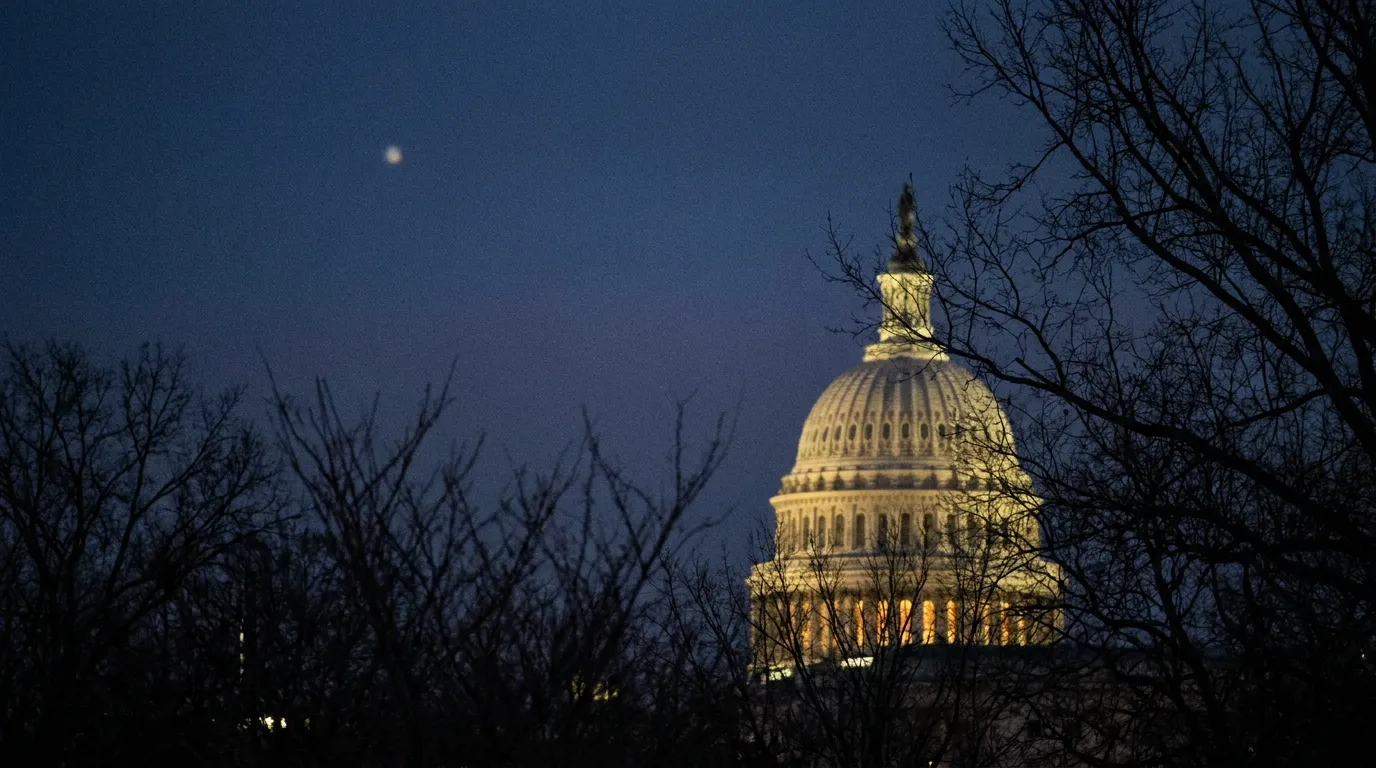
On Wednesday 22 July, the US House of Representatives did something it has never done before: it adopted, on the floor, a comprehensive statutory framework for prying open the government’s files on unidentified anomalous phenomena.
That sentence deserves reading twice. The good news first, then the cold water — and there is a lot of cold water.
What the House actually did
The vehicle was H.R. 8800, the National Defense Authorization Act for Fiscal Year 2027 — the annual must-pass defence bill that has become, by default, the only reliable place UAP policy ever gets written. Representative Eric Burlison, Republican of Missouri’s 7th district, offered his Unidentified Anomalous Phenomena Disclosure Act as a floor amendment. The House adopted it. The full NDAA then passed the same day, 216 to 212.
The procedural detail matters more than it sounds. On 20 July the Rules Committee designated Burlison’s revised amendment “made in order” — the gatekeeping step deciding whether an amendment gets a floor vote at all, or simply dies in a filing cabinet without anyone being seen to kill it. The rule governing debate was adopted on 21 July by 214 to 211, which tells you how thin the margins were on everything moving that week.
Douglas Dean Johnson — the researcher who tracks UAP legislation through Congress more closely than anyone, and who reads the amendment text rather than the press releases — has long noted that no UAP disclosure amendment had ever received a stand-alone roll-call vote on the floor of either chamber. The language kept dying upstream: in committee, in Rules, in conference, in the quiet places where nobody puts their name to a “no”. Reaching a floor vote was the wall. That wall is now behind us.
Burlison’s account of how it fell is more mundane than any conspiracy: months of negotiation and a rolling series of jurisdictional objections — first over whether Armed Services had jurisdiction at all, then, once settled, fresh concerns raised on behalf of Judiciary. This is what obstruction looks like in practice. Not a man in sunglasses; a staffer querying which panel owns the paperwork.
What’s actually in it
The amendment is modelled explicitly on the President John F. Kennedy Assassination Records Collection Act of 1992 — the closest thing American government has to a working template for forcing a reluctant bureaucracy to disgorge its history. Its core provisions: a permanent UAP Records Collection at the National Archives; an independent UAP Records Review Board to adjudicate what gets released and what stays sealed, rather than leaving that judgement with the agencies holding the documents; disclosure obligations extended to covered government contractors, not just agencies; and, most contentiously, authority to acquire recovered technologies and biological evidence by eminent domain where such materials are held by private entities.
The Review Board is the load-bearing piece. Independent adjudication is the one feature the JFK precedent proved actually works, and its absence is what makes every voluntary release programme a performance.
The eminent domain clause makes people sit up, so be precise: writing such a provision is not evidence there is anything to seize. It is a contingency, and legislators routinely authorise things that may not exist. It is nevertheless striking that it survived the revisions intact, because it speaks to the oldest and least verifiable strand of the subject — the claim that recovered hardware sits with contractors rather than in government hangars. That is precisely the terrain of Bob Lazar’s account of S-4, and precisely the terrain on which nobody has ever produced a bolt.
The quiet rewrite nobody’s discussing
The version the House adopted was dated 15 July, and differs from what Burlison originally filed. The most consequential change got almost no coverage: references assigning oversight to the House and Senate Armed Services and Intelligence committees were stripped out, replaced by the House Oversight and Government Reform Committee and the Senate Homeland Security and Governmental Affairs Committee.
Read that as a political trade. Armed Services and Intelligence have the deepest institutional relationships with the agencies that would be handing over records — and, not coincidentally, they were the source of the objections holding the amendment up. Moving oversight elsewhere bought passage. Whether it bought effective oversight is another matter: the Oversight Committee has more appetite for this subject and considerably less leverage over the intelligence community than the panels removed. Enthusiasm is not subpoena power anyone fears.
The Senate is where this has always died
Here is the cold water. An amendment adopted into the House’s version of the NDAA is not law. It is a negotiating position.
Each chamber passes its own version of the defence bill, and the differences are reconciled in conference — a process conducted largely out of public view, where provisions vanish without a recorded vote or an author. UAP language has now been blocked, stripped or diluted there three years running. The comprehensive UAP Disclosure Act was excluded from the final FY2026 bill; Burlison’s own amendment was left out of it too. The pattern is not subtle.
The Senate is not idle. Chuck Schumer and Mike Rounds have reintroduced their version as Senate Amendment 6344, with new language clarifying it would not create additional access to classified Special Access Programs — a concession aimed squarely at the objection that sank earlier drafts. Rounds confirmed the plan at this year’s UAP Disclosure Forum in Washington: “Leader Schumer and I will again offer this vital legislation as an amendment to this year’s NDAA.”
But the Senate’s FY2027 bill remains stalled amid broader fights over defence spending that have nothing to do with UAP. That is the realistic failure mode — not a shadowy veto, but the provision traded away as small change in an argument about topline budget numbers, by people who regard it as a curiosity.
Meanwhile, the executive branch is running its own track
Congress is not the only game. Around 21–22 July — the same week as the House vote — President Trump reportedly directed the Department of War and the intelligence community to waive prior nondisclosure agreements for former government employees and contractors with UAP-relevant information.
The mechanics, per senior administration officials briefing reporters, are narrower than the headlines suggested. Former personnel who believe they hold relevant information would first meet designated, appropriately cleared officials at AARO or at PURSUE — the Presidential Unsealing and Reporting System for UAP Encounters, the interagency declassification effort Trump kicked off via Truth Social in February. During those authorised conversations, applicable NDAs could be waived.
One senior official was blunt that this is “not a declassification directive”. It lets witnesses talk to the government without legal jeopardy; what they say then goes through existing declassification review before reaching the public. Stated plainly: a witness freed from an NDA to speak to a cleared official in a secure room, whose testimony is then reviewed by the very agencies it might embarrass, has not been freed to tell you anything. Fear of losing a clearance has demonstrably kept people quiet, so this is a real plumbing improvement — but it is a channel, not a window.
Note too that we are relying on anonymous officials describing a directive whose text has not been published: a materially weaker footing than the House vote. Update, 2 August: ODNI has since issued written implementing guidance with a 30-day deadline, which sharpens the mechanism considerably — though that memo has not been published either. That opacity has a second cost. Within days, the disclosure movement was publicly arguing about which of its own figureheads the process had captured rather than about the mechanism itself — which is what happens when the mechanism cannot be read.
The sceptic’s read deserves its hearing
PURSUE has been running since May, and the results so far are the best available guide to what “disclosure” actually yields in practice — the fourth tranche, in July, produced its most quotable item not from a modern sensor but from a 1949 filing cabinet: the transcript of the Los Alamos green fireball conference.
The first tranche landed on 8 May with roughly 160 files. The fourth arrived on 10 July: 40 items — 14 documents, 19 videos, four audio files, three images — from the Pentagon, NASA, the CIA, the FBI and the Department of Energy. There is genuinely interesting material in there: a 2019 encounter over the eastern United States in which an aviator and four other personnel reported an object with “flight characteristics unlike anything I had seen in my 28 years” of Air Force and Navy service; a September 2015 incident at the Pantex nuclear weapons plant near Amarillo, Texas, where security staff put the facility on lockdown and tracked a silent object with no visible means of propulsion through binoculars.
And yet. Sean Kirkpatrick, who ran AARO and knows exactly how such files are assembled, called the administration’s disclosure promises “bluster” and a “shiny object” in early May, and told the Associated Press after the first release that there was “nothing unexpected” in it — that without accompanying analysis it would “only serve to fuel more speculation, conspiracy and arm-chair pseudoscience.” Mick West, the most rigorous of the debunkers, admitted he had been hopeful before the second release and found “nothing really interesting” in it.
Neither man is a neutral arbiter; both have skin in a particular game. But their central point survives that objection intact, and it is the point this site keeps returning to: raw files without analysis are not knowledge. The administration’s answer to that gap is a scientific advisory council under Avi Loeb, convened in June — though it too has been handed only the material already released. A compelling narrative report from a credible aviator is a report. It tells you what a trained observer perceived and sincerely believed. It does not tell you what was there. That gap is the entire subject — it is why the surge in pilot reporting measures the reporting system at least as much as the sky, and why even the best-corroborated case on the books, the 2004 Nimitz encounter, gets shakier the closer you look at the specific numbers.
What would actually count as progress
Three tests cut through the theatre, in order.
Does the language survive conference? Not “was it adopted in the House” — that has now happened. Does it emerge in the reconciled bill the President signs, with the Review Board and contractor obligations intact? That is the only question that matters this autumn.
Does the Review Board get appointed and funded? The JFK Act’s board worked because it was independent, staffed, and empowered to overrule agencies. A board that exists on paper, unappointed and unfunded, is a way of appearing to have done something.
Does anything come out that an agency didn’t want released? Every tranche so far has been material the holding agencies chose to hand over. The test of a disclosure regime isn’t the volume it yields voluntarily — it’s the first document prised out over an agency’s objection.
The UAP Times take
We have rated this Well-sourced, five out of five on our scale, which will look odd on a site about flying saucers. It reflects the claim actually being made, which is not “aliens” — it is “the House adopted an amendment on 22 July.” That is public record: floor proceedings, the Rules Committee docket, the congressman’s own announcement. Legislative facts are, awkwardly enough, the most verifiable thing this field has ever produced.
What we would not rate Well-sourced is anything about what the sealed records contain. Nobody claiming to know that, in either direction, is working from evidence. The NDA directive sits in between: credibly reported and consistently described, but sourced to unnamed officials with no published text.
So: a real institutional barrier fell this week, after three years of the same language dying quietly upstream, and the people who did the unglamorous procedural work deserve the credit. It is equally true that the mechanism most likely to kill it is still ahead, operates without recorded votes, and has worked flawlessly every year so far.
Both things are true at once. Watch the conference report, not the press releases.
Further reading: for the same records-duty argument being applied to a federally funded lab rather than an agency — with a named 1952 reel of tape at the end of it — see the MIT Lincoln Laboratory “flying saucer talk”. For the executive-branch route this bill is designed to replace, and why its first named witness is refusing to use it, see the whistleblower turning down the NDA waiver. And for the reason a statutory declassification machine beats the amnesty now being floated at the White House, see why a pardon would not free anybody to talk.
Follow the file
Every new dispatch from the UAP desk, in your inbox. Sourced, sceptical, and no more than one email a week.