
For nine years the UFO disclosure movement has pointed its suspicion outwards, at the Pentagon, the intelligence community and the contractors it believes are sitting on the century’s largest secret. This summer it turned the same instrument on itself, and discovered — as anyone could have predicted — that it works just as well on friends.
The target is Luis Elizondo: former Pentagon counterintelligence official, the man who by his own account ran the Advanced Aerospace Threat Identification Program until he resigned in October 2017, and the single figure most responsible for the New York Times story that December which dragged this subject back into serious newsprint. Without Elizondo there is no modern Tic Tac story, no congressional hearings, and quite possibly no AARO.
The accusation is that he was never the leak. He was the plumbing.
This piece is a longer look than we ran a week ago, because the row has now been going for five weeks and almost every account of it — including, in one respect, our own first one — has compressed it into a single week and a single accuser. It wasn’t one week, and there are three people saying three materially different things. Sorting out which is which turns out to matter more than adjudicating any of them.
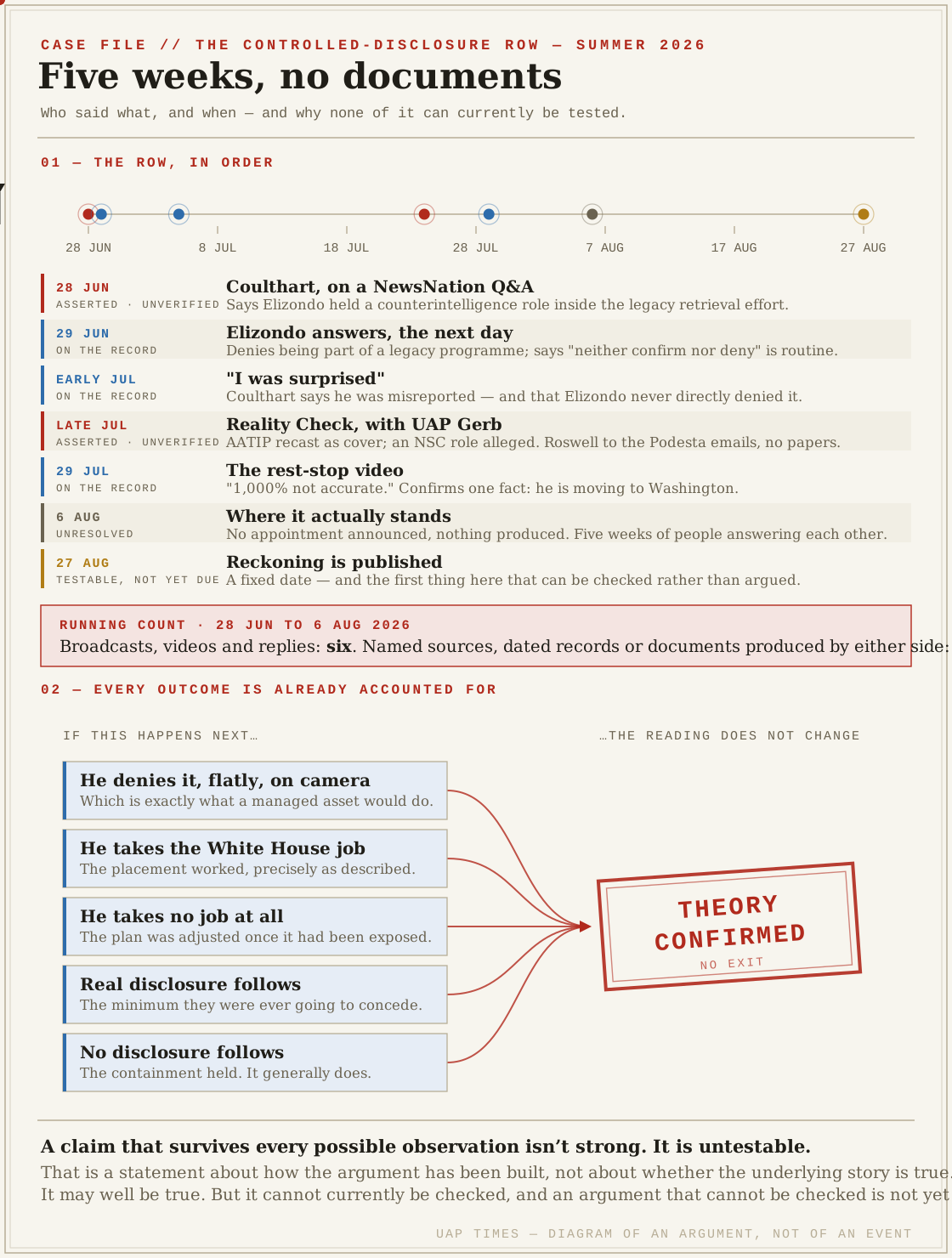
The row is five weeks old, and started with a journalist, not a researcher
The version that travelled was simple: an anonymous researcher accused Elizondo on a podcast, Elizondo hit back. That is the last two moves of a six-move argument.
It actually began on 28 June 2026, in a NewsNation question-and-answer session, when the Australian journalist Ross Coulthart — the most prolific broadcaster in this field since his 2021 book In Plain Sight — said that Elizondo had held a role inside the legacy crash-retrieval and reverse-engineering effort, in a counterintelligence capacity. His formulation was careful and worth quoting at length, because it has been paraphrased into something harsher ever since:
“Lue needs to be more forthcoming about his past roles. There are people that bitterly resent that Lue be appointed to a position of power in UAP transparency because they think that he was part of a previous agenda that was to try to control the narrative, to restrict what the public is entitled to know about UAP disclosure.”
Note the construction. Coulthart is not saying Elizondo restricted the public’s knowledge. He is saying other people believe he did, and that this is now a live problem for a man who may be given a job.
Elizondo answered the following day, denying he was part of any legacy programme and making a point that recurs throughout this story: for anyone holding a clearance, “we can neither confirm nor deny” is boilerplate, and is said about programmes one had nothing to do with just as readily as about programmes one ran. In early July, Coulthart returned to it on Reality Check alongside Meagan Medick, said he had been surprised by the backlash and misreported in the coverage, and made the distinction sharper still: what he had seen from Elizondo, he said, was a man “very deftly avoiding any breach of his National Security Oath obligations” — not a denial.
Only then, in the last week of July, came the Reality Check episode with the researcher known as UAP Gerb. And only then, on 29 July, the video reply that made the headlines.
What UAP Gerb actually alleged
The claim was aired on NewsNation’s Reality Check. Coulthart’s guest was a researcher who goes by UAP Gerb online and by the first name Sam publicly: an engineering graduate of Colorado State who has built a following on long-form YouTube work — often multi-hour — mapping alleged crash-retrieval programmes, reverse-engineering facilities and the lattice of defence contractors and federally funded research centres he believes administers them. He is anonymous, but he is not a drive-by; the output is voluminous and methodical, and he has taken his findings onto other shows, including Chris Ramsay’s Debriefed, under the same terms.
The episode itself is a sweep of the entire secret history: Roswell in 1947, the Podesta emails, the Majestic-12 papers and the disputed Eisenhower briefing document, the deaths of James Forrestal and John F. Kennedy, and an alleged migration of crash-retrieval control out of the National Security Council and into private aerospace hands during the 1990s. Much of that terrain is contested-to-discredited — MJ-12 in particular has been picked apart for four decades — and how much weight you give the whole depends heavily on how much you give the parts.
Within it, the allegation about Elizondo has two halves, and they need separating because only one of them is a prediction.
The first is historical: that before Elizondo emerged as a public whistleblower he was in fact helping to protect the very programmes he later gestured at — that his role was counterintelligence in the literal sense, keeping a secret rather than surrendering one. Gerb goes further on the mechanics than Coulthart does, characterising AATIP itself as an informal working group with no real budget, existing largely on paper, serving as cover for National Security Council activity and operated from the start as a limited release rather than a leak.
The second is forward-looking: that Elizondo is now being positioned for a role at the National Security Council in order to engineer a controlled disclosure — a managed release that concedes the minimum and closes the file. Gerb frames this as a rerun of something he says already happened once, under Director of National Intelligence James Clapper and the AATIP programme in 2016.
None of it has been independently verified. No documents were produced in the interview. The International Business Times covered the row and was careful to say so; so, to its credit, was NewsNation. What exists is an allegation, aired at length, by a person whose real name the public does not know.
Elizondo’s denial, in his own words
Elizondo did not let it sit. In a video posted on Wednesday 29 July — recorded, as it happens, from the cab of his pickup at a highway rest stop, mid-move from Wyoming to the Washington area — he confirmed the one verifiable fact in the whole affair, that he is relocating to DC, and gave an entirely mundane reason for it: fighting for UAP disclosure is a full-time job, and Washington is where that job is.
Everything else he rejected, in terms that were not diplomatic. On the specific suggestion that he and Clapper had built a managed “soft disclosure” network between them, he said: “That is 1,000% not accurate,” adding that “we never had such a conversation, and Jim Clapper and I never met to have that conversation.”
On the broader question of who benefits, he was blunter still: “In this process of disclosure, there are people out there that are trying to hijack and derail this conversation by feeding you false information.” And, addressing the community directly: “If you want to know what’s wrong with the UFO community, you have people out there, and by the way, yes, I’m addressing you who lied, to look in the mirror.”
That is a flat, specific, on-the-record denial from a named man with a reputation to lose. It deserves to be weighed as such. It is also, inevitably, exactly what the theory predicts he would say.
Coulthart is not making the same claim as Gerb
This is the part most of the coverage has flattened, and it matters.
Coulthart has not simply platformed his guest. He has his own version, and it is narrower and more interesting than Gerb’s. Coulthart’s stated belief is that Clapper intended to impose a controlled-disclosure narrative on the public using Elizondo as a frontman, specifically to limit what the public was told about crash retrievals — and that David Grusch’s 2023 allegations blew that plan apart by going considerably further than the script allowed.
He also believes Elizondo worked inside the legacy retrieval and reverse-engineering effort in a counterintelligence capacity, and he has said there ought to come a point where Elizondo can be more forthcoming about that past role.
Note what Coulthart is not saying. He is not saying Elizondo is a bad-faith actor. He is saying Elizondo was placed, may still be bound, and has never fully levelled about the placement. In Coulthart’s telling Elizondo is closer to a weapon that misfired in the movement’s favour than to an agent of the cover-up — and his July clarification, that Elizondo had been avoiding a breach of his oath rather than lying, pushes him further towards sympathy, not further from it.
The distinction gets lost in a headline and it is the difference between an accusation and a hypothesis. It is also the difference between a claim Elizondo can meaningfully deny and one he structurally cannot.
This argument has been had before — on paper, with names on it
Here is the part of the story nobody in the current row is citing, and it is the only part with a documentary record.
The question of what Elizondo actually was inside the building has already been litigated once, publicly, with the Department of Defense on one side and Elizondo on the other. In June 2019, Pentagon spokesperson Susan Gough stated that Elizondo “had no assigned responsibilities for AATIP while he was in OUSD(I)” — the Office of the Under Secretary of Defense for Intelligence. That is not a quibble about job titles. Elizondo’s public account has him directing the programme for the better part of a decade, up to his resignation in 2017.
When a 2009 memorandum from Senator Harry Reid surfaced and was offered by supporters as corroboration, Gough confirmed the document was authentic and said flatly that it “makes no change to previous statements” — noting, reasonably, that it predates the period in question.
Seven years on, that dispute has never been resolved in public. And this is where it gets genuinely awkward, because the unresolved fact serves both sides equally well.
If you think Elizondo overstated his role, the Pentagon’s position is your evidence. If you think Elizondo is exactly who he says he is, the Pentagon’s position is precisely what an institution would say about a man who had just walked its most sensitive file out of the door. And if you are UAP Gerb, arguing that AATIP was a thin paper cover for something being run elsewhere, then a Pentagon statement that nobody was formally assigned to it is not an embarrassment to your theory at all. It is a data point for it.
That is three incompatible readings of one document, and no way to choose between them from the outside. Which is a fair summary of this entire subject.
The wider provenance doesn’t simplify things either. AATIP’s sister effort, AAWSAP, was the roughly $22 million DIA contract that took the subject seriously enough to send investigators to a haunted ranch in Utah — a decision AARO’s own Historical Record Report treated in March 2024 as a distraction that discredited the sober study of aerial phenomena. That report, covering 1945 to October 2023, also found no evidence that any US programme has ever possessed or reverse-engineered non-human technology, and traced a number of famous cases to classified but entirely human aerospace work.
You can read that as the definitive answer or as the cover story. There is, again, no third position available from where we are sitting.
Elizondo’s own ambiguity is the fuel
The uncomfortable observation, for those inclined to defend him, is that Elizondo built the conditions for this himself.
Asked directly and repeatedly whether he was part of the legacy retrieval programme, he has for years neither confirmed nor denied it. Coulthart’s own read on those exchanges is that Elizondo was deftly avoiding a breach of his national security oath — which is a generous reading, and quite possibly the correct one. A man who is genuinely still bound cannot say “no” to a question about a compartment he cannot acknowledge exists. His own explanation, that the formula is standard and content-free, is true as far as it goes.
But it is a formula that carries no information in either direction, and that is the problem. A public figure whose central asset is candour, and who has spent years declining to answer the most obvious question about his own biography, has left a space. Somebody was always going to fill it. This summer somebody did.
The theory that cannot lose
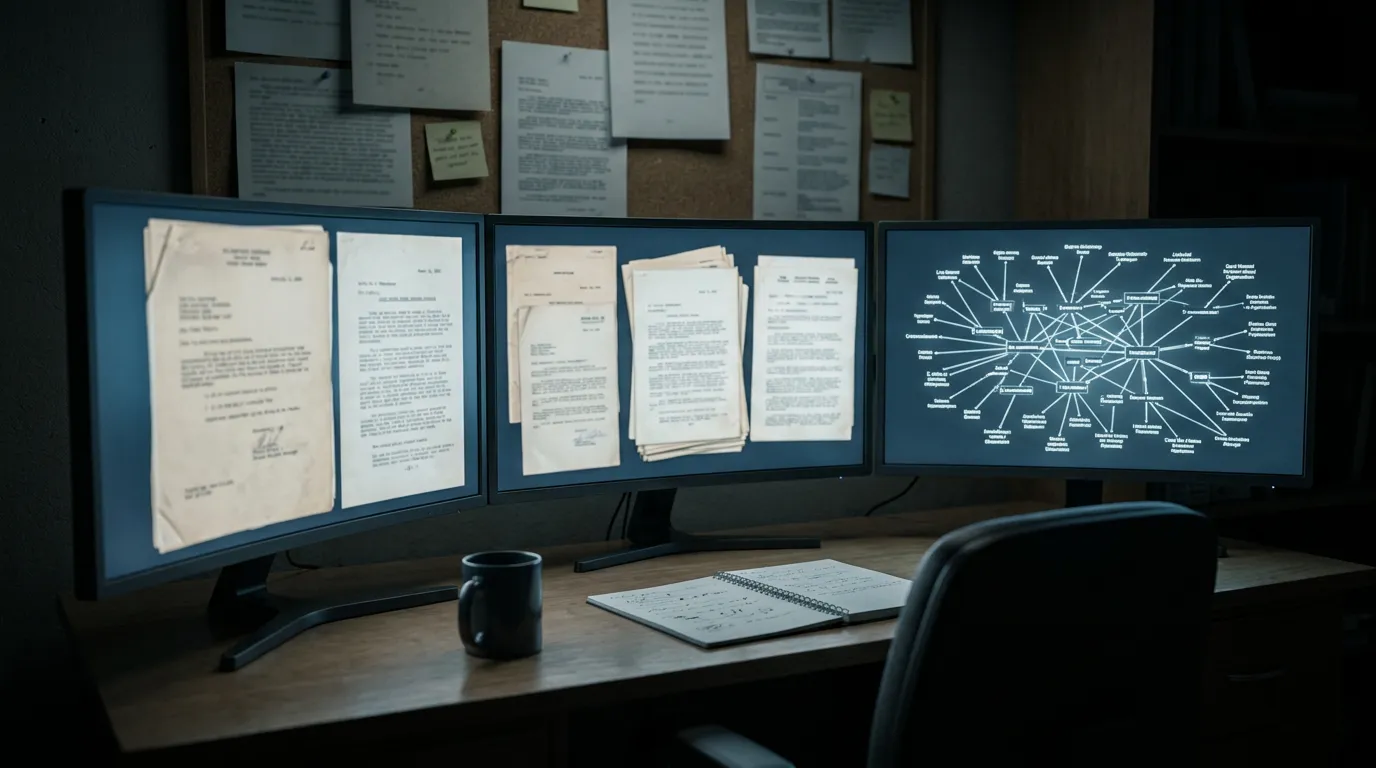
Here is the structural problem, and it is not a small one. It is drawn out in the lower panel of the diagram above.
If Elizondo denies the allegation, that is what a managed asset would do. If he takes a White House job, the theory is confirmed. If he takes no job, the plan was adjusted after exposure. If real disclosure follows, it was the minimum they could get away with. If it does not, the containment worked.
Every possible outcome is already accounted for. That is not evidence of a conspiracy; it is the signature of a claim that has been built, consciously or otherwise, so that nothing could ever count against it. Whether or not the underlying story is true, the argument as currently constructed cannot be tested — and an untestable argument, however satisfying, is not knowledge.
It is worth being precise about what that objection is and isn’t. It is not a rebuttal. Unfalsifiable claims are sometimes true; the world is full of real conspiracies that were, for a period, impossible to prove from outside. It is a statement about where the argument currently sits on the ladder between suspicion and evidence, and the honest answer is: on the first rung, five weeks in, with nothing added.
The field has been here before. The most instructive parallel is the decades the community spent adjudicating Bob Lazar’s personal credibility instead of his physics, on the reasonable-sounding basis that if the man checked out, the story did. He mostly didn’t, the story mostly didn’t, and thirty-seven years went by. Person-shaped questions are enormously entertaining and they very rarely resolve.
The sceptic’s read, which is largely right
Strip out the intrigue and a duller account covers most of the facts.
A former counterintelligence officer with a book, a media profile and a policy agenda is relocating to the city where policy is made — the same move made by every advocate who has ever wanted to be in the room. He has openly urged the administration to appoint a UAP “czar”, and reportedly sent transition officials a memo before the inauguration recommending exactly such a post for emerging technology and UAP matters. That is the sort of thing one says out loud while lobbying, and precisely not the sort of thing one says while secretly being installed. The strongest single piece of evidence that Elizondo wants the job is that Elizondo has said, in public, that the job should exist.
Meanwhile the accusation itself comes from an anonymous account, contains no produced documents, and lands in a community whose attention economy rewards exactly this: a familiar name, a betrayal narrative, a clip that travels. That is not a reason to dismiss Gerb — anonymity is often a rational response to this subject, and outsiders have broken real stories in it. It is a reason to notice that the incentives all point the same way.
There is also the timing. This row broke in the same fortnight that the House adopted a statutory UAP records framework and the President reportedly waived nondisclosure agreements for former officials with UAP knowledge. Those are the first genuine institutional openings in years. A movement that spends the following weeks litigating the loyalty of its own founders is a movement handing back the advantage.

What would actually settle it
Three things, none of them a podcast.
Does the appointment happen? An NSC or White House role is a matter of public record. It either occurs or it does not, and unlike everything else here, it comes with a date. It is also the one test with a built-in trap: because the theory reads both outcomes as confirmation, its proponents should say now, in advance, what result would count against them. If the answer is “none”, they have told you what kind of claim it is.
Does Elizondo answer the biography question? Not “was he involved” — he has declined that for years. Whether he will now say plainly what he is and is not permitted to discuss, and under whose authority. The NDA waiver route the administration has opened is, on its own terms, the mechanism for exactly that; if it does not work for the field’s most prominent former insider, that tells us something about the mechanism.
Does Gerb produce anything? A named source, a document, a dated record. The allegation currently rests entirely on inference from public behaviour, which is the same evidentiary standard the community rightly rejects when the Pentagon uses it. Gerb’s body of work suggests he is capable of documentary research; this particular claim has not yet been supported by any.
27 August is the first hard date in this story
There is one more test, and unlike the others it is already scheduled.
Elizondo’s second book, Reckoning: The Unspoken Truth about UFOs and the Urgency of Now, is published by HarperCollins on 27 August 2026, after a twenty-date speaking tour that ran from Minneapolis in April to Seattle in June. The publisher’s copy promises “previously undisclosed evidence”.
That is a commercial promise made by a publisher, and it should be read with the scepticism any such promise earns. But it converts a vague argument into a checkable one, in two directions at once.
If the book addresses his own past role — plainly, with dates, and an account of what he is and is not cleared to say — then the biography question is answered on the record and the loudest version of Gerb’s allegation loses its footing. If it does not, and instead recycles the material of Imminent with a new cover, then the fair reading is that the most direct question about the movement’s most prominent figure has now gone unanswered across two books, nine years in public life and a five-week row conducted largely about him.
The cynical read is available too, and we should say it out loud: a bitter, high-profile authenticity fight three weeks before publication is not the worst thing that can happen to a book. That cuts at everybody here. Coulthart has a show to fill, Gerb has a channel that grows on exactly this material, and Elizondo has a launch. None of that makes any of them wrong. All of it is worth knowing while you watch.
Either way, on 27 August there will be a physical object with page numbers, which is more than this argument has produced in five weeks.

The UAP Times take
Thin — two out of five on our scale — and the rating is about the central claim rather than the reporting around it.
That the row happened is a 1. Coulthart raised it, Gerb elaborated it, Elizondo answered it on camera, and the quotes are on the record. That Elizondo secretly served as the architect of a managed cover-up is, on the evidence currently public, a 4 — an unverified assertion from an anonymous researcher, structured so that no observation could contradict it.
We would add something less comfortable for the sceptics. The proposition underneath all this — that governments prefer controlled disclosure to real disclosure, and will happily use sincere people as the delivery mechanism — is not paranoid. It is close to the default behaviour of large institutions, and it is precisely the failure mode the ODNI’s own science advisory council is currently demonstrating, having been convened with distinguished members, no budget, and access only to material already released. Managed transparency is real. It is happening in plain sight, on paper, with names attached.
Which is why this particular fight is such a poor use of the moment. There is a version of the controlled-disclosure argument that is documented, dull and winnable, and it involves reading the conference report on the NDAA in the autumn. There is another version that involves deciding, without documents, which of your own is secretly working for the other side.
The field keeps choosing the second one. It has never once worked.
Further reading: the same suspicion of managed disclosure, argued from procedure rather than personality — why the whistleblower behind Immaculate Constellation is refusing the government’s new intake channel — and the case that shows where person-shaped questions end up, thirty-seven years of adjudicating Bob Lazar.
Follow the file
Every new dispatch from the UAP desk, in your inbox. Sourced, sceptical, and no more than one email a week.