
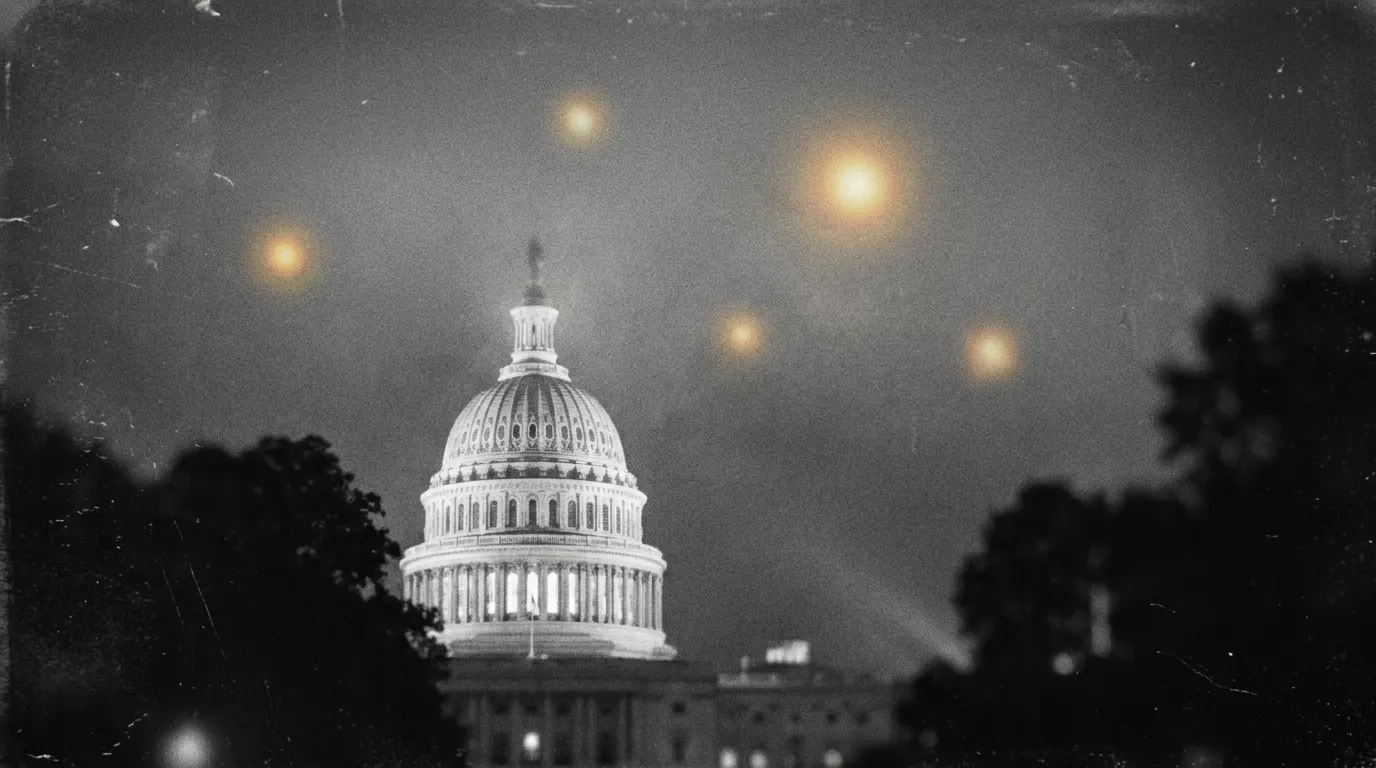
There is a particular kind of UFO case that officials cannot simply ignore, because it happens directly over their heads. In July 1952, unidentified objects were tracked on radar in the restricted airspace over Washington D.C. — not once but across two consecutive weekends — with jets scrambled, pilots reporting lights, and the story splashed across the world’s front pages. It forced the US Air Force into its biggest press conference since the Second World War. And the answer it gave then is still the answer today: a trick of the weather. Whether you believe that is the whole story is the interesting part.
Blips over the White House
It started at about 11.40pm on Saturday 19 July 1952. Edward Nugent, an air-traffic controller working the air route traffic control centre at Washington National Airport, saw seven unidentified returns appear on his scope in airspace where nothing should have been — no flight plans, no transponder-era identification, nothing.
Nugent called over his supervisor, the senior controller Harry Barnes. Barnes later wrote that he knew immediately a very strange situation existed, because the movements of the targets were completely radical compared with those of ordinary aircraft. He had two other controllers check Nugent’s set. It was working normally.
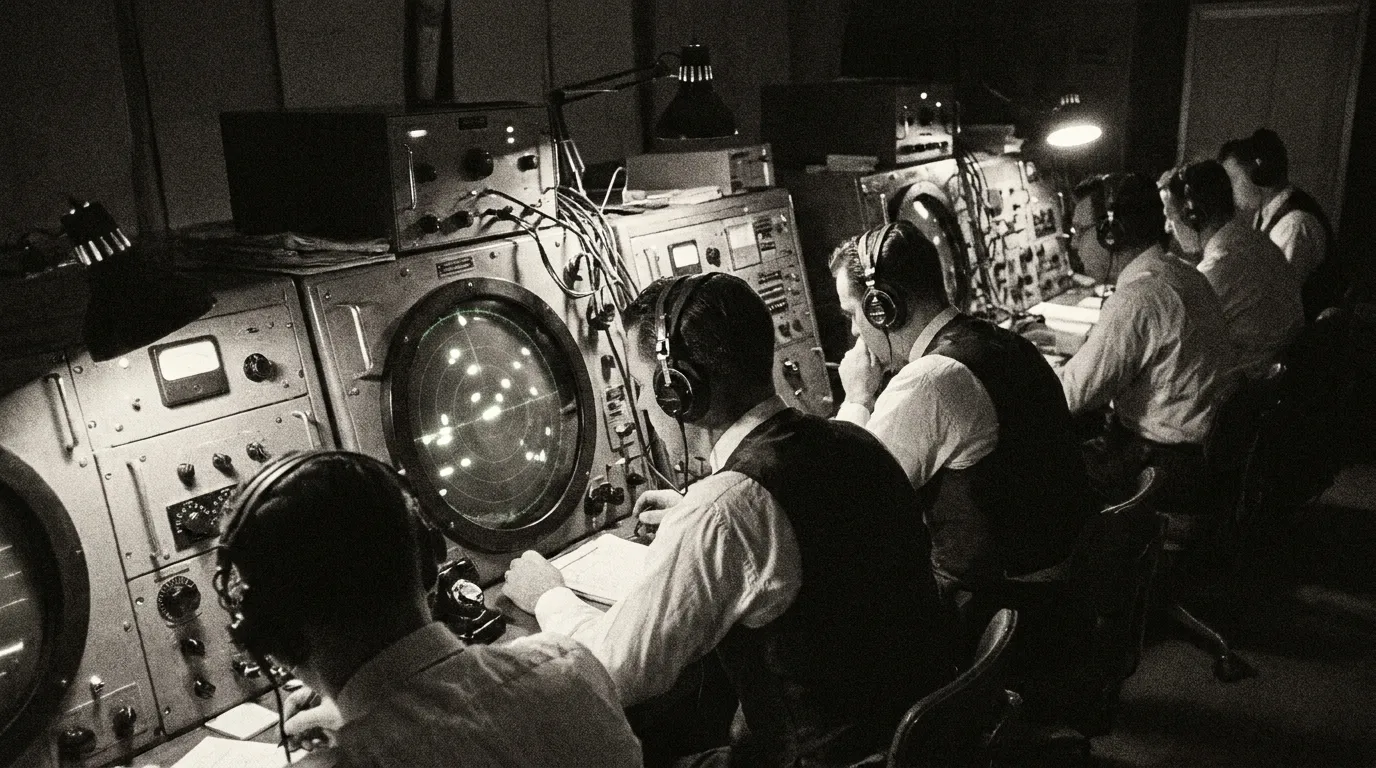
Barnes then telephoned National’s radar-equipped control tower, a separate installation with its own set. The controllers there, Howard Cocklin and Joe Zacko, said they had unidentified returns too — and that they could see a hovering bright light in the sky, which then departed at high speed. When the targets drifted over the White House and the Capitol, Barnes called Andrews Air Force Base, ten miles away. Andrews had them as well: slow and clustered at first, then accelerating away at speeds that contemporary accounts put in the thousands of miles per hour.
This is the load-bearing detail: multiple radar sets, operated by different people in different places, painting targets at the same time — and, on occasion, airline pilots and observers on the ground reporting lights where the radar said something was. It is much harder to wave away a coordinated set of returns than a single scope glitch.
Jets that arrived too late
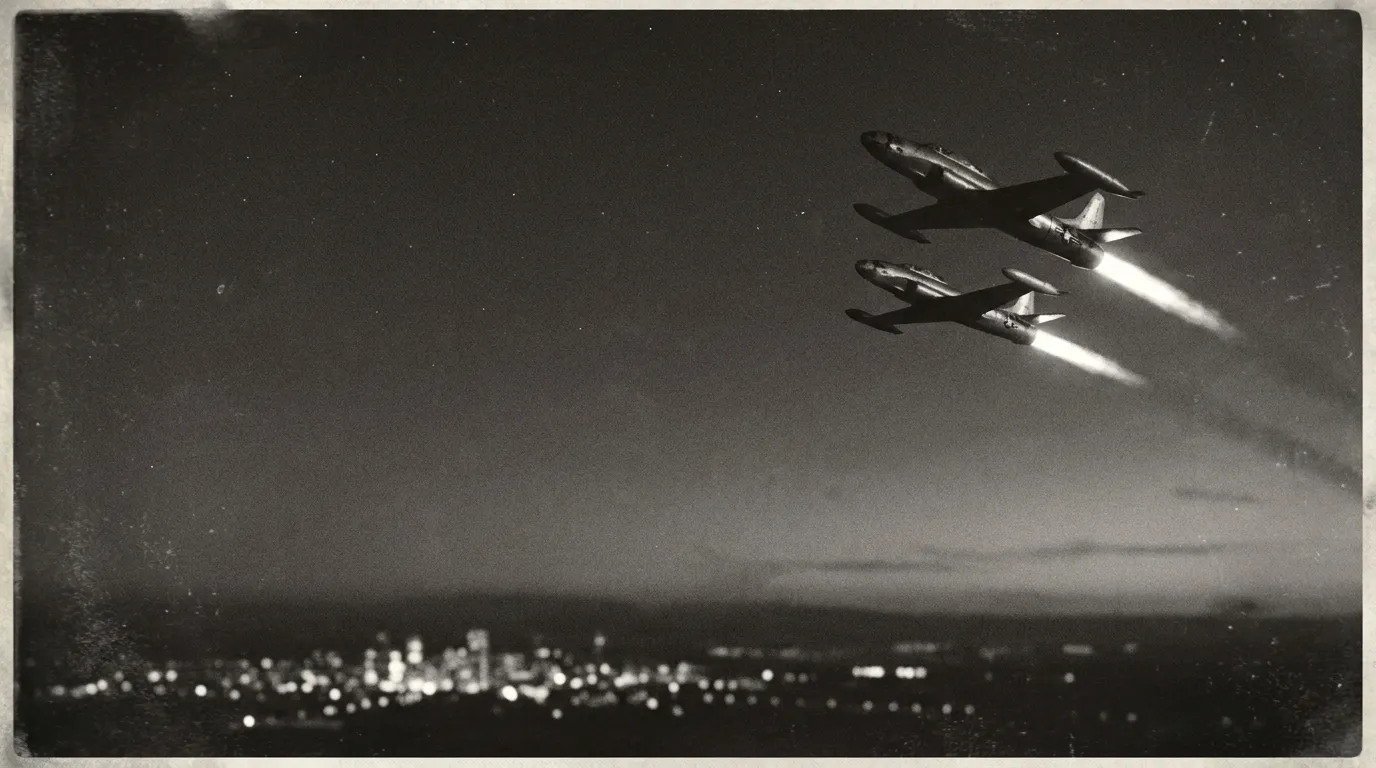
The Air Force scrambled F-94 Starfire interceptors from New Castle Air Force Base in Delaware. What followed became the signature frustration of the whole episode: as the jets arrived over the city, the objects seemed to fade from the scopes, only to return once the fighters ran low on fuel and turned for home.
The sightings of 19–20 July made front pages across the country and, in the middle of a nationwide wave of reports, landed on an administration with rather more pressing worries about what might be flying over the capital unannounced. Then it happened again the following Saturday.
The second Saturday
On 26 July, a National Airlines crew inbound to Washington reported lights above their aircraft at around 8.15pm. The radar returns came back. So did the interceptors.
That night the National radar room filled up with people whose presence tells you how seriously it was being taken. Albert Chop, the civilian press spokesman for Project Blue Book, was there. After midnight he was joined by Major Dewey Fournet, Blue Book’s liaison at the Pentagon, and Lieutenant John Holcomb, a US Navy radar specialist brought in precisely to assess whether the scopes were lying.
The moment everyone remembers came when an F-94 flown by Lieutenant William Patterson closed on targets and found them, by his account, all around him. Chop recalled Patterson asking the ground what he should do — and nobody answering, because nobody knew what to tell him. Whatever the returns were, a fighter pilot was flying through them at night over the capital and asking for instructions he could not be given.
The White House wanted an explanation. Accounts differ on whether President Truman personally telephoned Project Blue Book or whether the call came through his staff, but the request reached Captain Edward J. Ruppelt, the officer running the project, and the answer he gave was the one that would be made public three days later.
Where Ruppelt actually was
The detail that says most about how the US Air Force handled UFO reports in 1952 is not on any radar tape. It is Ruppelt’s own account of the week.
Ruppelt supervised Project Blue Book. He was physically in Washington during the first weekend’s events. He did not learn about them until Monday 21 July, when he read the newspapers. He then spent hours trying to obtain a staff car so he could get around the city and interview the controllers, and was refused, because staff cars were for generals and senior colonels. He was told he could hire a taxi at his own expense. He gave up and flew back to Blue Book’s offices at Wright-Patterson in Ohio.
The supervisor of the United States Air Force’s official UFO investigation could not get a lift across town to the biggest UFO event of the decade. Back in Dayton, he talked it over with Captain Roy James, an Air Force radar specialist, who thought unusual weather could account for the unknown returns. That conversation, more than any fieldwork, is where the official explanation was born.
The biggest press conference since the war
On 29 July 1952, the Air Force convened a packed press conference — the largest it had held since 1945. It was fronted by Major General John Samford, the Director of Air Force Intelligence, with Major General Roger Ramey, the Director of Operations, alongside him and officers from the Air Technical Intelligence Center at Wright-Patterson, Ruppelt and James among them, in the room.
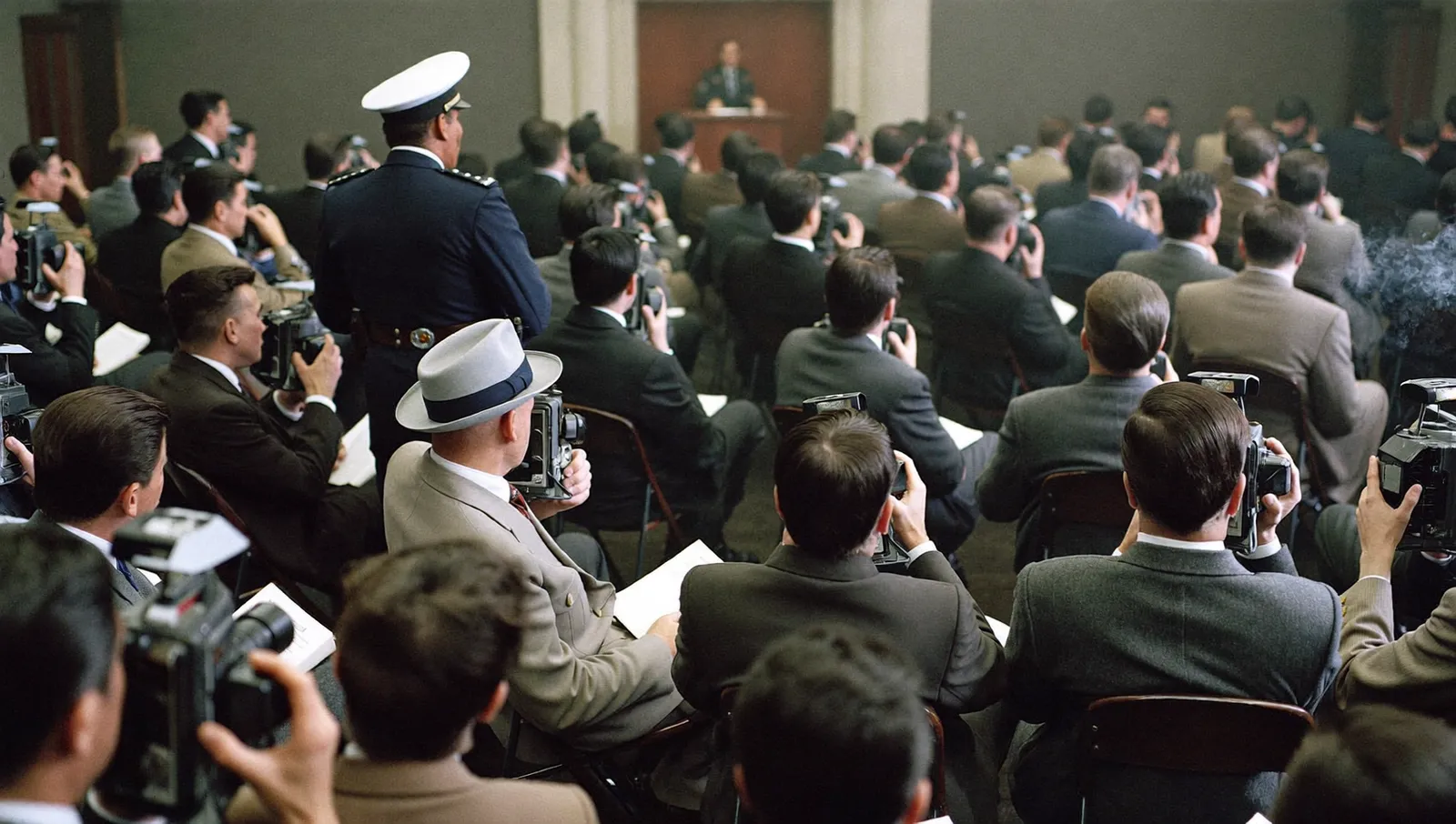
The explanation Samford offered was temperature inversion: layers of warm air over cooler air can bend radar beams and produce false, ground-based returns that drift and dart in exactly the disconcerting way these had. The visual sightings, he suggested, were misidentified stars and meteors. Project Blue Book would eventually file the radar events as mirage effects caused by a double inversion, and the visual reports as meteors combined with the normal excitement of witnesses.
Samford himself was more careful than the headlines that followed. He conceded that the Air Force was left with a residue of reports from what he memorably called credible observers of relatively incredible things, and declined to claim every case was solved. What he did assert — and this was the operative sentence for the administration — was that nothing in the file indicated a threat to the security of the United States. The press heard “weather”. The general had said something narrower.
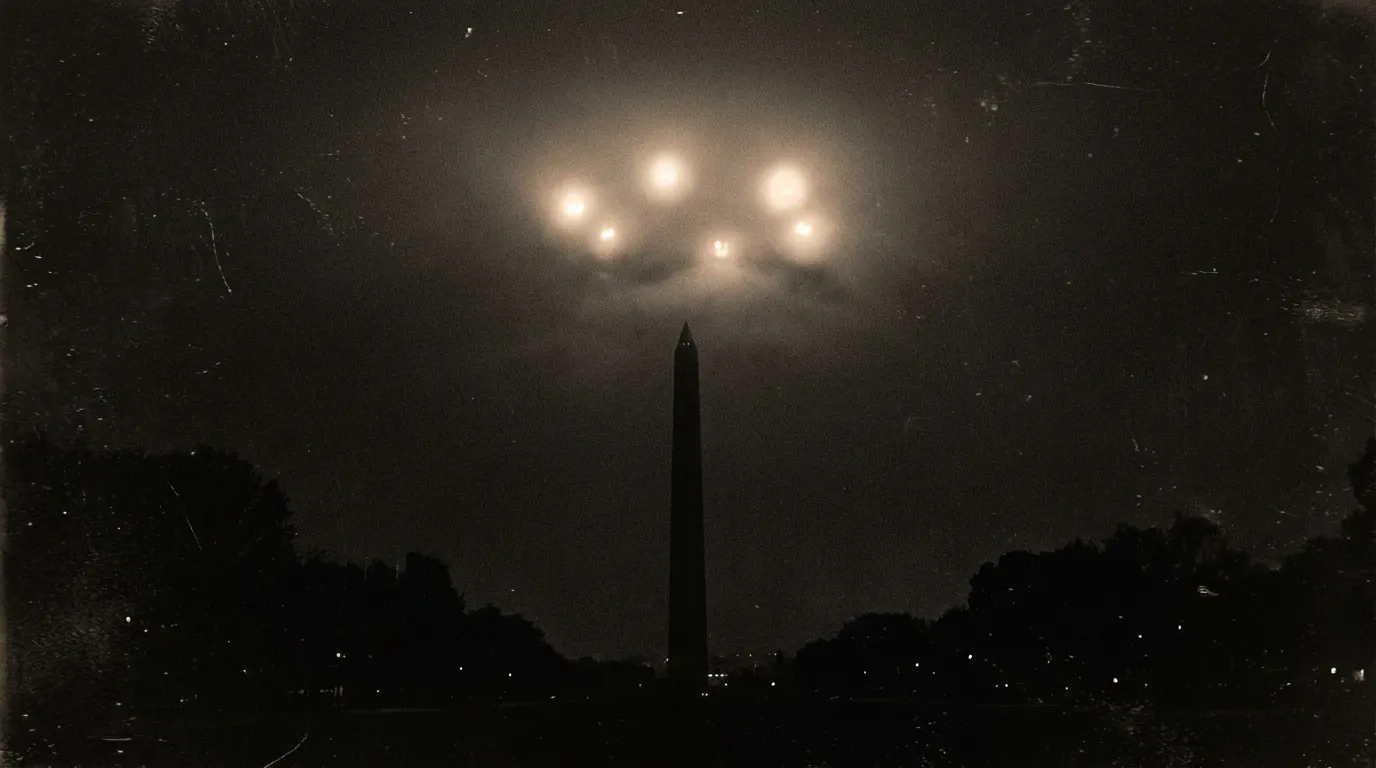
It was a plausible, deflating answer, and it did the job of cooling the story down within days — which was, transparently, part of the point. But it did not convince everyone who had been in the radar rooms, and it did not entirely convince the men standing at the front. Ruppelt’s own book, The Report on Unidentified Flying Objects, published five years later after he had left the service, is markedly more equivocal than the podium was. Blue Book would run the same argument — an ordinary propagation effect versus a genuine multi-sensor anomaly — again in 1957, over an Air Force jet rather than the capital: see the RB-47 incident.
The anomalous-propagation case, at its strongest
The sceptical explanation deserves to be stated properly, because it is not a hand-wave. It is real physics with a real name: anomalous propagation.
Radar assumes its beam travels in a predictable, gently curving path. When a layer of warm air sits over cooler, moister air — a routine condition on a hot, humid Washington night in July — the boundary refracts the beam downwards. The set then paints ground objects it should never be able to see: water towers, cars, buildings, the far shore of the Potomac. Because the duct itself shifts and breaks up, those returns appear, vanish, jump position and can seem to accelerate impossibly. On a 1950s scope, with no altitude information and no digital filtering, they look uncannily like manoeuvring craft.
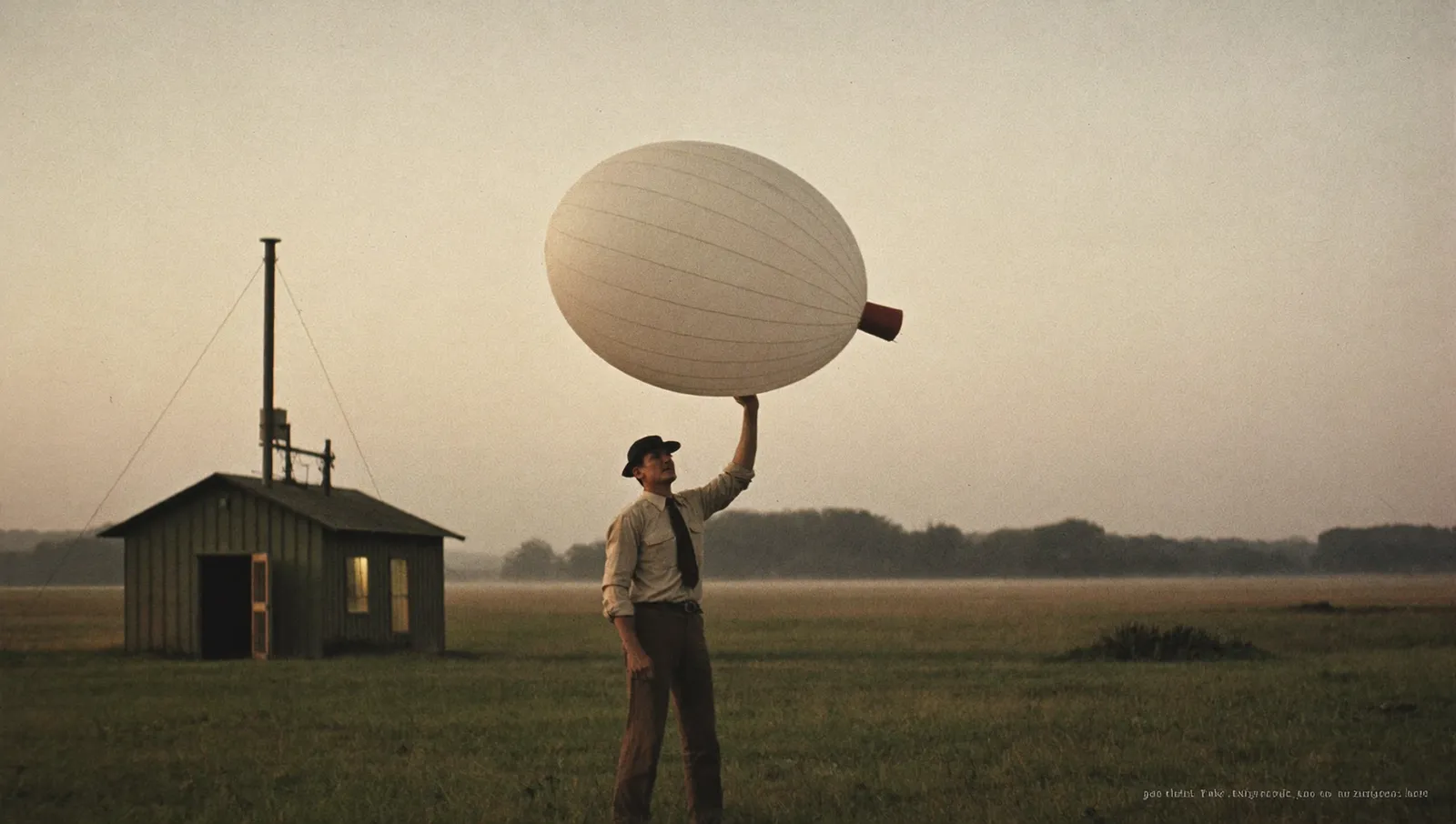
Anomalous propagation also explains the interceptors coming home empty, which is otherwise the case’s most dramatic feature. If the returns are ground clutter refracted into the beam, there is nothing at altitude for a fighter to find — and the ducting conditions that produce them are transient, so the correlation between “jets overhead” and “targets gone” needs no conspiracy at all, only a moving layer of air.
Two of the most prominent sceptics of the era, the Harvard astronomer Donald Menzel and Aviation Week editor Philip Klass, argued the inversion case hard and for decades.
Why it never quite closed
The counter-argument is narrow, technical and stubborn: was the inversion actually strong enough?
Lieutenant Holcomb, the Navy radar specialist in the room on the second night, checked with the airport weather centre and confirmed a slight inversion was present — but did not think it sufficient to produce returns that convincing. The atmospheric physicist James E. McDonald of the University of Arizona, the most technically formidable critic the Air Force ever faced, went further and argued the explanation did not hold up against the measured conditions. The physicist Bruce Maccabee — a UFO advocate, and worth reading with that in mind — has pointed to a later government study of mirage effects to make the same quantitative point: the temperature gradient present was too weak to do the job.
That is where the case has sat ever since. Nobody disputes that anomalous propagation is real, or that it was almost certainly responsible for some of what the scopes showed. What has never been settled is whether the specific atmospheric conditions over Washington on those two nights were capable of producing all of it, including the returns that experienced operators insisted behaved like controlled objects.
What the flap changed
The Washington sightings were the loudest event in the biggest UFO year the Air Force ever recorded, and the institutional response outlasted the story by decades. Alarmed less by the possibility of visitors than by the prospect of Soviet aircraft slipping through a reporting system clogged with saucer calls, the CIA convened a panel of scientists in January 1953 under the physicist H. P. Robertson. Its recommendation was not further study. It was public debunking, to reduce the volume of reports and the risk that a real intrusion would be lost in the noise.
That decision shaped US official posture on the subject for the next half-century, and it started here. Seventy years later the underlying problem has barely moved: the data that would settle a radar-visual case is generated by agencies whose institutional interest is in resolving it quickly and quietly — and, as the FAA’s 45-day radar retention window shows, is often gone before anyone independent can ask for it.
The UAP Times take
The Washington flap earns a Credible rating — four out of five on our scale. It has the ingredients that make a case durable: multiple independent radar sets, corroborating visual reports from controllers and aircrew, military interceptors launched in response, and a documented official record that survives in the Blue Book files. It also has a specific, physically real conventional explanation in temperature inversion — one that genuinely can produce fast, erratic false radar returns on a hot, humid Washington night, and that accounts neatly for the fighters finding nothing.
The honest verdict sits in the tension between those two facts. Inversions were almost certainly responsible for some of what the scopes showed. Whether they account for all of it is a question that turns on humidity profiles nobody adequately measured at the time, and it is therefore no longer answerable.
The Air Force did not so much solve the Washington flap as end it.
What the case really demonstrates is institutional, not aerial. The officer nominally in charge of investigating UFOs could not get a car; the explanation was arrived at in a conversation in Ohio; the press conference was scheduled before the fieldwork was done; and the CIA’s response, six months later, was to recommend talking the public out of it. Seventy years on, the Washington flap remains the case where the official explanation is entirely reasonable and still doesn’t feel like quite enough.
Further reading: for another radar case where jets were scrambled and came home empty, see The Tehran Dogfight and The Belgian Wave. For what the same Cold War state was doing about this three years earlier, behind closed doors, see the newly released 1949 Los Alamos green fireball transcript. A 1952 recording of Blue Book’s Edward Ruppelt briefing scientists at MIT is now being prised out of Lincoln Laboratory, and much of the press has filed it as the missing tape of this case — we think the date says otherwise. For the British answer to Washington’s radar summer, four years later and with a night fighter in the middle of it, see Lakenheath–Bentwaters. The Washington returns read as classic orbs; the case is on the sightings map.
Source: Project Blue Book files; contemporary press; Capt. Edward Ruppelt's account
Follow the file
Every new dispatch from the UAP desk, in your inbox. Sourced, sceptical, and no more than one email a week.