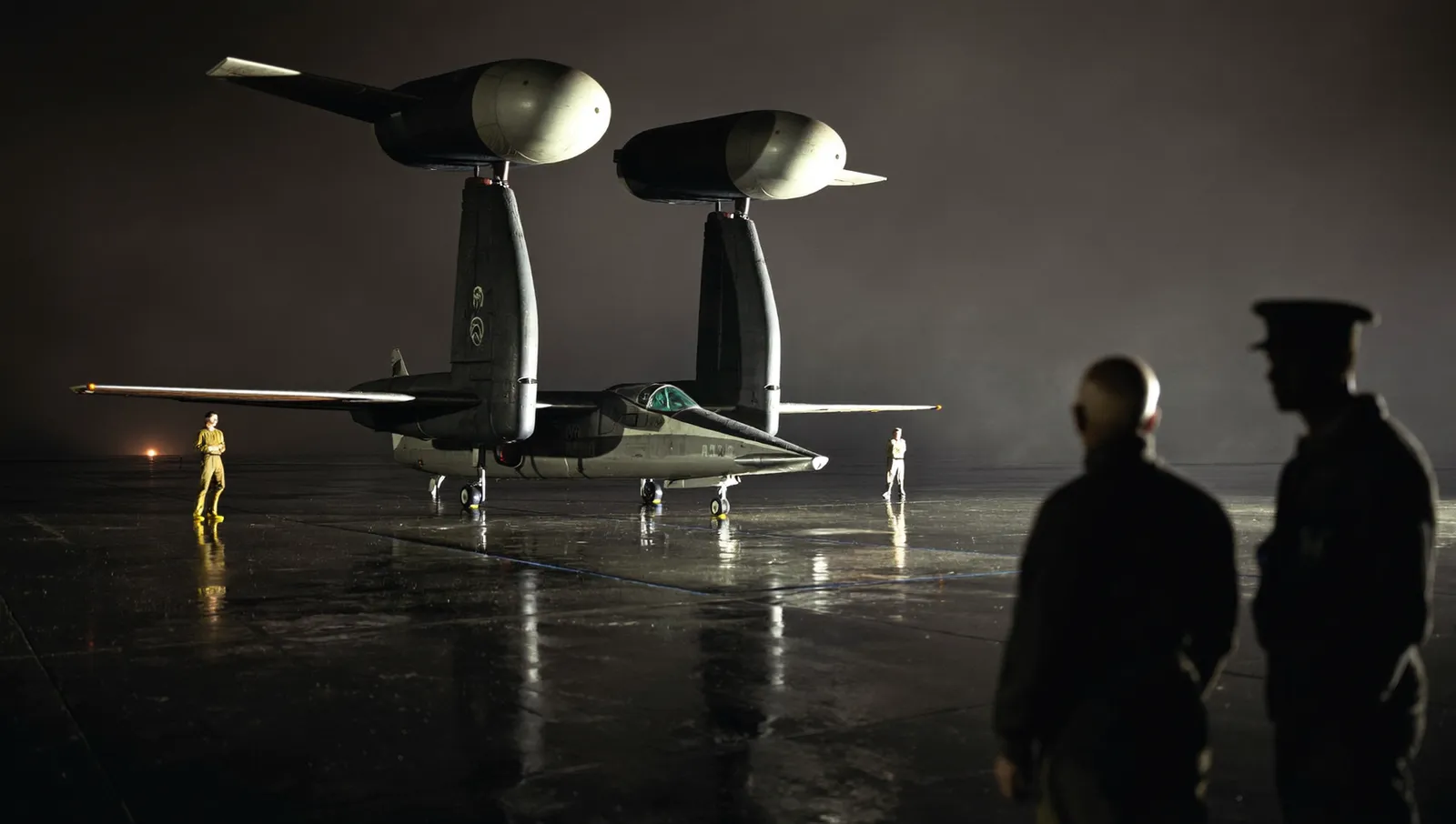
Britain’s most famous UFO case happened in a Suffolk pine forest in December 1980. Its most evidentially interesting one happened twenty-four years earlier, a short drive up the same coast, and almost nobody outside the field has heard of it.
On the night of 13–14 August 1956, across roughly six hours, American and British personnel at two air bases in East Anglia reported an intruder that appeared on at least three separate ground radars, on the airborne radar of an RAF night fighter, and in the eyes of men on the ground and in the air. Nobody touched a craft. Nobody was taken anywhere. What happened instead was duller and, for anyone who cares about evidence, considerably more interesting: a lot of trained people, working different equipment in different places, independently agreed that something was there.
Then almost all of the paperwork went missing.
A telephone call at half past nine
RAF Bentwaters sits near the Suffolk coast, and in 1956 — as in 1980 — it was British in name and American in practice. Shortly after 21:30Z on 13 August, its ground-controlled approach radar started producing returns that made no sense.
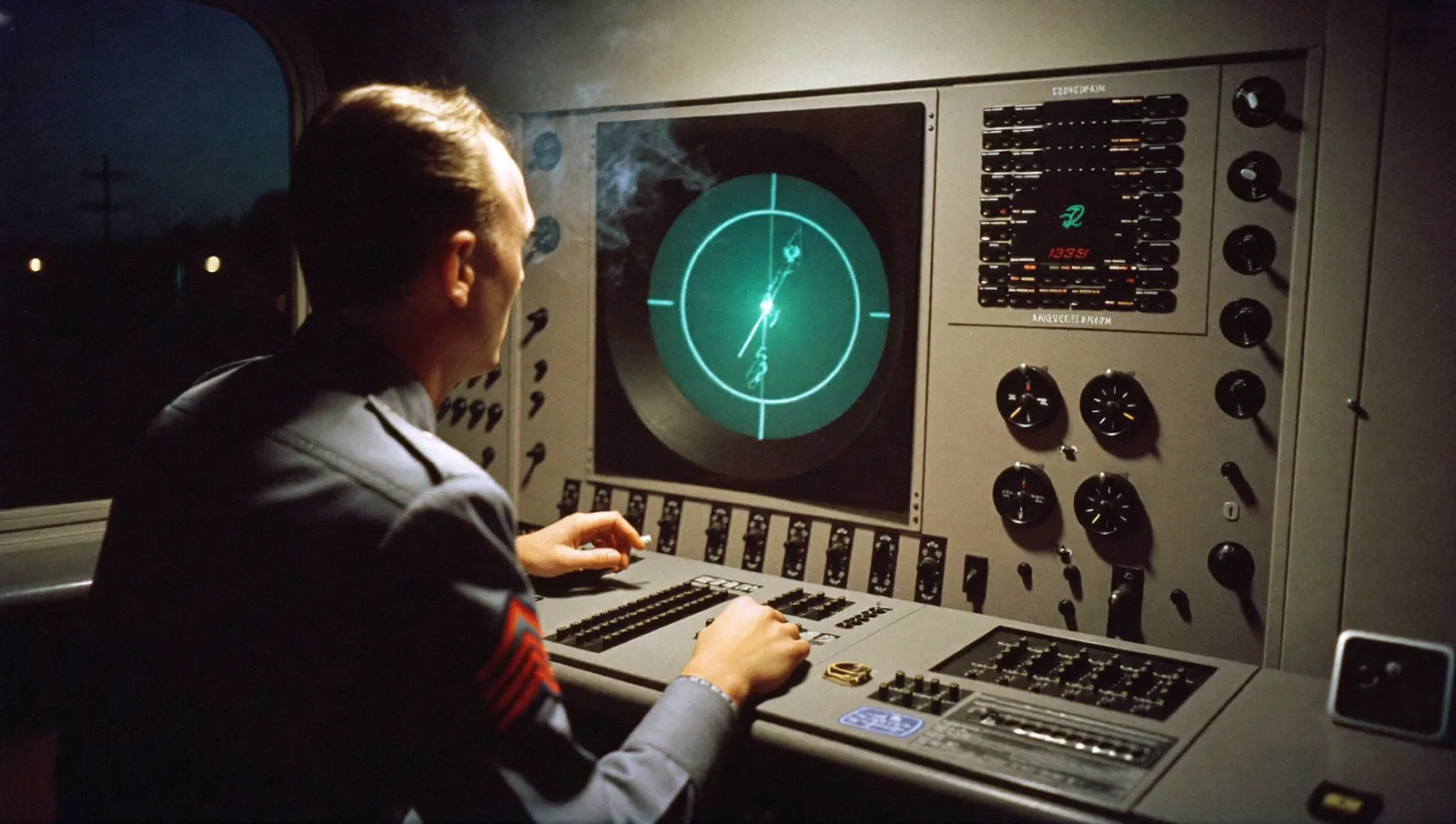
First a group of twelve to fifteen targets, moving together to the north-east at between 80 and 125 mph, preceded by three more in a triangular formation with perhaps a thousand feet between them. The group was tracked from eight miles south-west of the base out to forty miles north-east, at which point — in the language of the report that went up the chain — they “appeared to converge into one very large object”, a blip several times the size of the return from a B-36 bomber. That alone would have made for an unusual watch.
The thing that passed under the C-47
At around 22:00Z the Bentwaters GCA picked up a single target crossing the field from east to west at a speed the operators put at somewhere near 4,000 mph. At effectively the same moment, the control tower reported a bright light passing over the airfield east to west at about 4,000 feet, and the pilot of a C-47 transport flying over the station at that height radioed that a bright light had streaked beneath his aircraft, east to west, at terrific speed.
Three independent channels — ground radar, ground eyes, air eyes — converging on one event inside the same minute. Bentwaters then rang the Radar Air Traffic Control Center at RAF Lakenheath, twenty miles north-east of Cambridge, and asked the question that opens every retelling of this case: do you have any targets on your scopes travelling at 4,000 mph?
Lakenheath takes over
They didn’t, at first. What Lakenheath’s controllers found instead was a stationary echo some 20 to 25 miles south-west of the base — strange in a specific, technical way, because the radar’s moving-target indicator should have suppressed the return from anything travelling below roughly 40 to 50 knots, and yet the operators could detect “no movement at all” from it. Lakenheath’s own GCA unit was asked to look, and confirmed the same echo in the same place.
Then it moved. It ran north-north-east at a speed the controllers afterwards calculated at 400 to 600 mph, and — this is the detail everyone fixes on — in their words there was “no build-up to this speed; it was constant from the second it started to move until it stopped.”
It repeated the trick. Straight legs of eight to twenty miles, always around 600 mph, always with no apparent acceleration or deceleration, separated by stationary intervals of three to six minutes. That is not the flight profile of an aircraft, and it is not the flight profile of a meteor either.
Ten minutes behind a Venom
At that point Lakenheath telephoned the chief fighter controller on duty at RAF Neatishead in Norfolk, and the RAF took the night off the Americans. Two de Havilland Venom night fighters were scrambled from RAF Waterbeach in Cambridgeshire, each crewed by a pilot and a navigator working the aircraft’s own airborne radar.
The first Venom was vectored onto a target. Its navigator, who had the aircraft’s radar in front of him, called it the “clearest target that I have ever seen on radar”. Lakenheath passed that the echo was half a mile dead ahead. The pilot came back with the sentence that made the case famous.
“Roger… I’ve got my guns locked on him.”
Then a pause, and then: “Where did he go?”
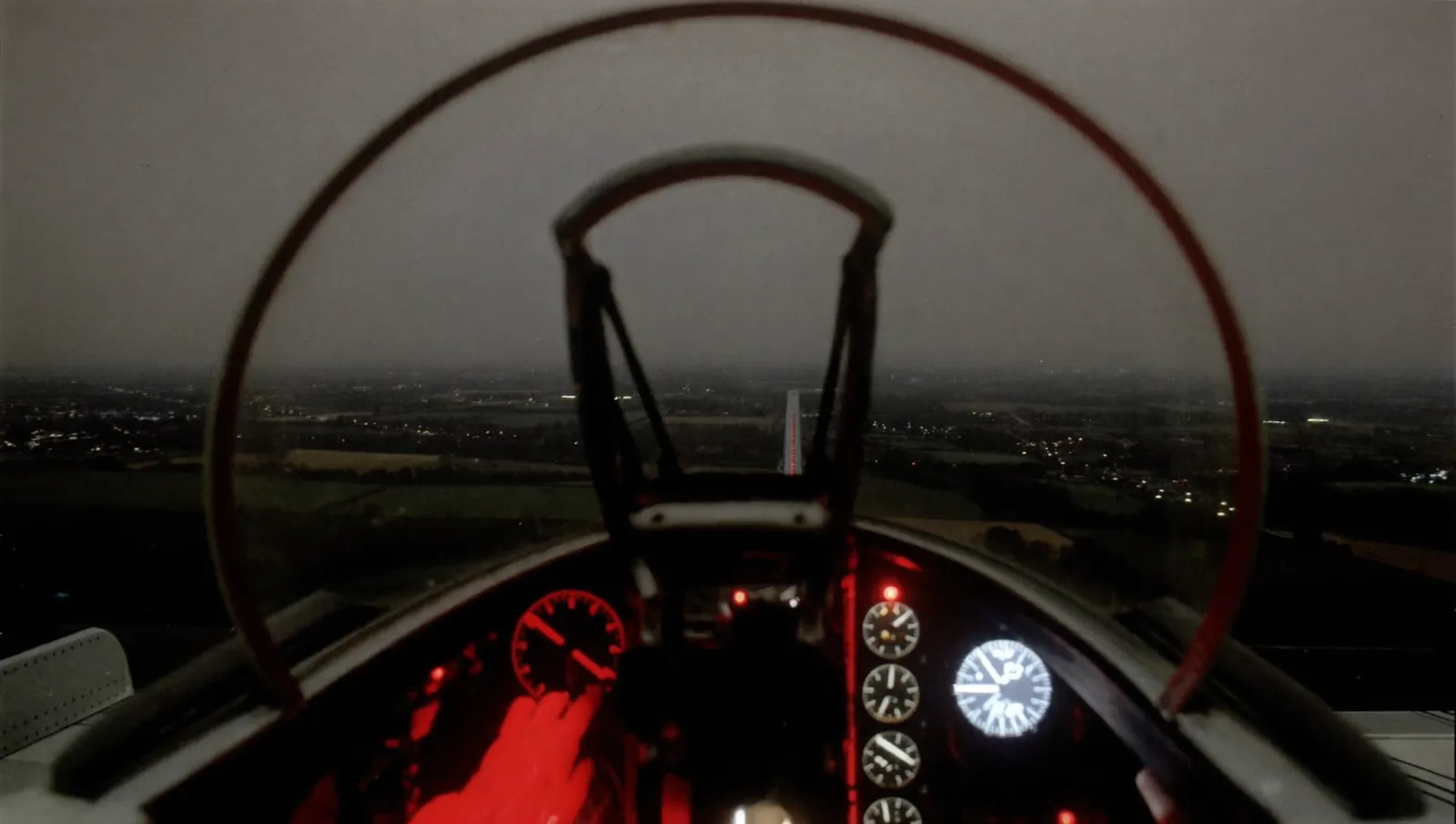
The ground scopes had an answer nobody wanted. The target had moved behind the fighter, and it stayed there. The pilot spent something in the order of ten minutes trying to shake it off with violent manoeuvring and failed; the Lakenheath watch supervisor later described him as “getting worried, excited and also pretty scared”. He broke off low on fuel. A second Venom was airborne but the encounter did not repeat, and radar contact was gone by about 03:30Z.
The pilot’s own verdict, as it was relayed afterwards, was flat and unmystical: “there was something there that was solid.”
The men who wrote it down
Here is where a careful reader should start applying pressure, because provenance is what separates a good case from a great one.
Something was reported at the time. Two teletype transmissions went from Lakenheath to Project Blue Book, dated 17 and 21 August 1956 and identical in substance, and a then-classified teleprinter message went from the 3910th Air Base Group to Air Defense Command at Ent Air Force Base three days after the event. That is more of a contemporaneous paper trail than most 1950s cases can show.
But the narrative everybody quotes — the stop-start target, the gun lock, the tail chase — is not from 1956. It comes from Technical Sergeant Forrest Perkins, the watch supervisor in the Lakenheath RATCC that night, who wrote directly to the University of Colorado’s UFO study team in 1968. Perkins’s letter is the fullest first-hand account in existence, and it is the reason the case appears in the Condon Report at all. It was also written twelve years after the event.
Flight Lieutenant Freddie Wimbledon, the chief fighter controller at Neatishead, went public later still: a letter to The Sunday Times on 19 March 1978, provoked by a piece endorsing Philip Klass’s debunking of the case. That piece was by the astronomer Ian Ridpath, who would go on to become Rendlesham’s most effective sceptic — Suffolk, it turns out, is a small county. Wimbledon backed Perkins on the tail chase and on the solidity of a return he remembered as tracked by three ground sets and one airborne one, but corrected the credit: it was his team who ran the interception, with the Americans listening in.
Twelve years, and twenty-two years. Hold on to those numbers.
The sentence the Condon Report could not avoid
The Scientific Study of Unidentified Flying Objects — the Condon Report, funded by the US Air Force and run out of the University of Colorado — closed the book on official American UFO study. It concluded that further extensive work could not be justified; Project Blue Book shut down in 1969. It remains the most-cited dismissal in the field. Lakenheath wasn’t the only radar-visual case its authors couldn’t close out either: the same report left the American RB-47 electronic-intelligence incident of 1957 filed as an unresolved “unknown”.
Which makes its own Chapter 5 quietly extraordinary. That chapter, on the optical and radar analysis of field cases, was written by Gordon D. Thayer, a radio-propagation physicist. Lakenheath is his Case 2, and his assessment reads:
“In summary, this is the most puzzling and unusual case in the radar-visual files.”
He went further. “The apparently rational, intelligent behavior of the UFO suggests a mechanical device of unknown origin as the most probable explanation of this sighting,” he wrote — before immediately adding, “However, in view of the inevitable fallibility of witnesses, more conventional explanations of this report cannot be entirely ruled out.” Elsewhere in the same analysis he concluded that “although conventional or natural explanations certainly cannot be ruled out, the probability of such seems low in this case and the probability that at least one genuine UFO was involved appears to be fairly high.”
Read that carefully, because it is routinely oversold. “Mechanical device of unknown origin” is deliberately agnostic — a made thing whose maker is unknown, not a spacecraft. What it is not is a debunking, and it sits inside the report whose front matter is used to end arguments. Thayer thought well enough of the case to write it up again for the American Institute of Aeronautics and Astronautics’ UFO Subcommittee, as “UFO Encounter II” in Astronautics & Aeronautics, September 1971.
Blue Book itself was less impressed, or perhaps just less organised. Its file on the incident is large and, in James McDonald’s description, confusing — and despite the case’s later reputation it was never carried on Blue Book’s official list of “unknowns”. J. Allen Hynek, Blue Book’s astronomical consultant, floated ionised meteor wakes as a radar explanation; Thayer rejected it on physics, noting the frequencies involved were around two orders of magnitude too high and that nothing in the reported movement resembled a meteor trajectory.
The sceptical case, at full strength
Philip J. Klass, the aviation journalist who spent decades taking these cases apart, had a specific answer rather than a shrug, and it deserves stating properly.
His argument was that the Lakenheath contacts came from a malfunctioning moving-target-indicator unit — the circuit that filters out stationary ground clutter, which when it misbehaves can generate exactly what was reported: echoes that appear to sit still and then jump. Add anomalous propagation, in which a temperature inversion bends the radar beam down onto ground features and returns them as phantom targets, and you have a well-known 1950s failure mode. For the visual side, Klass pointed at the Perseids: the shower peaks in the second week of August, and 13 August 1956 sits squarely on it.
None of that is hand-waving. Anomalous propagation has ruined more radar-UFO cases than every other explanation combined, and valve-era radar was riddled with it. Nor should anyone gloss over the two structural weaknesses on the other side: the load-bearing account is a twelve-year-old memory, and the original scope photographs, radar plots and duty logs no longer exist.
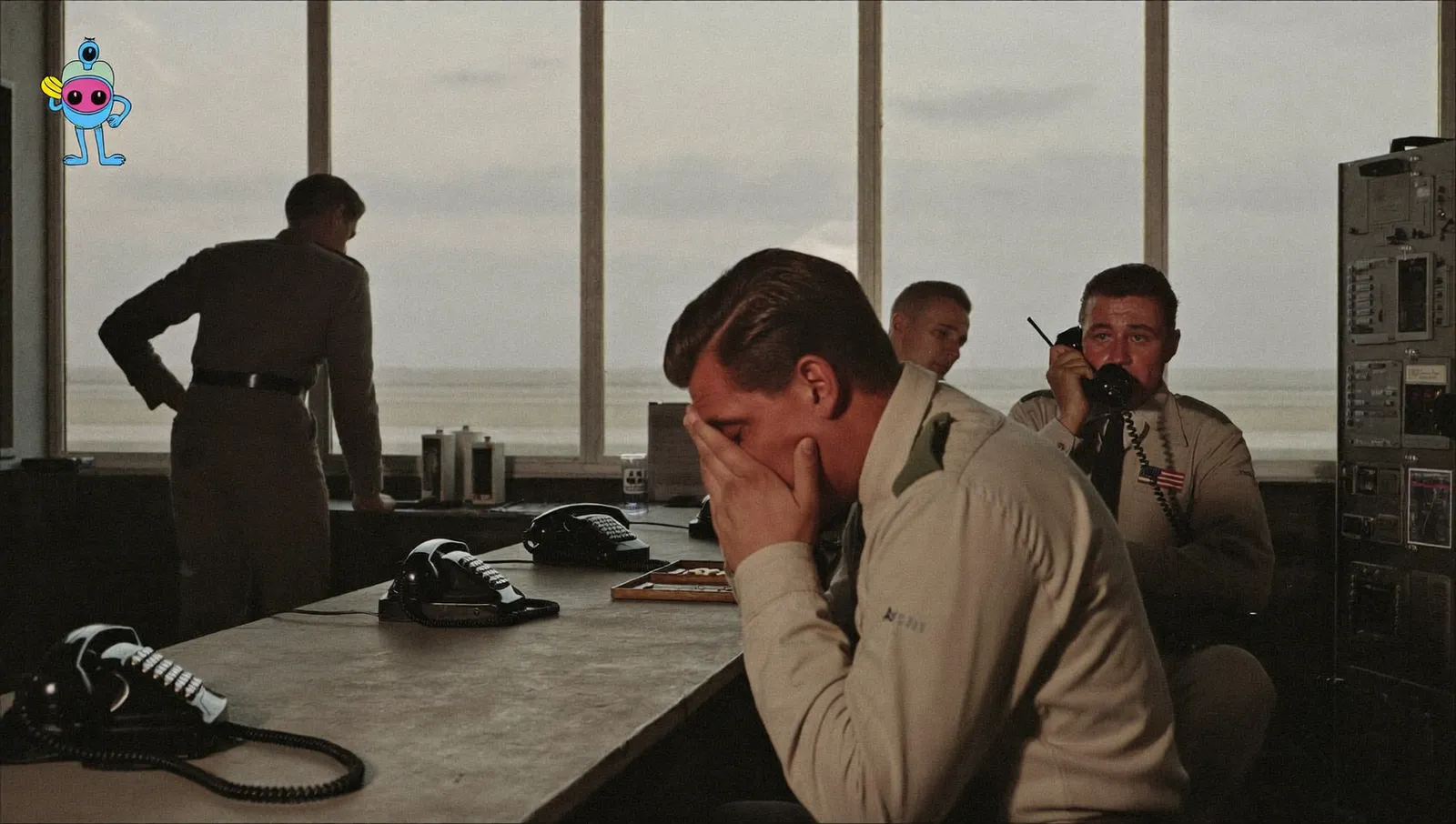
The counter-argument is that the sceptical explanation has to work harder than it looks. Thayer, whose professional speciality was radio propagation, considered it and thought it unlikely here — largely because the scopes were otherwise clean, and an atmosphere producing false echoes tends to produce a rash of them rather than one disciplined target. James E. McDonald, the University of Arizona atmospheric physicist and the most technically serious UFO proponent of the era, made the same point at length in Flying Saucer Review in 1970: the earlier Bentwaters contacts and the object’s non-ballistic manoeuvring fitted neither meteors nor propagation. Meteors do not stop for four minutes and then leave in a different direction.
Later work has not closed it either way. Martin Shough, who catalogued twenty-one ground and airborne radar-UAP contacts for NARCAP, published an analysis of Lakenheath in 1987 and then, with David Clarke and Andy Roberts, assembled a far larger dossier after 2000 from new testimony and documents. Their result was not vindication but complication: the night is messier and more layered than either 1969 camp assumed, Perkins and Wimbledon disagree about who controlled what, and no surviving record can arbitrate. Of the original RAF radar paperwork, nothing remains; the Air Ministry’s own investigation files were routinely destroyed in 1962.
Why a 1956 case still matters
Strip the era away and Lakenheath is the argument people are having right now. When the Nimitz encounter is debated, the real question is corroboration across independent sensor types: did the ship’s radar, the aircrew’s eyes and the targeting pod all register the same object, and can that be shown? Lakenheath is that structure run in 1956 with valves and grease pencils — multiple ground radars, an airborne radar, ground and air visual, an attempted intercept, and an official signal filed within days.
It is also a warning. This case had nearly everything the modern debate claims to want, and seventy years on it still cannot be settled — not because the event was too strange, but because the data was thrown away. The bottleneck was never the phenomenon. It was the filing cabinet, which is precisely the argument now being had about how long radar data is retained.
The UAP Times take
Lakenheath–Bentwaters earns a Credible rating, four out of five on our scale, and the rating is genuinely hard-won in both directions.
In its favour: the witness quality is about as good as this field gets — air traffic controllers, radar operators, a transport pilot and a night-fighter crew, none with anything to gain — and the redundancy across independent instruments is close to unmatched in the historical record. Better still, the case survived a government-funded study that set out to close the subject down, and whose own technical chapter conceded it could not explain this one.
Against it: the primary documentation is gone. The narrative rests on a letter written twelve years later, corroborated by another written twenty-two years later, and the two do not entirely agree. And the prosaic explanation is not silly — a faulty MTI circuit on a busy Perseid night really happens.
Our reading is that “unexplained” is the honest label, and that unexplained describes the evidence rather than standing in for a conclusion. It is not shorthand for aliens, and it is not shorthand for a broken radar either. Gordon Thayer had every professional incentive to file this one under propagation, and was better qualified to do so than almost anyone alive. He declined — and seventy years on, that remains the most interesting fact about the night of 13 August 1956.
Further reading: for what happened a few miles away twenty-four years on, see Two Nights in Rendlesham Forest. For the American radar-visual case that came first, see the Washington flap of 1952, and for the modern standard everyone now argues about, The Tic Tac at 25. The Lakenheath object was only ever reported as a light — see sphere / orb in our field guide, and find it on the sightings map. For the department’s modern position on the subject, see Britain’s UAP transparency gap.
Follow the file
Every new dispatch from the UAP desk, in your inbox. Sourced, sceptical, and no more than one email a week.