
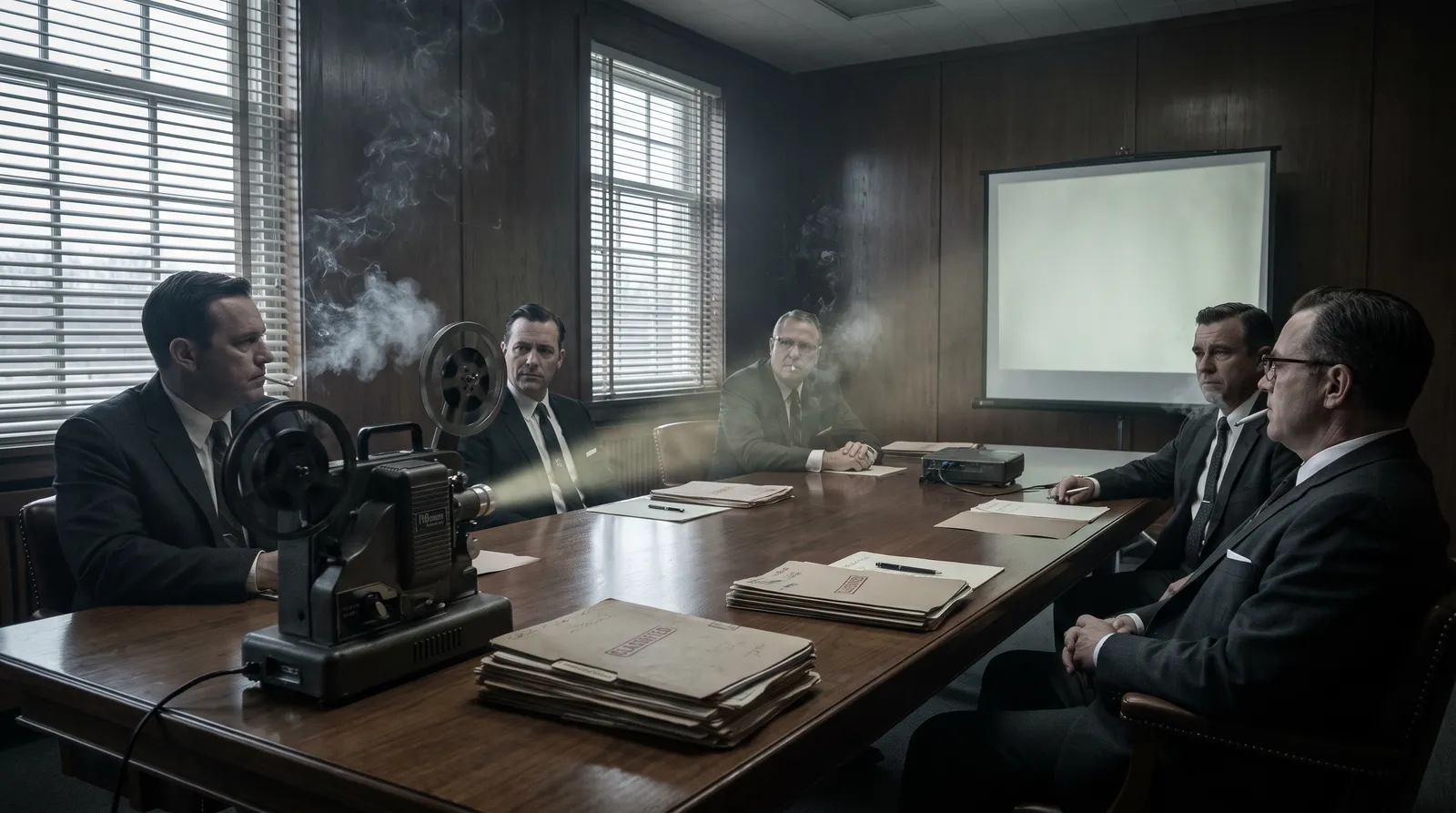
Most of the founding myths of the UFO field are hard to pin down. A balloon here, a rumour there, a witness who changed their story in 1989. The Robertson Panel is different. It met, it kept minutes, and the CIA itself later put the paperwork online. If you want to know why the US government’s public line on UFOs went cold in the 1950s, the answer is not a rumour. It is a document you can read.
The panel sat for four days in January 1953, and its recommendations were not really about whether visitors were here. They were about how to make the public stop talking about it. Both halves of that sentence matter, and the second one has been argued over ever since.
Why the CIA got involved
The summer of 1952 was the busiest the Air Force ever recorded, and the high point was the pair of radar-and-visual flaps over Washington in July, which we cover in our piece on the Washington flap. Jets were scrambled. A newspaper-reading public was told, in effect, that something unexplained had been tracked over the White House. The Air Force’s Project Blue Book, then run by Captain Edward Ruppelt, was drowning in reports.
The CIA’s concern was not primarily little green men. Its Office of Scientific Intelligence, under H. Marshall Chadwell, was worried about two practical things. One was that a flood of saucer calls would clog the reporting channels the military would depend on in a real Soviet attack. The other was that a credulous, jumpy public could be manipulated by a hostile power. Chadwell pressed for an outside scientific review, and in January 1953 it was convened.
Who was in the room
The chair was Howard P. Robertson, a Caltech physicist who had worked on weapons evaluation and carried real weight in Washington. With him sat Samuel Goudsmit, a physicist who had led the wartime Alsos mission; Luis Alvarez, the future Nobel laureate, then deep in radar and particle work; Thornton Page, an astronomer with operations-research experience; and Lloyd Berkner, a radio and ionosphere specialist.
J. Allen Hynek, Blue Book’s astronomical consultant, and Frederick C. Durant, a CIA consultant who wrote up the proceedings, took part as associate members. Ruppelt and other Air Force intelligence officers briefed the panel. The formal record is known as the Durant Report, after its author.
Note what the panel was not. It was not a field investigation, and it did not interview witnesses. It was five senior scientists with day jobs being shown the Air Force’s best material and asked what they made of it.
The two films
The centrepiece was photographic evidence: the Tremonton film and the Great Falls film. The Tremonton footage was shot on 2 July 1952 by Navy photographer Delbert C. Newhouse, who filmed a cluster of bright objects from a roadside in Utah. The Great Falls film was taken at Montana’s Great Falls on 15 August 1950 by Nick Mariana, a baseball club manager, who recorded two bright lights; the date itself is disputed in the literature.
Navy photo analysts had spent a very long time on Tremonton and had reportedly concluded the objects were not aircraft or birds. The panel disagreed. Members suggested the Tremonton objects were birds catching the sun, a view Alvarez was among those to advance, and that the Great Falls lights were consistent with reflections off aircraft. We have covered the Newhouse film’s later history in our look at the Pentagon’s sixth file release.
Neither verdict was proved in the room. Newhouse’s film was reanalysed after the panel met, and the arguments about gulls versus something else have run on for decades. The panel did not settle the films. It simply declined to be impressed by them.
What the report concluded
The headline findings, as the declassified record puts them, were measured. The panel found no evidence of a direct physical threat to national security. It judged that reasonable explanations could be offered for the great majority of sightings, and that nothing in the cases it was shown required a new physics or an outside intelligence. It did not rule out that some reports were unexplained, a point sceptics sometimes forget.
The interesting claim was the indirect threat. The panel worried that the public fascination itself was the hazard: reporting channels overloaded by harmless sightings, and a population primed for panic. The cure it proposed was not further study. It was an education programme.
The recommendations nobody forgot
That programme is the part of the Durant Report that gets quoted. The panel recommended that the national security agencies take steps to strip UFOs of the special status and aura of mystery they had acquired, and that the public be trained and educated to recognise ordinary phenomena. The word it used for the approach was debunking.
It was specific about the tools. The report suggested using mass media, television and film, and named the Walt Disney studio as a possible partner, as well as using military training to teach personnel how to identify what they were seeing. It also recommended that civilian flying-saucer groups be watched, citing by name organisations then active in California and Wisconsin, on the grounds that they could influence public opinion and might be a route for subversive messaging.
Read cold, that is an extraordinary list for a scientific panel to produce. Read in context, it is a Cold War memo written by people who had seen how radio broadcasts could cause real panic, and who were anxious about Soviet psychological warfare. Both readings are true at once, which is why the document is so durable as a Rorschach test.
What happened next
The panel’s report was classified at first, and the Air Force released only part of it, in 1958. The CIA later declassified more. In the meantime its logic showed up in policy. The Air Force tightened its handling of reports, Ruppelt left Blue Book during 1953, and the service’s regulations from that year narrowed what officers could say publicly about sightings.
The CIA’s own retrospective, a 1997 study by the agency historian Gerald K. Haines, described the panel as having recommended debunking and as having shaped how the agency stepped back from the topic. Haines noted that, afterwards, the CIA’s formal interest receded while its interest in what the Soviets might do with the subject continued. That is a long way from a cover-up of crashed craft, and it is also a long way from indifference.
The sceptic’s case, and the believer’s
The sceptic’s defence of the panel is stronger than its critics like to admit. The five men were not fools or stooges. Most UFO reports then, as now, do turn out to have ordinary explanations, and the panel’s central scientific judgement has held up well. Blue Book’s own later record, and the Condon Report in 1968, reached a similar overall view, though they differed on the unexplained remainder.
The sceptic would add that worry about information overload and panic was reasonable for 1953. The Soviets had the bomb, the Air Force had real reasons to guard its radar nets, and a switchboard full of saucer calls was a genuine operational problem.
The critics’ case has its own weight. Hynek, who was in the room, later complained that the review was brief and the outcome looked set in advance. The commonly cited tally is only a handful of hours spent on actual cases across the four days, though that figure comes from critical retellings rather than the minutes. The panel looked at a few selected cases, mostly ones with prosaic answers available. And its remit was framed around reducing public interest, not weighing the best evidence on its merits.
The deeper objection is the one that matters for today. A panel that sets out to reduce interest in a subject will tend to find reasons to. Whether the 1953 scientists were drawing a conclusion or carrying out an assignment is a question the paper trail allows you to ask but not to settle.
The UAP Times take
The Robertson Panel is as well documented as any episode in this field. The report and its minutes are in the CIA’s own reading room, the participants are named and their roles are not in dispute, and the agency’s historian has acknowledged the debunking recommendation in print. That earns it a Well-sourced rating, five out of five on our scale. The rating is for the record, not for any one reading of it: the minutes show what was recommended, and leave the motive for you to judge.
Our reading is that the panel was mostly right about the cases and mostly wrong about the remedy. The sightings in front of it were largely explicable. But the instruction to demystify the subject taught a generation of officials that the safe answer was to say as little as possible, and that habit is still being unlearned. Seventy years on, the interesting question is not whether the CIA once wanted the public to take UFOs less seriously. It is how much of today’s secrecy fight is that decision still working its way through the system.
Further reading: The Washington Flap of 1952, The Condon Report: How a Half-Million-Dollar Study Closed the Book on UFOs and Kenneth Arnold and the Nine Objects.
Follow the file
Every new dispatch from the UAP desk, in your inbox. Sourced, sceptical, and no more than one email a week.