
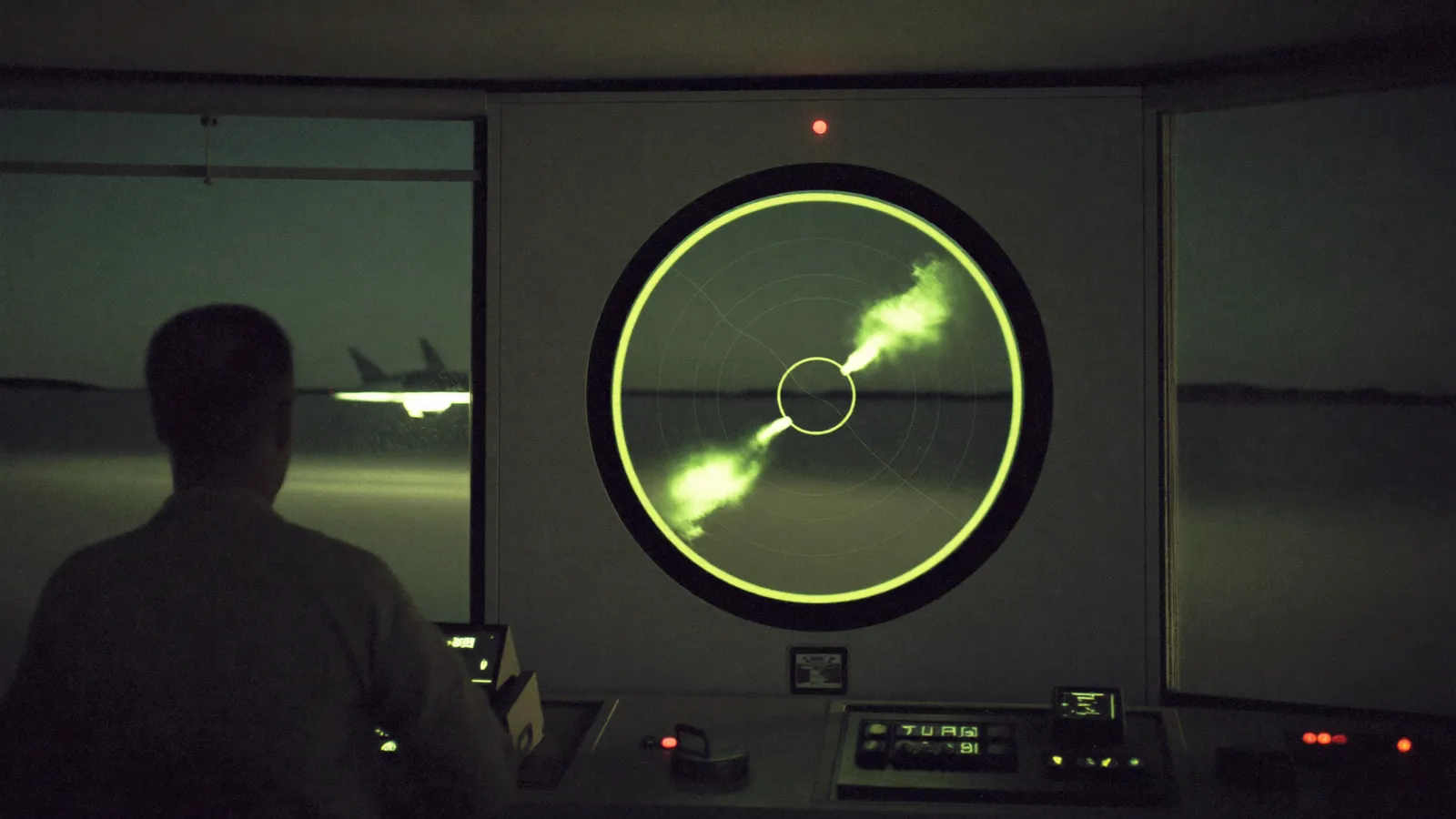
Ask a sceptic why so many radar-backed UFO reports fall apart under scrutiny, and the answer usually arrives in one word: propagation. Not because radar lies, exactly, but because it is far easier to fool than most people assume, and the ways it gets fooled have names, decades of peer-reviewed literature behind them, and a habit of producing targets that look, on a 1950s scope or a modern one, exactly like a solid manoeuvring craft. This is that physics, in full — and, just as importantly, the small number of documented radar-visual cases where the analysts who understood these mechanisms best looked straight at them and said: not this one.
What a blip actually is
Start with what radar does not do. It does not photograph an object. A pulse goes out, some of its energy bounces back, and a receiver measures how long that took and from which direction. Everything else — shape, size, “solidity” — is inference, built by software that strings successive returns together into a track and then calculates speed and heading from the sequence.
That last step matters more than it sounds. A radar system rarely measures velocity directly; it infers it by matching one return to the next and dividing distance by time. When that matching goes wrong — the software drops a genuine target and picks up a different return several miles away — the arithmetic can produce an acceleration no physical object could survive. That failure mode, not anomalous propagation, is the likely explanation behind the 1,252-knot “balloon” track logged over America in February 2023: a track-correlation glitch, dressed up by clean numbers on a screen. It is worth holding in mind precisely because it is a different mechanism from the ones below, and conflating the two is how bad debunkings happen as often as bad believing.
The beam that bends: anomalous propagation
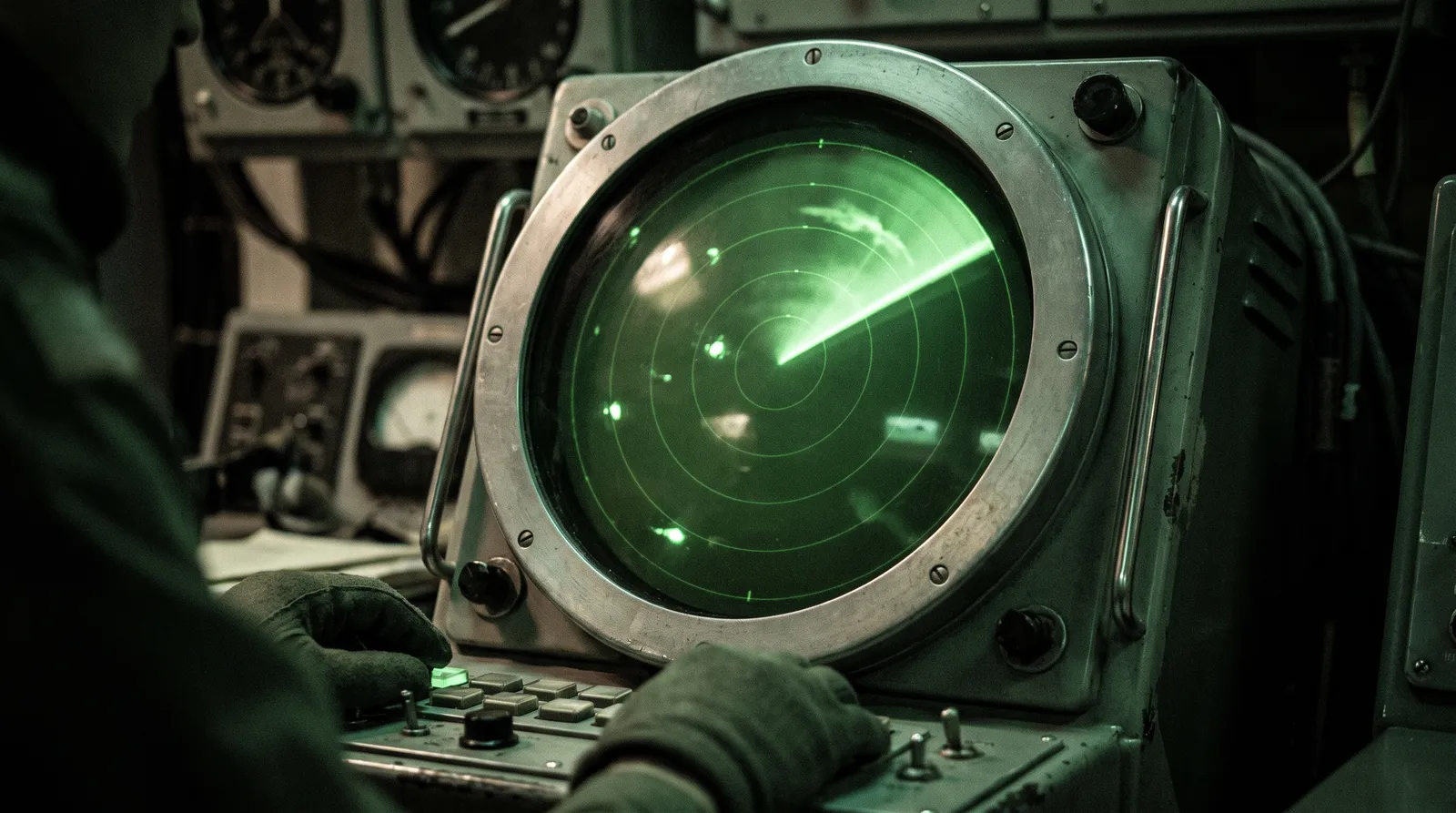
The mechanism with the best claim to fame is anomalous propagation (AP), and it is genuine physics with a precise cause. A radar beam’s path depends on the atmosphere’s refractive index, which normally decreases gently with height, bending the beam very slightly downward as it travels. A temperature inversion — warm air sitting over cooler, denser air near the surface, common on calm, humid nights — sharpens that gradient dramatically. According to the US National Weather Service’s JetStream training resource, the result is a beam refracted so strongly toward the ground that it strikes terrain, buildings, ships or open water far beyond the radar’s intended coverage, and returns those reflections as if they were legitimate targets at range.
In the most extreme case the beam gets trapped entirely between the inversion layer and the ground, ducting along like a wave in a pipe and bouncing repeatedly off the surface. Because the layer producing all this is itself unstable — rising, thinning, breaking apart with the smallest change in wind or humidity — the false returns it generates can appear from nowhere, vanish just as suddenly, and jump in apparent position in a way that looks, to an operator with no other information, exactly like a manoeuvring object rather than a mirage. This is the mechanism the US Air Force blamed for the Washington flap of July 1952, when unidentified blips tracked across three independent radar sets over the capital sent jets scrambling on two consecutive weekends.

Angels in the clutter
AP is not the only source of a phantom target, and the older radar literature has a word for the whole category: angels — returns with no obvious physical cause. Researchers spent much of the 1950s arguing over what produced them, and the current consensus, laid out by David Zrnić and Alexander Ryzhkov in a 2007 paper in the Journal of Atmospheric and Oceanic Technology, credits most diffuse “clear-air” angel echoes to insects and most sharp, coordinated point-target angels to birds. A flock migrating in loose formation can paint as a cluster of discrete returns moving together at 40–60mph — not far off the “twelve to fifteen targets… moving together” reported over Suffolk on the night Lakenheath and Bentwaters made history.
Two more mundane sources round out the list. Chaff — fine metallic strips dispersed during military exercises to test or defeat radar — drifts on the wind for hours after release and can generate slow, diffuse clusters days after the exercise that dropped it. And ground clutter itself, the mass of returns from buildings, hills and terrain that every radar has to filter out just to be usable, depends on a circuit called a moving-target indicator (MTI) to do the filtering. When an MTI circuit misbehaves, it can either let clutter through as apparently stationary “targets” or, worse, generate returns that look like they are jumping between fixed points. That specific failure — a faulty MTI, not a mystery craft — was the aviation journalist Philip Klass’s proposed explanation for the Lakenheath contacts in 1956.

How you actually tell the difference
None of this is hopeless to untangle, which is the part sceptics and enthusiasts both tend to skip. Since 2012–2014 the US National Weather Service’s NEXRAD network has carried dual-polarisation upgrades, transmitting pulses on both horizontal and vertical planes and measuring how differently they scatter. Raindrops return a highly uniform signal; birds and insects, being irregular and often airborne in loose swarms, return a much noisier one — a difference meteorologists now use every spring and autumn to strip migrating birds out of precipitation maps in near real time, as NOAA’s BirdCast project documents in detail.
That capability did not exist for any of the classic Cold War cases, and it still is not standard on the military and civil-aviation radars most modern encounters run through. Where it is not available, the discriminator has to be corroboration: does more than one independently operated sensor, ideally of a different type, agree on the same track at the same time? The All-domain Anomaly Resolution Office says as much about its own process. Its FY2025 annual report describes cross-referencing radar contacts against air-traffic logs, satellite catalogues and weather data, and — new that year — running three-dimensional simulations to test whether a candidate explanation, such as a balloon at a given altitude and wind vector, actually fits the geometry. That combination of methods is how the office says it resolved 238 separate reports as satellite flares and another 114 of 319 recent cases as balloons, birds, aircraft, drones or a single manned jet pack.
The case propagation was blamed for
Washington 1952 is the textbook illustration of just how far a prosaic explanation can stretch, and how uncomfortably it can still sit. When General John Samford told the largest Pentagon press conference since the war that the blips were a temperature inversion, he was describing a real and common phenomenon on a hot, humid Washington July night — one that also neatly explains why the scrambled F-94 interceptors found nothing, since a duct produces returns from the ground, not from anything actually at altitude. What has never been settled, as we set out in the full case file, is whether an inversion strong enough to fool three separate radar operators was actually present that night, a question the atmospheric physicist James E. McDonald argued the Air Force never adequately measured.
The case propagation couldn’t cover
Lakenheath–Bentwaters, four years later, is the harder problem, and it is harder for a specific technical reason rather than a vibe. Gordon D. Thayer, the radio-propagation physicist who wrote the Condon Report’s radar chapter, considered anomalous propagation for the Suffolk case and largely set it aside — because a duct throwing back ground clutter tends to flood a scope with a rash of similar false returns, not produce one disciplined, isolated target that a night-fighter’s own airborne radar then locked onto and lost behind itself. Thayer’s verdict, that the case’s “apparently rational, intelligent behavior… suggests a mechanical device of unknown origin,” is often oversold — it explicitly does not rule out witness error — but it is also the assessment of the one person in the room best qualified to invoke propagation, declining to. A near-identical argument played out over the American RB-47 incident the following year, where the sceptical case rested partly on a ground station picking up sidelobe energy from another transmitter rather than a true target — a real mechanism, contested by the same standard of “does the timing actually fit”.
A different order of problem: the Nimitz radar tracks
The 2004 Nimitz encounter belongs to a separate evidential category from either of those, because the claim on the table is not one anomalous blip but a multi-day pattern: the USS Princeton’s SPY-1 radar reportedly logged unusual contacts over roughly a week before the visual intercept and the FLIR1 video that followed. A single duct or angel echo does not naturally produce that kind of persistence. The sceptical case here has correspondingly had to get more specific — Mick West, who has spent years picking apart the Navy’s released footage, has floated a Cooperative Engagement Capability sensor-fusion glitch as one candidate mechanism for the radar side specifically, distinct from his separate argument that the FLIR video shows a distant, ordinary aircraft. Neither explanation is confirmed, and the case remains, as our own deep dive concludes, genuinely open rather than solved in either direction.
Why the tape matters more than the theory
Here is the uncomfortable symmetry running under every mechanism above: propagation, angel echoes and MTI faults are all, in principle, distinguishable from a real target — but only by examining the raw signal, not a summarised track. Elevation angle, signal strength across the beam, correlation coefficient, the presence or absence of clutter nearby: that is where the diagnosis lives. A “computed” speed or a clean video clip tells you almost nothing on its own, which is exactly the finding of the recent preprint working through all 112 PURSUE sensor videos released by the Pentagon: not one contained the four quantities needed to turn pixels into a genuine speed. Radar has the same problem one layer down, and in the United States it is compounded by a records schedule that erases the underlying data extraction recordings after 45 days — which means the physics above can be applied to a live case, but rarely to an old one.
The UAP Times take
This one earns a Credible rating — four out of five on our scale — which in this case describes the physics rather than any single incident. Anomalous propagation, angel echoes and MTI faults are established, peer-reviewed mechanisms with a real paper trail behind them, not hand-waves; the National Weather Service, the American Meteorological Society’s own journal and seventy years of Air Force files all agree on how they work.
What keeps this at a four rather than a five is the honest limit of what that explains. These mechanisms account for a large share of historical radar-UFO reports, and they were genuinely the right call in plenty of cases nobody now argues about. They do not, on the documented technical grounds Thayer laid out, comfortably cover Lakenheath, and they do not obviously cover a week of persistent SPY-1 contacts either — and the sceptical alternatives offered for those two, a malfunctioning MTI circuit and an unconfirmed sensor-fusion glitch, are themselves plausible rather than proven. Radar is not a lie detector. It is an instrument with well-understood failure modes, a handful of cases that don’t fit them, and — increasingly — not enough surviving data to tell you which is which.
Further reading: The Washington Flap of 1952 and Lakenheath–Bentwaters, 1956: The Night Every Radar in Suffolk Agreed. For the optical version of the same problem — sunlight glinting off satellites — see satellite flares and the UFO reports they manufacture.
Follow the file
Every new dispatch from the UAP desk, in your inbox. Sourced, sceptical, and no more than one email a week.