
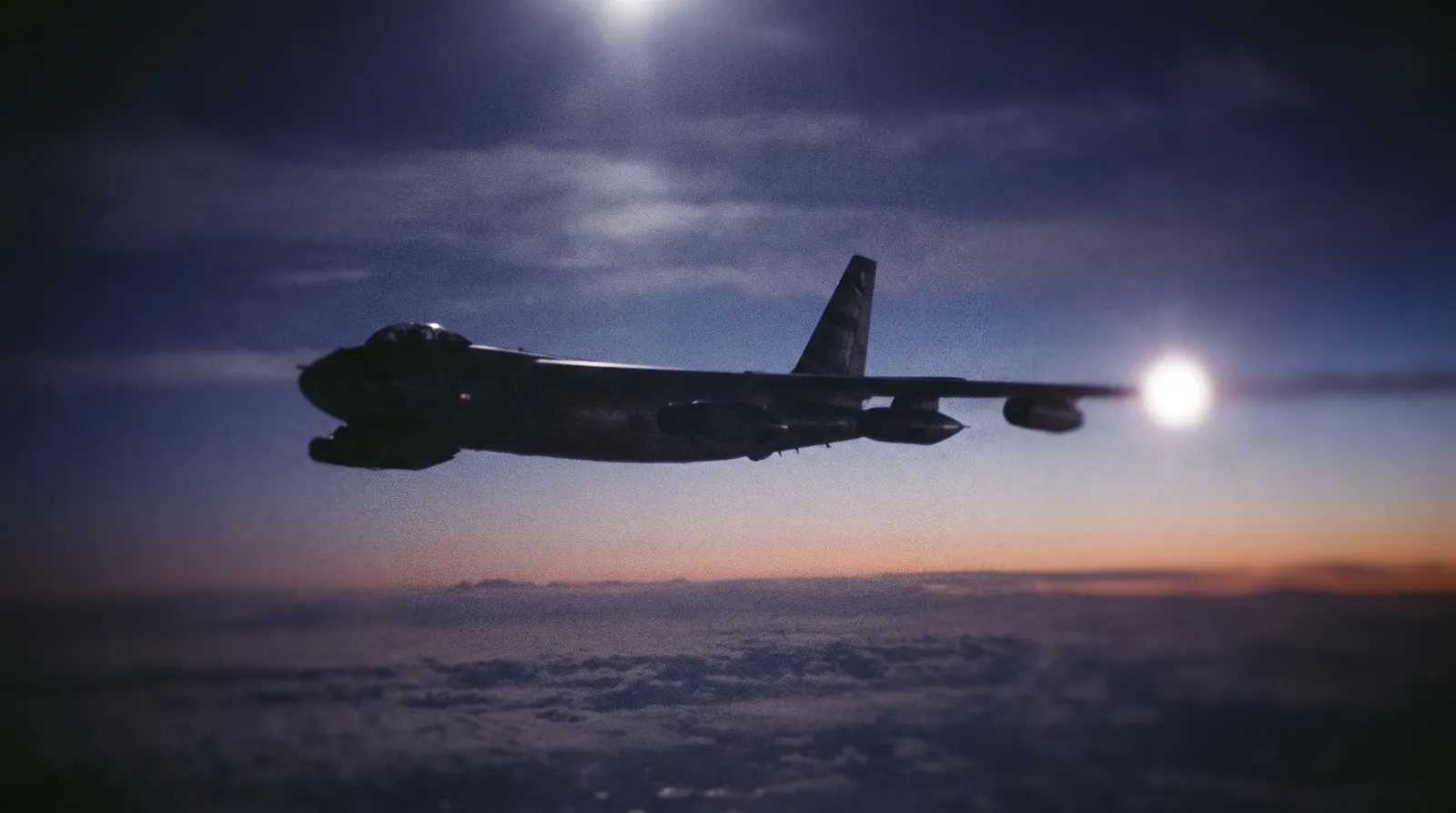
Most Cold War UFO cases give you a light in the sky and a scared witness. The RB-47 incident gives you a light in the sky, a scared witness, a second witness in the cockpit next to him, an intelligence-gathering aircraft’s own electronic sensors logging the same object on the same bearing, and an independent Air Defense Command radar station a hundred miles away confirming it on its own scope — all inside the same ninety minutes. It is the reason Cold War electronic-warfare officers still get asked about their old service, and one of the small handful of cases the US government’s own dismissal-minded study could not close out.
A training run, not a ghost hunt
On the night of 16–17 July 1957, an RB-47H — a reconnaissance version of Boeing’s B-47 Stratojet, tail number 53-4299, of the 55th Strategic Reconnaissance Wing out of Forbes Air Force Base in Topeka, Kansas — flew a routine composite training mission: gunnery practice over the Gulf of Mexico, a navigation leg out over open water, then an electronic countermeasures (ECM) exercise on the way home across the south-central United States. Six officers were aboard: pilot Lewis D. Chase, copilot James H. McCoid, navigator Thomas Hanley, and three ECM specialists at their consoles — John Provenzano, Frank McClure and Walter Tuchscherer.
This is worth underlining before anything strange happens. Nobody involved was a hobbyist scanning the horizon. The three men in the back of the aircraft were trained to distinguish a real hostile radar emission from noise, and their equipment existed for exactly one purpose: locating and classifying other people’s radar signals with precision. When their story gets picked apart decades later, it is their professional competence being argued over, not a stranger’s impression of a light in the dark.
A signal that shouldn’t have been there
Just before 4:00am Central time, as the RB-47 left the Gulf near Gulfport, Mississippi, on the leg home, Frank McClure’s number-two ECM monitor picked up an airborne signal to the aircraft’s right rear at roughly 2,800 megacycles — a frequency band typically associated with ground-based search radar, not with anything that should have been flying alongside them. That alone was odd. What made McClure sit up was how it behaved: the trace crept up his scope as though the display were inverted, then crossed behind the aircraft and continued down the opposite side, tracking a course no stationary transmitter could produce and no equipment fault he recognised could explain.
An ECM operator’s whole training is built around telling a genuine radar emission from an artefact of his own gear. McClure’s report, corroborated independently by his fellow monitors watching their own scopes, was that this behaved like neither: a real signal, on a real bearing, moving in a way that didn’t match anything airborne or fixed that they knew of.
The light that came out of the dark
At around 4:10am, the story stopped being purely electronic. Chase and McCoid, up front in the cockpit, both reported an intensely bright light — described as blue-white, closer to a landing light or a small sun than a star — closing on the aircraft from ahead and to the right, then sweeping past. Two trained aircrew, watching the same instrument panel seconds earlier, now had a shared visual sighting to set alongside McClure’s electronic one, on a matching bearing.
Both men described it, independently, as unlike any aircraft light, flare or celestial object they had encountered in their flying careers — a claim that carries some weight given Chase’s background as an experienced command pilot.
This is the detail that separates the RB-47 case from the great mass of 1950s light-in-the-sky reports: the visual sighting wasn’t the whole story arriving by itself. It arrived stacked on top of an electronic detection that had already been running for ten minutes, on the same side of the aircraft.
Ground truth: Radar Station Utah confirms
Rattled, Chase broke from his flight plan and radioed for a ground-radar check. At 4:48am he raised Duncanville Air Force Station in Texas — call sign Utah, part of the Air Defense Command’s early-warning radar chain — and asked whether they had anything on their scopes matching his reported position. Duncanville came back almost immediately: yes. Their own independent search radar had a return at the same location the RB-47 crew was reporting, a target their operators had no other explanation for.
This is the fact that keeps the case alive nearly seventy years later. A ground station with its own antenna, its own operators and no knowledge of what the aircrew thought they were seeing had a target sitting where the aircrew said one should be. Three physically separate detection systems — human eyes, airborne ECM receivers, and land-based search radar — were reporting the same thing, on the same bearing, without one having primed the other.
Ninety minutes, seven hundred miles
The encounter didn’t end at Duncanville. Whatever the RB-47’s sensors and crew were tracking appeared to pace the aircraft on and off for roughly ninety minutes and over 700 miles of track, from the Mississippi coast, across Louisiana and Texas, and up into Oklahoma airspace before the crew lost contact with it and continued home to Forbes. Investigators who later reconstructed the timeline — most thoroughly the physicist James McDonald in 1971 — flagged several moments where the object seemingly appeared and vanished across two or three of the “channels” (visual, airborne ECM, ground radar) at once, rather than one sensor simply picking up where another left off. That kind of correlated intermittency, rather than any single dramatic sighting, is what the case’s defenders lean on hardest: it is difficult to attribute to three unrelated glitches happening in step.
Blue Book’s verdict, and a case reopened
Project Blue Book, the Air Force’s UFO investigation office, logged the case at the time and it later passed to the Condon Committee, the University of Colorado study commissioned by the Air Force in the late 1960s to give an authoritative, largely sceptical, final word on the subject. The Condon Report tried out several conventional explanations for the RB-47 sightings and rejected each in turn, eventually filing it, in its own dry language, as “unknown” — one of a small minority of cases the notoriously debunking-minded study couldn’t close.
The case might have stayed a footnote had McDonald, an atmospheric physicist and prominent UFO researcher, not gone back to it in 1971. He tracked down and interviewed all six surviving crew members individually, corrected an error that had crept into earlier accounts (some records had the date wrong by two months), and produced what remains the single most detailed reconstruction of the night. His conclusion was unambiguous: of the cases he had examined in over a decade of research, the RB-47 incident was among the hardest to explain by any combination of misperception, equipment fault or hoax.
The sceptic’s case, in full
McDonald’s paper didn’t go unanswered. Philip J. Klass, the aviation journalist who became UFO research’s most persistent professional debunker, wrote his own extensive rebuttal the same year, later expanded into two chapters of his 1974 book UFOs Explained. Klass’s case deserves to be stated plainly rather than waved off, because it is a genuine, multi-part theory rather than a shrug.
His argument ran roughly like this: the initial ECM trace was a scope-alignment fault that made a mundane signal appear to move in an impossible way; the first visual light was a bright meteor; a later sighting was the crew mistaking the star Vega, low on the horizon, for something more solid; and the closing sighting, timed against published schedules, coincided with American Airlines Flight 966 on its approach into Dallas, whose landing lights the crew could plausibly have mistaken for their pursuer. As for Duncanville’s confirming return, Klass proposed the ground station wasn’t detecting an object at all but picking up sidelobe energy — stray radiation leaking sideways from other radar transmitters operating on a similar frequency, which a search radar can occasionally register as a false target roughly where a real one would sit.
It’s an internally consistent theory, and it is worth taking seriously precisely because it doesn’t lean on any single implausible coincidence — it stitches together several ordinary phenomena that, individually, happen all the time. Where it strains is in the stitching: it requires a meteor, a star misidentification, an airliner and a radar sidelobe artefact to have arrived in rough sequence, each correlating with what a different sensor or crew member reported, across a track spanning three states. Brad Sparks, responding to Klass point-by-point in Jerome Clark’s UFO Encyclopedia, argued the timing and geometry required for the meteor and Vega explanations don’t actually fit the crew’s reported bearings, and that Flight 966’s position doesn’t match the pursuit track described. Even researchers who lean sceptical of the case overall, such as writer Tim Printy, have concluded that while Klass’s specific chain of reasoning contains real errors, his broader instinct — that this is explainable by a run of mundane coincidences rather than anything exotic — still holds up better than the alternative.
That is about as fair a summary of an unresolved argument as exists in this field: neither side’s account is airtight, and the case has stayed open for seventy years precisely because both readings require you to accept something a little uncomfortable — either an anomaly that fooled three separate sensor types in sequence, or a chain of ordinary misidentifications lining up with genuinely striking precision.
The UAP Times take
The RB-47 case earns a Credible rating on our scale — four out of five. That sits below the top tier reserved for cases with an official confirmed report and no serious rival explanation, because a real, carefully argued sceptical case exists and has never been fully laid to rest either way. But it sits well above a routine light-in-the-sky report: this is named, trained military aircrew, an independent government radar station, a contemporaneous Air Force case file, and two of the most careful analysts UFO research has produced — one arguing for the phenomenon, one against — both taking it seriously enough to write tens of thousands of words. Whatever the RB-47’s crew actually flew alongside that night, the case remains a genuine textbook example of what a well-instrumented, multiply-corroborated UFO report looks like, for better or worse.
Further reading: Lakenheath–Bentwaters, 1956: The Night Every Radar in Suffolk Agreed and The Nimitz “Tic Tac” Incident: The Complete Deep Dive.
Follow the file
Every new dispatch from the UAP desk, in your inbox. Sourced, sceptical, and no more than one email a week.