
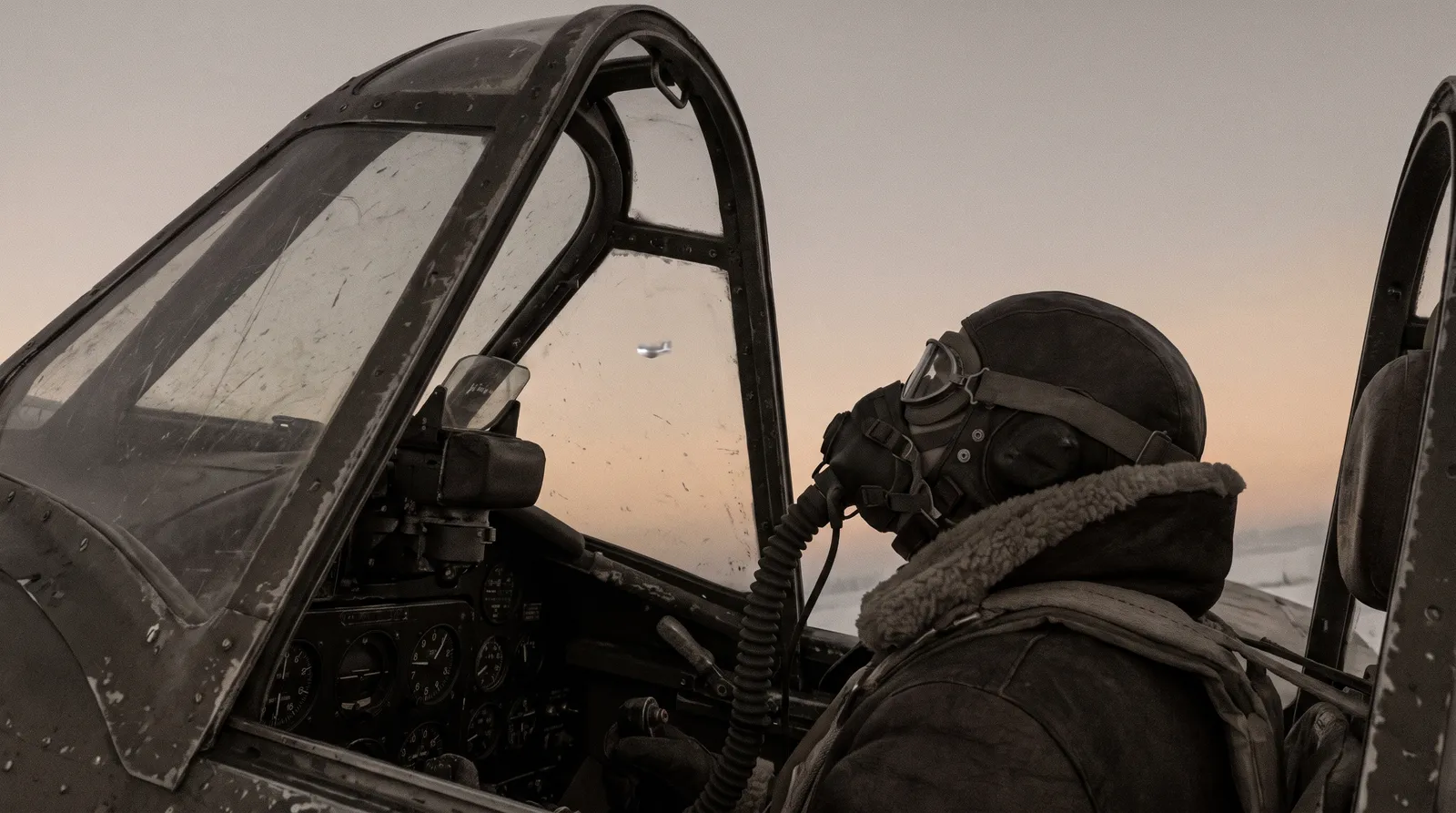
Every list of history’s great unsolved UFO cases eventually reaches one that isn’t really a mystery about a light in the sky. It’s a mystery about why a decorated combat pilot with a wife and a flight school back home climbed his fighter into thin air, alone, chasing something nobody on the ground could agree how to describe — and never levelled off. On 7 January 1948, Captain Thomas F. Mantell became the first person in the modern UFO era confirmed to have died in pursuit of one. The case that resulted is, unlike Roswell, documented from the very first afternoon rather than reconstructed thirty years later — and it is still, honestly, unresolved.
A highway patrolman’s phone call
It started as a stack of ordinary phone calls. At around 1.15pm, the Kentucky Highway Patrol rang Godman Army Airfield, on the edge of Fort Knox, to report an unusual object over Maysville, in the north-east of the state. Twenty minutes later a second call added detail: something “circular, about 250 to 300 feet in diameter,” moving west at a good clip. Then Owensboro rang in. Then Irvington. By 1.45pm, Technical Sergeant Quinton Blackwell, the control tower’s chief operator, stepped outside Godman’s tower and saw it for himself.
This is the detail that separates Mantell from most classic cases before it even gets to the tragedy: the object was not a single witness’s private experience. It was called in, independently, from several points along a line running roughly a hundred miles across Kentucky, in the space of half an hour, by highway patrolmen and control tower staff whose job was precisely to notice things in the sky.
What Godman’s tower actually saw
What they disagreed on was what it looked like — and the disagreement is instructive rather than damning. Operations officer Captain James F. Duesler described it as “like a teardrop, round.” Private First Class Oliver thought it resembled “an ice cream cone topped with red.” Lieutenant Orner logged it as “like a parachute, round, with some red lights around the bottom.” Decades later, in a 1997 interview, Duesler settled on “a strange gray-looking object, which looked like a rotating inverted ice cream cone.”
Four trained observers, watching the same patch of sky from the same airfield, produced four overlapping but not identical descriptions. That is not evidence of a hoax or of incompetence; it is what witness testimony of a genuinely unfamiliar shape, at genuinely uncertain distance, normally looks like. It’s also exactly the raw material sceptics point to when they argue that “unidentified” often means “badly estimated,” not “impossible” — the same distance-and-size problem the Galileo Project built an entire instrument to solve, seventy-odd years later.
Three fighters, then one
Godman’s commanding officer, Colonel Guy Hix, had three F-51D Mustangs of the Kentucky Air National Guard already in the air nearby on a routine ferry flight. Around 2.45pm the tower diverted them to investigate, with Mantell — a 25-year-old flight-school owner and the squadron’s most experienced pilot present — leading.
Climbing without pressurised cabins or, apparently, functioning oxygen masks, two of the three broke off at 22,500 feet and turned back; contemporary accounts name them as Lieutenants Albert Clemmons and B. A. Hammond. Mantell kept climbing alone. His last transmissions, relayed through the tower, were unambiguous: “The object is directly ahead of me and above me now, moving at about half my speed.” Then: “It’s metallic and of tremendous size.” After that, nothing.
Three pilots turned back without oxygen. One kept climbing.
His wristwatch, recovered from the wreckage, had stopped at 3.18pm. His F-51 broke apart during a high-speed descent and came down on a farm near Franklin, Kentucky — a small, grim irony that rarely makes the retellings: Franklin was Mantell’s own hometown. He was the Kentucky Air National Guard’s first flight fatality. Two years earlier he had flown C-47s towing gliders and dropping paratroopers into Normandy on D-Day, and brought a burning, nearly uncontrollable aircraft home from that mission; the Distinguished Flying Cross and an Air Medal with three oak leaf clusters were on his record before this flight ever began. A historical marker now stands near the crash site.
Project Sign’s fast answer: Venus
The Air Force needed something to tell the newspapers immediately, and it reached for the astronomer it had on hand. J. Allen Hynek, brought in as Project Sign’s scientific consultant, concluded that Mantell had most likely climbed in pursuit of the planet Venus — bright, high, and, in the wrong light, capable of producing exactly the kind of fixation a pilot without a horizon reference might develop.
It did not hold up, and to Hynek’s credit he said so himself. By 1952 he had reversed his own finding: Venus was not bright enough on 7 January 1948 to be plausibly mistaken for an object multiple ground observers described as large, metallic and manoeuvring, and contemporary weather notes recorded haze that would have dimmed it further still. A Project Sign consultant publicly retracting Project Sign’s own explanation, four years after the fact, is not something that happens in a subject known for confident overreach in one direction only.
Ruppelt’s second look: a very secret balloon
The explanation that replaced it came from Captain Edward J. Ruppelt, who took over what had become Project Blue Book in 1952 and reopened the file. His candidate was a Skyhook balloon: a classified high-altitude research programme, jointly run by the Navy and General Mills, using aluminised polyethylene envelopes up to roughly 100 feet across that could drift at altitudes no contemporary aircraft could reach. Skyhook stayed secret into the early 1950s — which meant that in January 1948, neither Mantell, his squadron, nor the highway patrolmen who first called it in had any way of knowing such a thing existed.
It is a genuinely strong fit on several counts. A reflective, silvery, oddly shaped envelope at extreme altitude explains the “metallic,” “tremendous size” description better than a planet does, and explains why three trained pilots gave up the chase rather than one glancing observer being fooled. Records later surfaced showing Skyhook balloons had in fact been launched from Clinton County Army Air Field in Wilmington, Ohio — about 150 miles from Fort Knox — on the very day in question.
Where the balloon theory strains
What Ruppelt’s explanation has never had is a launch log placing a specific balloon over Kentucky’s airspace at 2.45pm on 7 January 1948. Researchers including Kevin Randle have pointed out that “balloons launched that day from Ohio” and “the balloon Mantell chased” are two different claims, and only the first is documented.
The gap widened rather than closed when the atmospheric physicist Charles B. Moore — later central to the Air Force’s Project Mogul explanation for Roswell — told researchers decades afterward that he personally had been part of the Skyhook launch crew responsible. The researcher Brad Sparks checked the claim against the record and found Moore had not, in fact, been on that launch. It is one thing for a mystery to lack a smoking gun; it is another for a supposedly settled explanation to need one witness who turns out to have inserted himself into the story after the fact. There is also the size discrepancy nobody has resolved: ground observers put the object at 250 to 300 feet across, roughly three times a Skyhook envelope’s diameter — explicable by an altitude and distance nobody could measure, or a genuine mismatch, depending on how much you trust 1948 eyewitness geometry.
Why one death changed the shape of the story
Whatever it was, the fact that somebody died changed everything downstream of it. The historian David M. Jacobs has argued the Mantell case marked a hinge in both public and official thinking: “the fact that a person had died in an encounter with an alleged flying saucer dramatically increased public concern about the phenomenon. Now a dramatic new prospect entered thought about UFOs: they might be not only extraterrestrial but potentially hostile as well.”
That shift shows up directly in what came next. Project Sign, barely months old, went from cataloguing curiosities to fielding a genuine national-security question, and the pattern set here — an alarming multi-witness sighting, a rushed official explanation, a quieter walk-back years later — repeats almost exactly eleven months on at Los Alamos and again over Washington in the summer of 1952, the very case Ruppelt himself would later be pulled into explaining, imperfectly, on a tape MIT is now being asked to produce.
The UAP Times take
We rate the Mantell Incident Credible, four out of five on our scale. That rating covers the documentation, which is genuinely excellent for 1948: a contemporaneous multi-county reporting chain, named control-tower witnesses, a preserved radio transcript, an official Project Sign case file, and a death certificate. It does not cover the identity of the object, which remains honestly unresolved between two competing, imperfect explanations — a Venus theory its own author disowned, and a Skyhook theory that fits the physics but lacks the one document that would close it.
What the case does settle is smaller and sadder than either camp usually wants: a highly experienced pilot, without adequate oxygen, followed something he could not identify well past the altitude where his judgement could be trusted, and paid for it. Whatever Thomas Mantell was chasing, the chase itself is not in doubt.
Further reading: for the sighting that started the modern era seven months earlier, see Kenneth Arnold and the nine objects; for the case that shows what thirty years of retelling can do to a much thinner 1947 record, see Roswell 1947; and for the next time America’s best scientists sat down and failed to explain lights over a sensitive site, see the 1949 Los Alamos green fireball transcript.
Follow the file
Every new dispatch from the UAP desk, in your inbox. Sourced, sceptical, and no more than one email a week.