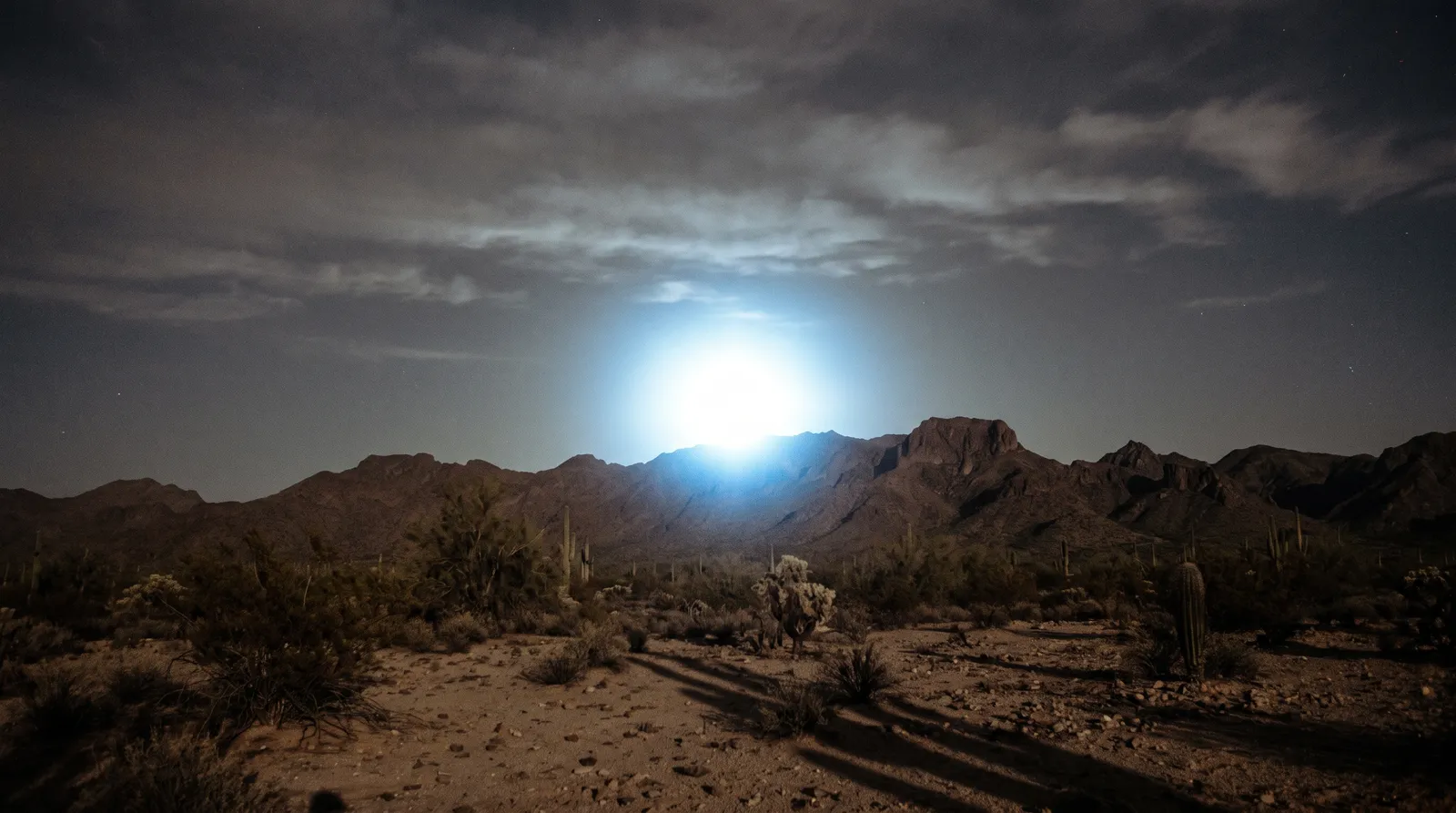
There is a straightforward reason to hope that nobody has ever flown a warp drive over your house. If they had, you would not have needed a Pentagon file release to find out about it. You would have needed sunglasses.
That, with the tensor calculus stripped out, is the finding of a preprint posted to arXiv last month by Shaun David Brocus Fell of the research organisation Applied Physics and Avi Loeb, the Harvard astrophysicist who now chairs the White House’s UAP Science Advisory Council. It is titled Radiative Signatures from Warp Drives Traveling Through the Earth’s Atmosphere, and it asks a question the field had somehow never run the numbers on: if a spacetime bubble did come through our air, what would it actually look like from the ground?
The answer turns out to be unambiguous, quantified, and — this is the part that has been widely mislaid in the coverage — a very strong argument that the objects in the Pentagon’s file releases are not warp drives.
What the paper actually calculates
Fell and Loeb take the Alcubierre metric — Miguel Alcubierre’s 1994 solution in which a craft sits at rest inside a bubble of contracting and expanding space — and use it as a stand-in for any zero ADM mass warp solution. In plain English, that means a bubble with no net gravitational pull, so you cannot spot it by watching what it does to nearby matter. If you want to detect one, you have to catch it doing something to the air.
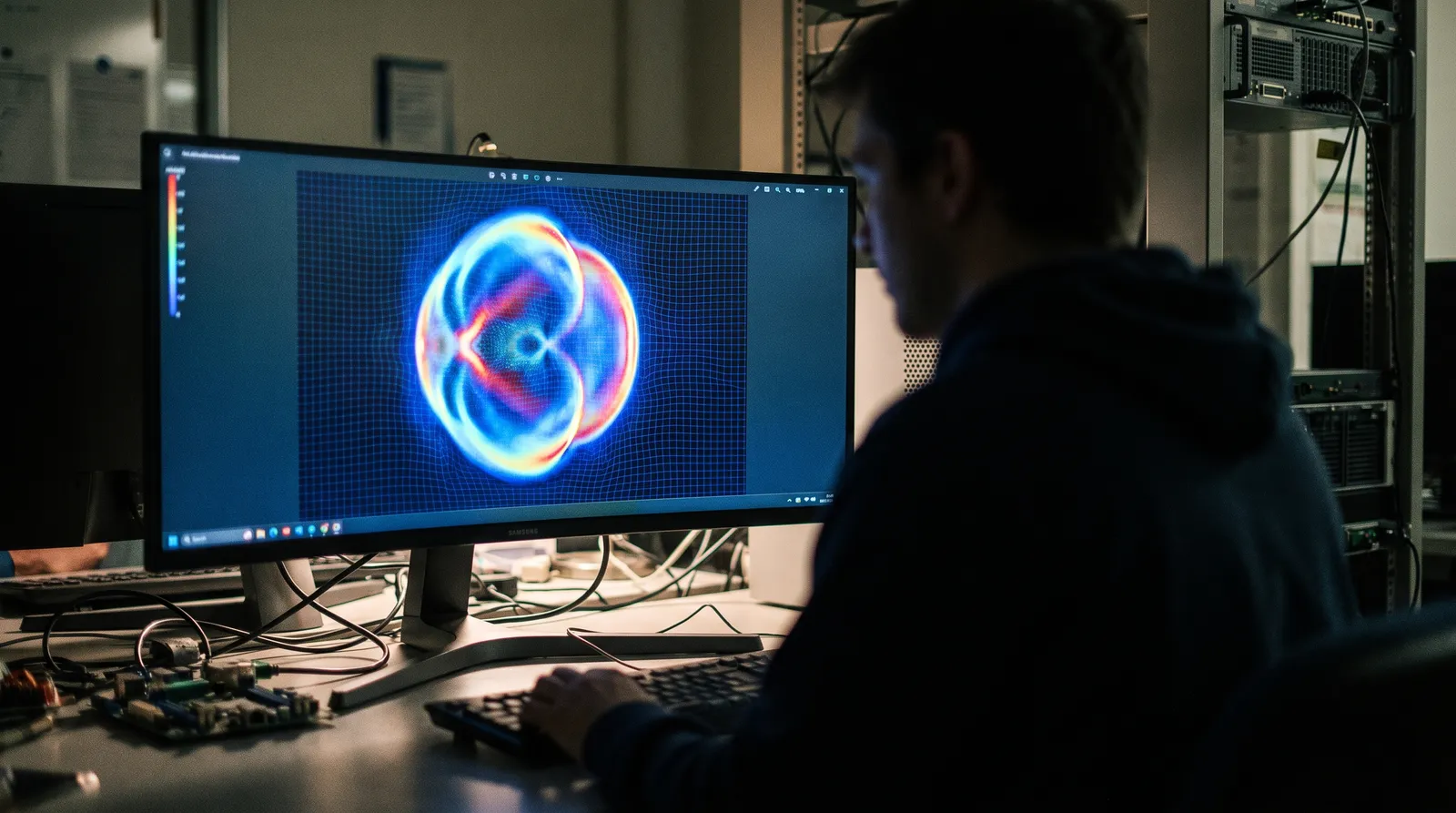
So they ran hydrodynamic simulations of atmospheric airflow around an aircraft-scale bubble moving at a range of speeds, and watched what happened to the gas it shovelled aside.
What happens is violence. At half the speed of light, the shocked air in front of the bubble reaches a temperature the paper puts at 220 billion Kelvin — roughly fifteen thousand times hotter than the core of the Sun. The resulting optical output exceeds one terawatt, which is on the order of a thousand large power stations’ worth of light coming off a single object the size of a fighter jet. Loeb’s own write-up of the work carries the headline that a warp drive would shine brighter than the Sun.
Drop the speed to a tenth of light and the temperature falls by a factor of around thirty. It is still an absurd number. The authors put the threshold for a “unique brilliant glow” at somewhere around a tenth of light speed, and say that anything above about five per cent of it produces qualitatively the same signature.
The sentence everybody skipped
Read the abstract to the end and it does something the press coverage largely did not. It states that a bubble at rest, or moving slowly relative to the Earth, would not generate such extreme luminosities — and then describes its own results as establishing “observational constraints on spacetime-based propulsion operating within the terrestrial environment”.
Constraints. Not evidence. The paper is a filter, and a good one, because it is symmetrical: it tells you what a relativistic warp drive would look like, and by direct implication what a loitering one would look like, which is nothing in particular. That cuts in exactly the opposite direction from the way the story has been told.
Why Loeb reached for the orbs
The link to UAP is not incidental — it is in the paper, and Loeb has made it explicit in his own commentary. He points to an assessment dated 5 June 2026, signed by AARO’s director Dr Jon Kosloski, describing an orange “mother” orb releasing smaller red orbs, with roughly forty per cent of the reported activity left unresolved.
That case is one of the strangest things in the whole declassification programme. In October 2023, six federal law-enforcement agents near Colorado Springs reported orange spheres that appeared for a second or two, ejected clusters of two to four red orbs, and vanished. AARO checked flight logs, radar and ADS-B and could not account for a substantial share of it. It has since become the canonical hard case of the PURSUE era, and it is the one Loeb is pointing at when he says orbs deserve a physical mechanism rather than a shrug.
He is right that they do. The question is whether this is the mechanism.
The orbs are slow. That is the whole problem
Here is the awkward arithmetic. Fell and Loeb’s signature switches on somewhere above five per cent of the speed of light. Five per cent of light speed is roughly fifteen thousand kilometres per second — about fifty thousand times the speed of sound.
Now look at what the witnesses in these files actually describe. A senior intelligence officer watching orange orbs for an hour. A helicopter crew reporting an orb swarm over roughly the same duration. Red orbs sitting above a ridgeline. Objects that hover, drift, split and linger — the defining complaint about orbs is not that they are too fast to track, it is that they hang around long enough for people to fetch a phone and still produce nothing conclusive.
An object that is visible for an hour is not travelling at fifteen thousand kilometres per second. And by the paper’s own reasoning, a bubble moving at ordinary aircraft speeds produces no distinctive optical signature at all — which means the model, applied to the actual reports, predicts nothing you could go and check. It has been reduced from a test to an unfalsifiable overlay.
There is a fallback available: that the brief flash is the high-speed transit and the lingering orb is something else. It is not a ridiculous reading — the Colorado agents did describe the orange spheres as appearing for only a second or two. But it has to be argued for, with data, and it is not what the calculation demonstrates.
Applied Physics are not cranks, which is why this deserves care
It would be easy to file this under speculative-physics-meets-UFOs and move on. That would be lazy.
Applied Physics is the group behind Warp Factory, the first serious numerical framework for testing whether a proposed warp metric is physically coherent — a toolkit that checks candidate spacetimes against the energy conditions rather than assuming them away. Their work is much of the reason warp-drive research has crept from science fiction towards something with referees, and Fell’s contribution here is legitimate computational physics: nobody had previously worked out the radiative signature of a warp bubble in a real atmosphere, and now somebody has.
The physics is not the weak link. The inference is. A calculation of what an exotic object would look like becomes evidence about UAP only if something in the record looks like the calculation — and on the paper’s own numbers, nothing does.
The sceptic’s read
The sharpest published criticism, which appeared in the trade press rather than in a journal, makes precisely this point: that the warp-bubble model describes effects witnesses do not report, and that the effort would be better spent on the sensor data already sitting in the archive than on theorising about evidence yet to be collected. It is a fair hit, and it lands harder because Loeb himself has been the loudest advocate for measurement over argument.
The broader sceptical position needs no new argument at all. Mick West and others have spent a decade demonstrating that the prosaic explanation is usually there for anyone willing to check, and the PURSUE releases have obliged: analysts have picked out sky lanterns drifting on the breeze in one batch of “orb” footage, and infrared decoys deployed during an exercise in another, confirmed against flight logs. Neither requires general relativity.
And there is a rival mechanism already in open peer review that does not require it either. John Birks, the University of Colorado atmospheric chemist who helped originate the nuclear-winter calculation, has proposed that a good share of orbs are burning meteor dust held together by its own magnetism. His model handles the Colorado case unusually well — orbs splitting into smaller orbs of different colours is a specific prediction of it — and, crucially, it predicts particular emission lines you could go and measure this year.
What would actually settle it
Both hypotheses want the same thing, and neither can currently have it.
A warp bubble’s signature is defined by its velocity. A dusty plasma’s signature is defined by its chemistry. To distinguish them you need either a measured speed or a measured spectrum, and the UAP corpus contains neither. Two researchers recently went through all 112 PURSUE sensor videos hunting for the four quantities you need to convert pixels into a velocity, and did not find one clip that carried the full set. Nobody, meanwhile, has ever taken a spectrum of an orb — which is why Loeb has proposed building the instrument that would.
Note what that implies about this paper’s real value. Its worth is not that it explains the orbs. Its worth is that it hands the field a hard number: measure an orb at above five per cent of light speed and something extraordinary is happening; measure it at aircraft speeds and one entire class of exotic explanation is off the table. That is a genuine contribution, and it is a sceptical one.
The UAP Times take
We have rated this Unconfirmed — three out of five on our scale. That rating is for the claim being built on the paper, not for the paper itself.
Two things are worth keeping apart, and the coverage has mostly mashed them together. The calculation is real, named and public: two identifiable authors, an arXiv number, a method anyone with the software can rerun. Taken purely as a physics result it would rate higher. What it is not, yet, is peer-reviewed — and what it does not do, on any reading we can construct, is show that the Pentagon’s orbs are warp drives.
In fact its most useful contribution is the reverse. Fell and Loeb have specified, in watts and kelvin, what a relativistic spacetime bubble would look like from a back garden, and the description matches nothing in the declassified record. The orbs in those files are slow, persistent, and visible for the better part of an hour. Whatever they are, this paper is fairly strong evidence about what they are not.
That is still a useful year’s work — ruling things out is how the residual gets smaller, and a shrinking residual is the only version of this story that ends in an answer. The trouble is that ruling-out papers get reported as ruling-in papers, and by the third aggregator the calculation has become “physicists link Pentagon orbs to warp drives”, which is neither what the abstract says nor what the numbers support.
Read it as its authors wrote it: a constraint, not a confirmation. The most interesting thing anyone could do with it now is go and measure an orb’s speed, and find out which side of the line it falls on.
Further reading: for the rival mechanism currently in open peer review, see the orb finally has a physics paper; and for the measurement that would adjudicate between them, Harvard’s proposed orb spectrograph.
Follow the file
Every new dispatch from the UAP desk, in your inbox. Sourced, sceptical, and no more than one email a week.