
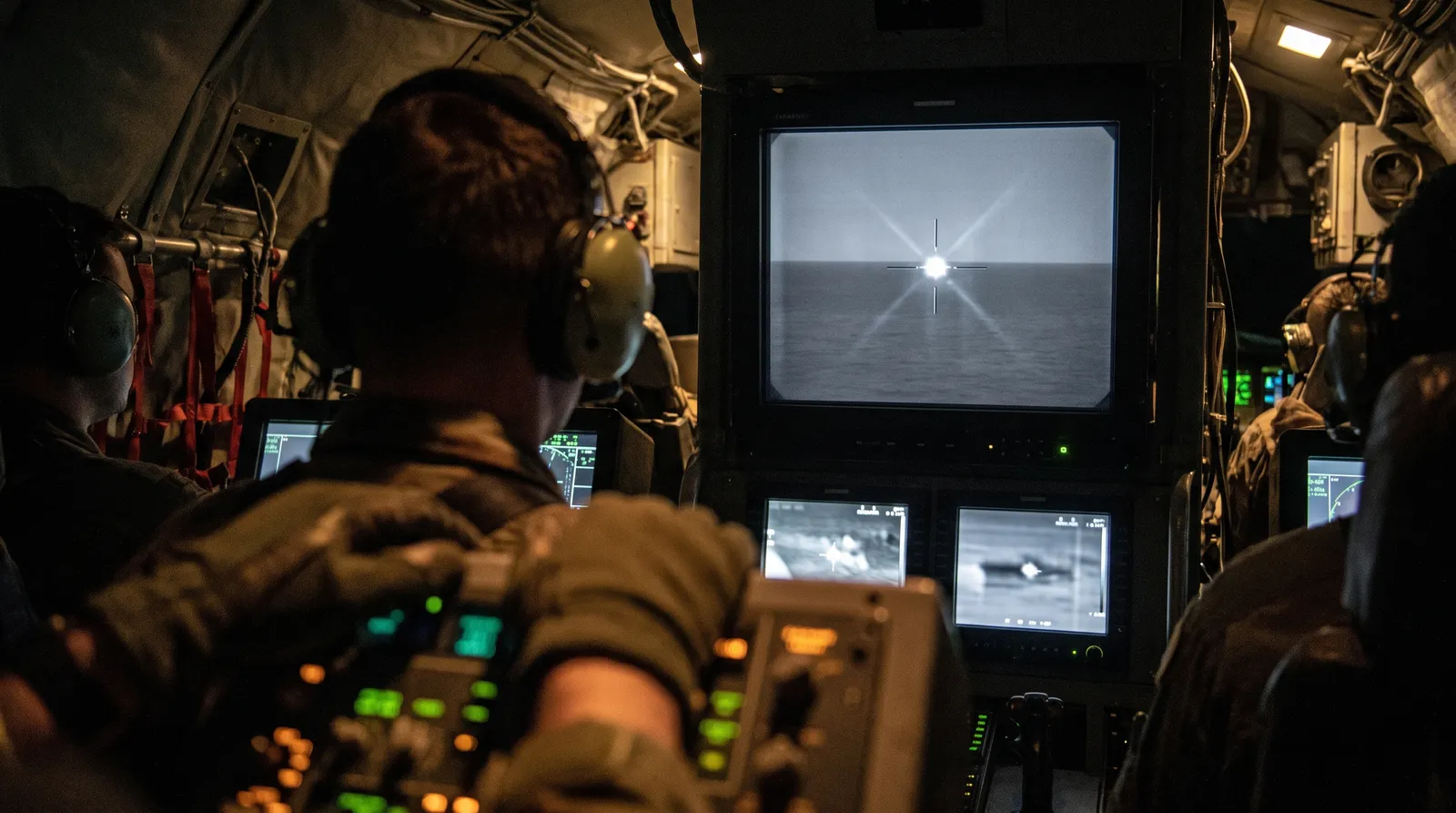
There is a video doing the rounds again this week of something over the Yellow Sea that looks like a six-pointed star. It is genuine US military infrared footage. The Department of War really did publish it. The All-domain Anomaly Resolution Office really has filed it as unresolved.
It is also, on the best available reading, a photograph of the camera.
All four of those statements can be true at once, and the fact that most people find that combination deeply unsatisfying is the most revealing thing about the disclosure era we are currently living through.
The file everyone is sharing
The clip is catalogued as DOW-UAP-PR104, “Unresolved UAP Report, Yellow Sea, 2025”. It runs to about eighteen seconds. It was submitted to AARO by US Indo-Pacific Command, and the footage comes from an infrared sensor aboard a US military platform.
It is not new. It went up on WAR.GOV/UFO in the fourth PURSUE tranche on 10 July, and it has been sitting on the Defence Department’s public video service ever since. What happened this month is that the sixth tranche landed on 18 September — 71 files, announced by chief Pentagon spokesman Sean Parnell, and mostly not what the headlines said it was — and a lot of people went back through the archive. PR104 is the most visually arresting thing in it, so PR104 is what got reposted, frequently captioned as though it had been declassified that morning.
The department’s own description of the file is admirably flat. The sensor pans to track an area of thermal contrast resembling a six-pointed star, keeping it roughly centred in frame. A small dark shape sits inside a tracking reticle, radiating faint star-like spikes. AARO offers no analytical conclusion whatsoever.
We should be straight with you about our own position here: we have read the department’s file text and the published analyses, not run the footage through frame-by-frame photogrammetry ourselves. Everything below is either in the official record or is standard optics.
What “unresolved” actually means in the Pentagon’s vocabulary
This is the word doing all the work, and it does not mean what the reposts imply.
In AARO’s own taxonomy, unresolved is a status of the evidence, not a category of object. It marks a case the office could not attribute with the data it had. The office’s public material is blunt about why that happens so often: sensors frequently do not collect enough information to support a positive identification, and a case with no range, no second sensor and no corroborating account cannot be closed on anybody’s say-so.
Crucially, AARO keeps “unresolved” and “anomalous” as separate categories. A file can sit in the first without ever qualifying for the second.
“The government cannot say what this was” and “this cannot be said” are different sentences. Only one of them is in the file.
So the people posting the Pentagon admits it cannot explain this are telling the truth. The people adding therefore it is not ours, and not from here have quietly swapped one sentence for the other.
Why a bright dot grows points
Here is the bit that makes the six-pointed star much less exciting and much more interesting.
Stars do not have points. Your eye gives them points, because of the structure of your own lens; cameras give them points, because of the structure of their apertures. When light from a very bright, very compact source passes the edges of an aperture — and especially past any struts or masks sitting in the light path — it diffracts, and the result is a symmetrical pattern of spikes radiating from the source. The number of spikes is set by the geometry of the instrument.
The textbook example is now a famous one. Every bright star in a James Webb Space Telescope image wears a six-pointed diffraction pattern: it comes from the telescope’s hexagonal mirror segments and its three-vane secondary support. Those stars are not shaped like stars. The telescope is shaped like that.
Military infrared optics are a harsher case still. The apertures are small, the detectors saturate readily, and a hot compact source — an engine exhaust, a flare, a hot skin against a cold sky — will bloom and spike in a pattern that belongs to the sensor rather than the target. This is the same family of effect we walked through when taking apart what an ATFLIR pod is actually doing in the Gimbal and GoFast videos.
The diagnostics analysts run are simple enough. Does the star pattern hold a fixed orientation relative to the frame rather than to the object’s motion? Does it grow and shrink with brightness rather than with apparent distance? Does it match the known signature of that sensor on ordinary targets? If yes, you are looking at the instrument.
This has happened before — in the same archive
It happened in the very first PURSUE tranche.
The most visually striking video in Release 01 was PR38, and Mick West pointed out at the time that its shape had already been worked out on the Metabunk forum two years earlier: diffraction spikes, related to Gimbal’s famous rotating glare but produced by a different camera. The government published the clip without that context. The internet supplied the mystery instead.
Metabunk also carries a thread on Ukrainian drone footage showing the same six-pointed signature — recorded over a battlefield thick with conventional aircraft, munitions and thermal decoys, which is a useful reminder that the shape turns up in places nobody is claiming visitors.
The pattern is not a coincidence. The clips that travel furthest are the ones with the strongest, strangest visual signature, and a strong, strange visual signature is very often exactly what an optical system does to a bright point of light. Virality selects for artefacts.
What the artefact does not explain
Now the fair-minded half, because “it’s a diffraction spike” is not the end of the argument and it would be dishonest to pretend otherwise.
Diffraction explains the shape. It does not identify the object. What the spikes tell you is that the source is bright and compact in the infrared. They do not tell you whether that source is a fighter’s exhaust seen from behind, a decoy flare, a drone, a ship’s stack or something nobody in the room recognised. An artefact-shaped image of an unidentified thing is still an image of an unidentified thing.
AARO, to its credit, has not claimed otherwise. It has not resolved the case, and it has not offered the diffraction reading as its own finding. That silence is the honest position when you have eighteen seconds of video and no range data — though it is also a silence that guarantees the internet will fill it.
It is worth adding the prior probability, too. The Yellow Sea sits between mainland China and the Korean peninsula and is one of the most heavily militarised stretches of water on the planet, criss-crossed by Chinese, South Korean, North Korean and American aircraft, drones and shipping. If you are going to see an unexplained hot spot anywhere, the surprise would be seeing none there.
The measurement problem underneath all of it
None of this is really an argument about one clip. It is an argument about what the archive is missing.
Two scientists, Ravi Kopparapu and Jacob Haqq-Misra, went through every PURSUE sensor video looking for the numbers that would let anyone calculate a speed, an altitude or an acceleration. Without a range to the object, a video of a moving dot is compatible with a slow object nearby and a fast object far away, and nothing in the released files closes that gap.
PR104 is that problem in miniature. Eighteen seconds, one sensor, no range, no bearing, no metadata, no operator statement, no conclusion. The Department of War has published the picture and withheld everything that would let you interpret it — which is also, more or less, how the last five tranches have gone.
The fix is unglamorous and entirely within the department’s gift: release the sensor metadata alongside the footage. Range, aspect, field of view, platform, the operator’s own account. Until that happens, every release will produce another week of people arguing about a shape.
The Field Kit
Some links are Amazon affiliate links. As an Amazon Associate, UAP Times earns from qualifying purchases — at no extra cost to you.
If this piece has a practical lesson, it is that your own kit invents shapes too — point a long lens at a bright light at night and you will manufacture spikes, blooms and haloes of your own. Worth knowing before you post the footage.
- Nikon Coolpix P1000 — the 125x zoom people film the Moon with → — genuinely capable of resolving an aircraft at distance, which is how most “orb” footage gets identified. Expect flare artefacts at full zoom; that is the camera, not the craft.
- Celestron SkyMaster 15x70 — for confirming a shape → — the cheapest way to check whether the thing your phone turned into a starburst is a starburst. Your eyes and a sensor fail in different ways, which is exactly why using both is worth it.
The UAP Times take
As reporting on a documented government file, this one stands up. The designation, the submitting command, the release date and the department’s own description are all checkable against a government portal, and the optics involved are ordinary physics rather than anybody’s theory. It earns a Credible rating, four out of five on our scale — a mark off because we are reading a video through the official file text and published analyses rather than the raw sensor product, and because the diffraction reading is the work of outside analysts, not AARO’s stated finding.
What the story is not is evidence of anything crossing the Yellow Sea that shouldn’t be there. The most likely account of PR104 is that a US military infrared sensor tracked a bright, compact heat source in busy airspace and rendered it, as such sensors do, as a six-pointed star. The Pentagon cannot tell you what the heat source was. Neither can we. Nobody who has looked at those eighteen seconds can, which is precisely the point — and precisely why “unresolved” has become the most over-read word in the subject.
If you want a genuine puzzle from this archive, the Gulf of Oman intelligence report remains a far better candidate than the prettiest picture in it. Pretty pictures are what cameras are for.
Further reading: for what a targeting pod is really doing to the image, see the physics behind Gimbal and GoFast. For the limits of every video in the archive, see the PURSUE velocity study. And for the prosaic explanation that now accounts for most new sightings, see satellites catching the sun.
Follow the file
Every new dispatch from the UAP desk, in your inbox. Sourced, sceptical, and no more than one email a week.