
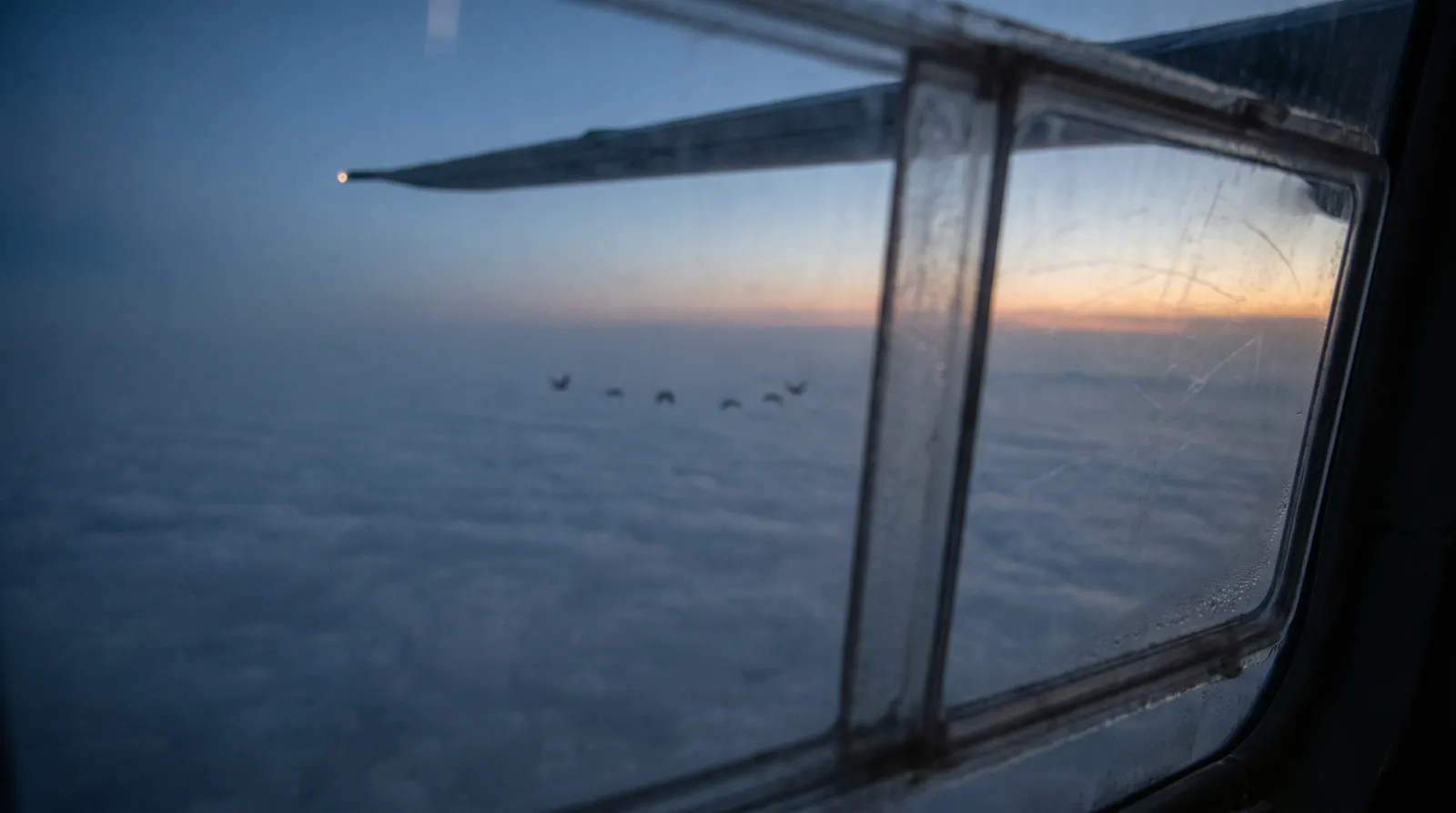
Six small bright dots, grouped loosely together, crossing a military infrared sensor somewhere over a US platform in 2025. The crew who filed the report did the responsible thing and considered the boring explanation. Then they ruled it out, for a stated reason: the objects were travelling at around 480 miles per hour, and birds do not do 480 miles per hour.
They are quite right that birds do not do 480 miles per hour. The difficulty is the other half of the sentence. Nobody measured 480 miles per hour — it was worked out from an assumed altitude, the assumed altitude was a guess, and a new analysis of the footage says the guess was badly out. Because every one of those six dots is blinking at the rate a bird’s wings beat.
The clip, and the number that came with it
The video arrived on 18 September in the sixth tranche of PURSUE, the Presidential Unsealing and Reporting System for UAP Encounters. That release ran to 71 files, and the attention mostly went elsewhere — to two warp-drive papers that had been freely downloadable since 2019. The infrared clip, catalogued as DOW-UAP-PR135 with a mission report filed as DOW-UAP-D108, got a decent run in the press as the “six mysterious spheres” video and then settled into the archive.
What the mission report says is modest and careful. Six small spherical objects, grouped together. Estimated altitude about 6.7 kilometres — roughly 22,000 feet. Estimated velocity around 480mph, which the report notes is some 63 per cent of the speed of sound. And then the reasoning that made it interesting: that speed is inconsistent with a flock of birds, and with the coordinated drone swarms anyone has demonstrated, which top out around 150mph.
Note the word doing all the work in that paragraph. Estimated. The report records no sensor engagement with the objects at all — no laser range, no track, nothing that returns a distance. The altitude is an eyeball figure from a crew looking at dots. And once the altitude is a guess, so is the speed, because the two are chained together.
What six scientists did instead of arguing about it
On 9 October, a preprint went up on arXiv under a title that gives away the ending: Six objects reported at 480 mph in a declassified military infrared video show brightness flicker at bird wingbeat rates. The authors are Jacob Haqq-Misra of Blue Marble Space, Ravi Kopparapu of NASA’s Goddard Space Flight Center, Richard Cloete and Omer Eldadi, Michael Shermer of Skeptic magazine, and Harvard’s Avi Loeb. It has been submitted to Scientific Reports.
Their method sidesteps the argument about distance entirely, which is what makes it clever. You cannot measure the speed of something whose range you do not know — we worked through that arithmetic in August, when Haqq-Misra and Kopparapu audited all 112 released sensor videos and found not one contains the four numbers you need. So this paper does not try. It measures something range cannot touch: how the brightness of each dot changes over time.
An infrared camera records heat. A bird in flight presents a wing area that sweeps and rotates through the stroke, so the amount of warm bird pointed at the sensor rises and falls periodically. The flicker rate is the flap rate — and it is the same whether the bird is 200 metres away or two kilometres.
Every object, its own beat
The measurement came back cleaner than anyone had a right to expect. All six objects oscillate in brightness, steadily, between 7.1 and 7.9 cycles per second — and each one does it at its own rate, independent of the other five.
That last detail is the one that matters. If the flicker were an artefact of the sensor, the display or the video compression, you would expect the dots to share it: one camera, one frame rate, one encoder, one pattern. Six independent frequencies cannot come from a single shared cause. The authors also ran the obvious control, planting constant-brightness objects into the same processing chain to see whether compression could manufacture a pulse. It could not.
For a reference range they used ground-based infrared footage of flying animals collected by the Galileo Project — the same Harvard-run observing programme whose instruments we have covered when it was trying to solve the distance problem. Processed through the identical method, those animals beat steadily at between 3.4 and 10.0 times a second. Birds in cruising flight run from roughly 2.5Hz for the largest species to above 10Hz for small songbirds. The six dots land squarely inside it.
Six objects. Six independent flicker rates. All of them in the band where wings live.
The 480mph was never a measurement
Which brings the paper back to the number in the mission report, and to the bit of geometry that dissolves it.
Apparent speed across a sensor is an angular rate, and turning an angular rate into a ground speed requires knowing how far away the thing is. Assume it is distant and it must be fast; assume it is close and the same pixels become something nearly stationary. The authors work out where you have to put a near-motionless object to reproduce the reported figure: a flock sitting at roughly 60 to 80 per cent of the aircraft’s own altitude — closer to the camera than the crew supposed, and not going much of anywhere — projects onto the ground at about 480mph. The crew’s own 22,000-foot estimate implies the aircraft was higher still, which leaves ample room underneath it for exactly that.
This is not an exotic claim. It is parallax, and it is the identical mechanism AARO invoked when it resolved the famous GoFast clip: an object that looks like it is skimming the ocean at terrific pace turns out to be at 13,000 feet, drifting with the wind. The office called it a trick of the eye, and we have been through the sensor physics that produces it.
So the mission report’s logic runs in a circle. The speed excluded birds. The speed came from the altitude. The altitude was an estimate made by people who had, by their own account, no range to the object.
Nineteen more, in nine other videos
The paper does not stop at one clip. Applying the same flicker analysis across the rest of the released corpus, the authors report another 19 objects in nine further military videos beating in the same band, from 2.3 to 11.0 times a second.
Loeb, writing it up on his own Medium feed, puts the figure at more than 8 per cent of every sensor video PURSUE has declassified — and singles out DOW-UAP-PR41, filed as an unresolved UAP report from the Middle East in 2020, where a bright point over water pulses 6.43 times a second. That 8 per cent is a blog post rather than a line in the paper, and should be read as his arithmetic rather than a peer-reviewed result.
The author list is part of the story
It is not often that Michael Shermer and Avi Loeb appear on the same paper. Shermer has spent a career as the house sceptic of American public science; Loeb has spent recent years as the most prominent credentialled scientist willing to entertain an exotic reading of hard-to-explain data — including, three weeks ago, publishing a second-hand claim he picked up at a dinner that we were distinctly unimpressed by. Both have now signed their names to a small flock of birds.
Loeb in particular has moved. In his write-up of the sixth tranche on 18 September, he argued that the reported speed excluded birds, and that no demonstrated swarm technology operates at 480mph — a factor of 3.2 above the fastest coordinated swarms. Three weeks later he is a co-author on the paper that takes that speed apart. Which is not an embarrassment but the process working, and precisely the move the field is usually accused of never making.
The case against the birds
Give the other side its hearing, because there is one.
This is a preprint, submitted to Scientific Reports but not yet through peer review, so no referee has had a go at the signal processing. We can find no substantive published rebuttal either — which is less reassuring than it sounds, given the paper is three weeks old.
The crew were trained observers filing a formal report, and writing off their altitude estimate requires some care: they were there, and they had context the video does not carry. The bird hypothesis is also, strictly, a sufficient explanation rather than a measured one — the authors cannot establish the range either. They have shown that a mundane configuration reproduces every number in the file, which is weaker than proving it happened and considerably stronger than the alternative, which reproduces nothing and requires new physics.
The flicker admits other readings in principle, too: a tumbling object would modulate. What it would not easily do is produce six separate objects each tumbling at its own rate, all of them inside the narrow band where wings live and none outside it.
What would actually settle it
To their credit, the authors say plainly what would kill their own argument: release the redacted sensor and platform data — the range, the platform velocity, the field of view. With a real distance to those six dots, the bird hypothesis survives or dies in an afternoon.
That is the same request the August audit ended on, and it is still unanswered. PURSUE has now published seven tranches, including last week’s black-triangle report, and it is still publishing pictures while withholding the measurements that would let anyone adjudicate them. The result is a transparency programme that generates arguments it has made unwinnable by design. Note how these authors got around it: by ignoring everything the redactions removed and measuring the one quantity that could not be taken out of the frame.
The UAP Times take
This earns a Credible rating, four out of five on our scale, and the missing mark is specific rather than vague.
What is strong: the flicker measurement is reproducible signal processing performed on a public file by six named scientists, published with its data package and with the compression controls actually run. Six independent frequencies are genuinely hard to explain any other way, and the parallax geometry is textbook — already validated by AARO’s own GoFast resolution.
What holds it off five: it is a preprint pending review, the identification of birds is an inference rather than a measurement, and the dataset that would close it is still behind a black bar. We rate the document, not the vibe, and the document is an unreviewed submission.
The broader point survives that caveat intact. The Pentagon’s own file excluded the boring explanation on the strength of a number nobody measured — and when somebody finally went looking for a quantity the redactions had left in plain sight, the boring explanation walked straight back in, flapping. Six tranches, 112 videos, and the most rigorous finding anybody has pulled out of the lot is ornithological.
Further reading: for the audit that found none of the 112 videos contain a usable speed, see two scientists checked every one; and for why a targeting pod makes slow things look fast in the first place, how a targeting pod actually sees a UFO.
Follow the file
Every new dispatch from the UAP desk, in your inbox. Sourced, sceptical, and no more than one email a week.