
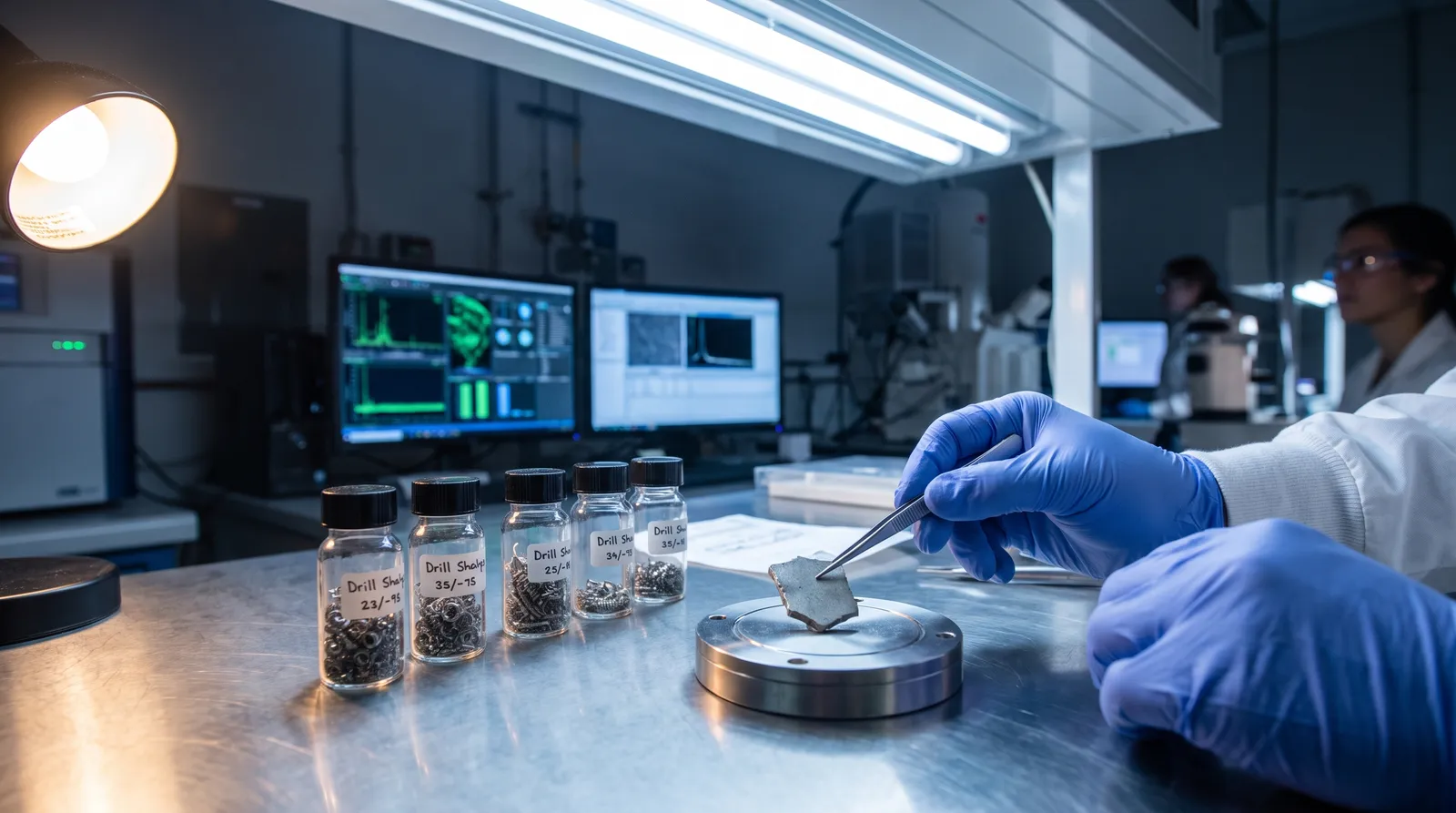
Somewhere in the Pentagon, someone is writing a procedure for what to do if a piece of an alien spacecraft turns up. Who signs for it. Which lab gets it. How the paperwork follows the metal.
This is disclosed in the same document that states, flatly, that no such thing has ever been in the government’s possession — and that nobody else has one either. Both sentences are in the All-domain Anomaly Resolution Office’s annual report, released in July, and both are meant seriously.
It is the least discussed passage in a document that got a fortnight of coverage for its case numbers, and it is arguably the most interesting thing AARO has said all year. Because the material question is the only one in this entire subject that could actually be settled. Radar returns get argued about for decades. Pilots get cross-examined. A lump of metal on a bench either has an isotopic ratio that cannot occur on this planet, or it does not.
So it is worth looking closely at what has actually been put on that bench.
The specimen from a field in Ohio
In 2024, AARO contracted Oak Ridge National Laboratory — one of the US Department of Energy’s seventeen national labs, with an eighty-year history in materials science — to evaluate a metallic specimen. AARO published Oak Ridge’s findings, plus its own supplement adding historical context, in January of this year.
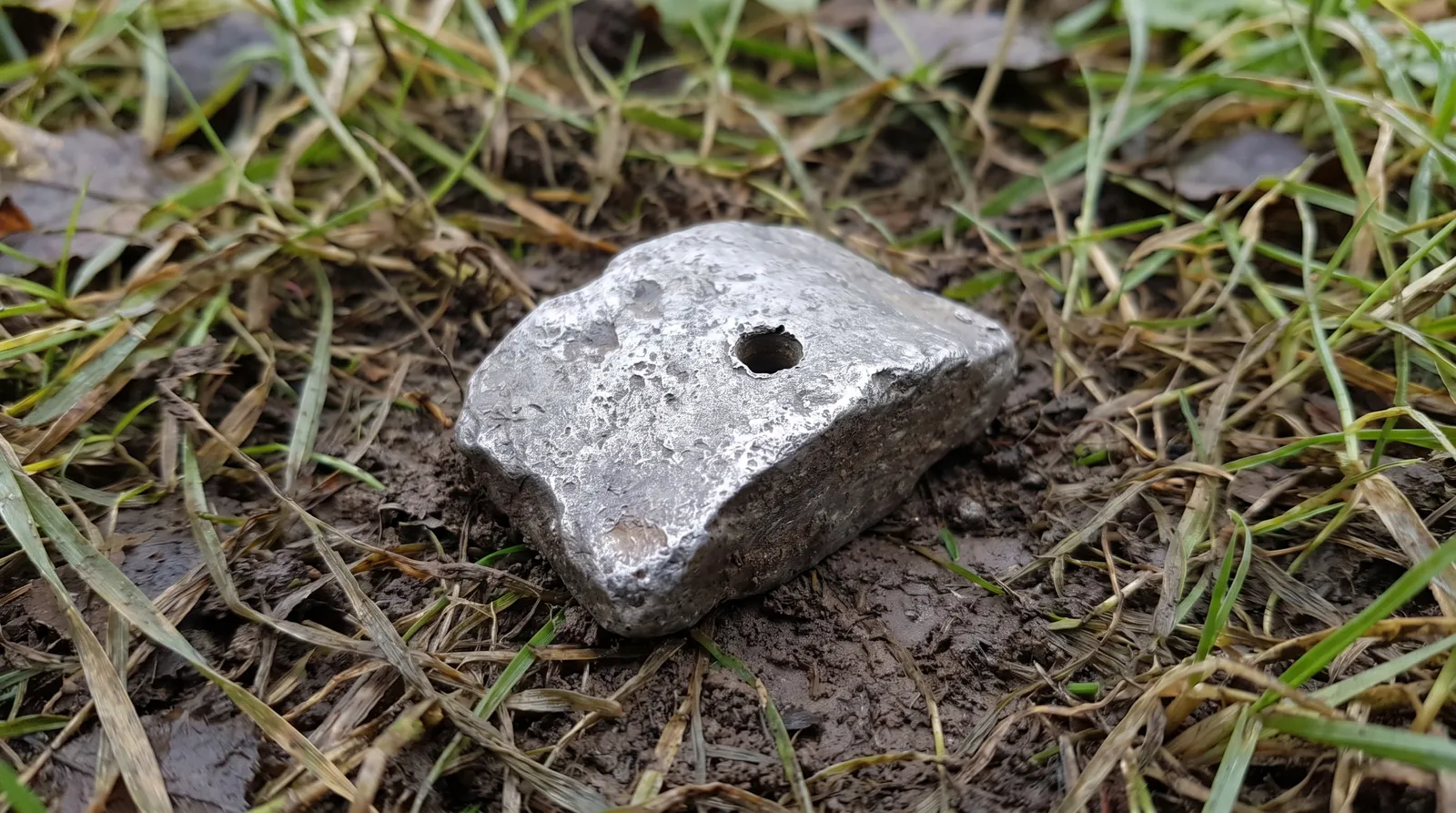
The provenance, as AARO records it: the material was reportedly recovered from private property near Flint Ridge State Park in central Ohio in the mid-1990s. The property owner reported seeing a large unidentified airborne object, and afterwards found the metal. It was alleged to have anomalous compositional and structural characteristics.
The civilian case file fills that in. A witness near Hopewell, Ohio — roughly forty miles east of Columbus — described a craft he called “primitive looking”, perhaps 300 feet long, passing low overhead in the summer of 1995. He heard what he described as metal grinding on metal. He then had to search the area to find the fragment, which he recovered from moist ground. The investigation was documented by Joe Stets, and the paperwork survives in the Phyllis Budinger collection archived by John Greenewald’s Black Vault.
Two details in that account matter more than the craft description, and we will come back to them: he had to look for it, and the sample was subsequently misplaced for years.
What the instruments found
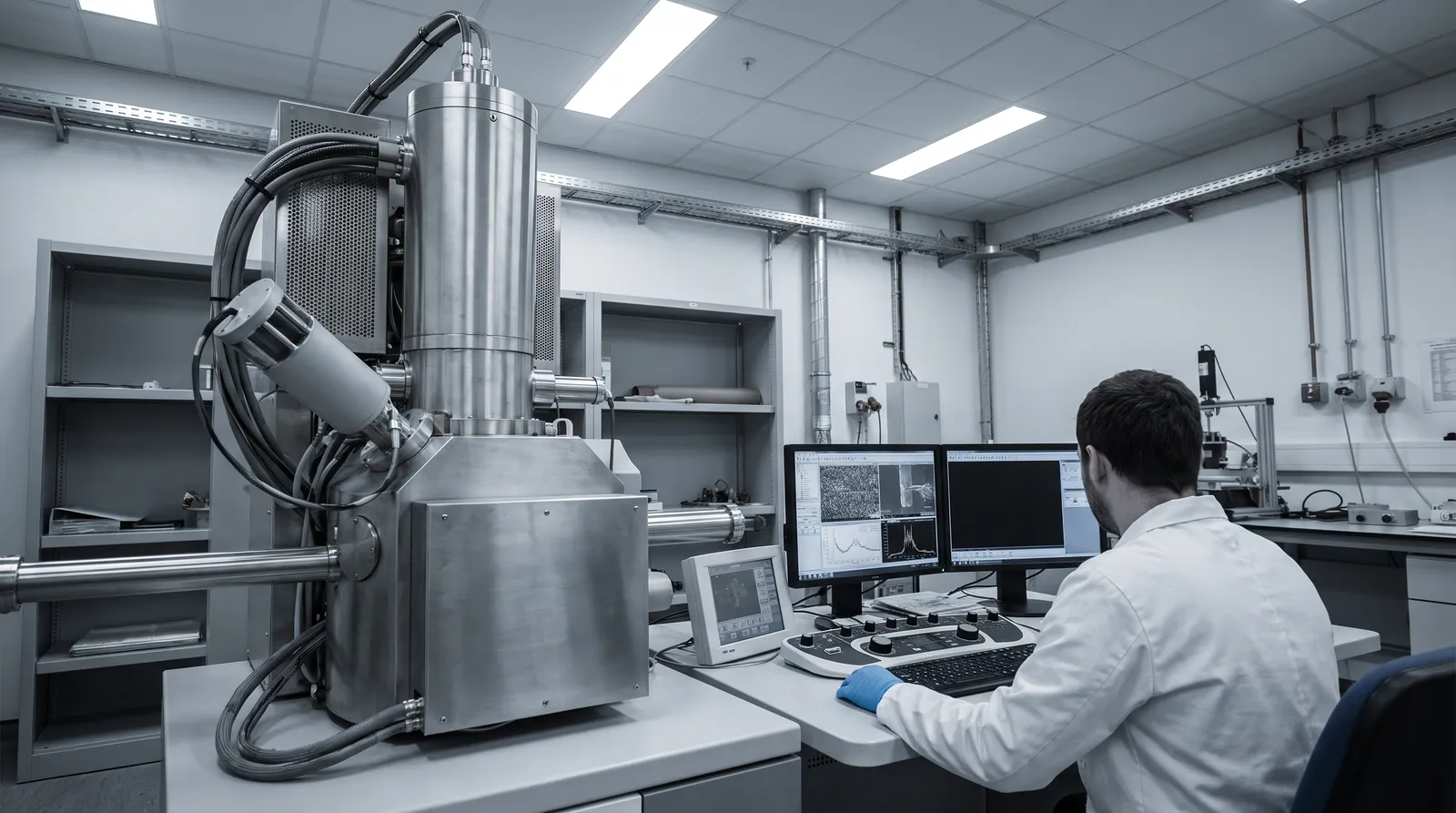
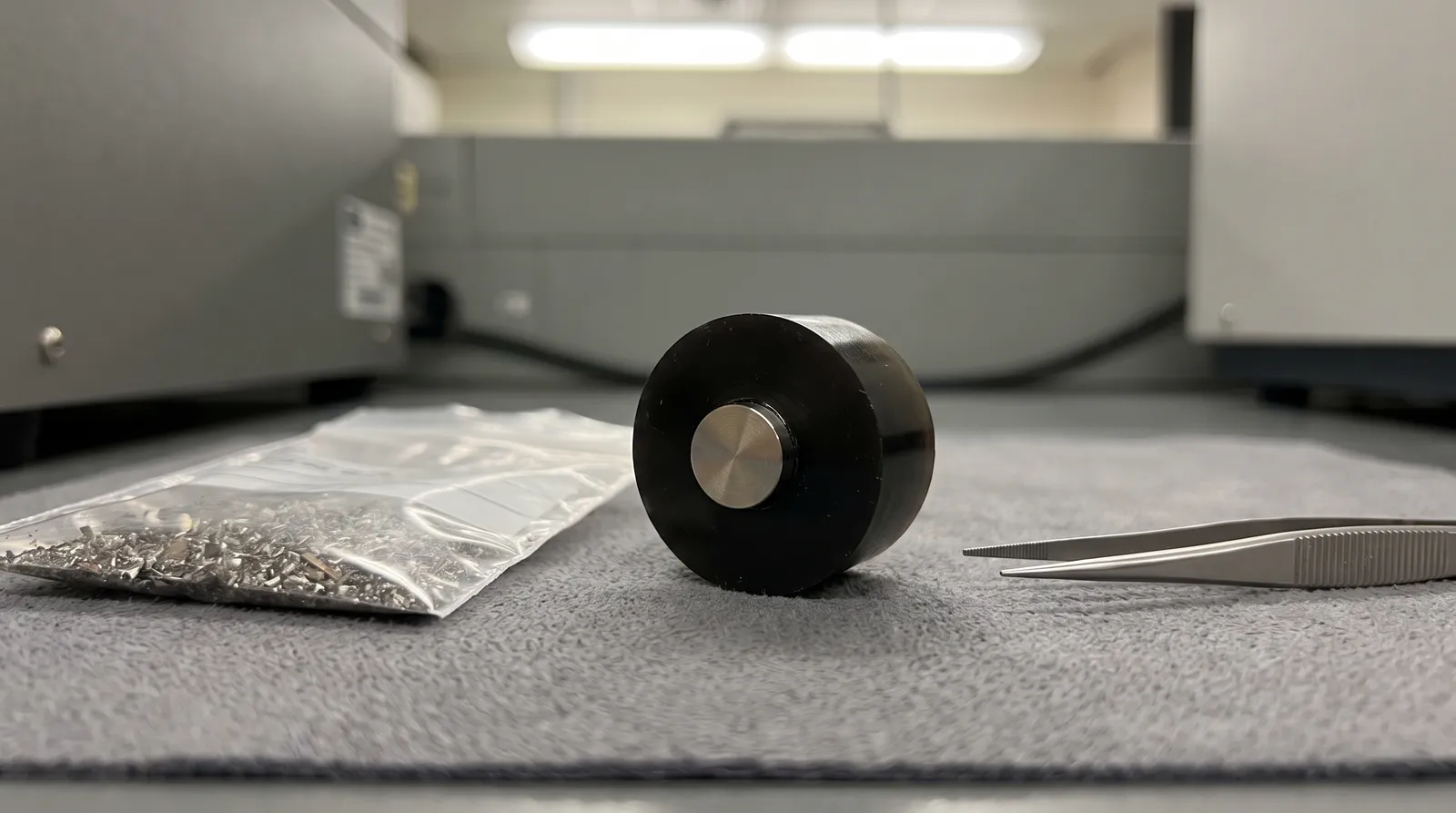
Oak Ridge received three bags of drill shavings and one small bulk piece. It ran the specimen through the full battery: inductively coupled plasma optical emission spectroscopy and high-resolution mass spectrometry for bulk chemistry, glow-discharge mass spectrometry as an independent cross-check, scanning electron microscopy with X-ray spectroscopy for structure, X-ray computed tomography for internal porosity, and roughly two days of gamma spectroscopy to see whether the thing was emitting anything it shouldn’t.
The answer was aluminium. Specifically, about 86% aluminium and 12% silicon by weight, with roughly 1% iron and small fractions of copper, magnesium, zinc and manganese, plus trace lead, chromium, nickel, titanium and gallium at parts-per-million levels. That is a near-eutectic aluminium–silicon casting alloy, and Oak Ridge matched it closely to two thoroughly ordinary reference grades, A413.1 and 369.1.
The microstructure told the same story twice over. Needle- and plate-shaped silicon, iron- and manganese-rich intermetallics, shrinkage porosity, interconnected pores up to a millimetre across, grain features spaced at hundreds of micrometres rather than tens. That spacing is a cooling-rate fingerprint, and it points to slow cooling in a mould — a large sand or permanent-mould casting. Rapid quenching leaves a much finer structure, and it wasn’t there.
Nor was anything else. No unexpected elements. No abnormal gamma emission.
AARO’s supplement went a step further and pointed out what the specimen lacks: strengthening additives such as strontium or sodium, which you would expect in any high-performance alloy. It also noted that the fragment’s shape suggests no functional design or intended application at all. Cast aluminium in the 300 series went into wide industrial production in the 1970s and now accounts for over 90% of all shaped aluminium castings. AARO’s list of plausible origins is deflating in the way only a government document can be: a commercial casting, an industrial by-product, recycled alloy, or a slow-cooling melt from something that caught fire — an automotive blaze, for instance.
The awkward part: the amateurs got there first
Here is the detail that ought to be more widely noted. The specimen was analysed decades ago, by civilian researchers, using infrared spectroscopy, X-ray diffraction and energy-dispersive spectroscopy. They concluded it was an aluminium alloy with a density of about 2.8 grams per cubic centimetre.
Which is, broadly, what a national laboratory concluded in 2024 with several million pounds’ worth of instrumentation.
The two analyses do not agree perfectly. The earlier work characterised it as a wrought 4000-series alloy of the sort used in aircraft welding; Oak Ridge’s structural evidence points firmly to a casting, not a wrought product. That is a real disagreement about how the metal was made, and Oak Ridge’s is much better evidenced. But on the load-bearing question — is this ordinary terrestrial aluminium — the amateur chemistry and the national lab reached the same verdict, roughly a quarter of a century apart.
That is a point in favour of the field’s more careful practitioners, and it is rarely made. The people who actually put UFO samples under instruments have a long track record of reporting boring results. It is the people relaying those samples in interviews who tend to find them extraordinary.
The other specimen, and the pattern
This is not the first sample AARO has sent to Oak Ridge, and the earlier one is better known.
That specimen was a layered magnesium–zinc alloy containing bismuth and lead, publicly alleged to be a component recovered from a crashed extraterrestrial vehicle in 1947 — the Roswell claim, in other words — and asserted to possess extraordinary properties, including the ability to act as a terahertz waveguide and thereby generate some form of antigravity effect. It passed through the hands of To The Stars, the venture co-founded by Tom DeLonge, before reaching the government.
Oak Ridge assessed it as terrestrial in origin, with an isotopic signature consistent with material formed on and exposed to this planet rather than anywhere else. On the waveguide claim it was more specific still: the bismuth wasn’t pure enough, and it was arranged in multiple layers rather than the single layer the physics would require, which the lab said would seriously disrupt any waveguide function. AARO concurred. To The Stars disputed aspects of the assessment.
Two specimens, two national-lab analyses, two results indistinguishable from industrial metallurgy. That is not proof of a negative. It is, however, a pattern, and it is the pattern that has held every single time this subject has produced something you can weigh.
Why the custody rules still matter
Against all that, AARO is nevertheless writing handling procedures — a formalised process, run through an appropriate line organisation, for UAP-derived physical material should such material ever come into the government’s possession.
The obvious reading is bureaucratic throat-clearing: cover the contingency, close the audit finding, move on. The less obvious reading is that Congress is currently trying to force the issue. In July the House adopted a comprehensive UAP records framework as an amendment to the 2027 defence bill, complete with authority to acquire recovered technologies by eminent domain from private holders. An office that may shortly be handed material seized from a contractor would be negligent not to have written down what happens next. Writing the procedure is not evidence that anything exists to seize — but neither is it nothing.
There is also a scientific constituency now watching. The UAP Science Advisory Council convened this summer under Avi Loeb includes Stanford’s Garry Nolan as its molecular biology and materials science adviser, and Nolan has been consistent for years about what he wants: samples with a defensible chain of custody, measured by reproducible methods, published after peer review. His standard and AARO’s are, on this narrow point, the same standard.
The sceptic’s read — and where it stops
The prosaic case is overwhelming and should be stated first. A man found a lump of metal in a field after seeing something in the sky. He had to hunt for it, which means he did not watch it fall. It then went missing for years. By the time it reached AARO, somebody had already drilled it — Oak Ridge could see the machining marks and noted the drilling predated the government’s acquisition. Ohio has had heavy industry and cast aluminium engine components for a century. The base rate for “metal found in a field is industrial metal” is close to one.
But the sceptic’s case has a boundary, and honesty requires marking it. That same broken chain of custody which stops the specimen proving anything exotic also limits what a null result establishes. Oak Ridge was careful about this: its conclusions are robust for the samples provided and the methods described. Nobody can demonstrate that the fragment on the bench is the object the witness saw, or that a fragment from a different part of the original mass would read the same.
So the correct conclusion is narrow and unglamorous. This particular piece of metal is ordinary cast aluminium. That is all it is, and all anyone has shown it to be. It is not evidence that no anomalous material exists anywhere; it is evidence that this one isn’t it — which is exactly what the last four years of analyses have kept saying, in increasingly expensive ways.
The UAP Times take
This story earns a Well-sourced rating, five out of five on our scale, and the reason is unusually simple: you can read the documents yourself. AARO published Oak Ridge’s methodology, the composition table, the micrographs and its own supplementary reasoning. The claim is testable, the tests are described, and the numbers are on the page. That is a rarer thing in this field than it should be, and it deserves to be said plainly rather than buried under a shrug.
What is being rated is the analysis, not the original sighting — the 1995 Ohio encounter remains a single witness, unwitnessed, with a sample he had to go looking for. Those are two different evidential questions and it is worth keeping them apart.
The genuinely interesting development is the procedure, not the aluminium. For four years AARO’s line has been that there is nothing to hand over. It is now quietly building the machinery for receiving it anyway, at the exact moment Congress is drafting the power to take it off whoever might be holding it. That is either an office covering a remote contingency, or an office that has learned something about how this ends. On present evidence it is the former, and we will say so.
But the material question remains the only one that can be closed for good. Every other strand of this subject — the videos, the testimony, the redacted cables — can be argued about indefinitely. A sample cannot. It either does something no terrestrial metal does, or it goes on the pile with the Ohio aluminium.
The pile is getting quite large.
Further reading: for the annual report this all sits inside, see the Pentagon’s latest UAP report; for the case where a government laboratory took soil and plant samples seriously and found genuinely odd results, Trans-en-Provence; and for the most famous exotic-material claim of them all — element 115 — Bob Lazar’s credibility file.
Follow the file
Every new dispatch from the UAP desk, in your inbox. Sourced, sceptical, and no more than one email a week.