
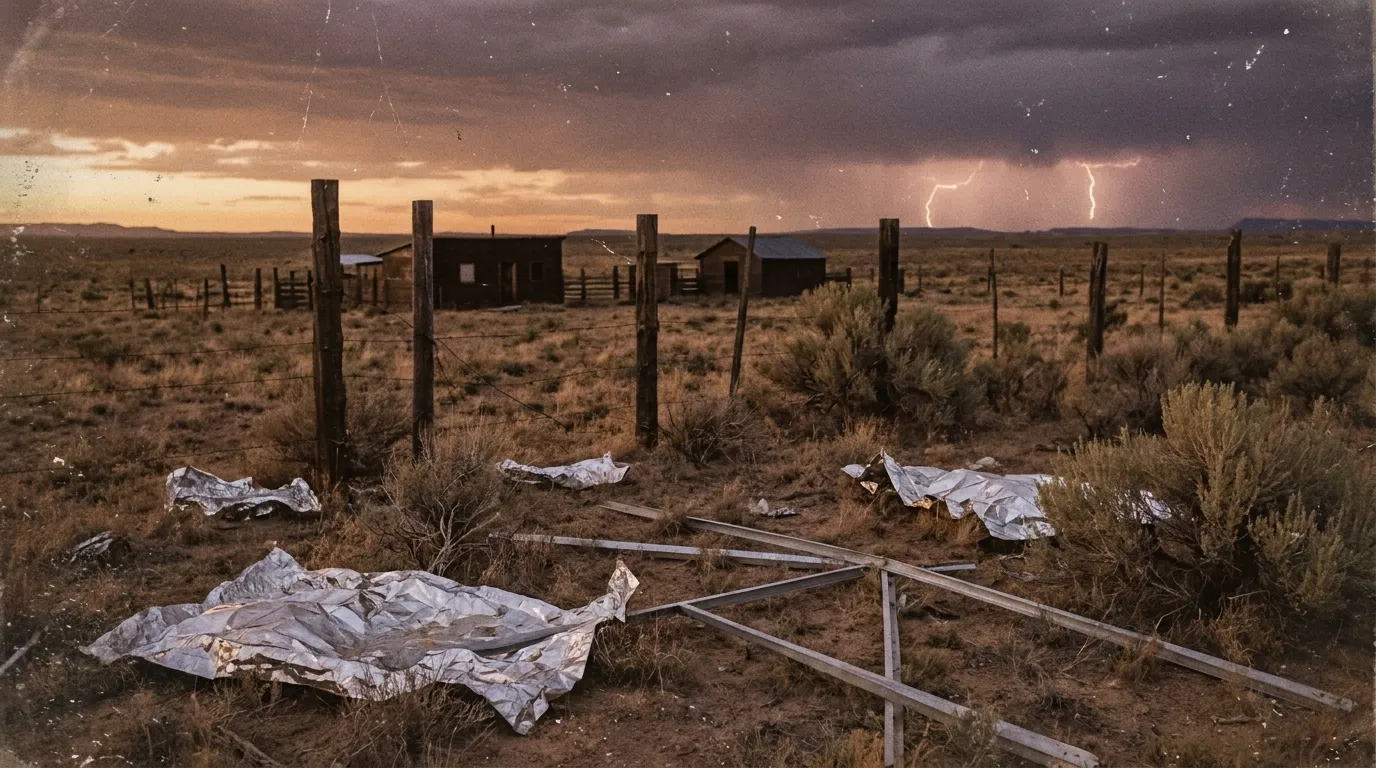
Roswell is the most famous UFO case in the world, and one of the weakest. Those two things sound contradictory; they aren’t. Roswell is famous because of what people said about it starting in 1978. The actual events of 1947 amount to a rancher finding some debris, an army press officer briefly losing his head, and a retraction the same afternoon. Everything that made Roswell Roswell — the alien bodies, the memory metal, the elaborate cover-up — arrived thirty years and several books later. Handle the two eras separately and the case becomes much easier to read.
What actually happened in 1947
In early July 1947, a ranch foreman named Mac Brazel found a scattering of odd debris — foil, rubbery material, lightweight beams, tape — across a pasture on the Foster ranch, out near Corona, some seventy-five miles from Roswell. It had been a summer of “flying disc” hysteria across America, so when Brazel eventually reported it, the story reached the Roswell Army Air Field, home of the 509th Bomb Group — at the time, the only nuclear-armed military unit on Earth.
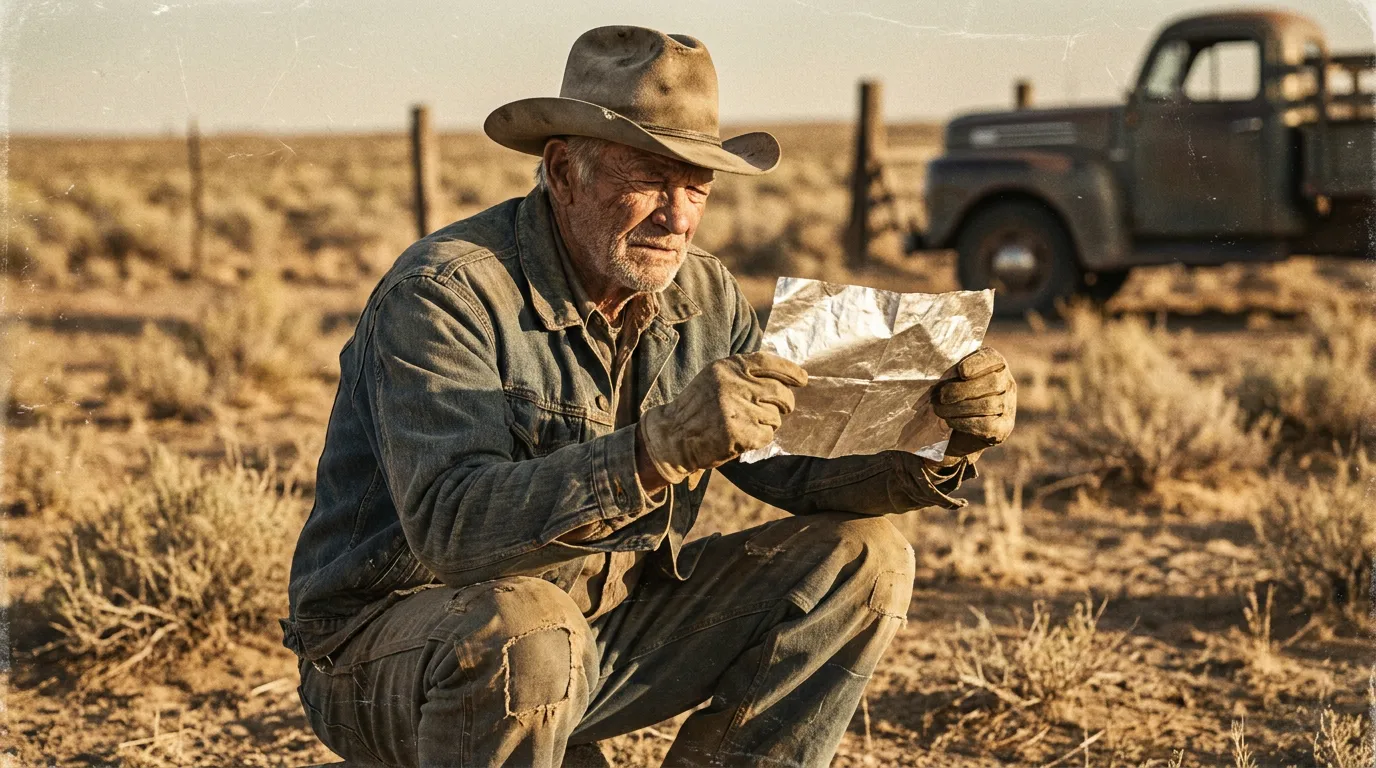
The timing is worth pausing on, because it is doing more work than most retellings admit. On 24 June 1947 the pilot Kenneth Arnold had reported nine objects skimming past Mount Rainier, a reporter’s paraphrase of his description produced the phrase “flying saucer,” and within a fortnight American newspapers were carrying disc sightings from nearly every state. Brazel did not find his debris in a neutral news environment. He found it in the middle of the loudest fortnight the subject has ever had.
The base intelligence officer, Major Jesse Marcel, went out and gathered it up. And then the field’s press office did something extraordinary: on 8 July 1947 it issued a release stating that the Army had recovered a “flying disc.” For a few hours, an official arm of the US military had announced it had a crashed flying saucer.
The retraction that should have ended it
It didn’t last. That same day the debris was flown to Fort Worth, where General Roger Ramey held a press conference, laid the material out for photographers, and identified it as a weather balloon. The papers ran the correction, everyone shrugged, and Roswell vanished from the public mind for three decades. There was no siege of the base, no men in black, no lockdown. The story simply died of embarrassment.
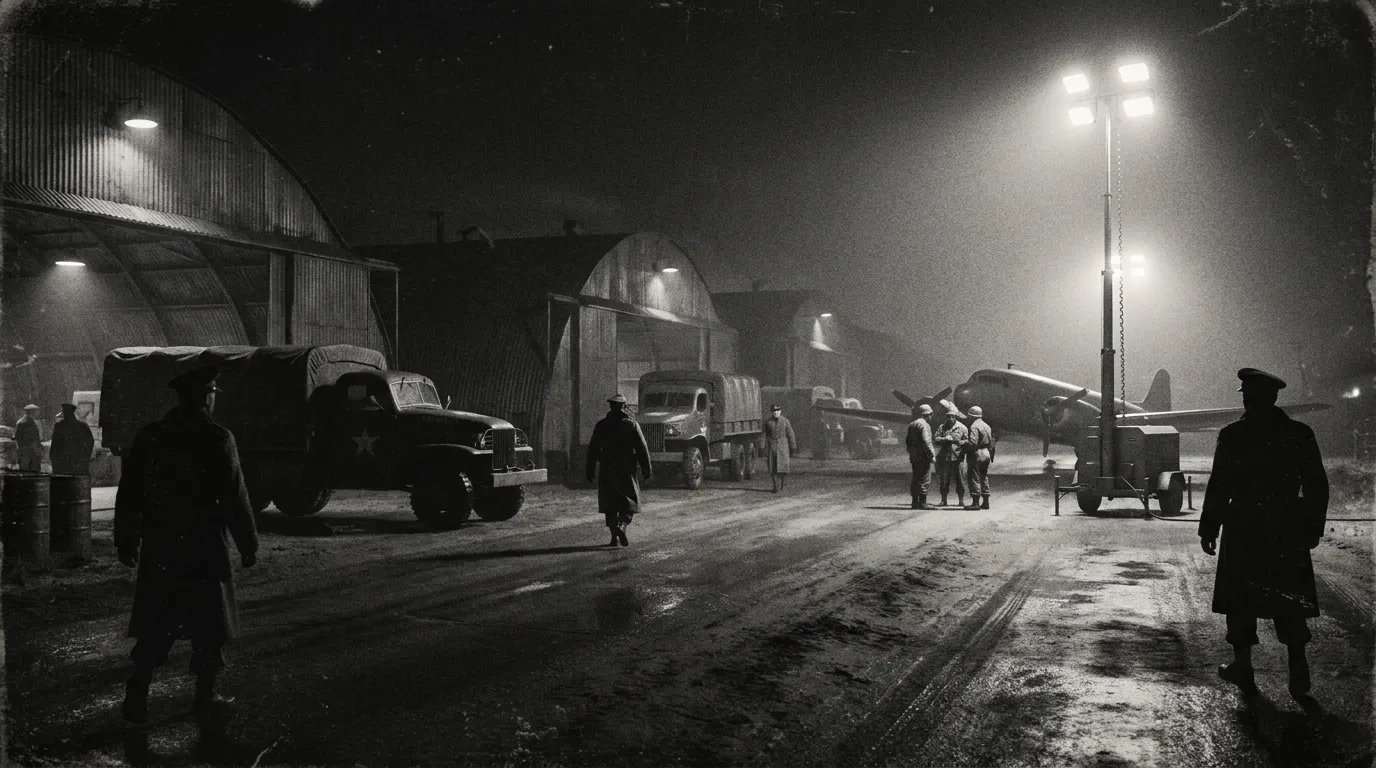
That thirty-year silence matters enormously. Whatever was recovered in 1947, nobody at the time behaved as if aliens had crashed. The most dramatic UFO case in history spent its first three decades as a non-story.
The rancher, and the years when nobody cared
The clearest evidence of that comes from Brazel himself. On 9 July 1947 the Roswell Daily Record ran a follow-up under the headline “Harassed Rancher Who Located ‘Saucer’ Sorry He Told About It,” and the wire copy has him plainly bewildered by the fuss he had caused. A man who had just handled the wreckage of an interstellar vehicle is not, as a rule, chiefly annoyed about the phone ringing.
Later accounts would add that Brazel was held and questioned by the military for several days before that interview, and that the tone of it was dictated to him. That may be true. It is also, importantly, testimony collected decades afterwards rather than anything in the 1947 record, and the distinction is the whole methodological problem with this case in miniature.
Then the trail goes cold. Roswell predates Project Sign, the US Air Force’s first formal UFO study, by roughly six months. It does not appear in Edward Ruppelt’s 1956 insider history of the Air Force’s investigations, written by the man who ran Project Blue Book. It is absent from the Condon Committee’s 1968 report, the university study that gave the Air Force its excuse to close Blue Book down. For thirty-one years, the world’s most famous UFO case was in nobody’s file.
How it came back
Roswell was exhumed in the late 1970s, when the nuclear physicist and UFO researcher Stanton Friedman tracked down a retired Jesse Marcel. Marcel, decades on, described debris that didn’t behave like a balloon — foil that unfolded itself, beams that wouldn’t burn, “memory metal.” A 1980 book by Charles Berlitz and William Moore, The Roswell Incident, packaged it for the public, and from there the story grew with each retelling: alien bodies recovered, a second crash site, tiny corpses in a hangar, beams inscribed with hieroglyph-like symbols, a decades-long government cover-up.
None of this was in the 1947 record. All of it came from memories recovered, and witnesses surfacing, thirty to fifty years after the fact. The growth curve is instructive: each successive book — Kevin Randle and Donald Schmitt’s investigations through the early 1990s, and at the far end Philip Corso’s 1997 The Day After Roswell, which claimed the crash seeded the transistor and the integrated circuit — needed a bigger story than the last one to justify itself.
The balloon that wasn’t quite a balloon
Here is the twist that sceptics and believers both tend to get slightly wrong. General Ramey’s 1947 “weather balloon” was a cover story — but not for a spacecraft. In the mid-1990s the US Air Force published two lengthy reports that identified the debris as the remains of Project Mogul: a top-secret programme of high-altitude balloon trains carrying sensors to detect the acoustic signature of Soviet nuclear tests.
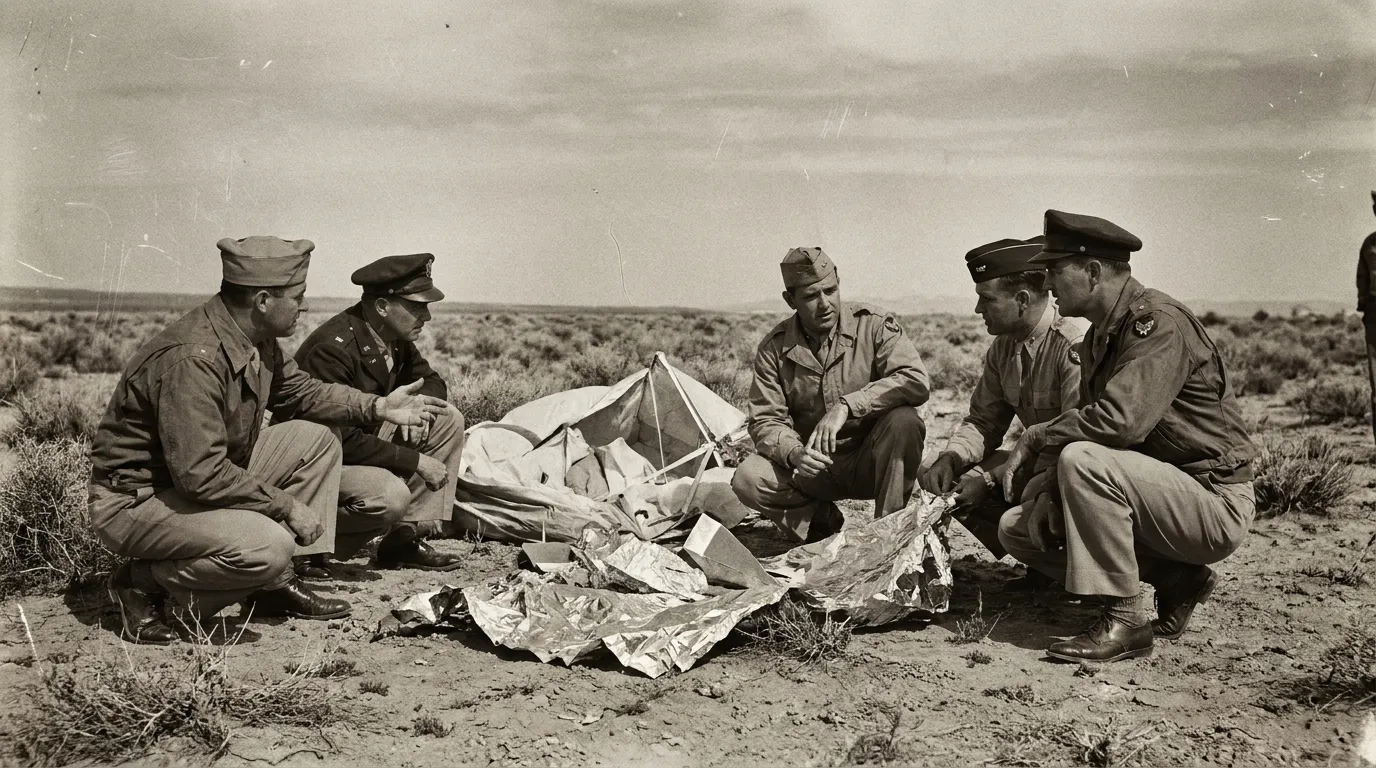
The first of those reports was not volunteered. It came in July 1994, after the New Mexico congressman Steven Schiff asked the General Accounting Office to find out what records the government actually held. Faced with a formal audit, the Air Force went looking and produced The Roswell Report: Fact vs. Fiction in the New Mexico Desert, pointing at a New York University balloon programme run under Mogul’s classified umbrella.
Mogul explains a remarkable amount. It was genuinely secret, which accounts for the military’s twitchiness. Its balloon trains used neoprene, balsa beams and foil radar reflectors held together with reinforced tape — a decent match for Marcel’s “memory metal,” lightweight beams, and the flowered tape later remembered as “hieroglyphics.” A classified balloon is not a boring answer; it is a Cold War answer, and it fits the physical debris better than a spaceship does.
Where the Mogul explanation strains
It is not airtight, and pretending otherwise does the sceptical case no favours. The Air Force pinned the debris on a specific launch — NYU Flight 4, of early June 1947, reconstructed decades later largely by the project’s own former engineer, the atmospheric physicist Charles B. Moore.
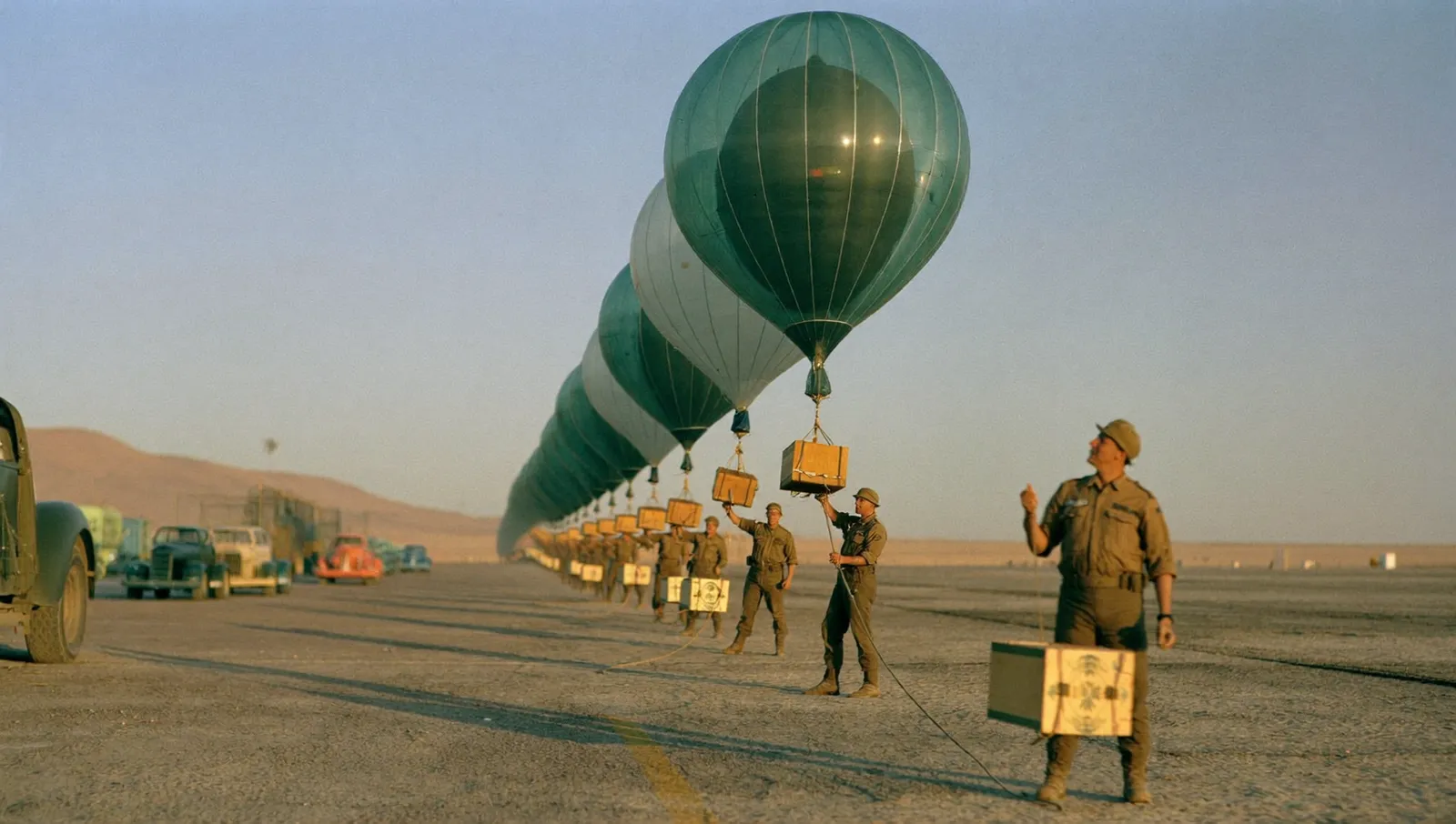
The problem, pressed hardest by researchers including Brad Sparks, Kevin Randle and David Rudiak, is that the NYU team’s surviving records list Flight 4 as cancelled, and Moore’s trajectory was retrofitted from partial data half a century after the event. Moore’s answer was that the numbering was informal and that unrecorded service flights were routinely launched. Both positions are arguable and neither is provable now.
Notice, though, what that dispute does and does not touch. Even if Flight 4 is the wrong flight, every Mogul train of that period used the same neoprene, balsa and foil. The material match does not depend on the paperwork. Karl Pflock, a researcher who spent years on Roswell and concluded no spacecraft was involved, still found parts of the Air Force’s account unpersuasive — which is roughly the right place to land. Mogul is the best-supported explanation available. “Best-supported” is not “proven.”
The bodies, and the witnesses who didn’t hold up
The Air Force’s second attempt, The Roswell Report: Case Closed (1997), tried to account for the alien corpses as well, and this is where the official case gets genuinely weak. Its explanation was that witnesses had confused the crash with Air Force high-altitude research drops of anthropomorphic test dummies over New Mexico — which began in the 1950s, six to twelve years after 1947.
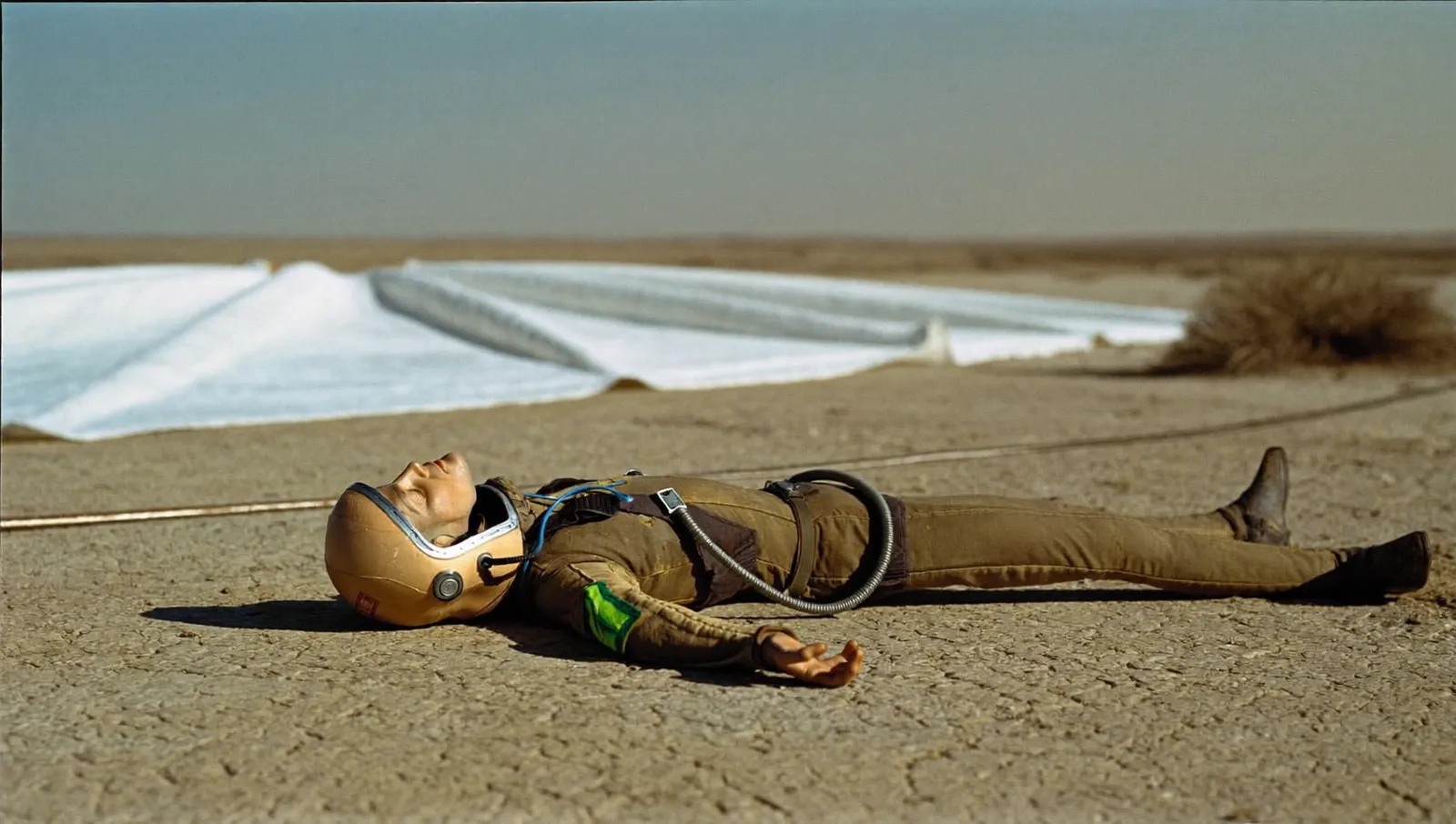
To bridge that gap the report leaned on “time compression,” the idea that witnesses had folded a decade of separate events into one memory. Even sceptics winced. Pflock called it a real stretch, and he was being polite.
But the bodies never had much to stand on in the first place. The two witnesses who supplied the most vivid detail have both since collapsed. Glenn Dennis, a Roswell mortician who came forward in 1989 with a story about a nurse who had assisted at an autopsy on small non-human corpses, could never produce her; the name he gave matched no one on the base rolls, and researchers who had championed him quietly dropped him. Frank Kaufmann, source of the most cinematic version of the recovery, died in 2001 — whereupon his own papers were found to contain forged military records, and Kevin Randle and Mark Rodeghier of the Center for UFO Studies publicly announced that they had been taken in for over a decade.
And then there is the 1995 “alien autopsy” film, sold to broadcasters worldwide by the British producer Ray Santilli as authentic 1947 footage. In 2006 Santilli conceded it was staged, shot in a London flat, the body sculpted by the special-effects artist John Humphreys. Three of the pillars of the Roswell bodies story, and not one of them bears weight.
The memo in the general’s hand
One genuine 1947 artefact does survive, and it deserves more care than either camp usually gives it. When the Fort Worth Star-Telegram photographer J. Bond Johnson shot General Ramey with the debris on 8 July, Ramey was holding a sheet of paper. The negatives are held today by the University of Texas at Arlington libraries, and for thirty years researchers — David Rudiak most doggedly — have tried to read what is on it.
Some transcriptions claim to find phrases that imply bodies and a real disc. Others find wording entirely consistent with a balloon recovery. The plain fact is that this is a low-resolution 1947 press negative of a crumpled page held at an angle, and that people tend to read out of it what they brought to it. It is the best physical evidence in the case, and it still cannot settle an argument — which tells you most of what you need to know about Roswell’s evidential base.
The UAP Times take
We rate Roswell an Unconfirmed rating — three out of five on our scale — and if anything that is generous to the extraterrestrial reading. The debris is real and was genuinely classified; the best-supported explanation for it is a secret nuclear-surveillance balloon, which comfortably accounts for both the material and the secrecy. The parts that make Roswell legendary — the bodies, the intact craft, the hieroglyphic beams — have no contemporary documentation at all and surfaced only after the case became a commercial phenomenon.
That does not make everyone a liar. Memory is reconstructive, a genuinely secret programme was involved, and 1947 was a strange, jumpy year. The historian Garrett Graff, whose 2023 book UFO traces the government’s dealings with the subject from the Second World War onward, makes the sharpest available point about it: there really was a cover-up at Roswell, and it was about Soviet atomic tests. The secret was real. It simply wasn’t the secret everyone wanted.
The mystery of Roswell is not what crashed. It’s how a corrected balloon report became the most famous four letters in ufology.
The honest verdict is deflationary. Roswell is the story of how a scrap of Cold War hardware, a hasty press release, and thirty years of retelling combined into a modern myth — and of how a myth, once it pays, starts hiring witnesses.
Further reading: for a case where the documents point the other way — toward something genuinely unexplained — see The Tehran Dogfight; and for the man whose 1989 testimony fused Roswell’s crash-retrieval myth to a real Nevada base, Bob Lazar’s Credibility: The Complete Evidence File. For the other great American crash-retrieval story, see Kecksburg 1965, and for the version Brazil produced, the Varginha case. For what else was worrying New Mexico’s atomic establishment in the same years, see the green fireballs of 1949. Roswell’s alleged craft was the archetypal disc; it’s logged on the sightings map.
Source: USAF 'The Roswell Report' (1994/1997); contemporary press coverage; Project Mogul records
Follow the file
Every new dispatch from the UAP desk, in your inbox. Sourced, sceptical, and no more than one email a week.