
The last week of August has been and gone, and the thing everybody was watching for did not arrive.
What did arrive, over the summer, was a slow accumulation of promises about a word now doing an enormous amount of work in this story: amnesty. Not a waiver, not a channel, not a reporting duty. Amnesty — the idea that the people who claim to have worked inside crash-retrieval programmes are kept silent by the threat of prosecution, and that the President could simply take that threat away.
It is a clean, satisfying theory of the case. It is also, on the law as it stands, close to exactly wrong. A pardon is the one instrument in the executive’s kit that would not solve the problem being described.
What was actually promised, and by whom
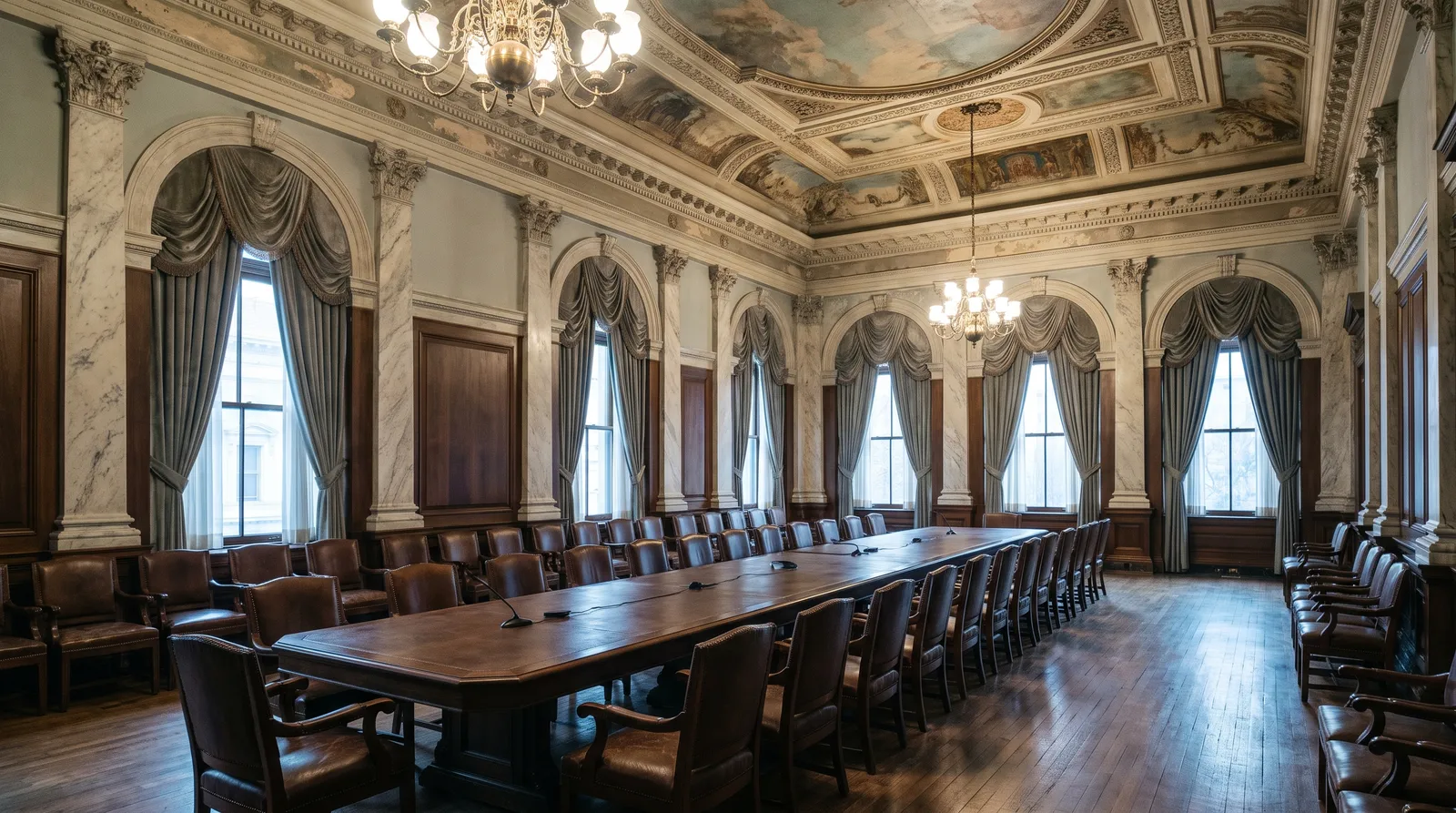
The clearest statement of the plan came on 25 June, at the Disclosure Foundation’s all-day forum in the Kennedy Caucus Room of the Russell Senate Office Building — an event that put Senators Kirsten Gillibrand and Mike Rounds on the same programme as Representatives Anna Paulina Luna, Eric Burlison and Tim Burchett, and which its organisers were careful to frame as being about oversight and process rather than proof.
Two things came out of it that matter here. Rounds, who co-sponsored the original UAP Disclosure Act with Chuck Schumer, said he would revive legislation specifically covering witnesses who come forward about recovered technology. And Luna, who chairs the House Oversight Task Force on the Declassification of Federal Secrets, said she was working with the White House on a possible amnesty programme — with, as NewsNation reported it, a list of named individuals lawmakers want covered so they can talk about alleged craft locations, recovered materials and non-human “biologics”. A former Pentagon analyst at the same event suggested the vehicle might be a presidential executive order.
Luna has been the most forward-leaning voice in this. She has said publicly that she has seen material in a SCIF that leads her to believe there are things the government cannot explain, and that she has “observed things that are of nonhuman origin and creation” — a claim, it should be said plainly, that rests entirely on her own account and no document anyone else has seen. Her position is that when it is declassified, she will hold a press conference and show it.
That conditional is not a rhetorical hedge. It is a legal one, and it points at the wrong tool.
The waiver already happened — and it stopped short
The government did open a door this summer. On 21 July a national security presidential memorandum went out, and on 31 July the Office of the Director of National Intelligence issued preliminary guidance, signed by Principal Deputy DNI Aaron Lukas, telling the Department of War and the intelligence community to let current and former employees and contractors disclose UAP information to designated representatives at AARO or the PURSUE task force, notwithstanding prior non-disclosure agreements, oaths or commitments.
We covered that memo as a duty to report with a very short list of people to report to. The month since has produced a more precise reading of it, and the most useful one comes from an unglamorous source: a legal client alert published in August by the law firm DLA Piper, written for defence contractors trying to work out what their staff are now allowed to say.
Its conclusion is blunt. The guidance is narrower than the statute it sits on top of. Where the FY2023 National Defense Authorization Act authorises UAP disclosures notwithstanding “any regulation or order” and “any provision of law”, the preliminary guidance reaches only NDAs, agreements, oaths and commitments. It does not authorise public disclosure of classified information. It does not address criminal liability under the Espionage Act. And it contains no implementing procedure for contractors at all — which, given that the people at the centre of the crash-retrieval allegations are almost always described as contractor personnel, is a fairly large hole in the middle of it.
So the contractual half of the gag was lifted. The criminal half, and the classification half, were not touched.
What a pardon can and cannot do
The pardon power in Article II is a power over “Offenses against the United States”. The settled reading, going back to Ex parte Garland in 1866, is that it may be exercised at any time after the commission of the offence — before charge, during proceedings, or after conviction. What it does not do, on any orthodox account, is licence conduct that has not happened yet.
That distinction is fatal here. A witness who wants to describe a recovered craft on television is not asking to be forgiven for something they did in 1989. They are asking permission to commit, tomorrow, an unauthorised disclosure of national defence information — the offence at 18 U.S.C. § 793(e), or § 798 where signals intelligence is involved. A pardon cannot issue for that, because it has not occurred. And a promise not to prosecute is worth exactly as much as the administration that gave it, for exactly as long as that administration lasts.
An amnesty forgives the past. The thing standing between these witnesses and a microphone is entirely in the future.
A pardon also does nothing whatever about the rest of the exposure: contractual liability to a private employer, civil suits, clearance revocation, and the quieter machinery of professional blacklisting that never needs a prosecutor to work.
The statute already does more than the memo
The irony is that the strongest protection in this area is already on the books, and under-used.
The FY2023 NDAA created UAP-specific whistleblower provisions, codified at 50 U.S.C. § 3373b, that set up authorised channels to Congress, inspectors general and AARO. Crucially, an authorised disclosure under that section is not subject to a non-disclosure agreement, and is deemed to comply with any regulation or order issued under the authority of Executive Order 13526 — the order that governs the entire classification system.
Read that again, because it is doing something the July guidance conspicuously does not. It reaches the classification regime, not just the paperwork.
The catch is that § 3373b protects disclosure to the government. It is a route into Congress and the inspectors general, not onto a stage. That is fine if what you want is oversight, which is what it was built for. It is less fine if what you want is the press conference — and the press conference is what keeps being promised.
The one lever that would work is the dull one
If the goal is genuinely to let a named individual describe a recovered object in public without going to prison, there is exactly one instrument that achieves it, and it is not amnesty. It is declassification.
The President’s authority over the classification system is about as close to plenary as executive power gets. Executive Order 13526 is a presidential order; it can be amended, and specific material declassified, by whoever signed the last one. Declassify the underlying information and the § 793 problem largely dissolves, because there is no longer national defence information to protect. No pardon required. No list of names. No question of what the next administration thinks.
That this has not been done — while an amnesty that could not work is discussed at length — is the most informative fact in the story. Either the material does not exist in the form described, or the executive branch is unwilling to declassify it, or the programmes are held somewhere the White House has not managed to get read into. All three are plausible. Only the last is flattering to anybody.
Rounds’s legislative route has the same shape as the records framework the House adopted in July: build a statutory declassification machine with a review board and a presumption of disclosure, and let it grind. It is slow, and it has died in conference three years running. It is also the only version that survives a change of president.
The sceptic’s read
There are two sceptical positions here and they deserve separating, because they are not the same argument.
The first is procedural, and comes from inside the community. Matthew Brown, who wrote the Immaculate Constellation report, has been publicly telling other witnesses not to use the new PURSUE intake channels — his view being that they are more of the same, and possibly a trap. Part of that objection is simply correct on the drafting, as the DLA Piper reading confirms. NewsNation has run a version of the same worry at policy level, reporting the argument that the latest push could be a “dead end”. You need not believe in bad faith to notice that a channel which routes testimony back into the executive branch, waives the NDA but not the criminal statute, and issues no contractor procedure, is not obviously built to produce public revelation.
The second position is duller and, on the evidence, more likely: there may be nobody to grant an amnesty to. The central claim — that identifiable people worked on programmes that recovered non-human craft — has been in the public record since David Grusch testified in 2023, and has produced, in three years, no document, no photograph and no corroborating witness willing to be named and specific under oath. AARO’s own review found nothing. The tranche releases have not turned up a supporting page. It is entirely possible the amnesty is being designed for a category of person that does not exist — in which case it will be legislated, never used, and cited for years as proof the cover-up ran deeper than anyone thought.
The public is unmoved by any of it. Gallup found a record 78% of Americans think the government knows more than it is telling — a number that went up, not down, after the disclosure programme began.
The UAP Times take
The record here is solid: the ODNI guidance is a published document, the statute is a statute, the legal reading comes from a firm advising clients who have to get it right, and the forum statements are on the record. What is not solid is the thing the amnesty is for. So this piece earns a Credible rating, four out of five on our scale — the policy fight is well documented, the claim driving it is not, and the amnesty programme itself currently exists as a lawmaker saying she is working on one.
The honest summary is that the disclosure push has spent a summer solving the easy half of a two-part problem and describing the hard half with the wrong word. Waiving an NDA is administratively cheap and legally tidy. Declassifying material is expensive, irreversible and politically dangerous, which is why it keeps not happening. Amnesty sits between them as a promise that sounds like the second and costs like the first.
If Luna’s press conference ever happens, it will be because something was declassified — not because anybody was pardoned. Watch for a declassification decision, or a § 3373b referral that reaches a public hearing. Everything else is vocabulary.
Update, 15 September: the Department of War has now issued a waiver that closes one of the three holes described above — it names contractors, and it names Special Access Program Indoctrination Agreements. It still does not touch the Espionage Act. We read it here: the Pentagon has voided its UAP secrecy agreements, and left the criminal statute alone.
Further reading: the ODNI memorandum that waived the NDAs and started the clock and the statutory records framework the House voted through in July.
Follow the file
Every new dispatch from the UAP desk, in your inbox. Sourced, sceptical, and no more than one email a week.