In July we wrote about three infrared camera pods bolted to rooftops around Las Vegas, and ended with a list of things that would have to happen before the exercise counted for anything. Top of that list: the claim that the array could recover a flying object’s distance, speed and acceleration “to better than 10%” needed to stop being a specification and start being a measurement, checked against aircraft whose real positions were already known.
That paper has now landed. The claimed 10% came back as roughly 1%.
Which is the good news. The more interesting news is what the instrument found once it could finally see in three dimensions: a great many aeroplanes, a scattering of small things drifting at about the speed of a bicycle, and nothing anybody involved is calling anomalous.
What was actually published
The paper is titled, with the romance you would expect, “An Assessment of the Triangulation Capabilities of a Multi-Site All-Sky Infrared Camera Array”. It went up on arXiv on 2 October as a 25-page preprint (2610.06922), submitted to the journal Sensors, and the author list is Avi Loeb with Alex Delacroix, Ezra Kelderman, Eric Masson and Regina Sarmiento — the engineering half of the Galileo Project rather than its publicity half.
A point of order before the numbers: this is a preprint. It is submitted, not yet accepted, and it has not been peer-reviewed. The project’s previous instalment — the commissioning study first-authored by Laura Domine, which logged half a million objects over five months from the Harvard prototype — did make it into Sensors in 2025, so the pipeline is real. But “submitted to” and “published in” are different evidential tiers, and this site is not going to pretend otherwise.
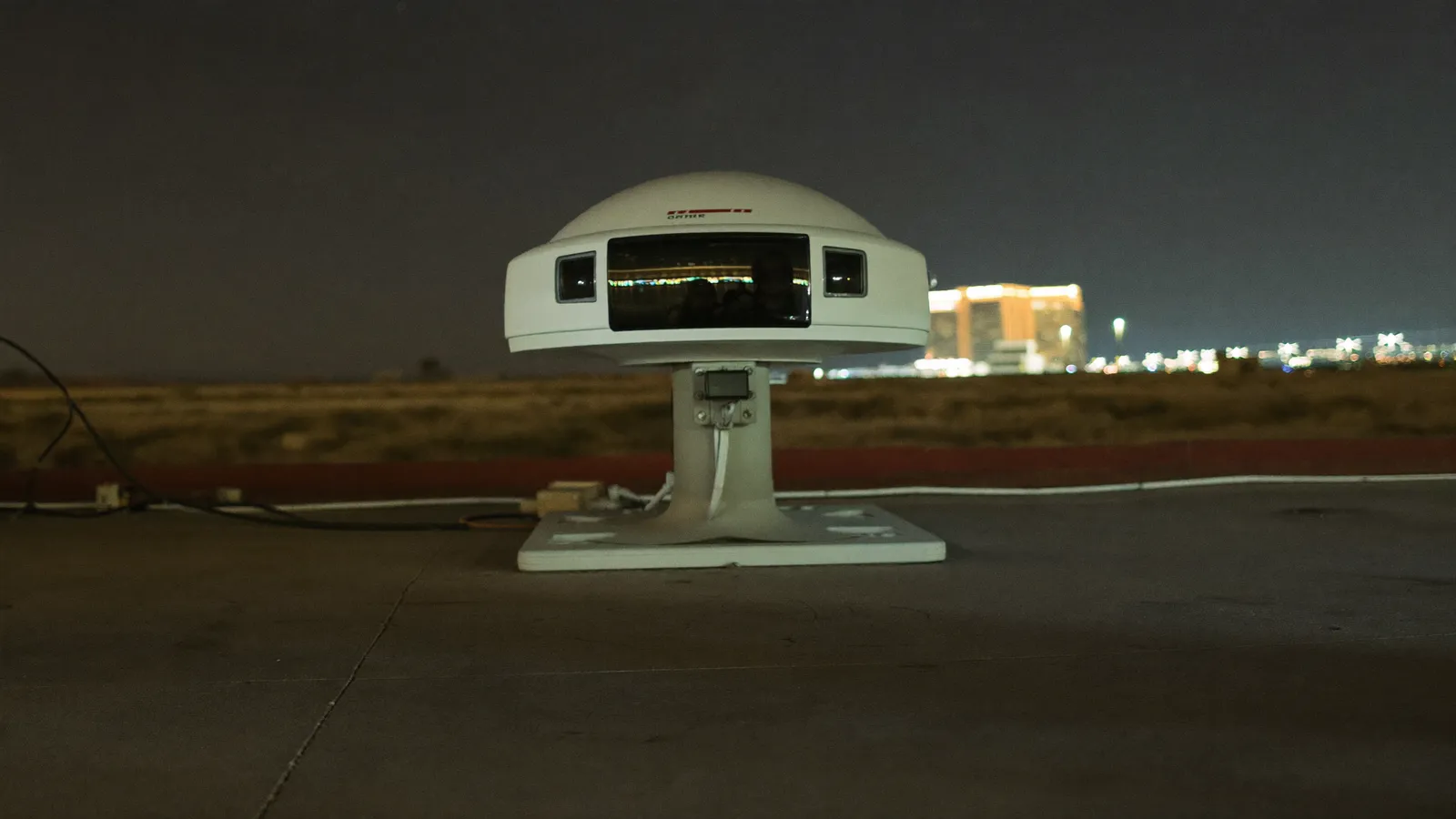
The hardware is as described in our piece on the method: three autonomous sites near Las Vegas — one on the roof of the Sphere — each carrying eight long-wave infrared cameras under a dome, with baselines of roughly 2km and 10km. Three widely spaced stations watching the same object at the same moment give you a parallax angle, parallax gives you a range, and range is the number eighty years of UFO photography has not had.
The test ran for a single week, 24 to 30 May 2026: 1,650 camera-hours, some 210 million detections, 5.3 million tracks. Automated cross-site matching produced 18,176 matched track pairs, of which 2,213 were supported by all three stations and merged into 739 unique objects. Of those 739, the paper identifies 598 as aeroplanes.
The genuinely clever bit is the calibration
Here is a problem that does not occur to you until you try it: a long-wave infrared all-sky camera cannot see stars, and it cannot see fixed landmarks either, because it is pointed at the sky. The standard astronomical trick — working out exactly where your camera is looking by matching the star field — is simply unavailable.
The team’s solution is the part of this paper that deserves the attention. They use aircraft as reference sources: specifically, aircraft broadcasting ADS-B, the transponder signal that continuously reports a plane’s identity, position and altitude, and which anyone can receive. Commercial aviation is already flying a few thousand calibration targets a day over Las Vegas, each one announcing precisely where it is.
That turns the exercise into something close to a laboratory test. You triangulate an object with your own cameras, ask the transponder where it actually was, and compare. It is the difference between claiming an accuracy and demonstrating one against data you did not generate.
The accuracy figures, and the catch in them
The results, as reported:
For aircraft solved from all three sites — 593 of them — distances came back within 5% of the ADS-B truth 99% of the time, and within 1% for 66%. The median relative distance error across the sample runs at about 1.4%. Speeds held up slightly less well: within 5% for 78% of cases.
For objects solved from only a single pair of sites — 5,626 of them — the figures degrade as you would expect: distances within 5% for 83%, within 1% for 40%, and speeds within 5% for 63%.
Three stations are not a luxury. They are the difference between a measurement and an estimate.
That degradation is the most practically useful thing in the paper. It quantifies how much worse a two-camera solution is than a three-camera one — which matters to anybody planning to build such a network, and bears directly on the uncomfortable fact that almost every case in the historical record was recorded by exactly one camera.
One caveat for anyone skim-reading: the paper carries several overlapping samples with different cuts, and the denominators move between sections. The 739 unique objects come from the full cross-site match; the kinematic analysis later works through a 365-object three-site subset. None of that is sleight of hand, but it does mean the single clean number people will want to quote does not really exist. Read the tables.
The unknowns, and why they are boring
Now the bit everybody actually wants. Once the cameras could measure range, what did the unexplained objects turn out to be?
The paper relaxes its identification requirements — deliberately loosening the criteria to let genuine outliers through rather than quietly classifying them away — and then looks at where objects fall in kinematic phase space. The population separates into two clumps without any appeal to what the things are.
The large clump, 301 objects, sits exactly where aircraft sit: 116 to 298 metres per second, median altitude 10.5km. Of those, 284 are confirmed by ADS-B. Seventeen are not — flying like airliners, at airliner height, without a transponder match, which in the real world usually means military traffic, a data gap or a matching failure rather than anything exotic.
The second clump, 64 objects, sits below 30 metres per second — under 70mph — at 3 to 5km, and the paper describes them on inspection as small. Birds, balloons, insects and debris live in precisely that corner of the plot.
So the honest summary of the first triangulated week is: 81 objects the instrument could not identify, none behaving in a way that needs new physics, and the authors conspicuously not claiming otherwise. That restraint matches the commissioning paper, which ended not in a parade of candidate UAP but in a statistical upper limit on how many anomalies it could have missed.
It lands in a telling context, too. Galileo Project scientists recently took one of the Pentagon’s own declassified videos — six objects logged at 480mph — and showed the brightness flickering at bird wingbeat rates. It is the same missing number the audit of all 112 PURSUE videos found could not be recovered from the official footage at all. A group that keeps deflating its own field’s best material is not behaving like a group hunting headlines.
The sceptic’s read
There is no published critique of this specific paper yet, so let us put the case properly rather than wait for someone else to.
First: these are the project’s own data, analysed by its own pipeline and assessed by its own authors, and not yet reviewed by anyone else. The ADS-B comparison is a genuine external check and the strongest thing in the paper — but a transponder validates the geometry, not the classification logic that decides which blobs become “objects” in the first place.
Second: one week is one week. Weather, as the paper concedes, affects detection and triangulation completeness, and a late-May week in the Nevada desert is not a representative sample of the world’s skies.
Third, and most durable, is Mick West’s standing objection, aimed at the Vegas array since it went up. He allows that triangulated sensors “may be a great clarifier for ufology”, then notes that a system projected to measure a few million objects a year “probably won’t find anything unambiguously anomalous” — and asks the question that actually matters: what will that change?
On this week’s evidence, approximately nothing, for anyone whose position was never data-driven. The reply to a null result has always been that the phenomenon does not perform on demand and is not obliged to fly through anybody’s baseline. That argument cannot be falsified, which is exactly why it endures.
But “it won’t convince the committed” is a fact about people, not instruments. This paper’s value is that it moves one specific claim out of the project’s press material and into a table you can check.
What it means for the famous cases
Retrospectively, nothing — and that is the point worth sitting with. No amount of instrumentation in Nevada in 2026 recovers the range of Gimbal or GoFast, because that information was never recorded. The same hole explains why nobody could say how large the jellyfish over Anchorage was in June, and why AARO’s annual reporting keeps filing cases under “insufficient data” — a category that is not evidence of anything except insufficient data.
What changes is forward-looking. If a network like this is running when the next genuinely strange thing crosses a city, the argument afterwards will be about a measured distance rather than about parallax, glare and somebody’s YouTube reconstruction. On this week’s showing, the instrument is good enough for that argument to be worth having.
The Field Kit
Some links are Amazon affiliate links. As an Amazon Associate, UAP Times earns from qualifying purchases — at no extra cost to you.
You cannot triangulate on your own — that is the lesson of the two-site figures above. But two friends, two timestamps and two honest bearings get you closer than any single phone video ever will.
- Rite in the Rain field notebook — log it before you forget it → — time to the second, compass bearing, elevation estimate, your exact position. Those four lines are what turn a video into something a second observer’s video can be matched against.
- Celestron SkyMaster 15x70 — for confirming a shape → — the cheapest way to settle whether the thing has structure or is three lights in a row. Too heavy to hand-hold for long; use a fence post.
- Nikon Coolpix P1000 — the 125x zoom people film the Moon with → — reach enough to resolve an airframe at distance, which is how most “orb” footage eventually gets identified. Expect flare at full zoom; that is the camera, not the craft.
The full kit list lives on our Field Kit page.
The UAP Times take
This earns a Credible rating, four out of five on our scale. The underlying claim is narrow and well-supported: a three-station infrared array near Las Vegas has had its range-finding checked against aircraft transponder data and come back accurate to roughly 1%, an order of magnitude better than the project had been promising. The numbers sit in a numbered preprint with five named authors, validated against ADS-B data the team did not generate. It falls short of our top mark for one reason — it is submitted to Sensors, not yet through peer review, and nobody outside the project has replicated it.
What we keep coming back to is the shape of this story. The July version was about an instrument that might one day supply the missing number. The November version is about an instrument that supplied it — and used it to establish that the unidentified objects over Las Vegas last May were drifting at jogging pace a few kilometres up, and were, on inspection, small.
That is not a disappointment. It is what the beginning of a measurement programme is supposed to look like: an honest denominator, published nulls, and a specification that survived contact with reality. The field has had eighty years of extraordinary claims recorded at unknown distances. One week of ordinary findings recorded at known distances is worth more than all of it.
Further reading: the method this paper validates, and why range is the number everything else depends on — three cameras over Las Vegas. The next instrument in the series asks what the orbs are made of rather than how far away they are: an orb spectrograph, now destined for Carl Sagan’s old house in Ithaca. And for the amateur version of the same discipline, the field kit — or, for the version with no instruments at all, the filmed CE5 session on the Bass Strait coast that logged nothing.
Follow the file
Every new dispatch from the UAP desk, in your inbox. Sourced, sceptical, and no more than one email a week.