
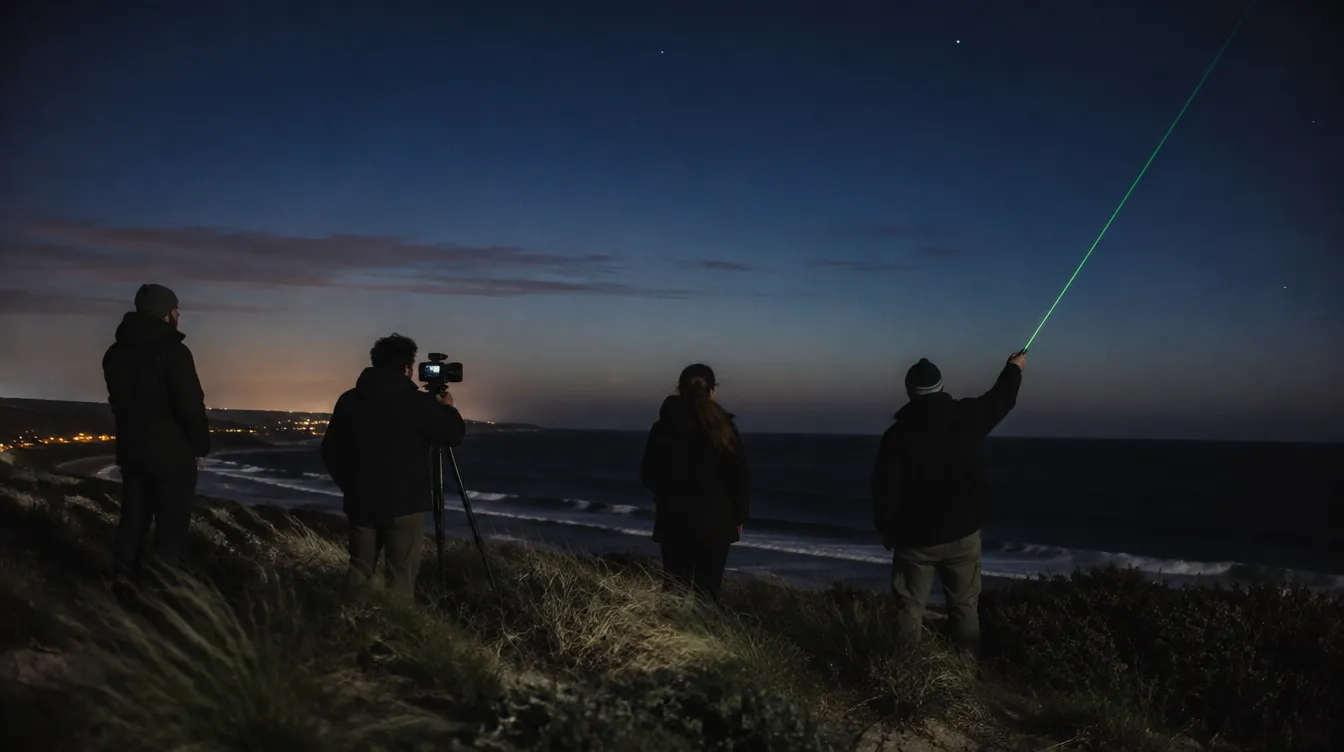
There is a particular kind of television bravery in pointing a camera at an empty sky and waiting.
On 17 November, NewsNation released a Reality Check segment in which Ross Coulthart stood on the Victorian coast at Barwon Heads, on the northern lip of Bass Strait, with four men who believe the right state of mind can persuade anomalous objects to show themselves. They meditated. They signalled. They asked, in Coulthart’s phrase, to “make a beacon”.
Nothing came.
That is the entire result, and it is worth more than most of what the subject produces in a month. A test with a stated method, a fixed place, a fixed night and a published failure is a better piece of journalism than a hundred pieces of shaky phone footage with no time stamp — which is a point this site keeps making about instrumented programmes versus eyewitness ones.
What they actually did
The group is White Hawk Psionics — spelled “Whitehawk” by about half the outlets covering it, which tells you how new this is to most newsrooms. Coverage names four participants: Troy Gavin, Steve Carnell, Vira Elan, and Jack Westacott, described as a parapsychologist.
Their method is CE5, which the segment frames with the more respectable-sounding label “neuromeditative signalling”. The team’s stated aim was to invite “golden orbs” to appear over the water, and their reason for choosing that stretch of coast was speculation that objects go in and out of the sea there. No evidence for that was presented on camera.
By every account of the broadcast, including the programme’s own framing, the orbs did not arrive. The team did not capture them during filming.
Where CE5 comes from, and what it claims
CE5 is not a NewsNation invention. The protocols were developed by Dr Steven Greer, whose Center for the Study of Extraterrestrial Intelligence has promoted them since the 1990s as the fifth rung of the old Hynek close-encounter ladder: the one where contact is initiated by the human rather than the visitor.
CSETI’s own manuals describe CE-5 as “active, real-time research activities” conducted in the field by trained members to initiate interaction with “extraterrestrial spacecraft and their occupants”. The practice is a mixture of coordinated meditation, what CSETI calls “coherent thought sequencing”, audio tones, and patterned light signalling with torches and lasers.
That last ingredient matters more than the first, and we’ll come back to it.
Greer’s commercial operation is part of the picture too: critics have long pointed at retreat packages running into thousands of dollars as a reason to look hard at the claims rather than past them. The White Hawk team are not Greer, and nothing here suggests they were selling anything on the beach. But the method they used is his, and it arrives with his track record attached.
Why a night like this almost always “works”
Here is the thing that should make any sceptic nervous about CE5 sessions that do produce a result. A group of people stand outside for several hours, in the dark, deliberately scanning the whole sky, having primed themselves to expect moving lights.
Low Earth orbit now has something in the order of ten thousand mirrors in it. On a clear night, from a dark coastal site, you will see satellites. Some of them will flare. Some will cross in formation. Mick West has spent years identifying exactly these sightings case by case using orbital simulation — matching date, time and coordinates against catalogued objects — and the answer keeps coming back as Starlink. We’ve been through the arithmetic of that in detail: the sky is fuller of false UFOs than it has ever been.
West is also honest about the limit of his own explanation. Satellites, he notes, “are not guaranteed to be perfectly aligned with the ground, so don’t always flare on demand”. Which is the quiet joke at the centre of CE5: a protocol that claims to summon lights is being run under a sky that supplies them on its own schedule, free of charge, several times an hour.
The criticism most often made of CE5 is not that practitioners are lying. It is that the sessions almost never demonstrate cause and effect. Something is seen; the meditation is credited; nobody checks the catalogue. Independent, peer-reviewed validation of the protocol is, to put it gently, scarce.
Which makes a filmed null result genuinely valuable. This time the catalogue was not consulted because there was nothing to consult it about.
The sea they chose
The location was not accidental, and it is the reason this story has reach beyond a single episode.
On 21 October 1978, Frederick Valentich, a 20-year-old pilot, took a Cessna 182L registered VH-DSJ from Moorabbin, bound for King Island across Bass Strait. He told Melbourne air traffic control he was being accompanied by an unknown aircraft. Pressed on what he was looking at, he said: “It’s not an aircraft.” His final transmission ended in a metallic scraping sound.
No wreckage was found. No oil slick, no body. The Department of Transport investigation closed with a formal conclusion that reads, in substance, that the reason for the aircraft’s disappearance has not been determined. In 1983 an engine cowl flap washed up on an island shore in the strait; it was compatible with the right range of airframes but was never conclusively matched to VH-DSJ, and secondary accounts disagree even on which island it landed on.
The sceptical case is substantial and deserves naming. Investigators established that Valentich’s stated reasons for the flight — collecting a friend, or crayfish — were untrue, which has fed a staged-disappearance theory that the official file does not confirm. The standing aviation explanation is spatial disorientation at night over water, the classic killer of inexperienced pilots. James McGaha, a retired military pilot and astronomer, and the investigator Joe Nickell went further and identified what they think he was describing: the apparently stationary lights above him were most likely Venus, Mars and Mercury, with the bright star Antares.
That is a coherent, testable, deeply unglamorous explanation for a case the folklore treats as unassailable. It also has nothing to do with Barwon Heads, which is where the film was made — a point worth stressing, because at least one write-up this week blurred the two. Barwon Heads was the filming location. It is not a confirmed site of anything.
The Field Kit
Some links are Amazon affiliate links. As an Amazon Associate, UAP Times earns from qualifying purchases — at no extra cost to you.
If you ever do stand on a dark beach waiting for something, the difference between an anecdote and a data point is almost entirely kit and discipline.
- Rite in the Rain field notebook — log it before you forget it → — write down the time from two sources, the compass bearing and the elevation as it happens. Do that and a satellite pass can be confirmed or excluded the next morning; skip it and you have a story.
- Celestron SkyMaster 15x70 — for settling what a light actually is → — enough magnification to turn a “golden orb” into a moving dot with a known trajectory. Too heavy to hand-hold for long, so budget for a tripod.
The full kit list lives on our Field Kit page.
What the programme got right
Coulthart’s record on this beat is mixed, and we have said so before — most recently when a shootdown claim he reported went unanswered by the White House rather than confirmed. He is a reporter who will carry an extraordinary claim a long way on thin sourcing.
This is not that. The segment is presented as a test, with the result it got, including the result it did not want. Coverage describes a night of investigation, meditation and what one write-up called healthy scepticism. A journalist who films a failure and broadcasts it anyway is doing the job.
It is also a reminder of how rare this is. The honest version of UAP television is mostly people standing around not seeing anything, which is why so little of it gets made — and why, when something is filmed, the first question should always be the boring one about what else was in the sky at the time. The viral Anchorage object turned out to have a very mundane answer that kite fliers spotted immediately.
The UAP Times take
Take the two halves separately, because they sit at very different evidential tiers.
The broadcast is real, dated and on the record: a named team, a named place, a stated method, a published null. That part is simply reporting, and it is good reporting.
The claim underneath it — that focused group meditation can draw anomalous craft out of the sky or the sea — rests on practitioner testimony, has no peer-reviewed support, and has now been tested on camera at a site of the practitioners’ own choosing with nothing to show for it. It earns a Thin rating, two out of five on our scale, and the only thing keeping it off the bottom rung is that the people making the attempt did so openly and reported the failure honestly.
One night proves nothing, and we should say that as plainly as we would if orbs had turned up. But it is a start on the right question. Run the protocol fifty times, log every light against a satellite catalogue, publish the misses with the hits, and you would have something science could chew on. Until somebody does that, CE5 is a belief with a torch.
Further reading: why most of the new lights in the sky are satellites catching the sun and what happens when you actually measure the distance to an orb.
Follow the file
Every new dispatch from the UAP desk, in your inbox. Sourced, sceptical, and no more than one email a week.