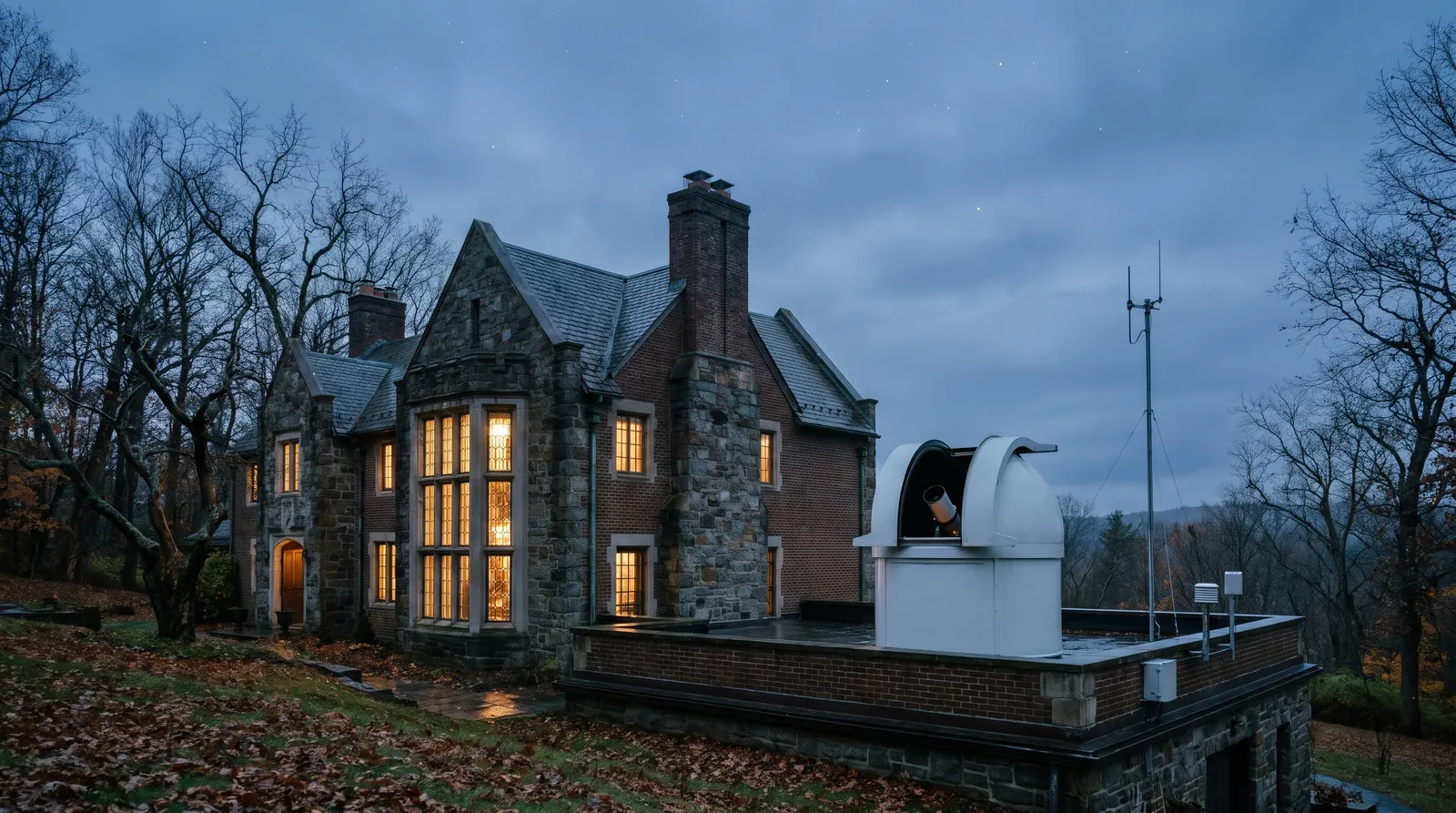
The house at 900 Stewart Avenue in Ithaca, New York was built in 1925 as a tomb.
Not a real one. A Cornell secret society called Sphinx Head raised $25,000 to put up a windowless Egyptian Revival lodge on the edge of the gorge, in the way that American undergraduates of a certain era did. In 1981 Carl Sagan bought it, moved in with his papers, and spent the last fifteen years of his life writing there — including, in 1996, the book containing the Baloney Detection Kit.
It is about to become a UFO observatory.
What was announced
Avi Loeb, the Harvard astrophysicist who runs the Galileo Project, confirmed this month that the project’s fourth observatory will be built at the Sagan house, funded by the scrap-metal entrepreneur Adam Weitsman. Weitsman bought the property from Sagan’s widow, Ann Druyan, on 26 November 2024 for $2 million — against a town assessment of $585,000, as The Ithaca Voice reported at the time. He said then that he wanted to restore it historically. He did not mention telescopes.
The plan now, per Loeb’s own announcement and a local news report of the project, is a continuous radar watch on the sky paired with a large optical telescope that slews to whatever the radar flags, photographs it at high resolution, and takes its spectrum. Renovation work starts this month; completion is anticipated in late 2027. A second, conventional telescope is to be installed for public outreach, remotely operable, which is the single most Sagan-shaped detail in the whole announcement.
This matters because it is the first Galileo site to combine the radar and the big optic. The existing three — in Massachusetts, Pennsylvania and Nevada — are arrays of wide-field cameras and sensors that watch everything and resolve nothing in particular.
Why this is news and not just another Loeb essay
In September we covered Loeb’s proposal for exactly this instrument — an orb imager, with a spectrograph on the back of it — and rated it four out of five with one specific reservation, which we wrote down at the time: “There is no announced budget, no timeline, no site and no hardware.”
Two months later there is a site with a deed, a named funder, a construction schedule and a telescope model. That is the gap between an essay and a building being closed in public, which in this field happens rarely enough to be worth reporting on its own.
It has also moved. In September the fourth observatory was pencilled in for Indiana. It is now Ithaca, which tells you the siting followed the money rather than the science — a philanthropist with a historic house went looking for something to put in it.
One wrinkle on the funding: in an October interview Loeb said the observatory was funded but declined to name the backer. Weitsman was named publicly only in this month’s announcement. Those two statements are consistent; it is simply worth knowing that the funding claim preceded the evidence for it by a few weeks.
The instrument, and the one number nobody agrees on
The design logic is sound and we have laboured it before. A camera records a direction and a brightness. It does not record a distance, which is why nobody has ever known how far away a UFO was, and without distance there is no size, no speed and no acceleration. A spectrum escapes that trap entirely, because the wavelengths at which a thing emits light are a property of its atoms rather than its range.
The radar is the clever part. Loeb has described a passive radar system — one that transmits nothing itself and instead listens for how existing television and radio broadcasts bounce off objects overhead. It needs no licence, no transmitter and no power budget to speak of, and he told the International Business Times that the team hopes to have one in place within a year.
Then there is the telescope, where the reporting does not line up. The IBTimes piece describes a “metre-class” instrument. Another account of the same announcement specifies a 0.7-metre PlaneWave CDK700, a well-regarded off-the-shelf research telescope. Those are not the same thing, and aperture is the whole game here: it sets both the resolution you can get on a small object a kilometre up and — more importantly for spectroscopy — how many photons you have to divide between wavelength bins before the thing leaves the frame. Until that number is nailed down, the capability claims are unfalsifiable in the dullest possible way.
The scorecard Loeb’s announcements should always be read against
The Galileo Project’s published output is about instruments and methods. It is not, so far, about discoveries.
Its commissioning study — first-authored by Laura Domine and published in Sensors — reconstructed roughly 500,000 aerial trajectories over five months from the Harvard site. About 16% were flagged as outliers by the software and inspected by hand in the infrared imagery. After all that, 144 tracks remained ambiguous, and the authors said plainly that they were probably mundane and could not be resolved without the distance and kinematic data they did not have. A statistical test set an upper bound of around 4% on the fraction of objects that could be anomalous.
That is a null result, honestly published, including the nulls. It is also, to be exact, the sum total: the project has never reported a peer-reviewed identification of anything in the sky as anomalous. When its first dataset went up, the response from the sceptics’ side of the field was close to silence — not derision, just a shrug at half a million aeroplanes.
Loeb’s wider track record cuts both ways, and the honest reading needs both halves. His claims about ‘Oumuamua and the Pacific spherules did not survive contact with the wider field, and last month he published a claim that the US holds alien technology sourced to a guest at a dinner party — a piece of work we filed at the very bottom of our credibility scale. He also chairs the White House’s UAP Science Advisory Council, and said this month that he had spoken to pilots about the encounters the President described on television. The man generates a great deal of noise. The Galileo Project’s papers are not part of it, which is the distinction that keeps this story on the credible side of the ledger.
Where it could fall over
Radar cueing is the hard part. Not the spectroscopy — the cueing. The objects this is built for are small, often slow, frequently low and sometimes described as cold. Small, low-cross-section targets in ground clutter are what radar is worst at, and passive radar, which takes whatever illumination the local broadcast towers happen to provide, is not the easy version of that problem. Mick West’s standing criticism of the project — that the filtering software needed to pull anything interesting out of the torrent of ordinary air traffic is itself years of work — applies with more force to a system that has to cue a slewing telescope in seconds.
Nothing is installed. The announcement is a plan with a budget. No instrument has been mounted, no data taken. It is worth saying out loud because UAP coverage has a habit of promoting an announced observatory to an operating one within two news cycles.
And it needs planning permission. The Sagan house is a contributing property in the Cornell Heights Historic District, which means externally visible alterations go before the Ithaca Landmarks Preservation Commission. Nobody has reported an application for rooftop astronomical hardware. The most terrestrial obstacle in this entire story is a local heritage committee, and we would not bet against it.
What Sagan would have made of it
He would have liked the instrument and distrusted the expectation, and it is worth being precise about why, because both halves get misquoted.
Sagan was not a UFO debunker of the dismissive kind. He co-organised the 1969 symposium at the American Association for the Advancement of Science that gave the subject’s most serious proponents a platform in the year after the Condon Report declared the whole business a waste of time. He thought extraterrestrial visitation unlikely and the question worth studying anyway, which is a harder position to hold than either of the ones it sits between.
What he actually did to the field was arithmetic. He and Steven Soter took apart the Hill abduction star map in Astronomy in 1974 by pointing out that with a thousand candidate stars to choose from, some pattern match was close to inevitable. That is the Baloney Detection Kit in action, and it is also, exactly, what the Domine paper did to 500,000 aircraft tracks.
So a radar-cued spectrograph in his old house is not an irony. It is the method he spent his life advertising, pointed at the subject he was most sceptical about, in the only way he ever said would count.
The UAP Times take
This earns a Credible rating, four out of five on our scale. The announcement itself is as solid as this subject gets: a named funder, a site with a public property record, local news confirmation of the renovation, and a scientist with published instrument papers putting his name to the plan. We are not relying on anyone’s anonymous source.
It is four rather than five because the thing being announced does not exist yet. Every capability claim — the radar’s sensitivity, the one-year timeline, what the optics can resolve — is the proponents’ own account of their own unbuilt hardware, and the one hard number that would let you check any of it, the telescope’s aperture, is reported two different ways by two different outlets. Ask us again when there is a spectrum.
Our expectation, stated so it can be held against us: if this observatory runs as described, most of what it catches will turn out to be burning meteor dust, aircraft lighting and balloons, and the unexplained residue will shrink rather than grow. That is a prediction, not a hope — and unlike eighty years of arguing about footage, it is one an instrument could actually prove wrong.
Further reading: for the design this building is the answer to, see the orb imager Loeb proposed in September; for the missing number its sibling observatory was built to supply, nobody has ever known how far away a UFO was; and for the physics a spectrum would adjudicate, the orb finally has a paper.
Follow the file
Every new dispatch from the UAP desk, in your inbox. Sourced, sceptical, and no more than one email a week.