For three years the central complaint of the American UAP file has been a single sentence: things are flying over our installations and nobody can say whose they are. This month Germany answered that question about its own airspace in eleven days flat. The trick was not a new sensor, a new office or a new act of Congress. It was that one of the objects landed on the tarmac and stayed there.
Four hours on the tarmac
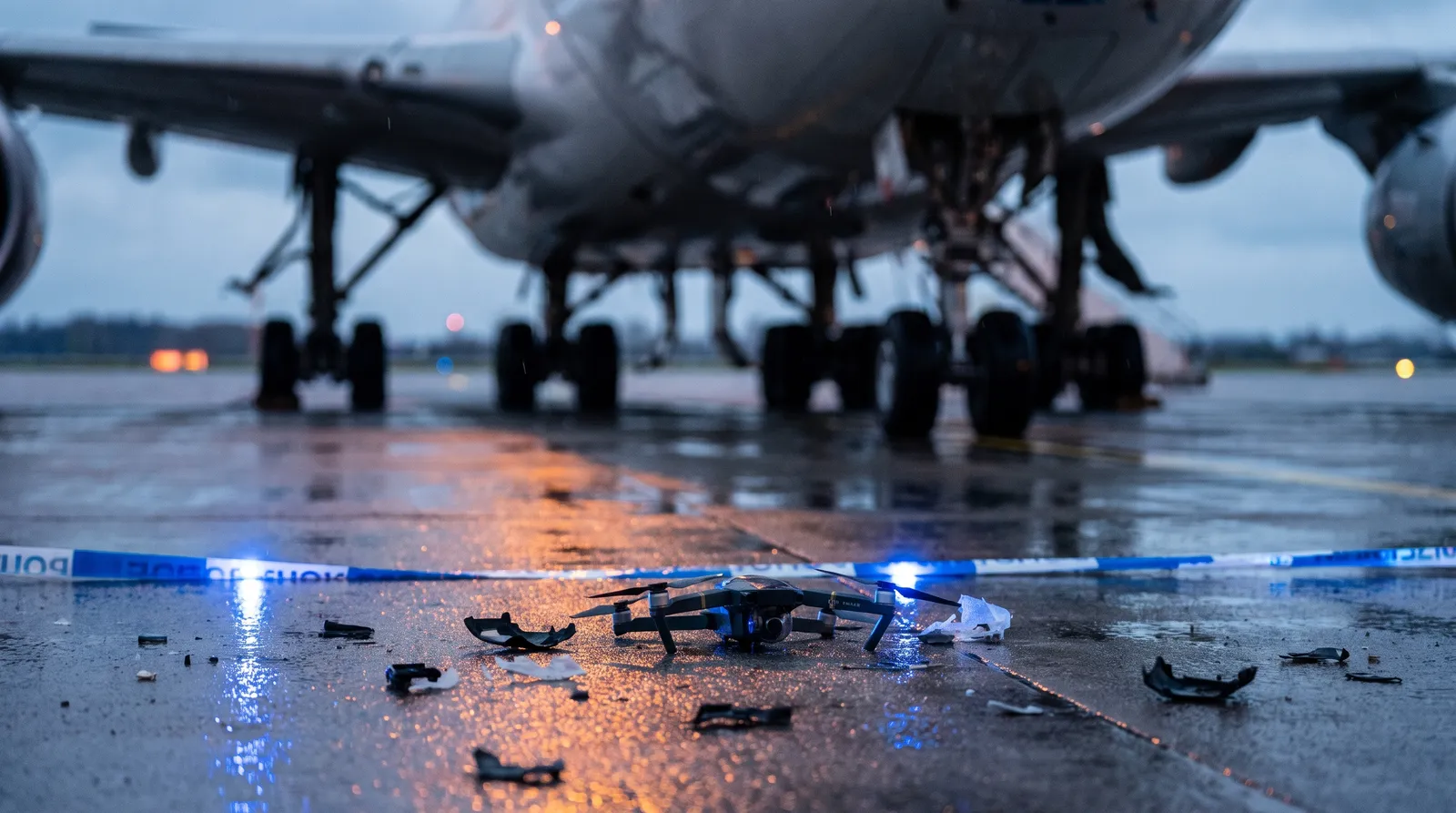
At around half past seven on the evening of 4 August, closed-circuit cameras at Leipzig/Halle airport recorded a first-person-view quadcopter roughly the size of a microwave oven flying deliberately at a parked Antonov An-124. The freighter, operated by Ukraine’s Antonov Airlines, had come in from France; it was empty at the time. The drone struck near a wing fuel tank.
Then nothing happened, which is the whole story.
The device carried a charge reported at up to 800 grams of PETN — described in some accounts as Semtex, which is a PETN-and-RDX mixture, so the reports converge rather than contradict. The detonator failed. The drone dropped to the concrete a few metres from the aircraft and lay there, unremarked, for about four hours, until an airport bus driver noticed it.
Leipzig/Halle is not an incidental target. It is one of NATO’s principal airlift hubs and a major node for German military and allied cargo. A functioning charge against a fuelled heavy freighter on that apron would have been a very different kind of August.
The second one, and the third
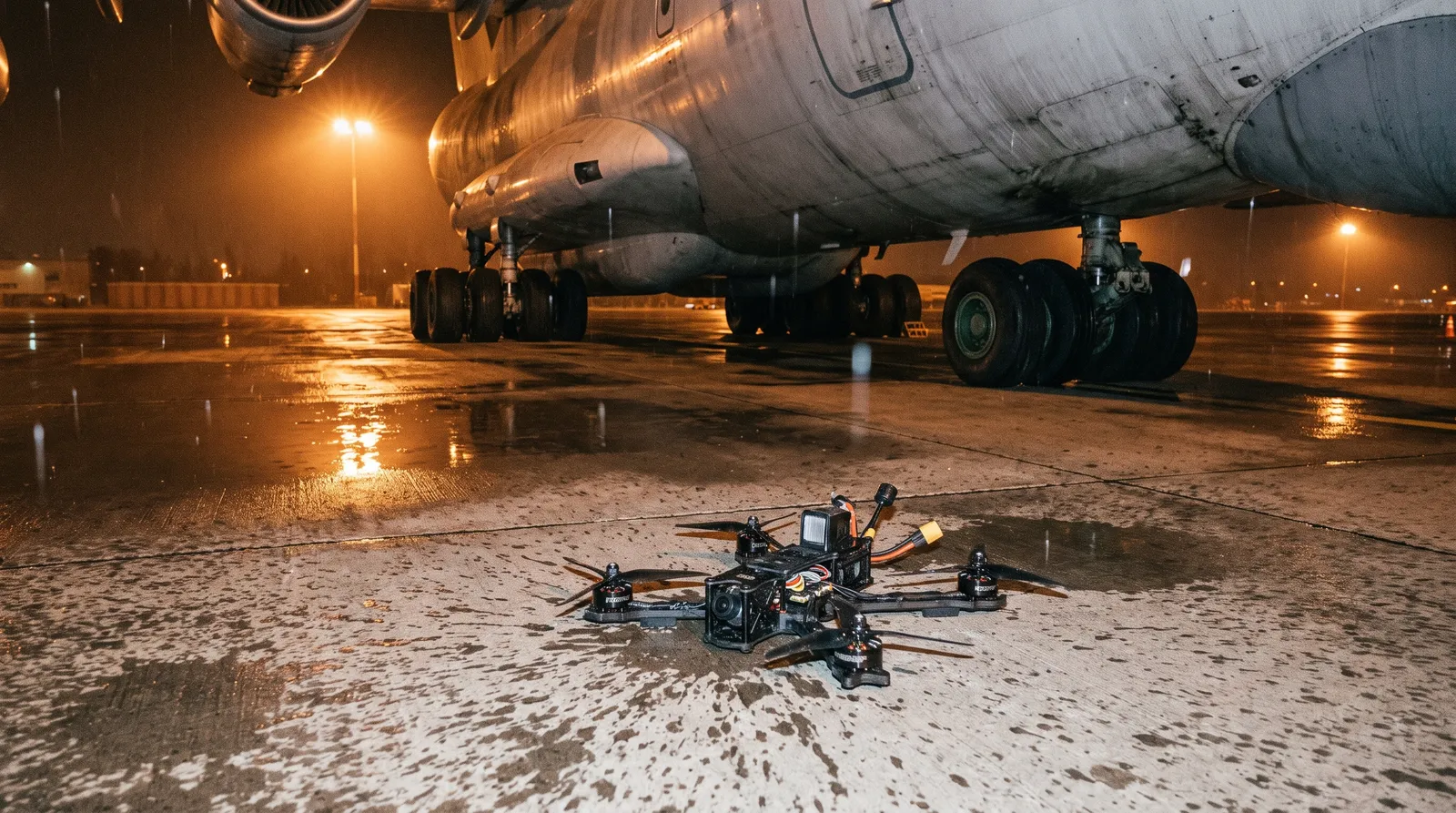
The following evening a Boeing 757 operated for DHL by European Air Transport Leipzig collided with a second drone at roughly 400 metres while going around from an approach. The crew declared a mayday, climbed to 10,000 feet and diverted to Hannover, landing safely with minor damage to the nose. That drone was never recovered — and so, unlike the first, it remains an unidentified object in the strict sense.
On 14 August investigators found a third drone west of the airport, at Kabelsketal, alongside roughly 50 grams of a substance they suspected to be hexogen — RDX. Three objects, one of them intact.
What a recovered object buys you
Here is what German investigators got from the one they could pick up, and it is worth listing in full, because this is the shopping list the UAP field has been asking for since 2017.
They got the airframe: an FPV quadcopter with no navigation lights, fitted with a 5G router and two SIM cards, meaning it could be flown from anywhere on earth over a mobile network rather than a local radio link. Federal Interior Minister Alexander Dobrindt assessed that it had probably been modified specifically to slip past the airport’s own drone-protection systems — which, being tuned to detect and jam conventional control frequencies, would not have seen a thing. They found an antenna in a nearby tree, likely used to relay the signal.
They got the chemistry: a named explosive in a measurable quantity, of a type that narrows the supplier list considerably.
And they got biology. A DNA trace recovered from the drone matched evidence held from the incendiary parcel attack on the airport’s own DHL logistics centre on 20 July 2024 — a device that burned on the ground rather than in the air only because the cargo flight it was meant for was delayed. Several suspects have been on trial in Vilnius since the spring over that parcel plot, where Lithuanian prosecutors allege the improvised devices were “organised and coordinated by citizens of the Russian Federation” linked to Russian military intelligence.
So: an object, a chain of custody, a forensic match, an existing prosecution, and a named agency. Germany’s Federal Public Prosecutor is now investigating on suspicion of attempted detonation of an explosive device and endangering air traffic. American officials, speaking to the Wall Street Journal, put their own assessment more bluntly and said Russia was behind it. The Russian embassy in Berlin denied responsibility on 7 August.
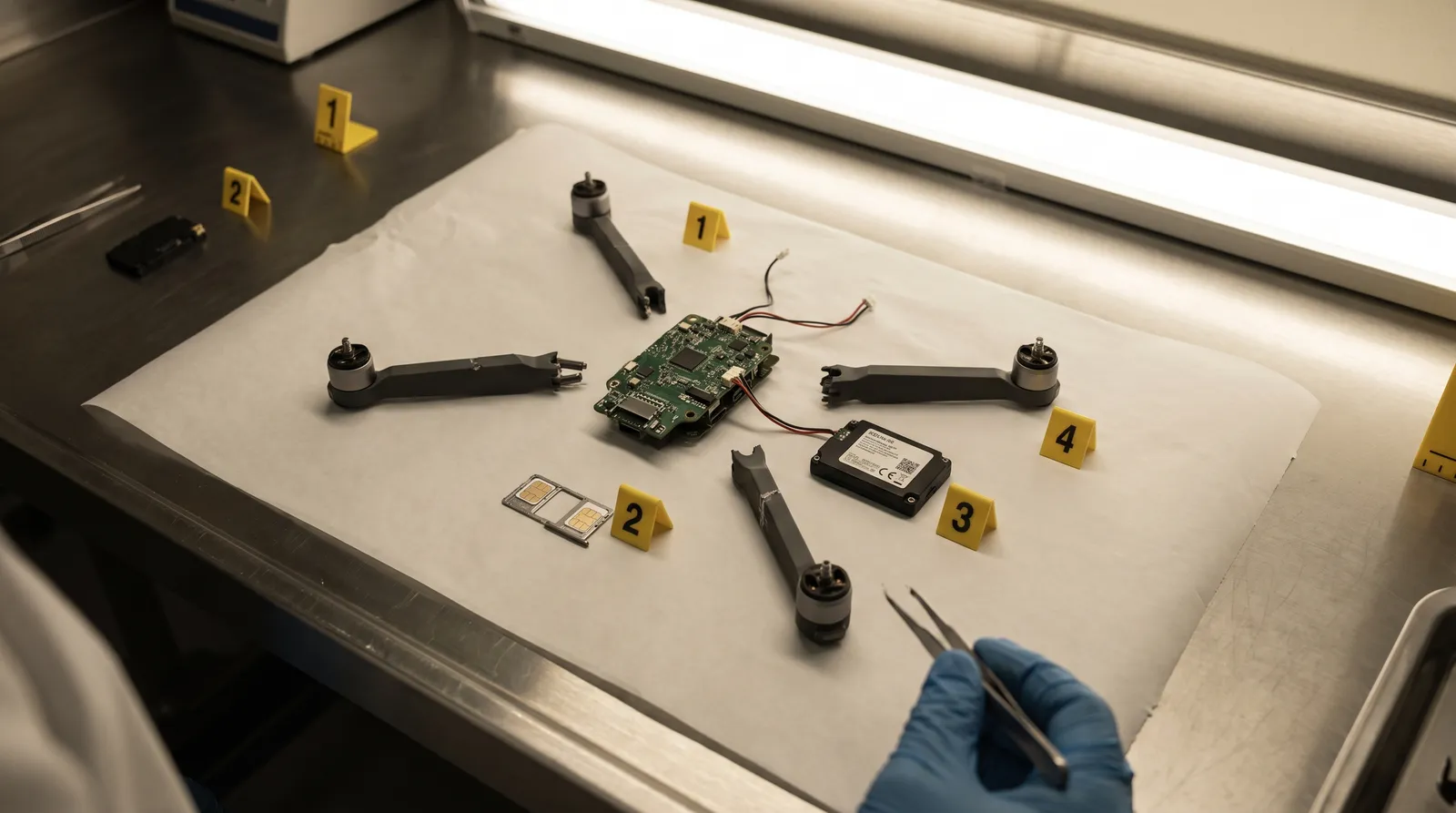
Every rung on that ladder exists because somebody physically held the object. Remove the hardware and the whole thing collapses back into a light in the sky.
Now read the American file
Set that against AARO’s Fiscal Year 2025 annual report, published on 21 July. The office logged 319 new reports and now holds 1,870 cases. It resolved 114 of them — balloons, birds, satellites, aircraft, drones, one rocket launch and, memorably, one manned jet pack.
The passage that matters is the one about national security sites. AARO says it received reports “suggestive of phenomena whose performance characteristics exceed the known state-of-the-art,” and then immediately adds the sentence that does all the work: “No technical data accompanied these reports.”
That is the difference in a line. Germany’s answer came from an object on a runway. America’s unresolved cases are, overwhelmingly, narratives — and we have written before about why nobody in the American system owns the job of attributing them, and about the FAA order that deletes the raw radar 45 days later. When the Secretary of State said in August that things are flying over US military installations and “they’re not ours”, the unstated second half of the sentence was that nobody has picked one up to check.
The Pantex incursion of 2015 is the purest example. A four-foot object put America’s nuclear weapons assembly plant into lockdown, the report has been released three times with progressively fewer redactions, and eleven years on the public still cannot see what Sandia’s analysts concluded from the photographs. Nobody caught it. So it stays a mystery, and mysteries do not decay — they compound.
The response you get when you can name the thing
Watch how fast a state moves once attribution is available. Germany’s National Security Council convened under Chancellor Friedrich Merz on 8 August. On 18 August, Dobrindt, Research Minister Dorothee Bär and Saxony-Anhalt’s premier Sven Schulze opened a Drone Security Technology Centre at Cochstedt, a German Aerospace Centre site about 40 kilometres south of Magdeburg, to test detection and counter-drone technology for airports and critical infrastructure. The joint drone-defence force is to roughly double to around 300 people, with 150 new hires and four additional bases.
None of that is a UFO programme. It is what a government does when the object has a name, an owner and a plausible sender. Compare the fourteen-month gestation of an American annual report that mostly counts things.
The scale, incidentally, is not trivial. The Bundeskriminalamt logged more than 1,000 suspicious drone flights across Germany in 2025 alone, concentrated over military facilities, airports, arms manufacturers and ports. On 7 August, two days after Leipzig, two drones were reported over the Mechernich military base in North Rhine-Westphalia. Europe has an incursion problem of exactly the kind Brussels has spent years declining to give a reporting category.
Where the caution belongs
Now the part we would want somebody to write about us.
The forensic chain is strong; the political conclusion is not yet proven. A DNA match links the drone to the 2024 parcel plot. It does not, on the public record, identify the individual, and it does not by itself establish that the Russian state ordered the August attack. The Vilnius prosecution is an allegation being tested at trial. The Wall Street Journal’s Russian attribution rests on anonymous US intelligence officials. Dobrindt himself has been notably careful in public, saying only that the threats are “not the work of amateurs” and require “very professional preparation,” carried out “probably on behalf of foreign powers.”
The BKA’s president, Holger Münch, was franker still when asked in December whether Russian actors were always behind Germany’s drone flights: “We do not know that with 100% certainty.” Identifying a drone operator, he noted, is genuinely difficult — a point worth holding onto, since it is the same problem in a different jurisdiction.
And there is an active warning about the reverse error. Lithuania’s defence minister has publicly cautioned that Moscow could stage false-flag operations using captured Ukrainian drones, precisely to poison this kind of inference. Attribution is a chain, and any chain can be built to break in a chosen place.
Why this is a UAP story at all
You could reasonably object that a Russian sabotage drone is not a UAP and this is a security story wearing a borrowed hat. Fair. But the objection proves the point.
It is not a UAP now. On the evening of 4 August it was an unidentified object over a NATO installation, indistinguishable in every operational respect from the hundreds of things that cross American restricted airspace each year and stay unattributed forever. What moved it out of that category was not better witnesses, more sensors, a hearing or a declassification tranche. It was custody of the object.
That should temper expectations in both directions. It is a caution against treating unattributed base incursions as inherently exotic — the resolved half of every case file has always been drones, balloons and aircraft, and Europe has just shown you what a determined state actor with a mobile-network-controlled quadcopter can do to a defended perimeter. It is equally a caution against the official reflex of declaring the mystery boring while conspicuously failing to build the one capability that would settle it.
The UAP Times take
This earns a Credible rating, four out of five on our scale. The physical facts are on the record from German federal authorities and multiple reputable outlets: the drone, the explosive, the aircraft it struck, the DNA match, the prosecutor’s investigation, the government’s response. What keeps it a rung short of well-sourced is the bit everyone leads with — the Russian state attribution rests on anonymous intelligence sourcing and an untested allegation in a Lithuanian courtroom, and the minister closest to the file will not say it out loud.
The lesson we would take away has nothing to do with Russia. For a decade the UAP debate has been argued as though the missing ingredient were candour: release the files, lift the NDAs, name the programme. Leipzig suggests the missing ingredient is more boring and much harder. Attribution is a physical process. It requires an object, a lab and someone whose job it is to walk from one to the other.
America has spent this summer building superb channels for people to tell it things. Germany spent eleven days on one object that failed to explode and got further. If the next incursion over an American base is ever going to be identified, somebody is going to have to pick it up.
Further reading: why it isn’t anybody’s job to find out what’s flying over America’s air bases and what the 2026 Pentagon UAP report actually found.
Source: Euronews / German Federal Public Prosecutor investigation
Follow the file
Every new dispatch from the UAP desk, in your inbox. Sourced, sceptical, and no more than one email a week.