
In February, the Bundestag amended Germany’s air security law to let the Bundeswehr jam, intercept and shoot down unidentified drones over German soil. In August, two of them were seen circling a Bundeswehr base at Mechernich, two days after an explosive-laden drone was found on the tarmac at Leipzig/Halle. In October, the Federal Government told parliament, in writing, that it holds no findings on unidentified aerial phenomena, operates no reporting channel for them, uses no definition of them, keeps no statistics on them, and has no plans to start.
Both of those things are true at once. Working out how is the interesting part.
What was asked
On 2 October, the AfD parliamentary group tabled a Kleine Anfrage — a formal written question the government is obliged to answer — under the title “Unidentified aerial phenomena (UAP) as a matter of air and space security and of state information and coordination structures”. It runs to eleven questions, and they are, for the most part, sensible ones: which federal authority receives, records and evaluates reports of air or space contacts that cannot be clearly identified; whether separate reporting channels exist; whether any cross-departmental working group assesses them; how many such reports have been logged in the past ten years; and whether the existing procedures are due for revision.
The government’s answer, Drucksache 21/8662, is dated 16 October. Two things are worth saying about the questioner before we get to it, because both bear on how much weight the exchange carries. The AfD is Germany’s far-right party, and a thin answer to a question from a party the government would rather not assist costs Berlin very little politically. The government also opened its reply by noting the questioners’ preamble and stating that it neither agrees with the assessments in it nor confirms them — standard defensive boilerplate, but a tell about the register of the whole document.
Reporting also differs on whose names appear on the face of the question: one account lists the MPs Lars Haise, Wolfgang Wiehle and Marcus Bühl, while the news agency Anadolu attributes the signature to the party co-leaders Alice Weidel and Tino Chrupalla. We could not open Drucksache 21/8323 to settle it, so treat it as the AfD group’s question with the authorship unresolved.
What came back
The Bundestag’s own press service summarised the answer in a sentence: the Federal Government, by its own account, holds no findings on “unidentified aerial phenomena”. Beneath that headline, the specifics are more informative than the headline is.
There are, the answer states, no separate reporting channels for UAP — “Für Meldungen zu UAP existieren keine gesonderten Meldewege.” There are no departmental terms or definitions for the category, and no federally uniform specifications. There are no cross-departmental structures or working groups to evaluate such events. There are no figures for reports over the past ten years. And a revision of existing procedures for recording and assessing such phenomena is not currently planned.
Asked what happens if something arrives that might not be from here, the answer is that there are no responsibilities or procedural rules in the sense of the question. An earlier assessment from the Bundestag’s own research service, quoted in the German coverage, put the government’s position on first contact on German territory as äußerst unwahrscheinlich — extremely unlikely, on current scientific understanding. That line belongs to the earlier position rather than clearly to this month’s document, and we would not hang much on it.
What the answer does offer is a map of who owns the airspace. Monitoring is shared between the interior, transport and defence ministries; near-Earth space falls to the research, technology and space ministry alongside defence. Sensors are deployed, their data merged and evaluated, space objects cross-checked against publicly available catalogue data, and there is access to data from European and international partners. On cooperation, Berlin says it is in regular exchange with its allies and partners on security questions and, as a matter of principle, gives no details.
The defence ministry’s substantive point, as reported, is that it watches the airspace around the clock, that identifying initially unexplained observations is part of keeping aviation safe, and that most of them turn out to be explicable — light reflections, space debris, the usual. For completeness, the government pointed back to Drucksache 16/9554, the 2008 answer signed off by Peter Altmaier, which said there were no findings on such sightings and no UFO files to publish. Eighteen years and one drone war later, the position has not moved a centimetre.
The year Germany spent identifying things
This is where the two halves of the story grind against each other. Germany has had an extremely busy eighteen months with objects it could not identify.
Berlin Brandenburg suspended flights for two hours in November 2025 over an unidentified drone. In February 2026 the Bundestag rewrote the Luftsicherheitsgesetz to give the Bundeswehr powers to intercept, jam or down drones at civilian request, and made flying one into airport airspace a criminal offence carrying up to two years — the AfD voted for it. In August, an explosive drone was recovered at Leipzig/Halle near a Ukrainian Antonov freighter, which the interior minister Alexander Dobrindt called a “new quality of danger”, and which turned into the one genuinely resolved case of the European drone wave. Days later came Mechernich.
None of that contradicts the October answer, and it is important to be clear about why. Unidentified drones over German infrastructure are not handled as UAP. They are police matters, aviation-security matters and air-policing matters, counted in those systems under those headings. When Berlin says it has no UAP findings, it is making a statement about a filing category, not about its sky.
But that is precisely the gap. Ask Germany how many unidentified objects it has logged in a decade and the honest answer is that nobody can say, because nothing is counted under a heading that would let you add them up. Europe’s problem with its own missing reporting field is the same problem one level up: EASA runs one of the world’s best aviation occurrence-reporting systems and has declined to add a box that would let anyone tally unidentified objects. Britain’s Ministry of Defence gives an almost identical answer in almost identical language, and has done since it closed its UFO desk in 2009.
The only reporting point in Germany is on a mountain
Germany does have somewhere for a pilot to report an unidentified object. It is a university form.
The Interdisciplinary Research Centre for Extraterrestrial Studies — IFEX — was founded at the University of Würzburg in January 2022 and is, as far as we can establish, the only research centre at a German state university with UAP written into its charter. It is led by Hakan Kayal, professor of space technology. In July 2025 it opened an online reporting form specifically for pilots, and the Luftfahrt-Bundesamt, the federal civil aviation authority, agreed to signpost it from its own occurrence-reporting pages. Telepolis dates the LBA cooperation to 2024; the research centre’s own announcements point to 2025. Either way it is a link on a government website pointing at a lecture-hall server, which is the whole picture in miniature.
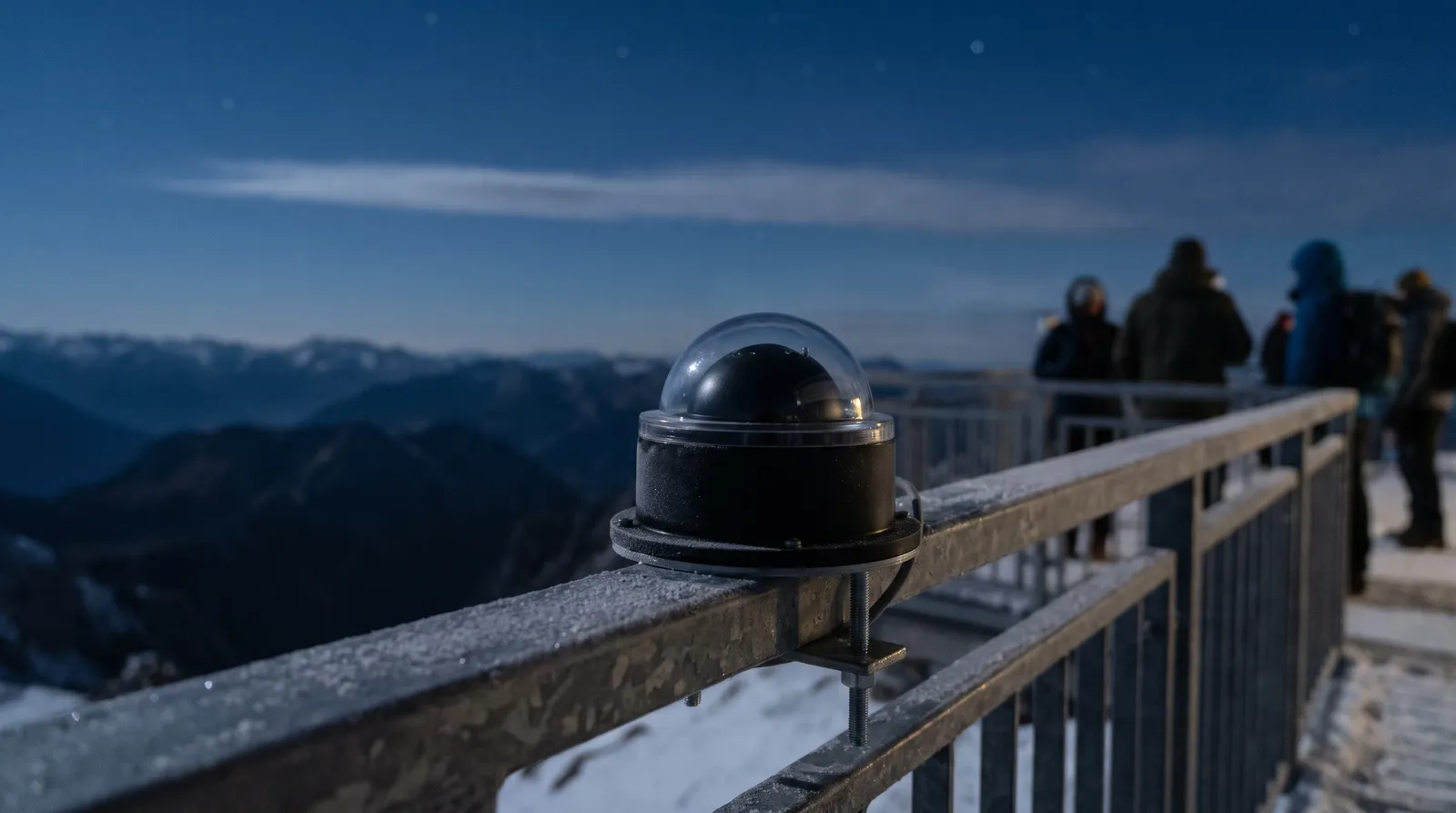
Kayal’s argument for it is the unglamorous one: systematic collection is what turns anecdote into data you can analyse, and pilots will not report into a channel that makes them look foolish. IFEX also runs hardware. Its SkyCAM-7 all-sky camera sits on the terrace of the Schneefernerhaus research station on the Zugspitze at 2,650 metres, doubling as a test bed for an anomaly-detection concept intended eventually for Mars; an earlier camera in the series watches Norway’s Hessdalen valley. It is a serious, modest, publicly accountable effort, and roughly the size of a research group.
The case for Berlin’s answer
The sceptical read deserves real room here, because it is strong.
A government that declines to create a UAP office is not necessarily hiding anything; it may simply have noticed what such offices produce. America built one, gave it a mandate and a budget, and its director’s standing complaint is that the office’s central problem is a shortage of high-quality data. The 2026 Pentagon report resolved a minority of its cases and left the rest open largely for want of sensor coverage. A German reporting channel opened tomorrow would spend its first two years logging Starlink trains, Venus, drones and camera artefacts, and would hand the country’s most excitable politicians a monthly number to wave about.
There is also a decent argument that Germany already does the thing that matters. NATO-integrated air surveillance does not care what you call an unknown track; it cares whether it is a threat, and resolves or escalates it accordingly. Adding a word to the paperwork would not have detected the Leipzig drone a minute earlier.
What the sceptical case cannot do is explain the refusal to count. A definition and a field in a database are cheap. They do not commit a government to a hypothesis, and they are the only way anyone ever finds out whether there is a pattern to argue about. Berlin’s answer concedes that it merges and evaluates sensor data from airspace and space surveillance. It is the aggregation, publication and ten-year series that are missing — and those are an administrative choice, not a scientific conclusion.
The UAP Times take
This is a documentary story rather than a sighting story, and it should be read as one. Nothing in Drucksache 21/8662 says anything is flying over Germany; it says Germany has decided not to have a category for the question. That is a legitimate choice, defensibly argued, and it is also the reason that in twenty years there will be no German dataset — only pilots talking to local papers, a camera on the Zugspitze, and a professor in Würzburg answering the form.
We rate it a Credible story — four out of five on our scale. The underlying record is a formal written answer in the parliamentary archive, summarised by the Bundestag’s own press service and reported consistently across German outlets, which is about as firm as provenance gets. It stops one rung short of well-sourced for an honest reason: we were reading the document through those summaries rather than off the page, the authorship of the question itself is unresolved in the reporting, and the dates around the Würzburg–LBA arrangement do not quite agree between sources. If the full text diverges from the summaries on any material point, we will say so here.
The thing to watch is not whether Berlin changes its mind. It is whether anyone in the Bundestag who isn’t the AfD asks the same eleven questions — because a government can brush off an awkward questioner indefinitely, and a boring, cross-party request for a number is much harder to answer with eighteen years of nothing.
Further reading: what happened when Germany actually recovered one of the objects over its airfields, Britain’s near-identical answer and the Five Eyes paperwork that complicates it, and Europe’s new shoot-down powers, granted the same year its ministers conceded most sightings weren’t drones.
Follow the file
Every new dispatch from the UAP desk, in your inbox. Sourced, sceptical, and no more than one email a week.