
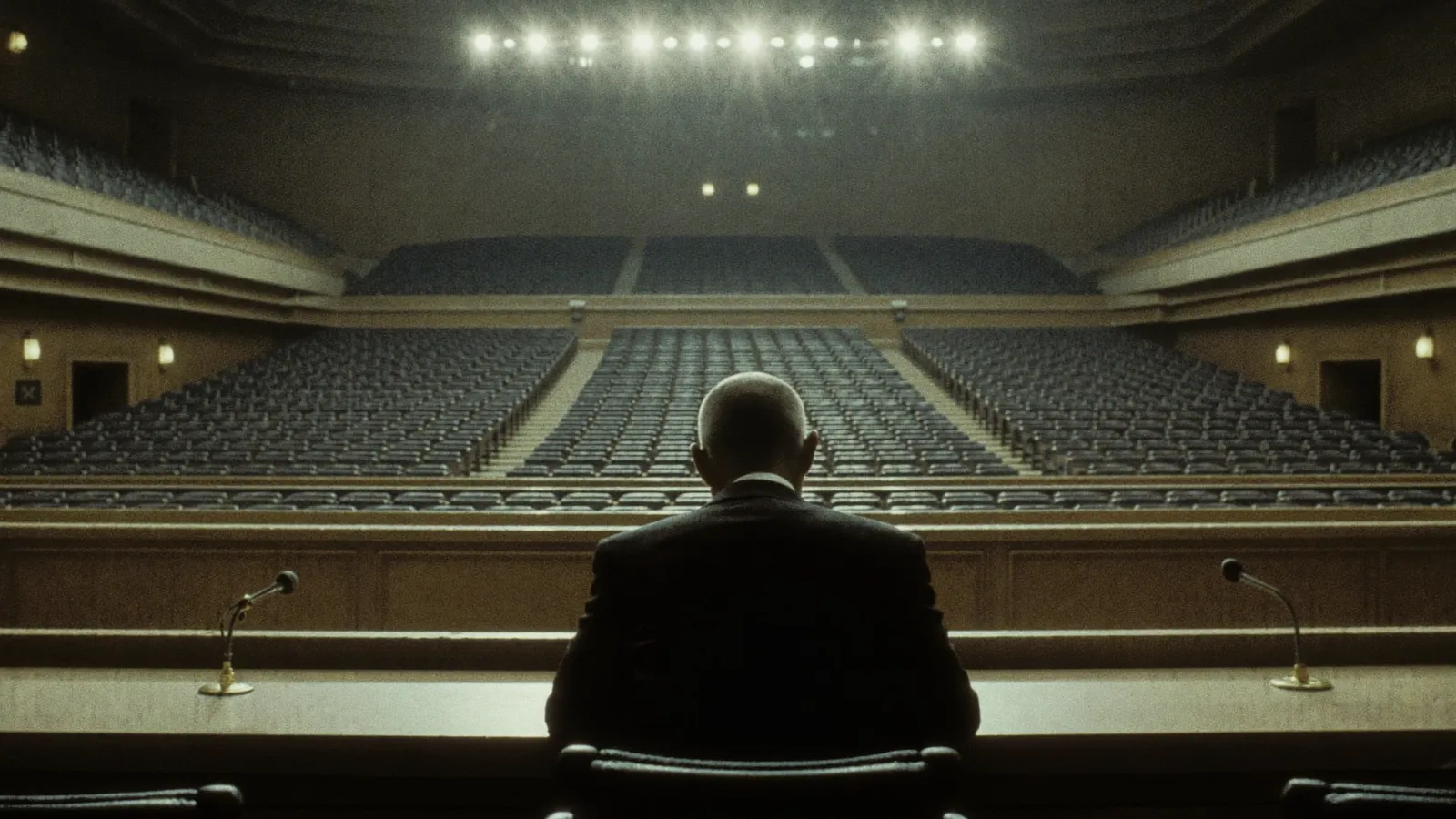
On 26 July 2023, a former intelligence officer sat at a witness table in a congressional hearing room, raised his right hand, and testified under oath that the United States government has for decades operated a programme to recover and reverse-engineer craft of non-human origin — and that it has retrieved “non-human biologics” from some of them. He did not claim to have seen the craft himself. He claimed something in some ways harder to dismiss: that as a serving officer with the right clearances he had been briefed on the programme by the people running it, had interviewed some forty witnesses, and had taken his concerns not to a podcast but to the Intelligence Community’s own Inspector General, who found them credible enough to act on.
That witness was David Grusch, and his testimony is the most institutionally serious form the crash-retrieval claim has ever taken. Where earlier figures offered silhouettes, salesmanship or contested job titles, Grusch offered a decorated career, a statutory whistleblower complaint, sworn testimony to Congress, and a set of lawyers drawn from the top of the intelligence establishment. He also offered, in public, no documents and no physical proof — which is the whole tension of his file.
The officer, not the claimant
Grusch’s credentials are real and, by the standard of this subject, formidable. He served as an officer in the US Air Force, including a combat-zone deployment to Afghanistan, and went on to hold senior analytic and management roles inside two of the most sensitive organisations in American intelligence: the National Reconnaissance Office, which runs the country’s spy satellites, and the National Geospatial-Intelligence Agency. He served as those agencies’ representative to the UAP Task Force and its successor work — meaning that, unlike almost everyone who has ever made a claim like his, monitoring the government’s UAP effort was literally part of his official job.
This is what separates Grusch from the field’s usual figures. He is not a man who says he was once near a secret; he is a man the government itself placed inside its UAP machinery, with the clearances and the reporting lines to match. Whatever one concludes about the truth of his allegations, the résumé behind them is documented, decorated and exactly where he says it was.
June 2023: going public, by the book
Grusch’s emergence was as procedural as the subject ever gets. In April 2023 the Defense Office of Prepublication and Security Review cleared his public statements — certifying, narrowly, that the text contained nothing classified, not that it was true. On 5 June 2023 the journalists Leslie Kean and Ralph Blumenthal — two of the three bylines on the 2017 New York Times story — published his allegations in The Debrief: that the US had recovered intact and partial vehicles of non-human origin, that a decades-long programme kept them outside congressional oversight, and that he had reported it all through official channels.
Crucially, he had already filed a complaint with the Intelligence Community Inspector General, alleging both the existence of the programme and illegal retaliation against him for disclosing it. The ICIG reviewed his complaint and reportedly found the allegations “urgent and credible” — the statutory finding that let the matter proceed. His lawyer was Charles McCullough III, the first-ever Inspector General of the Intelligence Community, joined by whistleblower attorney Andrew Bakaj: representation that signalled, at minimum, that serious establishment figures took him seriously enough to put their names on it. This was the disclosure argument arriving through the front door of the whistleblower statutes rather than over a broadcast desk.
The hearing
On 26 July 2023 Grusch testified to a House Oversight subcommittee, alongside the former Navy pilots Ryan Graves and Commander David Fravor of the Tic Tac encounter. Under oath, and repeatedly deferring to classification, he stated that he knew “the exact locations” of recovered craft and had provided them to the Inspector General and to Congress in a secure setting; that non-human biologics had been recovered from some craft; and that people had been harmed to keep the programme concealed. What he would not do in open session was produce the underlying evidence, saying he could discuss specifics only in a classified environment.
The hearing was a landmark less for what it proved than for where it happened: a sitting congressional committee, on the record, treating “does the government hold non-human craft?” as a question deserving sworn testimony rather than ridicule. For a subject that had spent decades as a punchline, that was the whole point — and it is a direct ancestor of the statutory UAP records framework Congress has been fighting over since.
What is corroborated, and what isn’t
Here is where the file has to be honest. What is genuinely established is that Grusch made his allegations; that he holds the clearances and career he claims; that he filed a complaint the ICIG treated as credible enough to examine; and that he repeated it all under oath, exposing himself to prosecution had he knowingly lied to Congress. That is a far stronger evidentiary base than mere assertion, and it is why he cannot be waved away.
What is not established is the allegation itself. Grusch’s account is, by his own description, second-hand — he has said he did not personally see craft or bodies, but was told of them by others he found credible. No documents have been produced publicly. No named corroborating witness has confirmed the specific claims on the record. And in March 2024 the Pentagon’s AARO, in the Historical Record Report Congress commissioned to run these allegations to ground, stated it had found no evidence that any US programme has ever possessed or reverse-engineered non-human technology — tracing several famous cases instead to ordinary, if classified, human aerospace work, much as happens when an allegedly exotic sample reaches a real laboratory. Grusch and his supporters read AARO’s denial as either incomplete or part of the very concealment he described; AARO reads the absence of evidence as an answer. That standoff is, once again, the entire subject in miniature.
The retaliation question
An inseparable part of Grusch’s story is his claim that he suffered reprisal for reporting — administrative and personal pressure that he says was intended to discredit and silence him. Critics have pointed to disclosed episodes in his past, including a period of reported mental-health difficulty, and argued they undercut his reliability. His defenders answer that a combat veteran’s documented struggles are neither disqualifying nor surprising, that the security-clearance process vetted him regardless, and that “look at his history” is exactly the discrediting move a retaliation complaint predicts. Both readings are available; neither can be settled from outside. It is the same trap that swallows every person-shaped question in this field, from Elizondo’s contested job title to thirty-seven years of adjudicating Bob Lazar.
The sceptic’s read
The deflationary account is straightforward and covers the public facts. A credentialed intelligence officer came to sincerely believe, on the basis of what colleagues told him, that a concealed programme exists — and reported that belief honestly through official channels. Sincerity, though, is not corroboration, and a chain of credible-sounding briefings is still testimony about testimony. On this reading Grusch is neither a liar nor a fantasist but a conduit: an honest man relaying an extraordinary story he did not witness and cannot document, whose ICIG “credible” finding speaks to the seriousness of his complaint rather than the truth of its contents. The strongest sceptical point is the simplest: three years on, the specific, checkable core — a craft, a body, a location, a document — has still not surfaced in any form the public or AARO can examine.
The UAP Times take
David Grusch is the most carefully constructed whistleblower the subject has produced, and that is meant as a description, not a dig. He did everything the field always says it wants: kept the paperwork, used the statutory channels, secured establishment lawyers, and swore to it in front of Congress under penalty of perjury. That makes his claim impossible to dismiss as a stunt and impossible, so far, to confirm as fact — because everything that would move it from serious allegation to established truth sits behind a classification wall or inside someone else’s untested testimony. Weigh him by conduct and he is the real thing: a credentialed officer who put his career and liberty on the line to say something on the record. Weigh him by evidence and the honest verdict is unproven, and unusually well-filed — a genuinely credible person making a genuinely extraordinary claim that, as of now, still rests entirely on the word of people we cannot cross-examine. The next real test is not another interview; it is a document.
Sources and citations
For readers who want to pull the threads themselves:
- Leslie Kean and Ralph Blumenthal, “Intelligence Officials Say U.S. Has Retrieved Craft of Non-Human Origin”, The Debrief (5 June 2023), the report that made Grusch public.
- The House Oversight subcommittee’s 26 July 2023 hearing on UAP, including Grusch’s sworn testimony.
- The Pentagon’s AARO Historical Record Report, Volume 1 (March 2024), on alleged reverse-engineering programmes.
- Contemporaneous reporting on the ICIG “urgent and credible” determination and Grusch’s legal representation by Charles McCullough III and Andrew Bakaj.
Further reading: for the insider who opened the modern era Grusch escalated, see Luis Elizondo; for a very different kind of believer, Dr Steven Greer; and for the procedural fight over how people like Grusch are allowed to speak, why one whistleblower is refusing the government’s new intake channel.
Follow the file
Every new dispatch from the UAP desk, in your inbox. Sourced, sceptical, and no more than one email a week.