
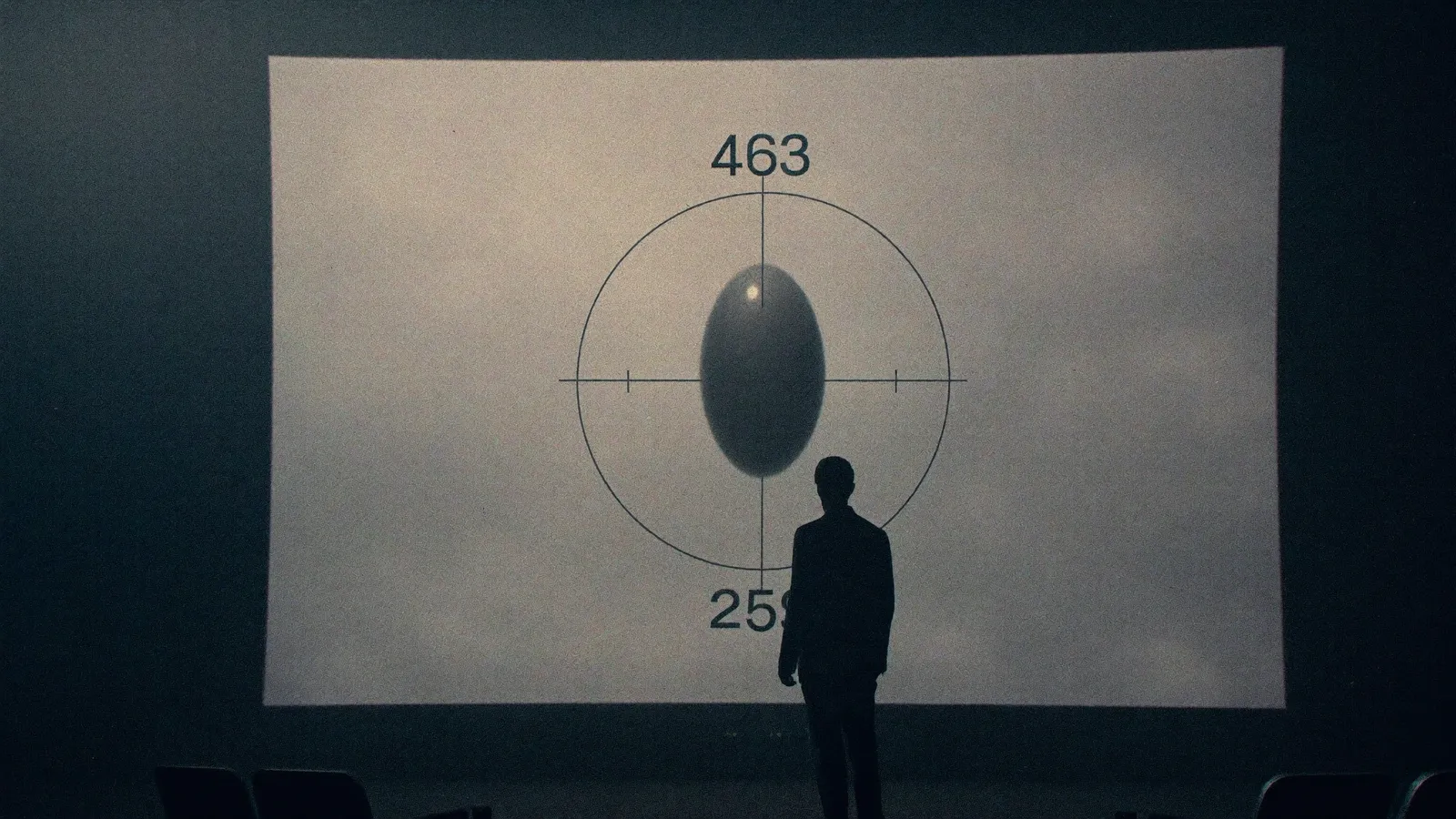
Almost everything that has happened to the UFO subject since 2017 — the congressional hearings, the establishment of AARO, the Navy’s grudging admission that its cockpit footage is real, the entire respectable turn — runs back through one man’s decision to quit his job and talk. Luis Elizondo is the hinge on which the modern era swings. He is also the figure whose central biographical claim has never been settled, disputed on the record by the institution he served, and turned this summer into a weapon by the very movement he helped build.
That combination is what makes him worth a file of his own. Elizondo is not a fringe claimant with an unverifiable story; he is a credentialed former intelligence official who moved a genuine secret into public view and changed the trajectory of the subject. The argument about him is narrower and stranger than the argument about most people in this story — not did any of this happen, but what exactly was he inside the building, and why won’t he say plainly?
The man who was really there
Start with what is not in dispute, because it is more than almost anyone else in this field can offer. Luis Elizondo is a career US intelligence officer. He served for around two decades across the Army and the Department of Defense as a counterintelligence special agent, with postings that by his account included counter-terrorism work overseas, and he finished inside the Office of the Under Secretary of Defense for Intelligence — OUSD(I) — one of the more sensitive corners of the Pentagon. Former colleagues, on-the-record officials and the paper trail of his resignation all place him where he says he was. Whatever one concludes about the UAP programme, the security clearance and the two-decade government career are real.
That is the foundation the whole Elizondo story rests on, and it is why he cannot be filed alongside the self-declared insiders whose résumés dissolve on inspection. When Elizondo describes walking out of the building, he is describing a real official leaving a real post. The fight is entirely about the title on the door of one particular programme.
AATIP, and the resignation
Elizondo says that in his final years at the Pentagon he ran the Advanced Aerospace Threat Identification Program — AATIP — a small, low-profile effort studying military encounters with unidentified craft, descended from the roughly $22 million AAWSAP contract that the Defense Intelligence Agency had funded at the urging of Senator Harry Reid. In October 2017 he resigned, and his resignation letter — addressed to the Secretary of Defense — framed the departure as a protest: too much secrecy, too little institutional seriousness about a genuine security question.
This is the part the record contests. In June 2019 the Pentagon spokesperson Susan Gough stated that Elizondo “had no assigned responsibilities for AATIP while he was in OUSD(I)”. That is not a small caveat: Elizondo’s account has him directing the programme, and the Department’s account has him formally assigned to none of it. When a 2009 memorandum from Reid surfaced as claimed corroboration, Gough confirmed it was authentic but said it changed nothing, noting it predated the years in question. The dispute has never been resolved in public — and, as this desk has written at length, the unresolved fact obligingly serves every side: proof he overstated it, proof the Pentagon would deny a man who walked its file out the door, or proof the programme was always a thin cover for something run elsewhere. Three readings, one document, no way to choose from outside.
The story that changed everything
Whatever his exact title, Elizondo’s effect is not in doubt. On 16 December 2017 the New York Times published “Glowing Auras and ‘Black Money’”, revealing the existence of the Pentagon programme and, alongside it, US Navy infrared footage of an object with no visible means of propulsion. Elizondo was the central named source. The story did what decades of ufology had failed to do: it made the subject reportable in a serious newspaper, on the strength of military sensor data and a named former official rather than a witness in silhouette.
The footage that arrived with it — the clips now known as FLIR1, Gimbal and GoFast, the Tic Tac encounter among them — became the most-scrutinised evidence the field has ever had, and the argument over what an ATFLIR pod is actually showing continues to this day. That the Navy later confirmed the videos were genuine, unclassified and “unidentified” is a direct downstream consequence of Elizondo’s decision to leave and speak. Sixteen years after Bob Lazar’s story had made Area 51 a punchline, Elizondo reset the terms: this time the evidence was a sensor return and the source had a name and a clearance.
To The Stars, and the advocacy years
Having left government, Elizondo joined To The Stars Academy — the venture fronted by the former Blink-182 musician Tom DeLonge — which served as the vehicle through which the Navy videos reached the public and around which much of the early post-2017 advocacy organised. In the years since he has been a near-permanent presence in the disclosure conversation: testimony and briefings, a relentless media profile, and steady pressure on Congress and the executive to treat UAP as a security and safety issue rather than a curiosity. His fingerprints are on much of the machinery — the hearings, the reporting mechanisms, the argument that insiders need real legal cover to speak — that the field now takes for granted.
In 2024 he published Imminent, a memoir laying out his account of the programme, his career and his conviction that the phenomenon is real, physical and unexplained. A second book has followed on its heels. Whatever the books settle or don’t, they cement his position as the subject’s most prominent former-insider author.
“Neither confirm nor deny” — the habit that costs him
The most persistent problem with Elizondo is one he built himself. Asked directly and repeatedly whether he was ever part of the alleged legacy crash-retrieval and reverse-engineering effort, he has for years declined to say yes or no, retreating to the intelligence world’s standard “I can neither confirm nor deny”. His defenders — the journalist Ross Coulthart among them — read this charitably, as a man “very deftly avoiding any breach of his National Security Oath” rather than dodging. That may well be right: someone genuinely still bound cannot answer a question about a compartment he is not cleared to acknowledge.
But the formula carries no information in either direction, and a public figure whose entire value is candour has, by using it for years on the most obvious question about his own past, left a vacuum. In the summer of 2026 the movement filled it, turning on him with the theory that he was never the leak but the plumbing — a managed asset staging a controlled disclosure. He denied it flatly and on camera. The accusation, as built, is unfalsifiable; his denial is exactly what it predicts he would say. That trap is the natural end state of years of answering the biography question with a phrase designed to answer nothing.
The sceptic’s read
The deflationary account of Elizondo covers most of the facts without much drama. A career counterintelligence officer left the Pentagon, went public with a real programme and real footage, and became the credentialed face of a cause — then built a media and publishing career on it, as advocates do. On that reading the AATIP-leadership dispute is a matter of how loosely “ran” is defined for a small, under-formalised effort, and the “neither confirm nor deny” habit is simply what a cleared officer says, load-bearing of nothing. The strongest point in his favour is also the least glamorous: unlike almost every predecessor in this subject, the thing he pointed at — the videos, the programme, the Navy’s own acknowledgement — turned out to be real. The sceptic’s genuine complaint is not that he invented anything, but that he has allowed a nine-year public career to rest on a job title he will not fully document and a biography question he will not plainly answer.
The UAP Times take
Luis Elizondo is the most consequential figure the modern UAP era has produced, and that is true whichever way the AATIP dispute eventually falls. He took a genuine secret out of the world’s most secretive building, attached his name to it, and forced a serious subject onto serious pages — an achievement no amount of later infighting erases. Weigh him by his effect and he is the real thing: the hinge of the disclosure decade. Weigh him by his own account of himself and the picture is cloudier — a central claim the Pentagon disputes, a habit of non-answers that has cost him the benefit of the doubt, and an advocacy built partly on ambiguity he could have dispelled and chose not to. Both are true at once. The honest file records that he changed everything, and that he has never quite finished telling us who he was while he did it.
Sources and citations
For readers who want to pull the threads themselves:
- Helene Cooper, Ralph Blumenthal and Leslie Kean, “Glowing Auras and ‘Black Money’”, New York Times (16 December 2017), the story that made Elizondo a public figure.
- Department of Defense statements on AATIP, including spokesperson Susan Gough’s June 2019 assertion that Elizondo “had no assigned responsibilities for AATIP”, widely reported at the time.
- Luis Elizondo, Imminent: Inside the Pentagon’s Hunt for UFOs (William Morrow, 2024), his own account.
- Our own reporting on the 2026 “controlled disclosure” row, The UFO Movement Has Accused Its Most Famous Insider of Running the Cover-Up.
Further reading: for the sensor footage his disclosure put on the table, see The Tic Tac at 25 and what an ATFLIR pod is really showing. For a very different kind of insider, see the profile of Dr Steven Greer; and for where person-shaped questions tend to end up, Bob Lazar’s evidence file.
Follow the file
Every new dispatch from the UAP desk, in your inbox. Sourced, sceptical, and no more than one email a week.