
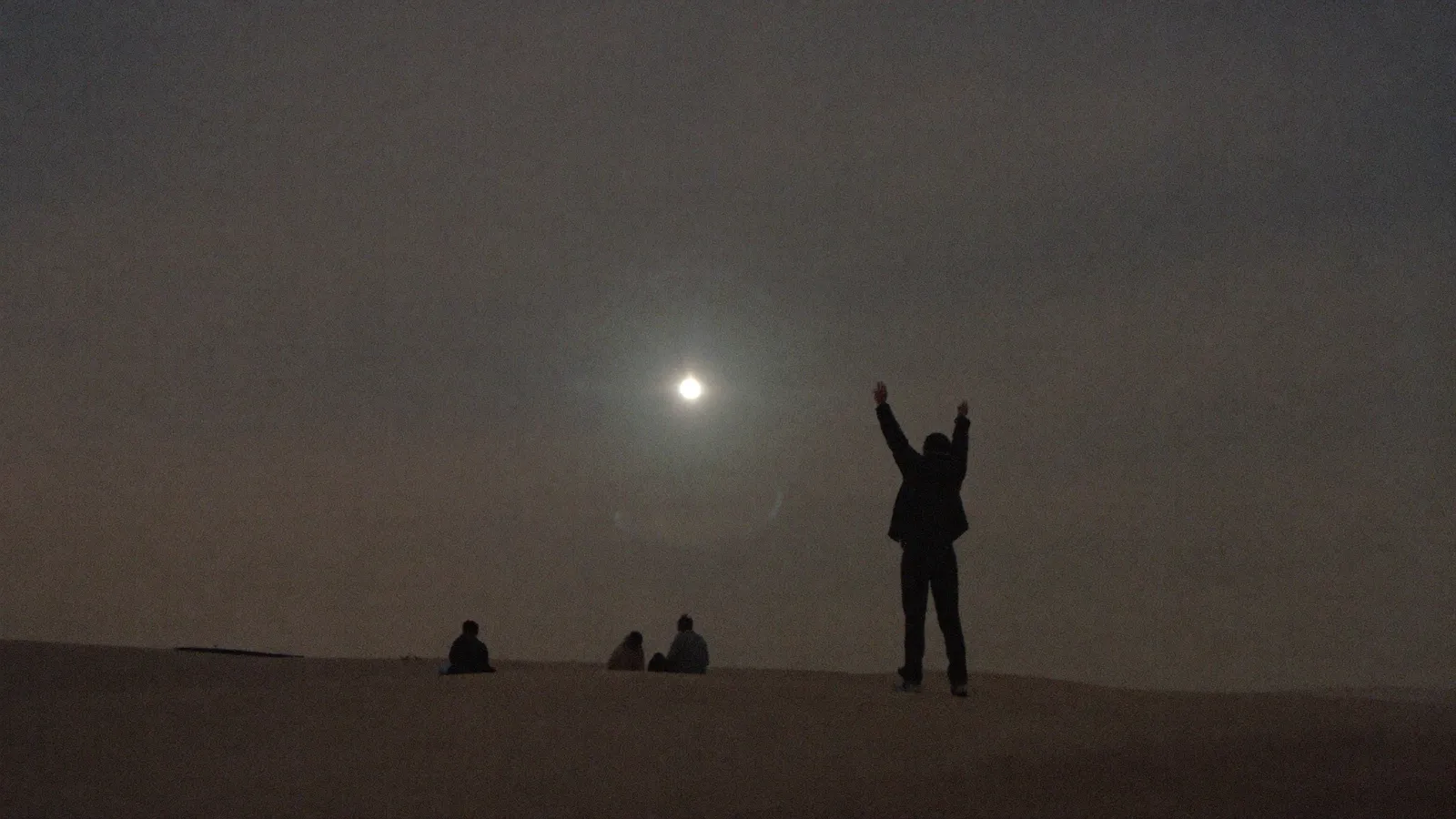
Of all the figures who have carried the UFO story through its wilderness decades, Steven Greer is the hardest to file under a single verdict — because two of him have been operating in public for thirty years. One is a serious organiser who put uniformed officers and defence-industry insiders in front of the world’s press in 2001 to say, on the record and years ahead of the Pentagon, that unidentified craft are real and that the government knows it. The other stands on desert ridges leading paying guests in meditation to summon those craft by thought, sells the training that teaches it, and has staked his name to physical evidence that keeps dissolving on contact with a laboratory.
Both are the same man, and neither cancels the other out. That is the whole difficulty of Greer: separate the organiser from the evidence he offers, and you find a genuinely consequential disclosure activist whose most testable claims are also his weakest. This is the file on the person — where he came from, what he built, and what actually holds up.
The doctor who walked away
The credential at the centre of the Greer story is, unusually for this field, entirely real. Steven Macon Greer trained as a physician, qualified in emergency medicine, and by the late 1980s was chairman of the emergency department at Caldwell Memorial Hospital in North Carolina. Colleagues, medical boards and hospital records place him exactly where he says he was: a working trauma doctor, not a self-appointed one. When Greer talks about walking away from a medical career to pursue this subject full-time, he is describing a real sacrifice of a real profession — the sort of biographical fact that, in a genre thick with invented résumés, deserves to be stated plainly and up front.
He traces the obsession to a childhood sighting in North Carolina and, later, to what he describes as a near-death experience during a teenage illness that left him with a lasting conviction that consciousness and contact were linked. Whatever one makes of that origin story, the direction it set is not in doubt. In 1990 Greer founded the Center for the Study of Extraterrestrial Intelligence — CSETI — and by 1993 he had given up medicine to run it. Everything that follows grows from that single decision to treat contact not as something that happens to witnesses but as something a trained group can go out and do.
CE-5: contact as a practice
Greer’s signature invention is the protocol he calls CE-5 — a fifth category bolted onto J. Allen Hynek’s classic scale of close encounters, defined as contact that is human-initiated. Where the earlier categories describe things done to passive witnesses, CE-5 casts the human as the one reaching out: small groups gather at night, run through breathing and meditation exercises intended to reach a “coherent” state of consciousness, and mentally “vector” craft toward their location, often signalling with lights and tones.
To Greer, this is the entire point — that intelligence behind the phenomenon is conscious and responsive, and that the right inner state opens a two-way channel. To critics, CE-5 is a machine for manufacturing positive results: assemble hopeful people in the dark, tell them their minds are summoning craft, and satellites, aircraft, Starlink trains and the ordinary confetti of the night sky reliably supply lights that feel like answers. It is a closed loop that can neither be failed nor independently verified. Both readings have been argued for decades; what is not in dispute is that CE-5 is now Greer’s most durable legacy — a method with a global following, an app, and expeditions that run to this day.
The day disclosure went to the Press Club
If Greer had done nothing else, the morning of 9 May 2001 would still earn him a place in this story. That day, under the banner of his Disclosure Project, he assembled more than twenty former military officers, air-traffic controllers, radar operators and government and corporate personnel at the National Press Club in Washington, DC, and had them state — to a room of mainstream reporters, carried by CNN and the wire services — that unidentified craft are real, that they had personally witnessed or handled evidence of them, and that the truth was being withheld. Greer said the twenty were a sample of more than four hundred such witnesses he had gathered and was prepared to march before Congress.
It is worth being clear about what this was and what it wasn’t. It was not proof of anything extraterrestrial — testimony, however sincere, is not a sensor return, and much of it was inevitably second-hand or unverifiable. But as an act of disclosure organising it was genuinely ahead of its time. The event put more than twenty credentialed insiders on a respectable stage a full sixteen years before the Tic Tac footage and the New York Times story cracked the subject open — proof that there were people willing to go on the record, and that a determined convener could get them there. Much of the machinery the modern disclosure movement now takes for granted, right down to the argument that whistleblowers need legal cover to speak, Greer was rehearsing in front of C-SPAN cameras while it was still a punchline.
The Atacama skeleton
The clearest window into the other Greer — the one whose evidence outruns his proof — is his 2013 documentary Sirius. Its centrepiece was a tiny, six-inch mummified skeleton recovered from Chile’s Atacama Desert, its elongated skull and unusual bone count presented on screen as a candidate for something not entirely human. “Ata”, as the specimen became known, was exactly the kind of physical exhibit the field had always lacked.
Then the specimen went to a laboratory, and the story ran the way these stories almost always run. Stanford immunologist Garry Nolan, who led the genetic work, found that Ata was human — unambiguously so. A fuller genomic analysis published in 2018 identified the remains as a female fetus or newborn of local Chilean ancestry, carrying a cluster of rare mutations in genes governing bone development that accounted for every anomalous feature. The skeleton was a human tragedy, not an alien; the ethics of parading likely stillborn remains as a UFO exhibit drew sharp criticism, and Chilean authorities noted the specimen’s removal from the country raised legal questions of its own. Greer has continued to argue the science does not fully close the case. The published genetics say otherwise, and the episode has become the standard exhibit for those who consider his evidentiary judgement unreliable — a pattern this desk has watched play out with allegedly exotic materials that reach a real lab and come back ordinary.
The bigger cosmology
Around the organising and the contact work, Greer has built an expansive worldview that goes well beyond “craft are real”. In books, films and lectures he argues that hidden, unacknowledged special-access programmes have controlled recovered craft for decades and reverse-engineered their propulsion; that this secret work long ago cracked clean, limitless “zero-point” energy, which is being suppressed to protect the oil economy; that the visiting intelligences are essentially benevolent; and — his most provocative claim — that a rogue faction may be preparing a staged, false-flag “alien invasion” to justify militarising space and frighten the public.
These are, by any standard, extraordinary claims, and they are the part of the Greer file resting on the least verifiable ground. The suppressed-free-energy thesis in particular sits outside anything the physics community recognises, and no working device has ever survived independent testing. It is a coherent, internally consistent story that explains a great deal and predicts almost nothing checkable — which is precisely why supporters find it illuminating and critics find it unfalsifiable. Set it beside the way official disclosure is actually inching forward through legislation and appropriations riders, and the contrast is stark: one process leaves a paper trail, the other asks you to trust the narrator.
The business of contact
No honest profile can skip the commercial dimension, because Greer’s critics — including many inside ufology — return to it constantly. Contact expeditions, “Ambassador” training programmes, an app, films funded by crowd-raises and paid events form a real revenue stream around the free-energy-and-benevolent-ET message. Greer’s defenders answer, not unreasonably, that running a global organisation costs money and that mainstream institutions were never going to fund this work. But the structure creates an unavoidable tension: a man who tells paying customers their meditation is drawing down spacecraft has a financial stake in their believing it worked, and that conflict shadows every uncorroborated result the method produces.
The sceptic’s read
The case against Greer does not require calling him a fraud, and the fairest critics don’t. It requires only noticing that across thirty years, the reproducible, independently verified evidence he has personally delivered is thin to absent. The CE-5 footage is orbs and lights of the kind any dark sky supplies. The one hard physical specimen turned out to be a human infant. The free-energy claims have never produced a working, tested device. The grand cosmology of suppression and benevolence is unfalsifiable by construction. What remains — and it is not nothing — is a gifted organiser and communicator who assembled real witnesses, kept the disclosure argument alive through its least fashionable years, and framed the subject in a way that reached millions. The sceptic’s complaint is not that Greer achieved nothing; it is that he routinely presents conviction and testimony as though they were proof, and that the distinction is the entire job.
The UAP Times take
Steven Greer is best understood as two overlapping figures whom it is a mistake to judge as one. As a disclosure organiser he was genuinely early and genuinely effective: the 2001 Press Club event put credentialed insiders on the record years before Washington would touch the topic, and the modern movement’s playbook is partly his. As a source of evidence he has a poor record — the Atacama skeleton, the free-energy claims and three decades of inconclusive contact footage all point the same way, from extraordinary assertion to ordinary or absent confirmation. Take his testimony-gathering seriously and his physical evidence sceptically, and you have him about right. He matters to this story not because he proved the case, but because he refused to let it be laughed out of the room — and then kept reaching for a proof that has never quite arrived. Weigh the organiser and the evangelist separately, and the file makes sense; collapse them into a single hero or a single hoaxer, and you have lost the person.
Sources and citations
For readers who want to pull the threads themselves:
- The Disclosure Project’s own account of the 9 May 2001 National Press Club briefing, and contemporaneous CNN/wire coverage of the event.
- Greer’s books Hidden Truth, Forbidden Knowledge (2006) and Unacknowledged (2017), which lay out the special-access-programme and free-energy theses in his own words.
- On the Atacama specimen: Sanchita Bhattacharya et al., “Whole-genome sequencing of Atacama skeleton shows novel mutations linked with dysplasia”, Genome Research (2018), and Garry Nolan’s public statements on the analysis.
- Critical overviews of CE-5 and Greer’s claims from the sceptical literature, including coverage at Skeptical Inquirer.
Further reading: for another individual whose paper trail keeps coming back half-right, see Bob Lazar’s Credibility: The Complete Evidence File. For the modern, document-driven face of the same fight Greer began, see The House Just Voted for UAP Disclosure and the row over who controls the disclosure narrative.
Follow the file
Every new dispatch from the UAP desk, in your inbox. Sourced, sceptical, and no more than one email a week.