
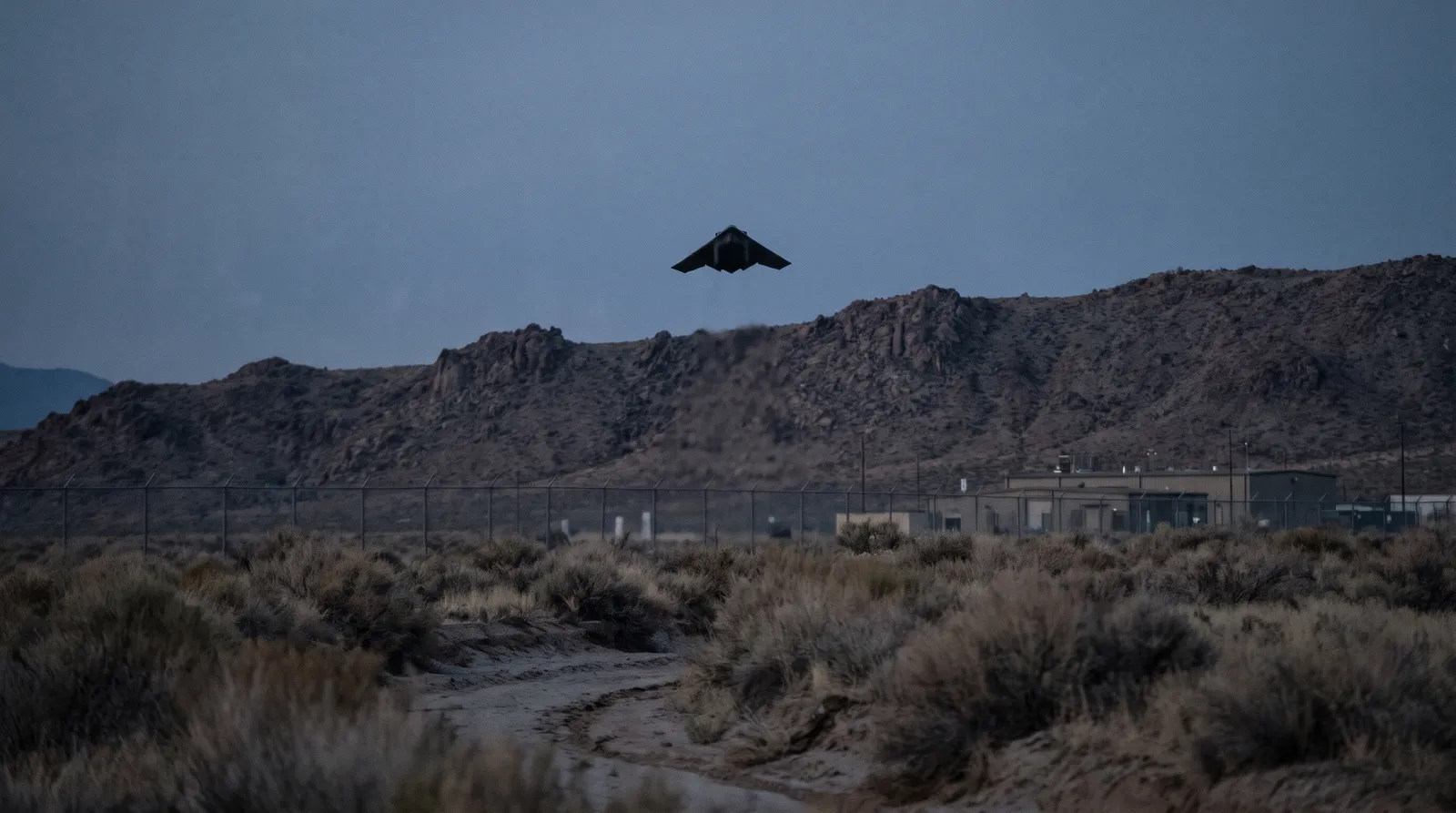
Here is a sentence from a US government file, published on Friday, that is worth the price of admission on its own: ascent occurred in absolute acoustic silence.
It appears in the seventh tranche of the Pentagon’s UAP disclosure programme, describing an encounter in June in which two federal special agents — and, by some accounts, a third witness watching from another angle — stood near a sensitive national security site somewhere in the western United States and watched a matte-black triangle climb a few hundred feet above a ridgeline, stop dead, hover, and leave at the speed of a fighter jet.
Within hours “1,800 mph” was in headlines on four continents. It is not a measurement. It is arithmetic performed on two eyeball estimates — and the more interesting problem is that the two federal documents describing this encounter do not agree about how long it lasted.
What was actually released
On Friday 23 October, the Department of War published its seventh batch of declassified UAP records under PURSUE — the Presidential Unsealing and Reporting System for UAP Encounters, publishing since May under an executive order directing agencies to declassify records on unidentified anomalous phenomena.
Chief Pentagon Spokesman Sean Parnell announced it in the department’s now-familiar formula, adding that files will keep coming “on a rolling basis”. Most outlets counted 28 new records, taking the archive to 478 across seven releases; at least one reported only ten landing on the portal. Nobody appears to be counting the same thing twice, which tells you something about the coverage.
What everyone agrees on is that this is the smallest tranche yet and contains no video. Documents only. After a sixth release padded out with literature reviews you could have downloaded in 2019, that is a change of texture rather than of policy.
The rest is a grab-bag: sightings from the 1940s and 1950s, papers on how NASA and the Defence Department agreed to handle suspected fragments of space vehicles, and — for the first time here — a 2010 report on Skinwalker Ranch, a roughly sixty-page study produced by Bigelow Aerospace Advanced Space Studies under the DIA’s AAWSAP contract. Given that eleven days ago Robert Bigelow was insisting the DIA had lost track of the AAWSAP material, the timing is either reassuring or very funny, depending on your disposition.
But the triangle is the story, and the triangle is where the documents start arguing.
The encounter, as the files describe it
The headline record is an AARO Memorandum for Record catalogued as DOW-UAP-D176, “Triangular UAP”, dated 2026. Alongside it sits an FBI FD-302 — the bureau’s standard interview write-up — covering the same witnesses. (The FD-302’s presence in the tranche comes from Avi Loeb’s blog and subsequent coverage; we could not open the portal PDFs ourselves, which matters, and we will come back to it.)
The composite picture from the published reporting runs like this. In June, two federal agents at a sensitive western site — described as having extensive operational experience and specific familiarity with drones — saw a dark delta-shaped object above a ridgeline. It rose vertically roughly 200 to 300 feet over about ten seconds, without tilting, banking or swaying. It then stopped, in the memo’s word, instantaneously, and held station for around twenty seconds. Then it banked, accelerated, and descended into a canyon at a velocity the memorandum compares to that of a military fighter jet. The witnesses lost sight of it within seconds. A ground survey of the canyon drainage the next morning found no wreckage, no ground scarring and no vegetation damage.
The object was small. The FBI estimate gives a wingspan of approximately nine to fifteen feet, a depth of six to nine feet and a thickness of one to two feet — Loeb renders it as four to five metres across. The witnesses’ own comparison, recorded in the FBI statement, is that it most resembled a delta wing drone.
Hold that last detail. It is the single most important line in the file and almost nobody quoted it.
Where the two documents part company
This is the bit that should give any careful reader pause, and it has been flagged in at least one analysis of the tranche: the FBI account and the AARO memorandum give different durations for the same event.
The FBI write-up puts the total at around three seconds. The AARO memorandum describes distinct phases — roughly ten seconds of ascent, about twenty of hover, then two to three of departure. Thirty-odd seconds against three, for the same witnesses watching the same object.
The benign explanation is probably the right one: the FBI’s three seconds is the departure phase alone, and AARO’s memo the fuller reconstruction. But two federal records of the same encounter, released the same day in the same tranche, can be read as contradicting one another on the most basic measurable in the case — and the “1,800 mph” doing the rounds pairs a roughly estimated mile and a half with the shorter of those two numbers.
The thermal reading has been mangled the same way. Much of the coverage ran with “no heat signature”, which sounds like physics-defying propulsion. The FBI account appears to say almost the opposite: that the object read hotter than ambient, with a completely consistent thermal signature across its whole body, and that the agent could not identify discrete heat sources associated with propulsion. Those are very different claims. A uniformly warm object is not a thermally invisible one. It is an object whose exhaust, if it has one, is shrouded, cool, or pointed away from a man on the ground with a monocular.
A uniformly warm object is not a thermally invisible one.
What the file actually supports
Strip out the headline arithmetic and this survives: trained observers who know what drones look like reported a small matte-black delta object climbing vertically in silence, holding a stationary hover and departing fast and low into terrain, with a warm but featureless thermal profile and no debris the next morning. That is a genuinely interesting report. It is also, in almost every particular, a description of a small, quiet, electrically powered uncrewed aircraft — which is precisely what the witnesses said it most resembled. Electric propulsion makes little noise and not much of a plume; a nine-to-fifteen-foot flying wing has the acoustic and radar signature that European defence ministries have spent two years demonstrating they cannot reliably characterise, as five nights of unidentified drones over the French naval base at Toulon illustrated this month. And a body that has sat in sunlight all day reads uniformly warmer than the air around it whether it runs on batteries or exotic physics.
What does not fall out of a drone explanation is the speed — and the speed is the one number in the file that nobody measured.
Why nobody can tell you how fast it went
This is not a new complaint, nor ours. In August, Jacob Haqq-Misra and Ravi Kopparapu went through the PURSUE sensor videos to see which permitted a defensible velocity estimate — covered here at the time. The answer was none, for a structural reason: without a range to the object you cannot turn an angular rate into a speed, and the releases do not carry range data.
Two agents on a ridge with no rangefinder is that problem in its most acute form. Every figure here — the altitude, the mile and a half, the three seconds — is a human estimate made under surprise, against terrain. Errors in the distance propagate straight into the speed: if the object crossed half a mile rather than a mile and a half, the fighter-jet comparison collapses into something a racing drone can do.
That is the honest state of the evidence, and it is why AARO has filed the case as unresolved — a designation the Department is careful to explain means investigators lacked sufficient information for a definitive identification, not that anything otherworldly has been established. As Axios put it more plainly: the records express no conclusion about whether the government believes any of this represents alien life.
The triangle’s long shadow
None of which explains why this shape lands so hard. Black triangles are the most persistent craft morphology in the whole UAP record — the Belgian wave of 1989 and 1990 and the Phoenix Lights made them famous, and three decades of claims about an anti-gravity triangle the US will not admit it flies have kept them alive.
The difference in scale is worth sitting with. Belgium’s witnesses described something the size of a football pitch. This object is roughly the size of a dinner table. Anyone taking “black triangle confirmed over secret base” away from Friday’s release has been handed a thirty-year-old archetype wearing a drone’s dimensions.
Avi Loeb, who sits on the White House UAP science advisory council and is reliably first to the microphone on each tranche, framed the open question to NewsNation as whether the object came from an adversary’s black programme or an off-world one, and said plainly that the release lacks the data scientists would need to settle it. His stated priority — getting calibrated sensors to the places these things are reported — is the only proposal on the table that would actually fix the problem. He is also an interested party blogging within hours of each release, and his enthusiasm has outrun his evidence before.
From the sceptical side there is, a day out, no published technical rebuttal: Mick West and the Metabunk regulars have not had time to take this apart. We will not pretend that case has been made when it hasn’t — but nor will we pretend the obvious prosaic reading isn’t sitting in the file, in the witnesses’ own words.
The UAP Times take
The document release is real, official and verifiable: a named programme, a dated publication, a Pentagon spokesman on the record, a catalogued AARO memorandum and an FBI interview record. That earns a Credible rating, four out of five on our scale.
It is not a five for two reasons. The first is ours: we could not reach the PURSUE portal from here, so we are reading D176 and the FD-302 through news coverage and one interested blogger rather than off the PDFs, and even the file counts in that coverage disagree. The second is the file’s own: every extraordinary quantity in the case — the altitude, the distance, the three seconds, the implied 1,800 mph — is an uninstrumented human estimate, and the two agencies writing it up produced timelines differing by an order of magnitude.
What is left is still worth having. Trained observers at a defended site watched something small, dark and triangular climb in silence, hover and go, and the government published their account rather than burying it. That is the programme working as advertised, which is more than we could say for the tranche before it. But if you want to know what it was, the answer in the file is not satisfying: nobody knows, because nobody was holding a rangefinder. Seven tranches in, the Pentagon has proved it will publish the stories. The measurements that would turn one into evidence remain, with impressive consistency, somewhere else.
Further reading: why none of the PURSUE videos permit a defensible velocity estimate and the TR-3B, the triangle America won’t admit it flies. For the structural reason objects keep crossing defended airspace unanswered, see why it isn’t anybody’s job to find out.
Follow the file
Every new dispatch from the UAP desk, in your inbox. Sourced, sceptical, and no more than one email a week.