
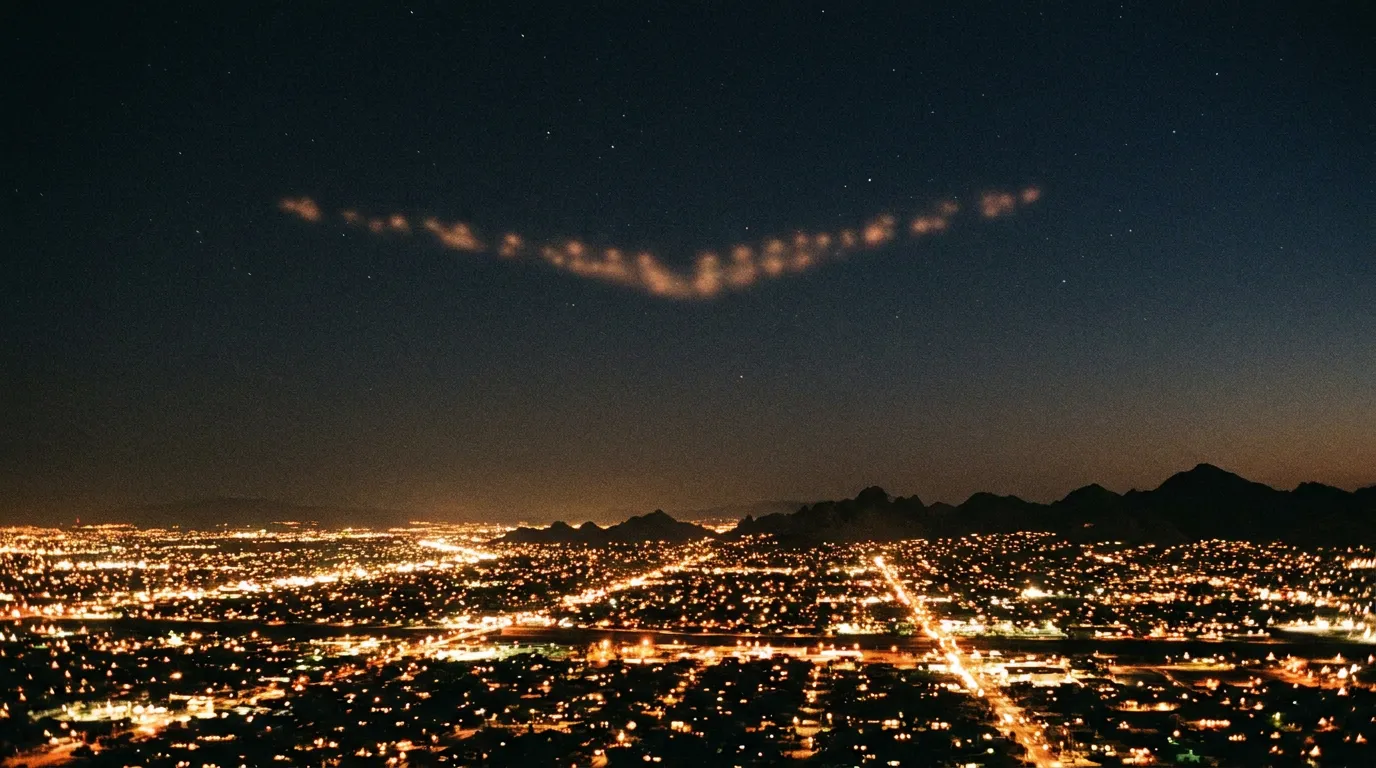
The single most important fact about the Phoenix Lights is that there were two of them. Almost every argument about the case — believer or sceptic — goes wrong by treating the night of 13 March 1997 as one event. It wasn’t. There was an early event, around 8pm, and a later one, around 10pm, and they have completely different explanations. One is largely solved. The other is not. Keep them apart and the whole thing snaps into focus.
Collapse them, and you get the argument that has run for nearly thirty years: sceptics point at the flare evidence for the 10pm lights and declare the whole night explained; believers point at the thousands of witnesses to the 8pm formation and declare the whole night unexplained. Both are describing something real. Neither is describing the same thing.
This piece was expanded on 5 August 2026 with the full minute-by-minute timeline, the amateur astronomer who put a telescope on the 8pm lights, the flare evidence in detail, the arithmetic on size and speed, and the questions that would still close the file.
One night, two events
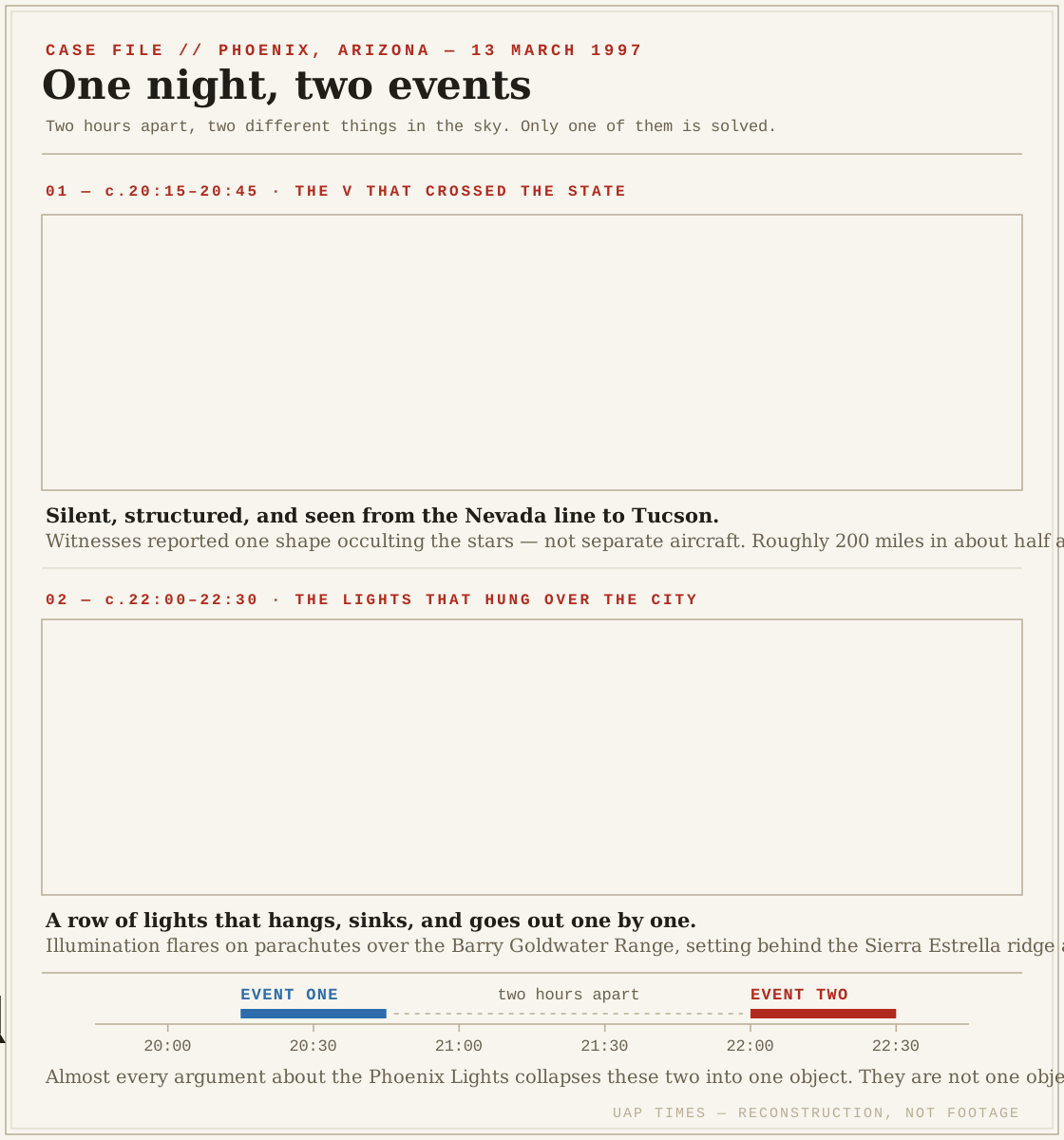
That gap in the middle of the diagram is the part nobody argues about and everybody forgets. Roughly two hours separate the two events. In between, nothing much was reported at all. Whatever crossed Arizona at eight o’clock was long gone by the time the famous row of lights appeared over the city.
The night, in order
Reconstructed from the contemporary call logs, the reports gathered by the National UFO Reporting Center under Peter Davenport, and the accounts collected in the weeks afterwards, the evening runs roughly like this. Arizona does not observe daylight saving, so all times are local and, that week, the same as the Nevada clock.
- Just before 8pm — the first call of the night comes out of Henderson, Nevada: a large V of lights heading south-east, silent.
- c.20:16 — Paulden, in northern Arizona. A driver reports a cluster of lights moving south.
- c.20:17–20:23 — Prescott and Prescott Valley. Multiple independent witnesses, including a father and son who describe a structured object with lights along its leading edge.
- c.20:30–20:35 — the Phoenix metropolitan area. The largest concentration of witnesses. Several describe the object passing directly overhead.
- c.20:45 — Tucson, and the formation leaves the state’s populated corridor.
- c.22:00–22:30 — an entirely separate event: a row of bright lights appears over the south-western horizon as seen from Phoenix, hangs, and goes out one at a time. This is the footage everyone remembers.
Two things fall out of that list. The first is that the 8pm event covered something like 200 miles of ground in around half an hour — a speed in the hundreds of miles an hour, brisk but nothing an aircraft can’t do. The second is that the 10pm event didn’t travel at all. It sat over one bearing and slowly sank. They do not behave like the same object because they were not the same object.
Event one: the V that crossed a state
At about 8pm, people across a huge stretch of Arizona — from the Nevada line, down through Phoenix, and on toward Tucson — began reporting an enormous V or boomerang formation of lights moving slowly and silently overhead. Witnesses described it passing between them and the stars, occluding the sky as it went, apparently a single vast structure rather than separate aircraft.
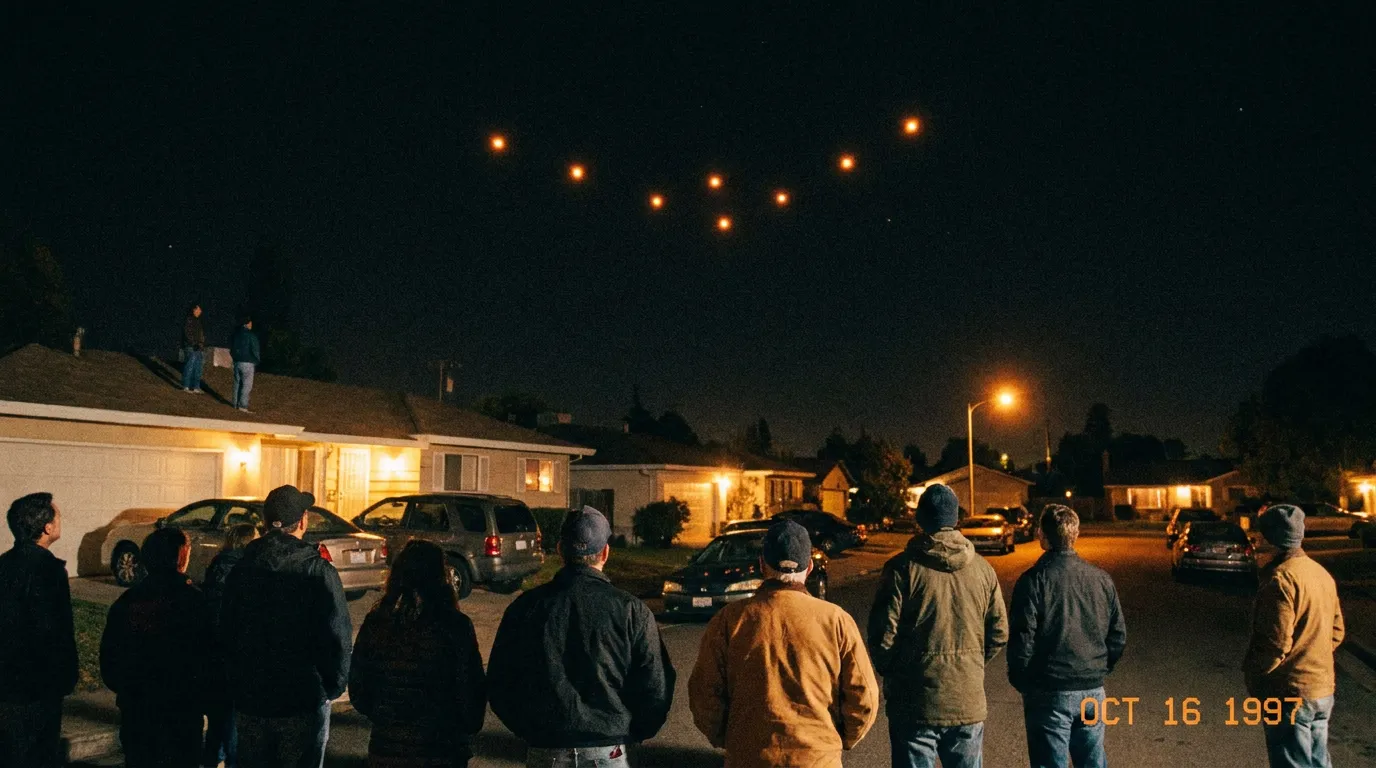
This is the genuinely interesting event, and the harder one to dismiss, because of the sheer number and spread of witnesses reporting a consistent shape over a long track. Three features recur in the accounts with enough regularity to be worth taking seriously as data rather than colour.
It was silent. Not quiet — silent. Witnesses standing in suburban streets on a March evening reported hearing nothing at all, which is the detail that most often turns a casual observer into a lifelong one. A formation of military jets low enough to look a mile wide would have been heard in the next county.
It occulted the stars. This is the crucial claim and the hardest to test. Witnesses did not simply report lights in a V; they reported that the sky between the lights went out — that something solid and unlit passed in front of the star field. If that is accurate, separate aircraft cannot account for it. If it is a trick of contrast and expectation, the case largely dissolves.
It appeared to be one thing. The lights held their relative positions as the object crossed the sky. Aircraft in formation drift; witnesses consistently said these did not.
The most-quoted account comes from a Phoenix family who watched the object approach over a period of minutes, grow steadily larger, and pass overhead as an enormous shallow arc — closer to a carpenter’s square than a neat V — with lights spaced along the leading edge and, in their telling, a mass behind them that they could see against the sky. They estimated it as low, slow and vast, though ordinary people at night are poor judges of all three.
The arithmetic nobody does
Take the witness descriptions at face value and run the numbers, because they lead somewhere uncomfortable for both sides.
If the object was as low as many witnesses estimated — a thousand or two thousand feet — then the reported angular width makes it well over a mile across. An object that size, moving at a few hundred miles an hour a couple of thousand feet above a metropolitan area of two and a half million people, would have been a physical event: pressure, downwash, noise, and a very great deal of it. Nothing of that sort was reported. That is a serious problem for the low-and-huge reading.
Push it higher, though, and the arithmetic relaxes. Put the lights at twenty thousand feet and the same angular span becomes a spread of a few miles — a loose formation of aircraft strung out across the sky, not a solid object. Silence is then automatic, because at that altitude and power setting you hear nothing. The occultation claim is the only thing standing in the way, and the occultation claim is precisely the one thing no camera ever confirmed.
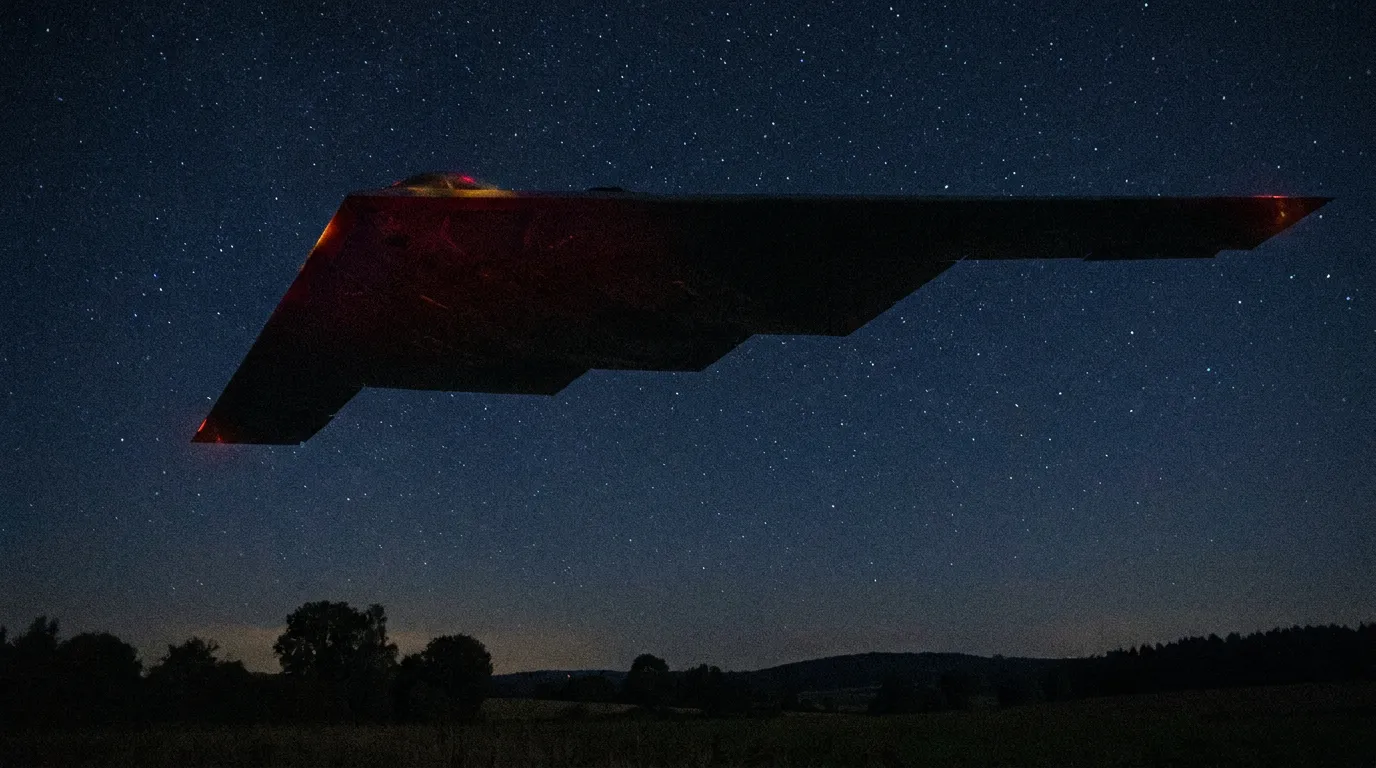
There is also no radar. No air traffic control track from Sky Harbor, no military track from Luke Air Force Base, nothing produced in the years since by anyone on any side. That absence cuts in an awkward direction: a genuine formation of transponder-equipped aircraft at altitude would have shown up as ordinary traffic and been unremarkable to a controller — which is exactly what “nothing unusual on the scopes” means. The lack of a radar mystery is weak evidence for the mundane answer, not against it.
The man with the telescope
The single most damaging piece of evidence against the 8pm object being one craft did not come from the Air Force. It came from a twenty-year-old amateur astronomer in Scottsdale with a ten-inch Dobsonian in his back garden.
Mitch Stanley had his telescope out that evening. When the lights came over, he put it on them. What he reported seeing was not one structure but several distinct aircraft, flying in formation, each with its own visible lights. He said so at the time, to his mother, standing next to him. His account surfaced publicly through Tony Ortega’s reporting in the Phoenix New Times in the following year, by which point the case had already hardened into legend and a single contrary witness with a telescope was easily lost in the noise.
It is the only optically-aided observation of the 8pm event on the record. Everyone else was looking with the naked eye, at night, at lights with no reference for range. One person applied magnification, and magnification resolved the object into aircraft.
That is not the end of the argument, and it should not be presented as one. Stanley observed for a short period, on one bearing, from one location, and the 8pm reports span hundreds of miles and the best part of an hour. It is entirely possible he resolved a flight of planes that was genuinely there while other witnesses elsewhere saw something else. But the honest weight of it is this: the one time anybody pointed a real instrument at the Phoenix Lights, the instrument said aircraft.
Event two: the lights that hung over the city
Then, around 10pm, a different thing happened: a row of bright lights appeared to hang, more or less stationary, over the Phoenix area, before slowly winking out one by one. This is the footage most people remember — the static string of glowing dots. And this is the part that is, for practical purposes, solved.
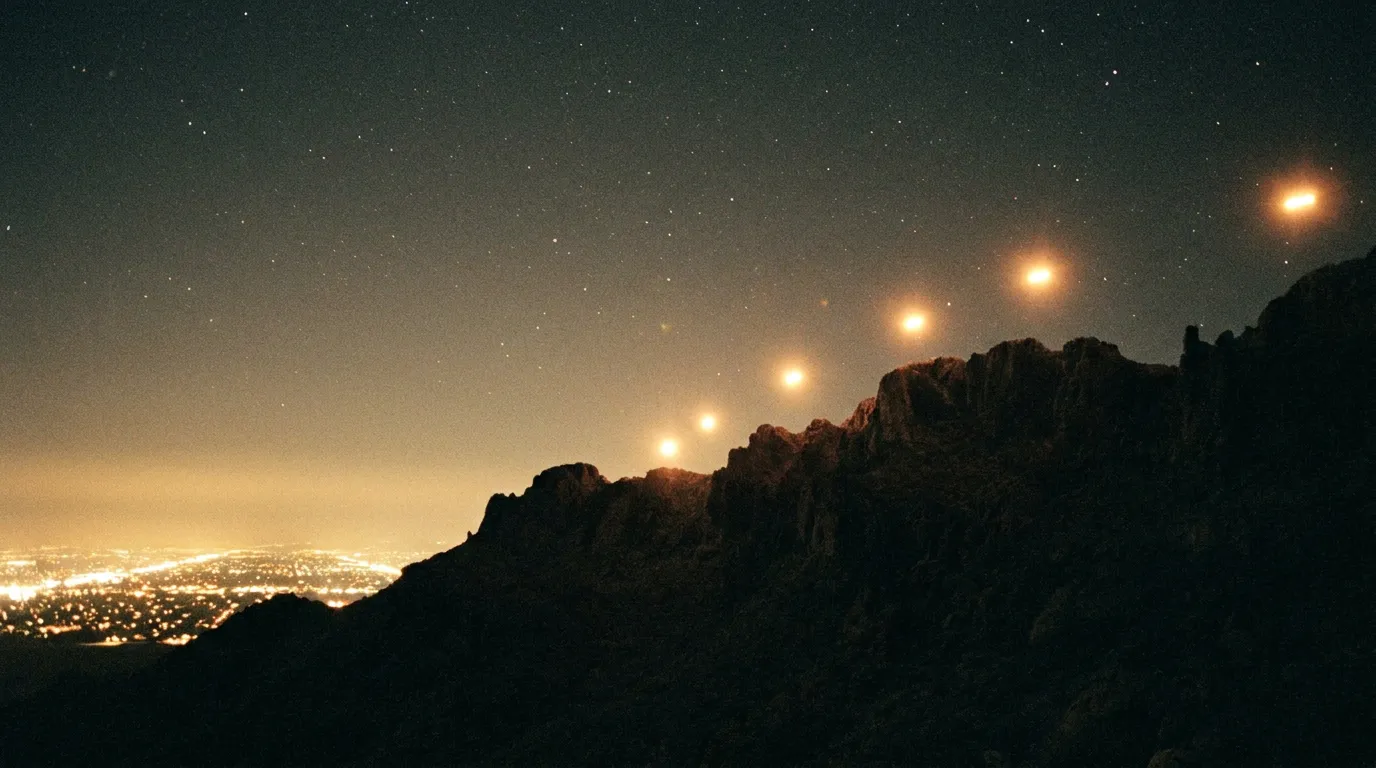
The Maryland Air National Guard’s 104th Fighter Squadron was in Arizona that spring on Operation Snowbird — the long-running programme that sends units to the desert for good flying weather — operating out of Davis-Monthan Air Force Base at Tucson. Its A-10 Thunderbolt IIs were dropping high-intensity illumination flares on the Barry M. Goldwater Range, the enormous stretch of restricted desert south-west of Phoenix.
The flares in question are LUU-2 type: intensely bright, burning for around five minutes, descending slowly beneath a small parachute. Drop a stick of them from altitude and you get exactly what Phoenix saw — a row of lights that appears to hang in place, drifts slightly, and then goes out in sequence.
A decade later the pilot who dropped them, Lieutenant Colonel Ed Jones, confirmed on the record to the Arizona Republic that his flight had put the flares up that night. That is about as direct as attribution gets in this field: a named officer, a named unit, a named range, a documented deployment.
Why the flare case actually holds
Attribution alone is not proof; plenty of official explanations have been offered for UAP cases and quietly fallen apart. This one holds because it makes predictions that can be checked against the footage, and the footage keeps agreeing.
They set, they don’t switch off. This is the decisive detail. Watch the videos shot from vantage points where the Sierra Estrella ridgeline is visible in frame, and the lights do not blink out in mid-air. They slide down to the skyline and are cut off by it, one at a time, in the order the ridge profile predicts. Something that extinguishes at a fixed line in space is not a light going out. It is a light going behind a mountain.
The geometry is right. From central Phoenix, the Goldwater Range lies beyond the Estrellas, on the correct bearing, at a distance that puts flares at range altitude just above the ridge. A witness in the city cannot see the range and has no way to judge that the lights are forty-odd miles away rather than over the next suburb — which is why they looked like they were hovering above the city.
The descent rate is right. Flares under parachutes fall slowly and predictably. Measured off the tape, the lights sink at a rate consistent with parachute descent, not with a craft deliberately holding station.
Nobody has produced a competing physical account. Not one that explains a stationary row at a fixed bearing, at that hour, on the night an air national guard unit was dropping illumination flares on the range in that exact direction.
The famous 1990s “spectral analysis” claiming the lights could not be flares came out of a private lab, was never published anywhere that would check it, and does not survive contact with the ridgeline footage. It remains one of the case’s most-repeated claims and one of its least defensible.
A grim little coda makes the point better than any analysis. In April 2008, lights appeared over Phoenix again, the story went national again, and a resident promptly admitted he had tied road flares to helium balloons in his back garden. The city’s sky, it turns out, is a very easy thing to write on.
The governor who laughed, then didn’t
Arizona’s then-governor, Fife Symington, initially played the whole thing for laughs. At a June 1997 press conference he announced that the culprit had been apprehended, and his chief of staff was paraded in before the cameras in an alien costume. It was a decade later that Symington changed the tenor of the story completely: in 2007 he stated publicly that he too had seen the 8pm object, that it was enormous, delta-shaped and unlike any aircraft he knew, and that he considered it unexplained. He is a former Air Force officer and a pilot, and he leaned on it: he knew, he said, more or less everything that flies, and this was not on the list.
His stated reason for the costume was that he had a city on the edge of panic and wanted to bring the temperature down. Whether that reads as responsible or as cynical probably depends on what you already think of politicians.
A sitting governor mocking a UFO case is ordinary; that same governor, years on, saying he witnessed it and can’t explain it is not — and it’s a large part of why the 8pm event still carries weight.
It is worth being precise about how much weight. Symington is a good witness in the sense that matters least — status — and an ordinary one in the sense that matters most. He was looking with his eyes, at night, with no range reference, and he described the sighting publicly ten years after the fact, by which time the case’s imagery was everywhere and his own memory had a decade of reinforcement behind it. His reversal is genuinely significant as a fact about the case’s respectability. It is not additional physical evidence, and it should not be sold as such.
The investigation that never happened
The most consequential thing about the Phoenix Lights may be institutional rather than aerial: nobody with authority looked into it properly, and the vacuum did the rest.
Phoenix city councilwoman Frances Barwood asked the obvious public questions — what was it, who was flying, has anyone checked — and got, by her account, nothing back but a deluge of calls from residents who had seen it and a distinct chill from colleagues who wished she would stop. No city inquiry followed. Luke Air Force Base’s early responses amounted to a shrug. The Air National Guard’s flare explanation for the 10pm event took months to become public, and by the time it did, a substantial fraction of the audience had decided that a delayed explanation is a manufactured one.
That is how the case’s shape got set. In the absence of any official reconstruction, the record was assembled by campaigners and film-makers — most durably by Dr Lynne Kitei, the physician whose photographs and 2005 documentary have shaped the popular version ever since — and by the case’s louder promoters, whose evidential standards were not always high. Some of the resulting mythology is fair reporting of real testimony. Some of it is dreadful. Untangling the two thirty years on is a much bigger job than it needed to be, and the reason it needed doing at all is that no one in a position to answer the question in March 1997 bothered to.
The sceptic’s read, in full
Give the deflationary case its due, because for the 10pm event it is overwhelming, and for the 8pm event it is strong.
The 10pm lights are flares. Named unit, named pilot, named range, correct bearing, correct descent rate, and video showing them cut off by a known ridgeline. Anyone still presenting that footage as the mystery is either not aware of the evidence or not interested in it.
The 8pm formation is very probably aircraft. The one magnified observation resolved it into separate planes. The reported track — north-west to south-east across Arizona, in the region of four hundred miles an hour — is a description of an air corridor, not an anomaly. A flight transiting toward Tucson at altitude fits the geography, the timing and the silence. Human beings are famously unable to judge the distance, size or number of unresolved lights at night, which is why a scattered formation reads as one solid object; this is the same structural weakness that turns distant light sources into close ones in case after case, and no amount of witness sincerity repairs it.
Nor is the sheer number of witnesses the trump card it looks like. Thousands of people seeing the same thing establishes that something was there; it does not establish what. And most of the accounts that fill the record were given days or weeks later, after two weeks of saturation coverage, photographs and television reconstructions had told everybody what they were supposed to have seen. Memory is not a tape.
There is even a close precedent for the whole shape of it. In the Hudson Valley in the 1980s, thousands of people across New York’s suburbs reported an enormous silent boomerang, night after night — and at least part of that wave was a handful of light-aircraft pilots flying deliberately in formation for the fun of it. The gap between “a formation of small planes” and “a mile-wide craft” was closed entirely inside the heads of the people watching.
The believer’s read, in full
And now the other side, honestly stated, because it is not stupid.
Occultation is the whole argument. Multiple independent witnesses, in different towns, at different times that evening, described not lights but a dark mass moving in front of the stars. That is not the sort of thing an aircraft formation produces, and it is not obviously an artefact of expectation, because the people describing it were describing it before there was a public narrative to conform to.
The consistency across distance is the second point. The Paulden reports and the Tucson reports were made by people with no contact with each other, in the same half hour, describing the same shape and the same silence. A shared misperception is easier to argue for after the story breaks than during it.
Third, no specific flight has ever been produced. Nearly thirty years on, with the Snowbird deployment documented, the flare drop attributed and the pilot named for the 10pm event, nobody has ever put a tail number, a flight plan or a squadron to the 8pm formation. If it was a routine transit, it was a routine transit that left no paperwork anyone has found — and the same institutions that were happy to confirm the flares have never confirmed the planes.
And fourth: the governor. Not as proof, but as a sanity check on the witness pool. The dismissal of the whole case as excitable civilians runs into a former Air Force officer and pilot who saw it, said nothing for ten years, and then said he couldn’t explain it either.
Four questions that would close the file
None of this requires anyone to disclose anything sensitive. It requires records that either exist or don’t.
Which aircraft were transiting Arizona between 20:00 and 21:00 on 13 March 1997? Military movement records, Snowbird transit logs and FAA data from that window would either produce a formation on the reported track or fail to. Thirty years on, none of it is sensitive. It has never been systematically published.
Are the original camera tapes still extant, and where exactly was each one shot from? The 8pm footage is thin and poor, but the questions it could settle are geometric. A known camera position and a known focal length turn “lights in the sky” into angles, and angles are testable.
Did any radar record anything, and can the tapes be produced? The answer is probably “ordinary traffic, and no, they were wiped decades ago” — but that is an answer, and nobody has ever put it on paper.
Who else had an instrument on it? Mitch Stanley cannot have been the only person in Arizona with a telescope out on a clear March evening. One more magnified account, from a different bearing, would move this case further than another thousand naked-eye reports.
The UAP Times take
The Phoenix Lights earn a Credible rating — four out of five on our scale — but only if you respect the split. The 10pm hovering lights are flares. We are not hedging on that one: the attribution is named, the geometry works, and the footage shows them setting behind a mountain range. Treating them as the mystery does the case an active disservice, because it hands sceptics an easy win over the wrong event.
The 8pm V is the real puzzle, and our honest reading is that it is probably aircraft too — but only probably, and the gap between “probably” and “demonstrated” is where this case lives. The one instrumented observation says planes. The arithmetic says planes, provided you move the object higher and further away than the witnesses believed. What nobody has produced, in nearly thirty years, is the flight itself: no plan, no unit, no tail numbers, no confirmation from an institution that was perfectly willing to own the flares two hours later.
So the Phoenix Lights is not really a story about a spaceship. It is a first-rate case study in how two ordinary-to-extraordinary events on one night fuse in public memory into a single legend, and in what happens when nobody in authority takes twenty minutes to write the fusion down before it sets. Something crossed Arizona that evening that a great many level-headed people, up to and including the governor, could not identify. That is worth taking seriously without pretending it’s settled either way.
Further reading: for another silent triangle its own air force investigated, see The Belgian Wave; for the closest precedent to the 8pm formation, the Hudson Valley boomerang; and for a case where the radar did back the witnesses up, Stephenville 2008. The Phoenix craft is the classic chevron / boomerang; it’s logged on the sightings map. And for the secret-craft theory that tries to tie all these triangles together, see the TR-3B. And if you’d rather be Mitch Stanley than the crowd next time, start with the field kit.
Source: Contemporary witness testimony; USAF/Maryland Air National Guard statements; Phoenix New Times reporting (1997–98); Arizona Republic (2007); Gov. Fife Symington (2007)
Follow the file
Every new dispatch from the UAP desk, in your inbox. Sourced, sceptical, and no more than one email a week.