
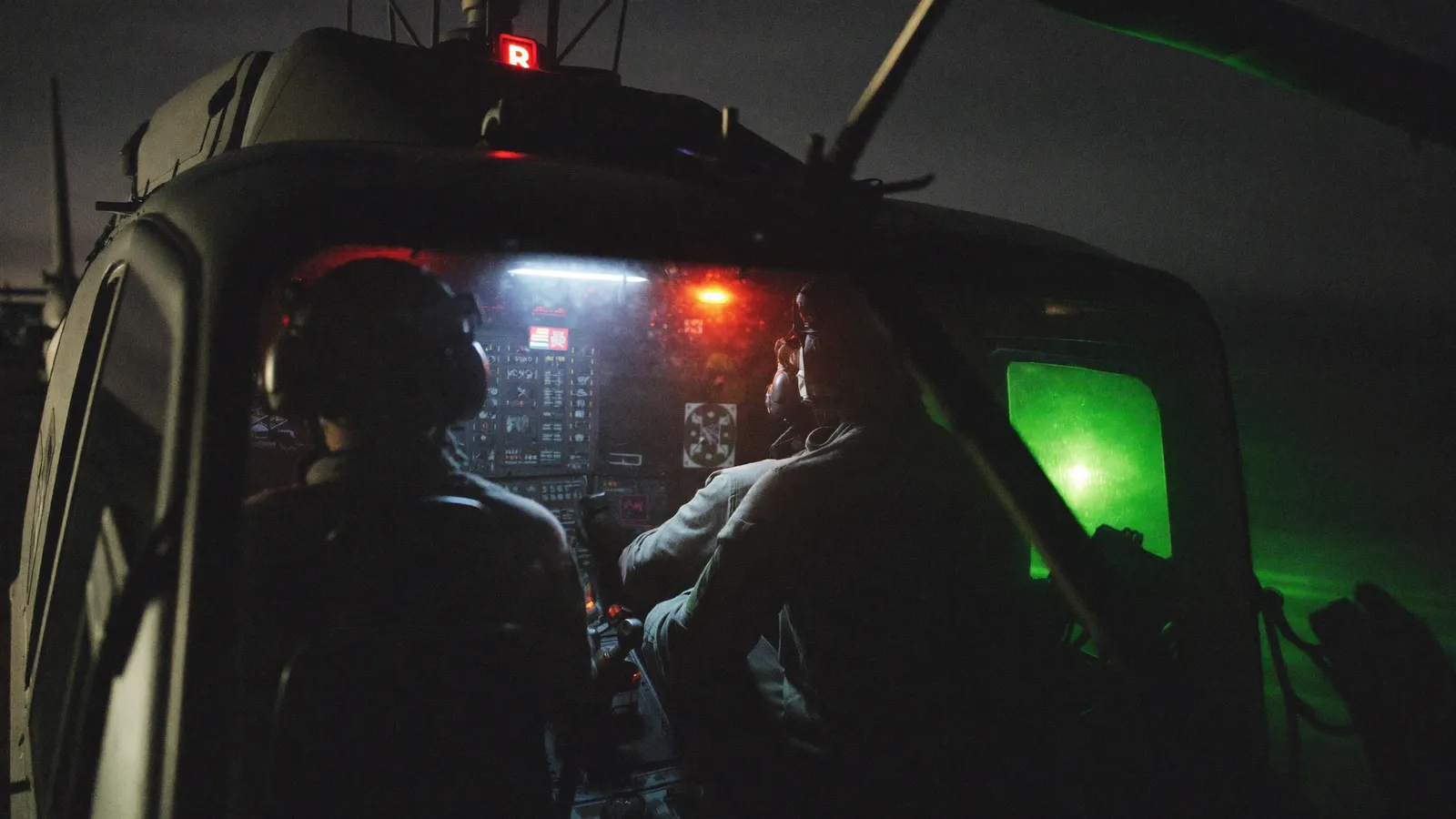
Most helicopter crews who nearly collide with something in mid-air have very little time to notice details. The crew of Army Reserve helicopter 68-15444 had rather more time than they wanted, and four independent memories of exactly what they saw — which is precisely why this 1973 case still gets called Ohio’s best-documented UFO encounter, decades after most of its contemporaries were quietly forgotten.
On the night of 18 October 1973, a Bell UH-1H Huey en route to Cleveland found itself, for something like five minutes, underneath a cigar-shaped object that a family two miles away was watching at the same time from the ground. Then the crew’s altimeter did something none of them had asked it to do.
A medevac crew on the way home
The helicopter belonged to the 316th Medical Company (Air Ambulance), an Army Reserve unit based in Cleveland, and its four occupants were not thrill-seekers. Captain Lawrence J. Coyne, 36, was the unit’s full-time commander and a pilot with 19 years in the air, much of it flying medevac runs in Vietnam. First Lieutenant Arrigo Jezzi, 26, a chemical engineer in civilian life, was the co-pilot. Sergeant John Healey, a Cleveland police officer, rode as flight medic. Sergeant Robert Yanacsek, a computer technician, was crew chief, and it was Yanacsek who first spotted a single steady red light on the horizon to the east as the aircraft cruised toward home at around 2,500 feet.
At about 23:00, closing on Mansfield, Yanacsek reported the light was converging on their course rather than passing behind them, which is the detail that changes a light on the horizon into a collision problem. Coyne began a controlled descent to get under it. The light did not resolve into another aircraft’s beacon. It resolved into a grey, metallic, slightly domed cylinder — no wings, no rotors, no visible means of propulsion — that filled the windshield: a red light at the nose, a white light at the tail, and, low on its underside, a beam of green light that swept up and briefly lit the cockpit.
The climb nobody commanded
The crew braced for impact. Instead, by every account they gave in the days that followed, the object paused directly above the helicopter for several seconds before accelerating away to the north-west. What happened to the aircraft in that window is the case’s single strangest fact.
Coyne had put the Huey into a dive to avoid the object, collective pitch down, expecting the altimeter to be unwinding through roughly 1,700 feet. When he and Jezzi both checked it, the needle instead read approximately 3,500 feet, and the vertical-speed indicator was showing a 1,000-feet-per-minute climb — in progress, with no one’s hand on the controls to produce one. Coyne’s own account, repeated consistently in every interview he gave afterward, was blunt: he had commanded a descent and got an unpowered climb instead, and none of the four of them could explain how.
“I had the aircraft in a dive… the next thing I knew we were climbing, and there was nothing I was doing to make that happen.” — Capt. Lawrence J. Coyne, as recorded by CUFOS investigator Jennie Zeidman
Once the object departed, control behaved normally again and the crew flew on to Port Columbus, from where they’d flown out that evening, before continuing home. Coyne radioed Mansfield tower to ask whether any high-performance aircraft were operating in the area; the request went unanswered on frequency, and no other traffic was ever identified in the vicinity that night.
Two miles away, a family looking up
The reason this case rises above a four-man story is that it isn’t only a four-man story. Driving south from Mansfield toward their rural home at roughly the same time, a mother and her three teenage children — the DeLong family, in the fullest published account of the case — noticed a bright red light in the sky and pulled over to watch it. What they described independently to investigators lines up with the crew’s account from the other direction: a large object, blimp-like in outline, appearing to hover low over a helicopter that was flying unusually close to the ground before both the light and the aircraft moved off together.
Neither party knew of the other’s existence until CUFOS investigators tracked them down separately in the following days. That is the structural feature that makes the Coyne Incident stand out from most cockpit-only UFO reports: a ground-based, uninvolved witness group corroborating the shape, position and behaviour of the object from an entirely different vantage point, with no chance to have compared notes first.
The paper trail, and the Enquirer’s cheque
Unlike many decades-old cases, this one has documentation from close to the event rather than a memoir written years later. Coyne filed an official Army incident report; the FAA was notified through the flight service station once the flight plan closed. Jennie Zeidman — a former Project Blue Book civilian staffer working as a field investigator for J. Allen Hynek’s Center for UFO Studies — interviewed all four crew members and the ground witnesses within days, took measurements at the reported location, and later published a detailed, minute-by-minute reconstruction as A Helicopter-UFO Encounter over Ohio (CUFOS, 1979). It remains the single most thorough published investigation of any American UFO case from its era.
It’s also worth noting what didn’t investigate it: Project Blue Book, the US Air Force’s official UFO study, had closed in December 1969, four years before Coyne’s crew ever left Port Columbus. There was no standing government body left to hand this one to. The job fell entirely to a civilian research group with a stopwatch and a notebook.
The case did get one piece of establishment recognition, of a distinctly 1970s flavour: in June 1974 the National Enquirer’s “blue ribbon” panel of UFO researchers — which by most accounts of its composition included Hynek among others with genuine scientific credentials — voted unanimously to award the crew $5,000 for supplying the most scientifically valuable UFO report of 1973. It’s an odd provenance for an award, and the tabloid’s involvement understandably makes some readers wince. But the vote itself was made by researchers assessing witness quality and corroboration, not by the newspaper’s editors, and the case they were assessing is the same one described above.
The sceptic’s case: an Orionid, mistaken
The most sustained rebuttal came from Philip J. Klass, the aviation writer who built a career finding prosaic explanations for celebrated UFO cases. Klass proposed that the crew had encountered a bright fireball from the Orionid meteor shower, which peaks in the third week of October and was indeed active on 18 October 1973 — and that the reported climb was simple “operator error,” a misread altimeter during a moment of disorientation and fright.
It is not a foolish starting theory. Meteors genuinely do produce brief, brilliant, moving lights that startle pilots, and human instrument-reading under adrenaline is a known source of error. But it has two specific problems that critics, including CUFOS’s Jerome Clark, raised at the time and that have never been resolved in Klass’s favour. First, a fireball bright and low enough to be mistaken for a solid, cigar-shaped, green-beam-projecting object hovering for several seconds at close range over a specific stretch of Ohio should, in principle, have been noticed by somebody else that night; no other sighting reports or fireball logs from the same window and region have ever surfaced to corroborate it. Second, a meteor is gone in a second or two by definition — it cannot pause, project a beam, and depart on a different heading, and it has no mechanism for putting a helicopter into an unrequested climb. Klass’s explanation accounts for a light in the sky. It does not account for the object the four crew members and the DeLong family both described, and it does not touch the altimeter at all.
What decades of scrutiny leave standing
Strip away the National Enquirer cheque and the case’s minor celebrity, and what’s left is genuinely unusual: four trained crew members, interviewed separately within days, agreeing on shape, lighting, duration and the anomalous climb; an independent family group two miles away corroborating the object’s appearance and position without prior contact with the crew; a same-week Army report and FAA notification rather than a story assembled from memory years later; and a proposed prosaic explanation that fails on its own terms rather than merely being unpopular with believers.
What’s missing is everything modern instrumentation would provide: no radar contact (Mansfield tower had nothing on scope, and Cleveland Center’s own returns were never conclusively tied to the object), no photograph, no physical trace, and — the detail every honest reading of this case has to sit with — an altimeter reading that rests entirely on two men glancing at an instrument during the most frightening ninety seconds of their working lives. That is testimony, not telemetry, however consistent and however quickly it was recorded.
The UAP Times take
The Coyne Incident earns a Credible rating, four out of five on our scale: multiple trained witnesses interviewed separately within days, an independent ground-witness family corroborating the same object from a different vantage point, contemporaneous official reports, and a proposed sceptical explanation that doesn’t survive contact with its own details. It falls short of the top mark because nothing about it was captured on an instrument a sceptic can’t argue with — no radar track, no film, no physical trace — which leaves even the case’s best-attested detail, the unrequested climb, resting on two altimeter readings under extreme stress rather than on data.
Fifty-plus years on, nobody has produced a candidate explanation that accounts for all of it: the shape, the beam, the ground corroboration and the climb together, rather than any one in isolation. That is not proof of anything exotic. It is, however, a genuinely unresolved case built on witness testimony taken about as seriously and as quickly as this field has ever managed.
Further reading: for the modern case built on radar tapes and infrared footage rather than testimony, see The Nimitz “Tic Tac” Incident; for the 1956 case that assembled a near-identical evidential structure with radar and an attempted intercept, see Lakenheath–Bentwaters; and for what happens to a strong case left to grow for forty years, see Two Nights in Rendlesham Forest.
Follow the file
Every new dispatch from the UAP desk, in your inbox. Sourced, sceptical, and no more than one email a week.