For four years the disclosure movement has wanted one thing above all others: a sitting president saying it out loud, on camera, without a press officer rewriting it afterwards. On Sunday night it got about nine seconds of that, and the nine seconds are a useful lesson in why the wish was always the easy part.
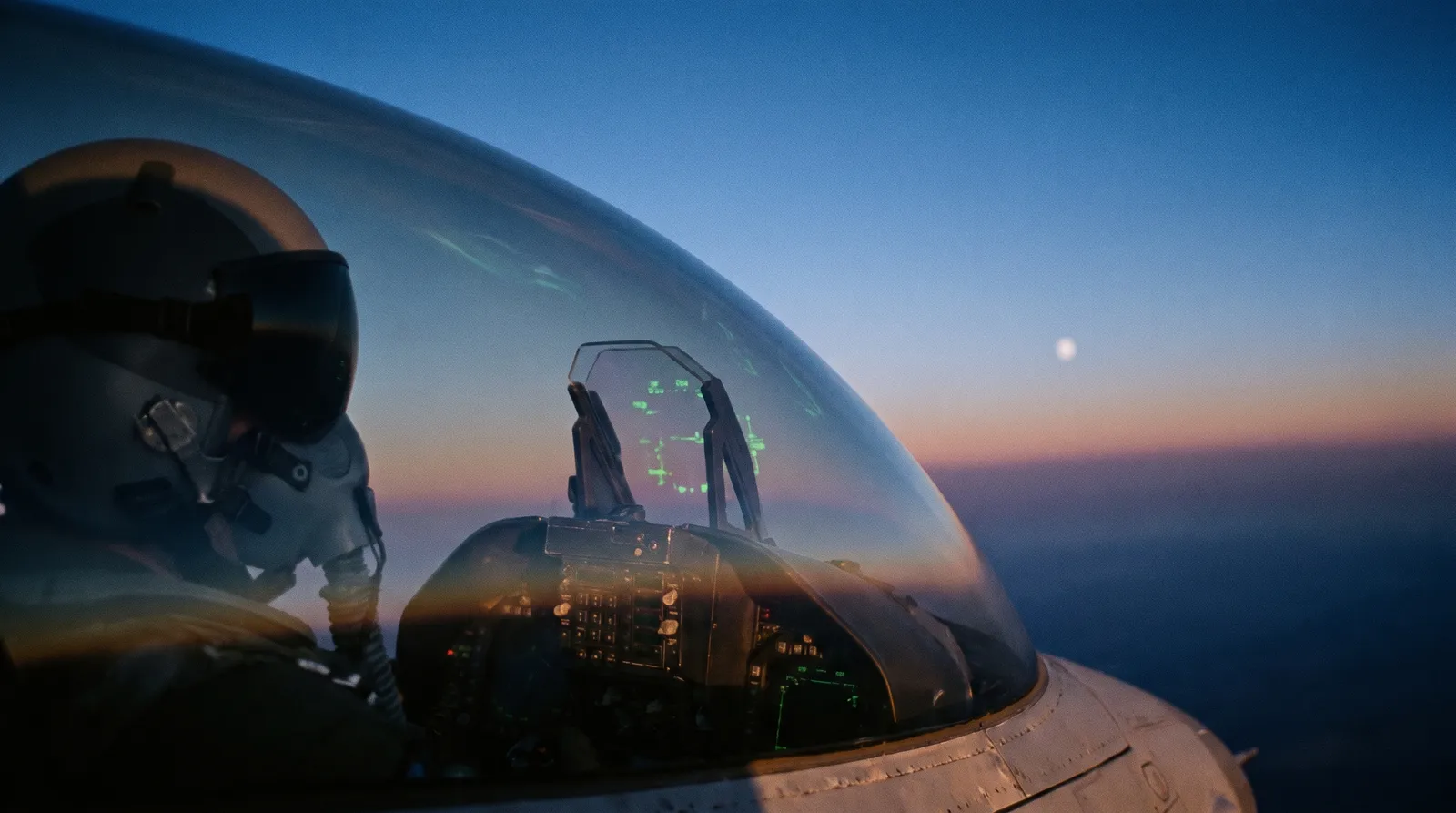
In an interview with Ross Douthat broadcast on CBS’s 60 Minutes on 8 November, Donald Trump described meeting Air Force pilots in the Oval Office — “first term and a little bit second term” — who had told him things he called very strange. One of them involved an F-22. “Something goes by them at three times their speed and it’s round,” he said, by the account carried in CBS’s own transcript and in the Associated Press report that ran the following morning.
Then, in the same answer, he undercut it. “I’m not too much of a believer,” he said. Asked what it might have been, he offered: “Well, maybe it was a comet.”
That is the whole package in one exchange: the most senior accountable source in the United States, relaying a hypersonic encounter he cannot date, naming no pilot, and reaching for a comet.
What he was actually asked
Douthat’s question was not a soft one, and it is worth preserving because it frames everything that follows. He put it to Trump that this administration has released more UFO footage than any modern administration — and that much of that footage has been interesting but fuzzy, unclear, and, in his word, a little disappointing.
He is right, and we have the arithmetic to prove it. When two researchers went through all 112 videos the Department of War has published under the PURSUE programme, they found that not one of them permits an actual velocity to be calculated — no range, no scale, no second angle. The files are real. The numbers are not in them.
So the president was being invited to supply, from personal knowledge, the thing the released record conspicuously lacks: a figure. He supplied one. Three times the speed of an F-22.
The figure has already moved once
This is the part the wire copy noted and the aggregators mostly dropped.
Trump has told a version of this story before. In a Newsmax interview with Rob Finnerty on 15 October, recorded at the White House, he described an object moving at four times the jet’s speed, and put the number of pilots he had spoken to at five or six, three or four of whom came to the Oval Office. At least one outlet traces the same higher figure back further still, to a Gutfeld! appearance in September 2024.
Nobody has established whether the October account and the November account describe the same encounter. Trump did not say when it happened, where it happened, or which squadron it involved, in either telling.
A detail changing from four to three across three weeks is not proof of invention. It is exactly what happens to a number that has been passed from a pilot to a president to a television studio without ever being written down. But it does tell you what kind of evidence you are handling: this is anecdote in transit, and it is losing precision as it travels.
What three times an F-22’s speed would actually require
The F-22 Raptor’s published top speed is roughly Mach 2.25 — about 1,500 mph. Three times that is somewhere north of 4,500 mph, call it Mach 6.5 to 7. Four times is faster again.
At those speeds in the atmosphere you are not in aeroplane territory, you are in re-entry territory: a plasma sheath, a heat signature that infrared sensors scream about, and an overpressure wave that arrives on the ground as a bang people file complaints about. The handful of vehicles that have genuinely flown in that band — X-15s, scramjet testbeds — did it instrumented, briefly, and with a recovery team standing by.
Trump’s own description makes the problem worse rather than better. “It’s not aerodynamic, it’s round,” he said, which is accurate about spheres and fatal to the claim: a sphere at Mach 6 in dense air is the least efficient shape available.
And the comet does not help either. Comets are in heliocentric orbit, millions of miles away, and visibly do not overtake fighter aircraft at altitude. If the object was close enough for a pilot to clock its shape and its closing speed, it was not a comet, and if it was a comet, the pilot’s speed estimate is meaningless. Both halves of the answer cannot be right.
Avi Loeb thinks the pilots are reliable. That is a different claim from the account being measured
Within a day, Harvard’s Avi Loeb was on NewsNation’s Jesse Weber Live describing what the president had been told as puzzling at best, and the pilots themselves as very reliable. He added that he has spoken to several pilots himself and found their accounts both credible and hard to explain.
Loeb is worth listening to here, and he is also doing something he has criticised others for. His standing argument — the one that made his name in this field — is that testimony is a reason to go and get an instrument, not a substitute for one. Five weeks ago he published a secondhand account of alien technology that he had picked up at a dinner party, and the gap between his sourcing standard and his publishing standard has been getting wider ever since.
Trained observers being honest and a measurement existing are two separate things. Fighter pilots are very good at identifying aircraft and historically poor at estimating the range and speed of objects they cannot identify, because both estimates depend on knowing how big the thing is. Worth noting too: the F-22 is a single-seat aeroplane. However many pilots the president met, each one of them was, in the cockpit, the only witness aboard.
The more consequential answer was the one about the programme
Douthat also asked about the claim that has animated Congress since 2023: that somewhere in the US government sits a programme on this subject that even presidents are not read into.
“No, and I haven’t heard that,” Trump said — and then, in the line that will be quoted for months: “But if there is, I’m going to find out about it right after this interview.”
Take that seriously for a second. He is the commander-in-chief of the department that would be hiding it. He does not need to find out; he needs to ask, in writing, and the request is self-executing. As of this morning, two days on, there is no indication that anything of the kind has been issued, and the Pentagon has not put anything on the record about the pilots or the encounter either.
It is also precisely the outcome we flagged in September, when a well-funded campaign set itself the goal of getting the president to assert the conclusion by 3 November. The campaign got its presidential statement five days late and several evidential tiers short: an anecdote, a disclaimer, and a promise to look into it.
Why it lands in this particular week
The timing is not innocent. Every member of the congressional UAP caucus who stood for re-election on 3 November won, some narrowly, and the chambers changed hands around them — which means the records framework everybody has been fighting over now gets written into a conference report by the Congress that just lost, in December, before the new one arrives.
House Oversight chair James Comer has told Ask a Pol that the UAP hearing pulled from September’s calendar may be revived in what he expects to be an aggressive lame-duck period, while conceding that neither the topic nor the witness list has been agreed. A presidential anecdote about an F-22 is, in that context, free publicity for a hearing that does not yet exist.
One last caveat, and it is an awkward one for everybody writing this story up. The broadcast carried only part of a conversation that ran to roughly 52 minutes, the various published transcripts do not agree with each other on the exact wording of the UFO passage, and CBS did not independently establish who the pilots were, when they flew, or what they saw. We have been careful above to attribute to the transcript and the wire rather than to the president’s intent.
The UAP Times take
The fact of the statement is beyond dispute: it was broadcast, transcribed and reported by the Associated Press, and a head of state talking about hypersonic round objects over his own airspace is legitimately news. What sits underneath it is not evidence. It is an undated, unlocated, unnamed account, relayed at third hand, whose single quantitative detail has already changed from four to three — and whose only on-record official explanation is a comet that cannot possibly have been there.
So it earns an Unconfirmed rating, three out of five on our scale. That is not a slight on the pilots, whom we have no reason to doubt and no way to identify. It is a statement about what we have been handed, which is a story about a measurement rather than a measurement.
The upgrade path is unusually clear, which is what makes the week genuinely interesting. The president said he would find out about the alleged programme right after the interview. He can also, with a single tasking, have the Air Force pull the hazard reports, the radar tapes and the gun-camera footage for the encounters his own visitors described, and hand them to the office his own department funds to resolve exactly this. Until one of those things happens, the most powerful man in the world is a UAP witness in the same position as everybody else: sure he was told something strange, and unable to show you.
Further reading: the audit that found none of the 112 released videos permit a speed and the lame-duck conference report that now decides the disclosure bill.
Follow the file
Every new dispatch from the UAP desk, in your inbox. Sourced, sceptical, and no more than one email a week.