

Before there were grey aliens on lunchboxes, before “abduction” was a genre with its own conventions, there was a mixed-race couple driving home from Niagara Falls on a dark New Hampshire road, and a light that would not leave them alone. Almost everything the culture now assumes about being taken — the missing time, the examination table, the recovered memory under hypnosis — traces back to one case, and one case only: Betty and Barney Hill, September 1961.
The road out of the White Mountains
Betty and Barney Hill, of Portsmouth, New Hampshire, were driving south on US Route 3 late on the night of 19 September 1961, returning from a holiday in Canada. Betty first noticed a bright light that seemed to be moving against the stars. Barney stopped the car and looked through binoculars, and later described seeing, through what he took to be a row of windows on a silent, hovering craft, figures who appeared to be watching him back.
What happened next is disputed in every particular, but what is not disputed is that Barney ran back to the car in something close to panic, and that the couple drove on rattled and half-convinced they had imagined the whole thing. They arrived home later than the driving time should have allowed, with no clear memory of a stretch of the journey.

Two hours nobody can account for
The Hills’ own reconstruction of their timeline showed a gap of roughly two hours they could not explain — the detail that would later anchor the entire case and give the culture the term “missing time.” Betty also noticed pink patches of what looked like fine powder on her dress, and Barney later said the toecaps of his shoes were scuffed in a way he couldn’t explain. Both later pointed to a set of shiny circles on the boot of the car, which Barney claimed deflected a compass when he ran one over them — a piece of “physical evidence” that was never independently tested and has never been treated as more than anecdote even by the case’s defenders.
None of this is dramatic on its own. Missing time, unusual marks, an unsettled couple — it’s the kind of loose end plenty of odd nights leave behind. What turned it into a case was what the Hills did next, and how quickly official channels engaged with it.
Pease Air Force Base and the sceptical investigator who believed them
Betty reported the sighting to Pease Air Force Base two days later. Major Paul W. Henderson filed Air Force Information Report No. 100-1-61, logging the lights, the manoeuvres, and — significantly — a note that regional radar had picked up an unexplained “shimmering” return around the same time and location. That radar note is the closest thing this case has to independent instrumentation, and it is worth being precise about its weight: it is a contemporaneous log entry, not a tracked flight path, and it has never been more than that.
Betty also wrote to Donald Keyhoe at NICAP, the National Investigations Committee on Aerial Phenomena, then the country’s most serious civilian UFO body. NICAP sent Walter N. Webb, an astronomer at Boston’s Hayden Planetarium, to interview the Hills in October 1961. Webb spent six hours with them and came away, by his own account, satisfied that they were intelligent, sincere people describing something real to them — while candidly flagging the ordinary uncertainties of night-sky observation. Webb’s report ran to more than sixty pages by the time NICAP filed the final version in 1965. That is a serious, professionally conducted contemporaneous investigation — and it establishes that the Hills reported a sighting promptly and consistently, which is more than can be said for most cases on this file. It does not, on its own, establish what they saw — a “shimmering” radar log entry is a long way from the sensor and video record that anchors a case like the Navy’s 2004 Nimitz encounter.
Under hypnosis with Dr Benjamin Simon
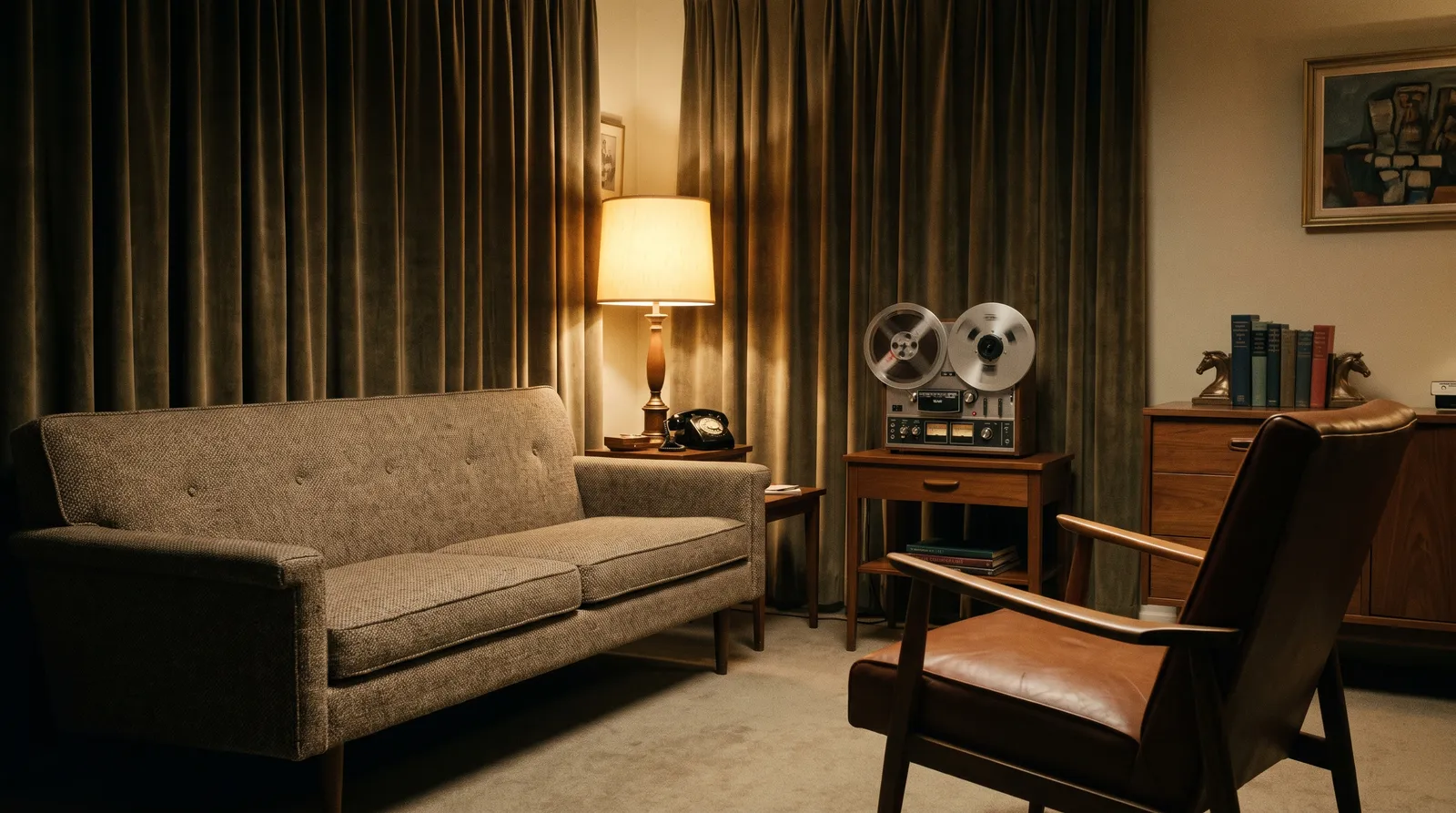
The detail that made Betty and Barney Hill immortal came later still. By late 1963 both Hills were suffering real anxiety and physical symptoms — Barney developed a stomach ulcer — and their physician referred them to Dr Benjamin Simon, a Boston psychiatrist and neurologist with a serious wartime record using hypnosis to treat combat trauma. Between December 1963 and June 1964, Simon put each of them separately under hypnosis across some two dozen sessions.
It was in these sessions that the story most people now associate with the case emerged: a craft on the ground, occupants leading the Hills aboard, a physical examination on a table, and — in Barney’s most quoted recollection — a instrument drawn along his skin. The two accounts, recorded separately, matched closely enough on many points that Simon himself found it striking, and it is this convergence, more than anything else, that has kept researchers returning to the case for sixty years.
The star map
The single most tantalising piece of the story arrived a decade later. Betty had sketched, under hypnosis, a two-dimensional star map she said she had been shown aboard the craft. In 1973, an Ohio schoolteacher named Marjorie Fish built physical models of nearby Sun-like stars using the Gliese catalogue — literally constructing them from beads on fishing line — and announced a match: two prominent stars in Betty’s map corresponded, she argued, to Zeta¹ and Zeta² Reticuli, a wide binary roughly 39 light-years away.
Stanton Friedman publicised the claim in Saga magazine in 1973; Astronomy magazine ran a fuller feature in 1974, and the reaction was immediate and severe. Carl Sagan and Steven Soter published a rebuttal in the same magazine attacking both the statistical method — with roughly a thousand candidate stars to choose from, some pattern match was near-inevitable — and the underlying catalogue data, much of which was imprecise by 1970s standards. Later, far more accurate stellar-distance data from the Hipparcos and Gaia space missions did nothing to rescue the match; several of Fish’s proposed stars turned out to be at distances that break the pattern entirely. The star map remains the case’s most seductive claim and its least defensible one.

What the hypnotist himself concluded
Here the case takes its most awkward turn for anyone hoping for a clean verdict either way. Dr Simon — the psychiatrist whose sessions produced the abduction narrative in the first place — did not conclude that his patients had been taken aboard a craft. His professional opinion, stated plainly at the time and confirmed decades later in his own recorded remarks, was that the sessions had surfaced a shared fantasy, built largely from Betty’s own recurring dreams about the encounter, dreams she had described to Barney at length before he was ever hypnotised. Under hypnosis, Barney himself acknowledged that Betty had told him “a great many details” of what she’d dreamed.
Simon also noted the timing: the Hills’ hypnosis sessions ran through early 1964, during the same season that a wave of NBC and The Outer Limits episodes were airing gentle alien-contact storylines — precisely the kind of ambient cultural material a hypnotically relaxed mind can borrow from and misfile as memory. None of this proves nothing happened on that road in 1961. It does mean the person best positioned to judge the abduction narrative’s authenticity did not believe it was a memory of an external event — a caution worth keeping in mind whenever a UAP claim rests on recovered or reconstructed memory rather than something measured at the time.
The sceptic’s case, in full
The strongest sceptical treatment comes from the writer Robert Sheaffer, who argued the sighting itself has an available mundane explanation: Barney’s original description of the object closely tracks the appearance and position of Jupiter that night, brightened and distorted by the psychological state of a frightened man peering through binoculars on a dark road at 1am. Sheaffer also points to the drift in the story’s specificity over time — details sharpening across dozens of retellings and hypnosis sessions in ways more consistent with elaboration than recall — and to Betty Hill’s later career, in which she reported UFO sightings with increasing frequency and produced photographs, shown at a 1980 conference, that even sympathetic researchers found unpersuasive. The Scottish writer Steuart Campbell went further, arguing the entire “abduction” content was confabulated during hypnosis atop a genuine but far more mundane misidentification of a planet and a conventional aircraft.
Kathleen Marden, Betty Hill’s niece, has spent decades defending the case’s core facts — the radar note, Webb’s contemporaneous report, the closely matching separate hypnosis sessions — and has published detailed rebuttals to Sheaffer’s timeline arguments. Both sides are arguing from the same sixty-year-old paper trail; no new instrumented evidence has arrived to settle it.
Legacy: how one couple wrote the template
Whatever actually happened outside Lancaster, New Hampshire, on 19 September 1961, its cultural afterlife is not in question. John Fuller’s 1966 book The Interrupted Journey and the 1975 NBC television film The UFO Incident introduced the general public to the now-standard abduction furniture: the craft on the ground, the beings, the table, the recovered memory. Every abduction account since — including the very different, much later testimony gathered at Ariel School — sits downstream of the vocabulary the Hill case established, whether or not any individual case has anything else in common with it.
The UAP Times take
The Hill case earns an Unconfirmed rating — three out of five on our scale. Its strengths are real: a sighting reported to the Air Force within two days, a serious NICAP investigation by a professional astronomer within a month, a radar log entry naming an unexplained return, and two independent hypnosis narratives that converged on real detail. That is a stronger contemporaneous paper trail than most cases this old can claim.
Its weaknesses are just as real. The abduction content itself exists only inside hypnotic recall — a method modern psychology treats as capable of manufacturing vivid, sincerely held false memory, not just retrieving buried truth. The star map, the case’s most striking specific claim, does not survive contact with better stellar data. And the psychiatrist who ran the sessions concluded, in his own professional judgment, that he had documented a shared dream rather than an abduction.
The most influential UFO case of the twentieth century may be less a description of what happened than an explanation for a two-hour gap nobody could otherwise fill.
Something unsettled two ordinary, credible people badly enough to send them to a psychiatrist for six months. What that something was remains exactly as open now as it was in 1964 — which, after everything the case spawned, is a stranger conclusion than either believing or dismissing it outright.
Further reading: for the case that gave abduction testimony its modern imagery, see The Ariel School Encounter. For a contemporaneous case built on a single officer’s testimony rather than hypnotic recall, see Socorro 1964. For a later case where the abduction narrative itself, rather than the sighting, is what hypnosis and polygraphs still can’t settle, see Travis Walton, 1975.
Follow the file
Every new dispatch from the UAP desk, in your inbox. Sourced, sceptical, and no more than one email a week.