
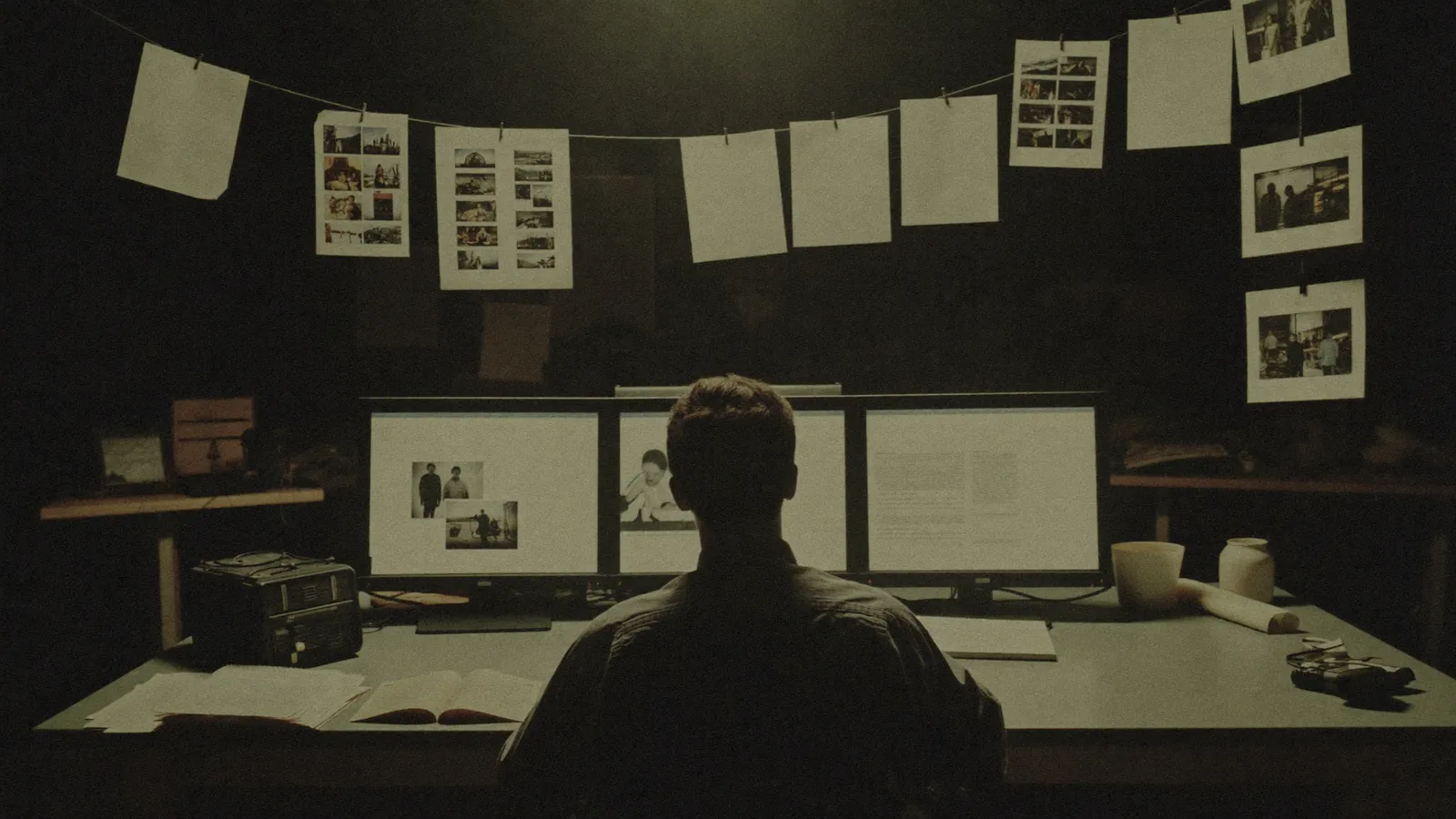
Most of the people in this section are the subjects of reporting. Ross Coulthart is the reporter — and that is precisely what makes him one of the most consequential, and most argued-over, figures in the modern UAP story. He arrived at the subject not as a believer or an insider but as a decorated investigative journalist with a mantelpiece of Australia’s top press awards, and he brought that credibility to bear on a beat most serious reporters still won’t touch. Whether he has spent that credibility wisely is the question his file turns on.
He belongs here because journalism is now part of the phenomenon it covers. The disclosure era runs on a small number of reporters who decide which insiders get a microphone, and Coulthart is the most prominent of them outside the United States. To weigh the subject honestly you have to weigh the people framing it — and few have framed more of it than he has.
The credentials are real
Start with what is not in dispute. Ross Coulthart is a genuine investigative journalist with a long, serious career in Australian television — Sixty Minutes Australia, the Sunday program, and the Nine and Seven networks — and multiple Walkley Awards, the Australian equivalent of a Peabody, for work that had nothing to do with UFOs: war crimes, corporate misconduct, institutional abuse. This matters, because it means his interest in the subject cannot be waved away as a crank’s hobby. When Coulthart turned to UAP, he did so with a reputation built on exactly the kind of adversarial, document-driven reporting the field is usually starved of.
In Plain Sight
His entry point was the 2021 book In Plain Sight: An Investigation into UFOs and Impossible Science, a lengthy survey of the modern evidence, the witnesses and the official record. It landed at the moment the post-2017 thaw was making the subject respectable again, and it established Coulthart as a leading journalistic voice on it — someone who had interviewed the pilots, chased the officials, and was willing to say on the record that he found the core of the phenomenon real. The book is a serious piece of advocacy journalism; how much further than advocacy it goes is where readers divide.
The interviews that shaped the era
Coulthart’s real influence has been as an interviewer. He conducted early, prominent on-camera conversations with Luis Elizondo, and he was central to bringing David Grusch to a broad television audience — the whistleblower whose sworn testimony reset the terms of the debate. As the UAP anchor for NewsNation’s Reality Check, he became the venue through which many of the era’s insider claims first reached the public. That is genuine access and genuine reach, and it is why his editorial judgement matters so much: to a large audience, the subject looks the way Coulthart frames it.
The careful version, and the confident one
The fairest way to read Coulthart is that there are two of him on the page, and they don’t always travel together. There is the careful reporter — the one who, in the 2026 controlled-disclosure row over Elizondo’s past, chose his words precisely, distinguished what he believed from what he could prove, and later clarified that what he had seen from Elizondo was a man avoiding a breach of his oath rather than lying. That Coulthart is a credit to the beat.
Then there is the confident one — the reporter who has stated, at times with striking certainty, that the US government holds recovered craft and non-human intelligence, sourced to insiders the audience cannot see or check. Critics, including sympathetic ones, argue this is where his journalism strains: that relaying an anonymous insider’s extraordinary claim with the authority of a Walkley winner lends it a weight the underlying evidence has not earned, and that the line between reporting a claim and endorsing it sometimes blurs. It is the oldest hazard on this beat, and the more credible the reporter, the more it matters.
The sceptic’s read
The deflationary account is not that Coulthart is a fraud — he plainly isn’t — but that he is an advocate wearing a reporter’s authority. On this reading his real contribution is access and platform rather than verification: he has secured remarkable interviews and moved the conversation, but the extraordinary specifics he has relayed remain, years on, sourced to the unnameable and unconfirmed by anything the public can examine. The strongest version of the criticism is friendly: a journalist of his calibre is exactly the person who should be hardest on his own sources, and the subject’s history — from Bob Lazar onward — is a graveyard of credible-sounding insiders who never produced. The sceptic’s ask of Coulthart is simply the ask of any reporter: show the document, not the demeanour.
The UAP Times take
Ross Coulthart is the most credentialed journalist to commit himself fully to the UAP beat, and that cuts both ways. When he is careful — separating claim from confirmation, holding a source’s language up to the light, resisting the neat narrative — he is exactly what the subject needs and rarely gets: an adversarial reporter with real chops taking it seriously. When he is confident ahead of the public evidence, he lends anonymous, unverifiable insider claims the borrowed authority of a serious newsroom, which is the most powerful way there is to make an unproven thing feel proven. Weigh him as an interviewer and platform and he is central to the era; weigh him as a verifier and the record is thinner than his certainty. The honest file rates him the way it rates the people he interviews: real access, real reach, and a core of extraordinary claims still waiting on the one thing that would settle them.
Sources and citations
For readers who want to judge his work directly:
- Ross Coulthart, In Plain Sight: An Investigation into UFOs and Impossible Science (HarperCollins, 2021).
- His UAP reporting for NewsNation’s Reality Check with Ross Coulthart, including his interviews with Luis Elizondo and David Grusch.
- Our own detailed account of the reporting he shaped, the 2026 “controlled disclosure” row.
Further reading: the two insiders his interviews put in front of the public — Luis Elizondo and David Grusch — and, for the standard of proof this beat keeps failing to meet, Bob Lazar and the scientist who spent a career demanding better, Jacques Vallée.
Follow the file
Every new dispatch from the UAP desk, in your inbox. Sourced, sceptical, and no more than one email a week.