
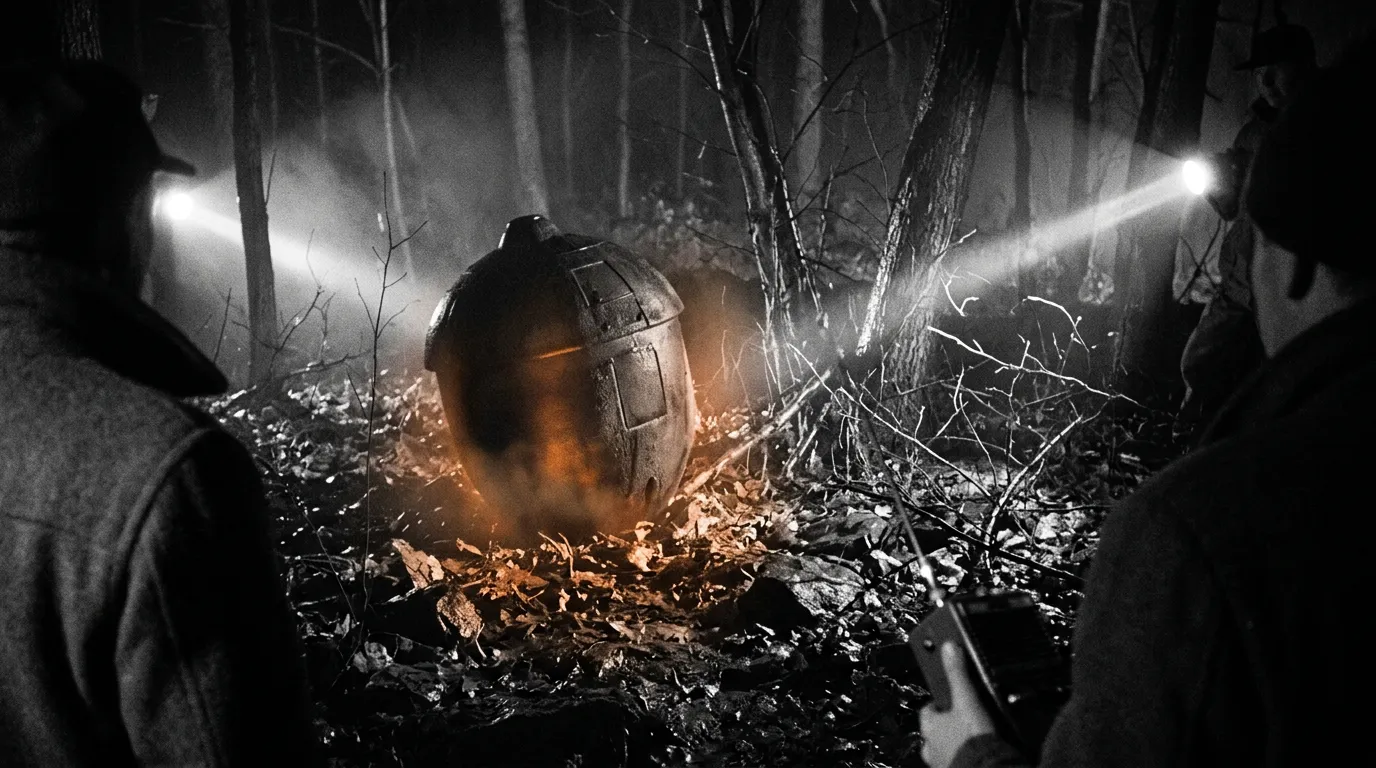
Kecksburg is sometimes called “Pennsylvania’s Roswell,” and the comparison is fairer than most. Both cases begin with something genuinely falling from the sky, both hinge on claims of a military recovery, and both are haunted by the same problem: the dramatic part rests almost entirely on human memory, while the boring part is well-attested. On the afternoon of 9 December 1965, something real streaked across the sky. What, if anything, ended up in the woods near Kecksburg is a much harder question.
A fireball across six states
At around 4:45pm that day, a brilliant fireball was seen across a huge swathe of the north-eastern United States and Canada — Michigan, Ohio, Pennsylvania and beyond, with reports from at least six states and from Ontario. Thousands saw it. It passed over the Detroit and Windsor area, dropped hot metal debris over Michigan and northern Ohio, started grass fires, and produced sonic booms over western Pennsylvania. On the face of it, exactly what a large meteor or a piece of re-entering space hardware looks like.
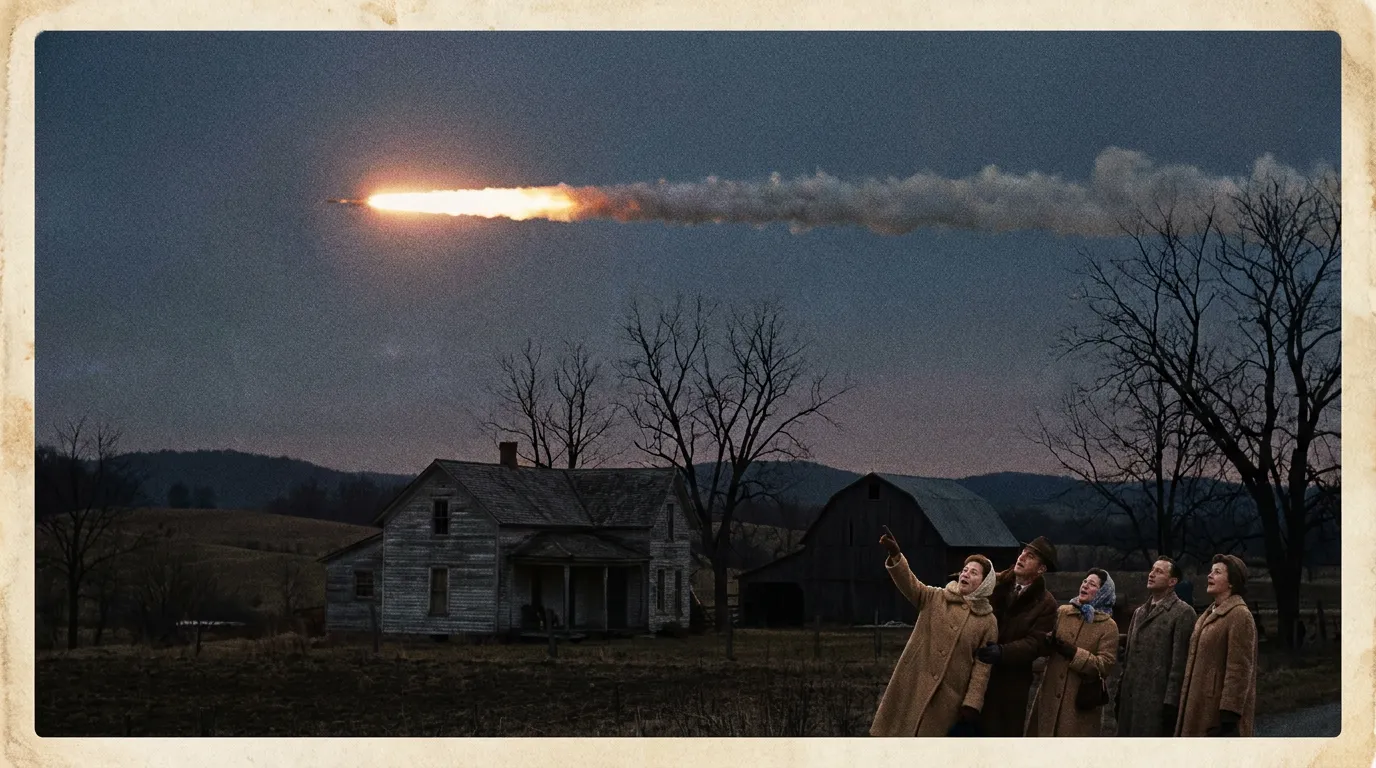
That much is not in dispute. Something big and fast came down through the atmosphere that evening, and it was spectacular enough that newspapers across two countries carried it the next morning. The disagreement is entirely about what happened next in one small Pennsylvania community in Westmoreland County, thirty-odd miles south-east of Pittsburgh.
The thing in the ravine
In and around Kecksburg, witnesses reported that an object had come down in the woods, and some described going to look and finding not a meteorite but a manufactured object: acorn- or bell-shaped, perhaps nine to twelve feet long, copper-coloured, with a band around its base carrying markings that a few compared — the phrase recurs across these cases — to hieroglyphics.
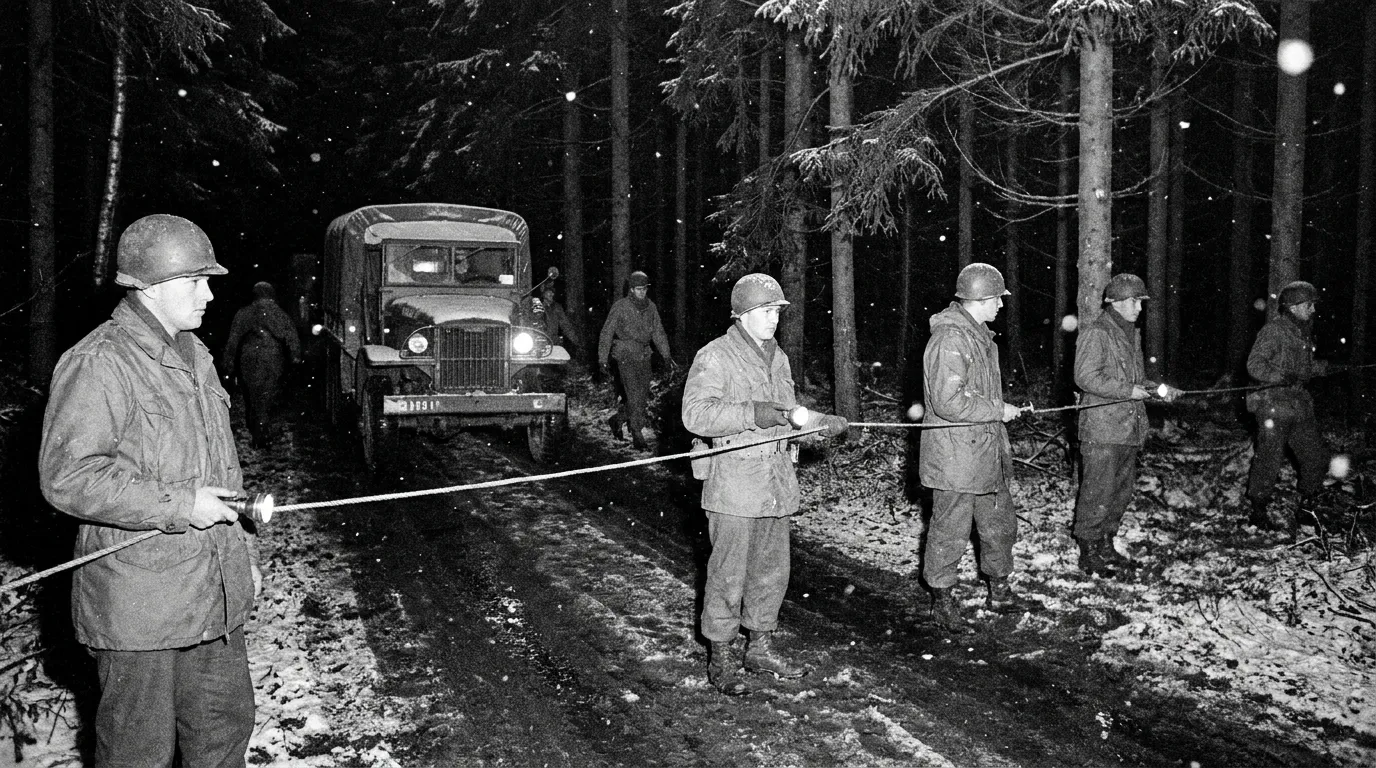
The witnesses then describe a rapid, heavy military response: the US Army arriving, sealing off the area, keeping locals and reporters out. This is the heart of the Kecksburg legend, and it is worth being precise about its status. It is genuine testimony from real residents — but it is testimony, gathered and amplified over the following decades, largely by the Pennsylvania researcher Stan Gordon, who began collecting accounts in the late 1960s and has worked the case ever since. There is no 1965 paperwork describing a recovered craft.
The truck that drove away
The story’s signature image is a flatbed army truck leaving the scene at night, carrying something large under a tarpaulin, while the official line held that nothing had been found.
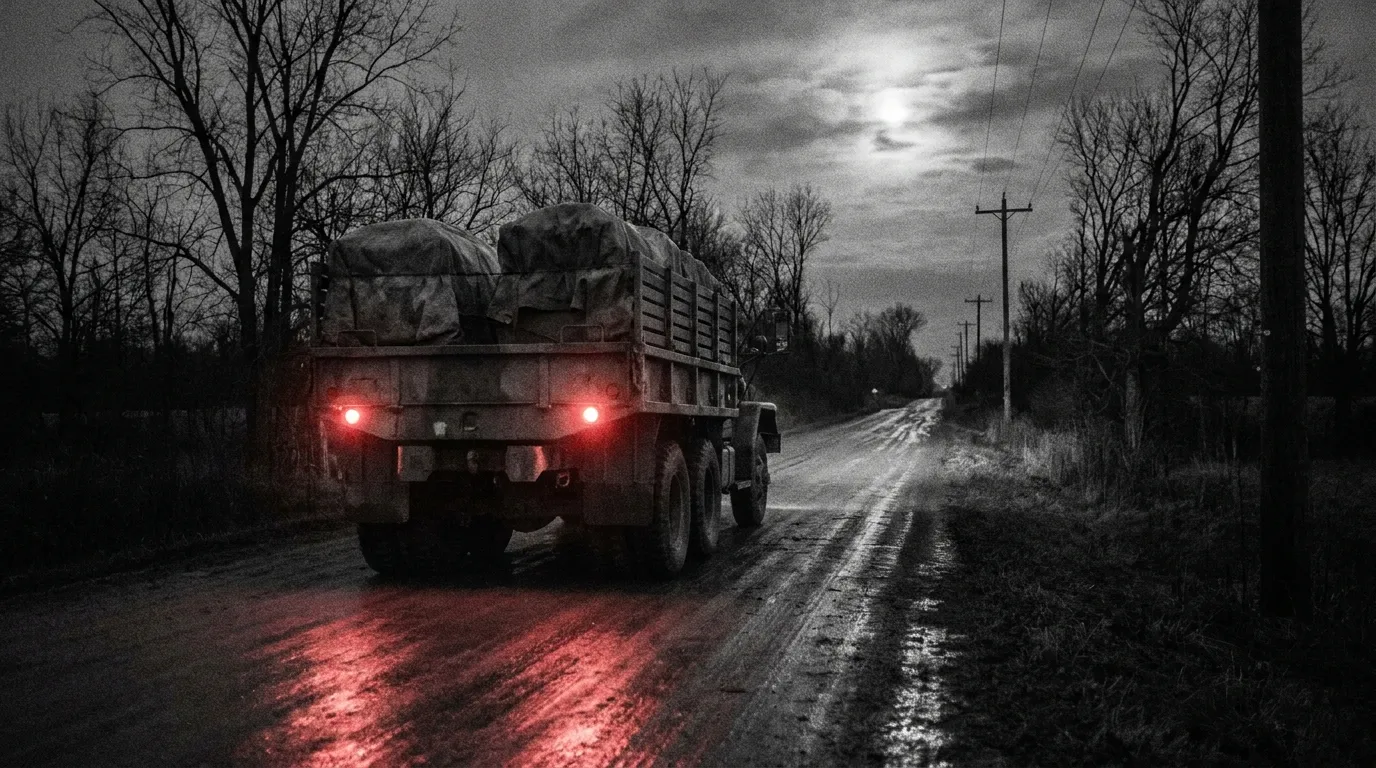
If true, that is a cover-up. But “the military recovered a meteorite or a piece of a satellite and was tight-lipped about it in 1965” is also entirely consistent with the same scene, and considerably more likely. The Cold War military did not need an alien craft to be secretive about hardware falling out of the sky — and in December 1965, with Soviet and American spacecraft re-entering regularly, recovering foreign debris quietly was standing practice rather than conspiracy.
What the Air Force says it did
The official response is thinly documented but not undocumented. Major Hector Quintanilla, then running Project Blue Book, told the Associated Press late on 9 December that Air Force investigators had been sent to help search the area. The unit involved appears to have been the 662nd Radar Squadron, based at the Oakdale Armory near Pittsburgh, roughly fifty miles from Kecksburg, which maintained a liaison with Blue Book.
According to the Blue Book file, a three-man team went out, searched, and reported back that nothing had been found. That is the entirety of the official record of a recovery: a negative. No inventory, no photographs, no follow-up analysis, no evidence bag.
This is the fulcrum of the whole case. Residents say a large object was lifted onto a truck and driven off; the Air Force’s own paperwork says a small team looked and found nothing. Both cannot be right. The difficulty for the sceptic is that “we searched and found nothing” is exactly what a tidy file would say either way. The difficulty for the believer is that a genuine recovery operation, of the scale the witnesses describe, ought to have left a paper wake somewhere — and sixty years of freedom-of-information requests have not surfaced one.
The story that nearly wasn’t told
The route by which Kecksburg reached the public is unusually well preserved, and it matters. That evening a local woman, Frances Kalp, telephoned John Murphy, the news director of radio station WHJB in nearby Greensburg, to report that a flaming object had come down in the woods near her home. She said she and her children had walked to within about half a mile of the site and seen something that looked, in her phrase, like a “four-pointed star”.
Murphy called the Pennsylvania State Police, who in turn asked Kalp to meet them in Kecksburg and lead them to the spot. By most accounts Murphy was the first reporter on the scene — which, given how quickly the area was closed off, made him the only journalist with an independent look at whatever was there.
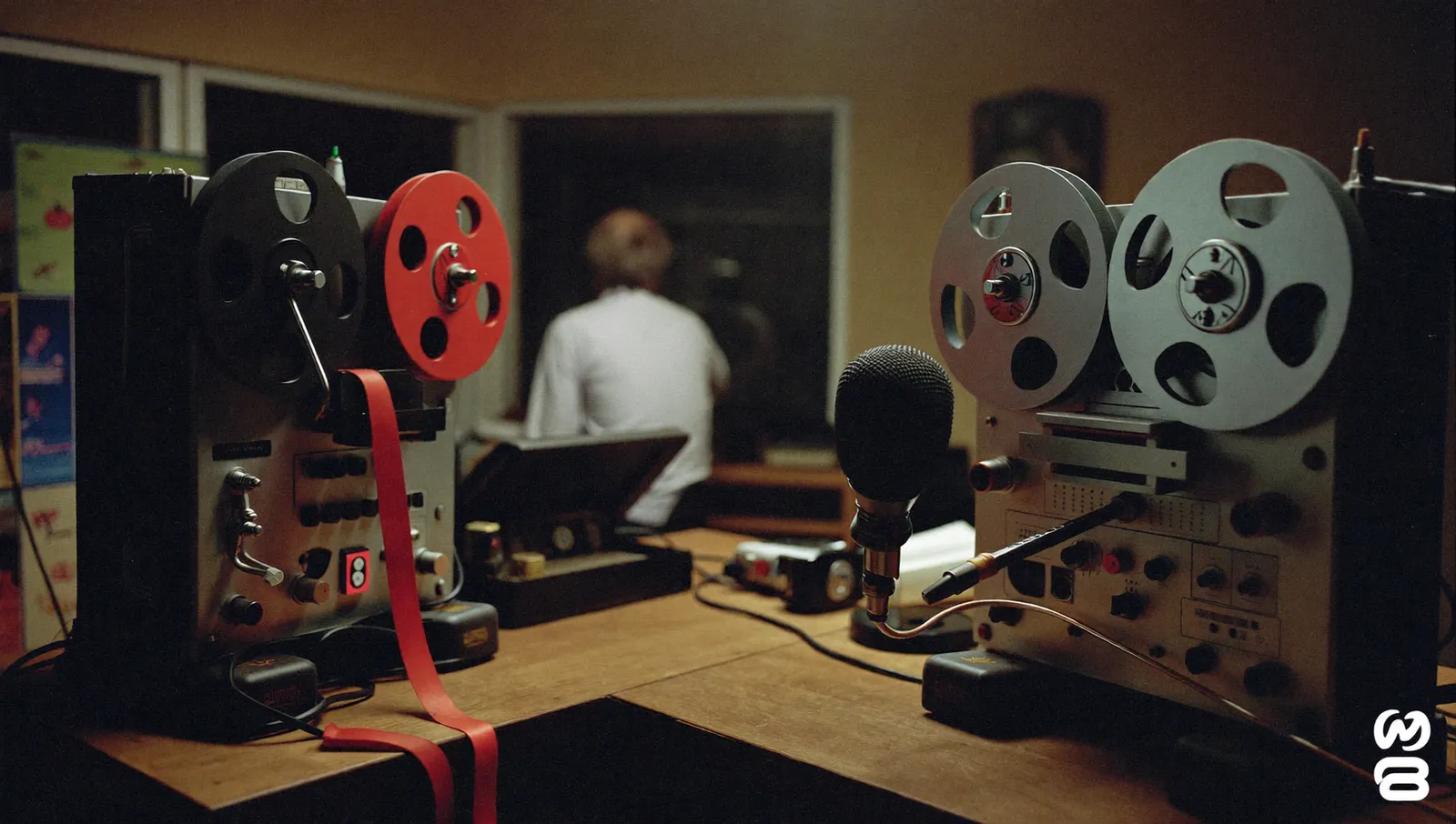
Murphy went on to produce a radio documentary, Object in the Woods. What was broadcast, according to those who heard both versions, was substantially shorter and quieter than what he had assembled, with the material about a strange object removed. Gordon has reported that Murphy’s former wife told him officials visited the house and took photographs he had shot. Murphy himself died in 1969, hit by a car while on holiday in California, and the unedited tape has never surfaced.
Treat that carefully. A confiscated tape is a claim, relayed second-hand, and the man at the centre of it cannot be asked. But it is at least a specific, checkable-in-principle claim about a named broadcaster and a named programme, which puts it a tier above the usual “they silenced the witnesses” boilerplate.
Meteor, satellite, or something else
Three explanations compete. The first is the simplest: a large meteor. In 1967 the astronomers Von Del Chamberlain and David J. Krause published “The Fireball of December 9, 1965” in the Journal of the Royal Astronomical Society of Canada, reconstructing the object’s path from photographs and witness reports and concluding it was a natural body burning up in the atmosphere. On that reading, the “landed craft” is a product of excited witnesses on a dark December night and a genuinely secretive military tidying up. Some researchers, notably Ivan T. Sanderson, disputed the reconstructed speed and trajectory, but no astronomer of standing has ever endorsed a controlled descent.
The second is a re-entering spacecraft. The Soviet Venus probe Kosmos 96 failed in Earth orbit and came down on the same date, and its descent module was — awkwardly for sceptics — broadly bell-shaped. But US Space Command’s 1991 assessment placed the re-entry over Canada at around 3:18am, roughly thirteen hours before the Pennsylvania fireball. Nicholas L. Johnson, then NASA’s chief scientist for orbital debris at Johnson Space Center, put it flatly in 2003: there was no way any debris from Kosmos 96 could have landed in Pennsylvania around 4:45pm. James Oberg, the former NASA engineer who had originally floated the Kosmos idea, later accepted that the orbital analysis backed the tracking data and that the two events were a coincidence of the calendar.
The third, the extraterrestrial reading, has the least documentary support and the most cultural momentum. It was fixed in the public mind by an episode of NBC’s Unsolved Mysteries broadcast on 19 September 1990, for which the production built a full-size polystyrene acorn. The town asked to keep the prop. It stands on a pedestal near the volunteer fire station to this day, which tells you something about how the case has aged: the most solid physical object associated with Kecksburg is a television prop.
The lawsuit and the missing boxes
NASA’s position has long been that it examined fragments in the 1960s and concluded they came from a re-entered satellite — but that the relevant records were lost. That answer satisfied nobody, and in 2003 it produced a lawsuit.
The journalist Leslie Kean, working with support from the Sci Fi Channel, filed a Freedom of Information Act suit against NASA in the US District Court for the District of Columbia. It ground on for years. At a hearing in 2007, Judge Emmet G. Sullivan described NASA’s handling of the request as “a ball of yarn” and remarked that heads should roll. Steve McConnell, NASA’s public liaison officer, testified that two boxes of records from the relevant period were missing and presumed destroyed.
A settlement in October 2007 required NASA to conduct a far broader search under court supervision and to pay Kean’s legal costs. That search was completed in August 2009, and the case was dismissed by joint motion. Several hundred pages were produced. There was no smoking gun — no recovery report, no photographs, no analysis of an acorn-shaped object. What the litigation did establish is narrower and, in its way, more useful: that a federal agency asked to account for its own 1965 files could not fully do so.
Lost records are catnip to a cover-up theory. They are also what happens to 1965 files. The honest position is that the absence proves an absence of documentation, not the presence of a conspiracy — a distinction that recurs in the modern era too, where the argument has shifted from misplaced boxes to radar data that is deleted on a 45-day cycle before anyone can ask for it.
The sceptical case at its strongest
Put fairly, the sceptical reading is not “the witnesses are lying”. It is that a single spectacular fireball, seen by an entire region, was followed in one village by a night of confusion, torchlight, state troopers, servicemen and a press pack — and that memories formed in those conditions, then rehearsed over twenty-five years and finally consolidated by a network television dramatisation, are not reliable evidence of a manufactured object.
Robert Sheaffer, the veteran UFO sceptic, has argued for years that there is no residual mystery at all: the Great Lakes fireball of 9 December 1965 is a well-documented astronomical event, written up by astronomers at the time, and everything else is accretion. The strongest version of his case does not require anyone to have invented anything. It requires only that people who saw a real fireball, and then saw real soldiers in the woods, joined the two together.
Against that, the proponents have one durable point. The acorn descriptions do not obviously derive from the fireball; they came from a small number of people who say they got close, and several told the same story before there was a story to tell. That is not proof. It is the reason the case has not simply collapsed.
The UAP Times take
Kecksburg earns an Unconfirmed rating — three out of five on our scale. A real, spectacular fireball is the one solid fact, and everything exotic is built on top of it from later testimony. The acorn-shaped craft, the markings, the sealed cordon and the covered truck are vivid and sincerely recounted, but they are memories, unsupported by any 1965 record, and each has a mundane counterpart that fits the same evening at least as well.
Our reading is that something certainly fell near Kecksburg — the sky put on a show for half a continent — and that the balance of evidence points to a natural object, recovered or not, wrapped in ordinary Cold War secrecy. The Kosmos 96 alternative, once the sceptics’ favourite, has been quietly abandoned by the people best placed to test it, which is a useful reminder that prosaic explanations can be wrong too.
What Kecksburg really demonstrates is the cost of not collecting evidence at the time. One competent survey of that ravine in December 1965 — photographs, samples, a signed inventory — would have settled the matter in a week. Instead there is a negative entry in a Blue Book file, an edited radio programme, two missing boxes and a polystyrene acorn on a plinth. The case endures not because the evidence is strong but because the image is: a small town, a thing in the woods, and a truck disappearing into the dark. That is a very good story. It is not, on what can actually be shown, a very good case.
Further reading: for the other great “crashed craft and a cover-up” legend, see Roswell 1947. For an earlier fireball flap that the US government did document properly — and only declassified decades later — see the green fireballs over Los Alamos. Kecksburg’s object was the classic bell / acorn form; it’s on the sightings map.
Source: Contemporary press; Stan Gordon's investigation; NASA statements and FOIA litigation
Follow the file
Every new dispatch from the UAP desk, in your inbox. Sourced, sceptical, and no more than one email a week.