There is a number buried in this year’s Pentagon UAP report that ought to have made more noise than it did. In a single reporting year, the government’s anomaly office resolved 238 sightings at once — not one by one, over months of painstaking work, but in a batch — because someone finally taught its analysts to recognise the glint of sunlight off a satellite.
That is the largest single act of debunking in the short history of official UAP investigation, and it happened without a new sensor, a new witness, or a new sighting. It happened because the office wrote a better filter. We covered the report itself here; this is the piece about the mechanism that ate a third of its caseload — how a satellite catches the sun, why there are suddenly so many of them doing it, and, just as importantly, where the explanation runs out.
What a satellite flare actually is
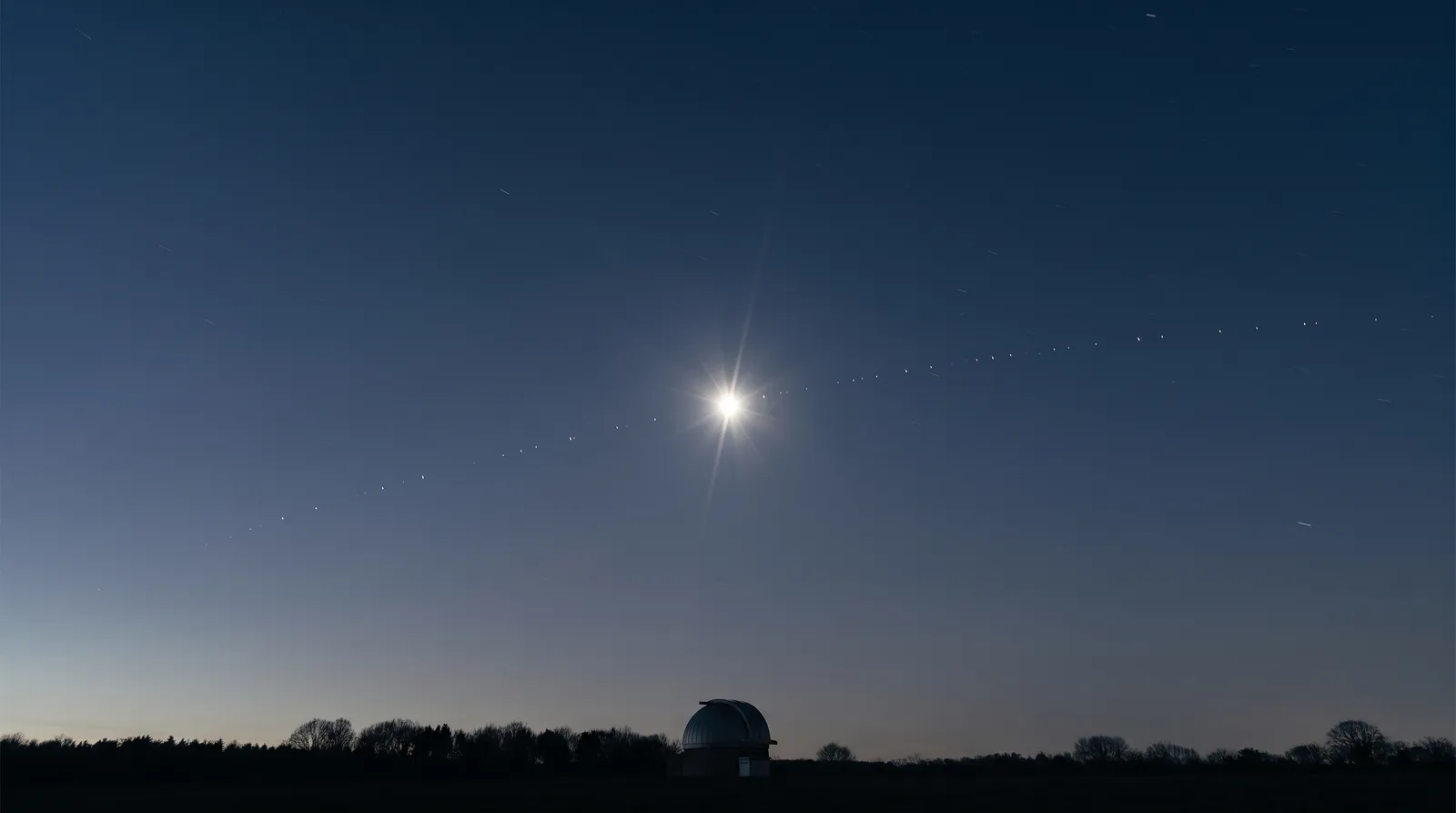
Start with the physics, because it is simpler than it sounds. Most of the time a satellite in low orbit reflects sunlight diffusely — it scatters a little light in all directions and shows up, if at all, as a faint moving dot. A flare is what happens when a flat, shiny surface on the spacecraft — a solar panel, an antenna, the chassis itself — lines up just so between the Sun and your eye, and reflects the sunlight specularly: like a mirror, in a narrow beam, straight at you.
For a second or two, that beam can make an object that was invisible a moment earlier blaze brighter than any star, then vanish just as fast. It appears from nowhere, brightens impossibly, holds a steady point of light, and is gone — which is, more or less, a checklist of what people report when they report a UFO.
Skywatchers have known this for decades. The old Iridium communications satellites were famous for it: their flat, door-sized antennas produced predictable “Iridium flares” so bright you could see them in daylight, and enthusiasts planned evenings around them. What has changed is not the physics. It is the number of mirrors.
The sky genuinely changed, and recently
For most of the space age there were a few hundred working satellites up there. As of 2026 there are close to ten thousand from a single operator: SpaceX has roughly 9,819 active Starlink satellites in low orbit, which by itself accounts for something like 54% of all active spacecraft ever, orbiting at once. This is not a rounding error on the night sky. It is a different night sky.
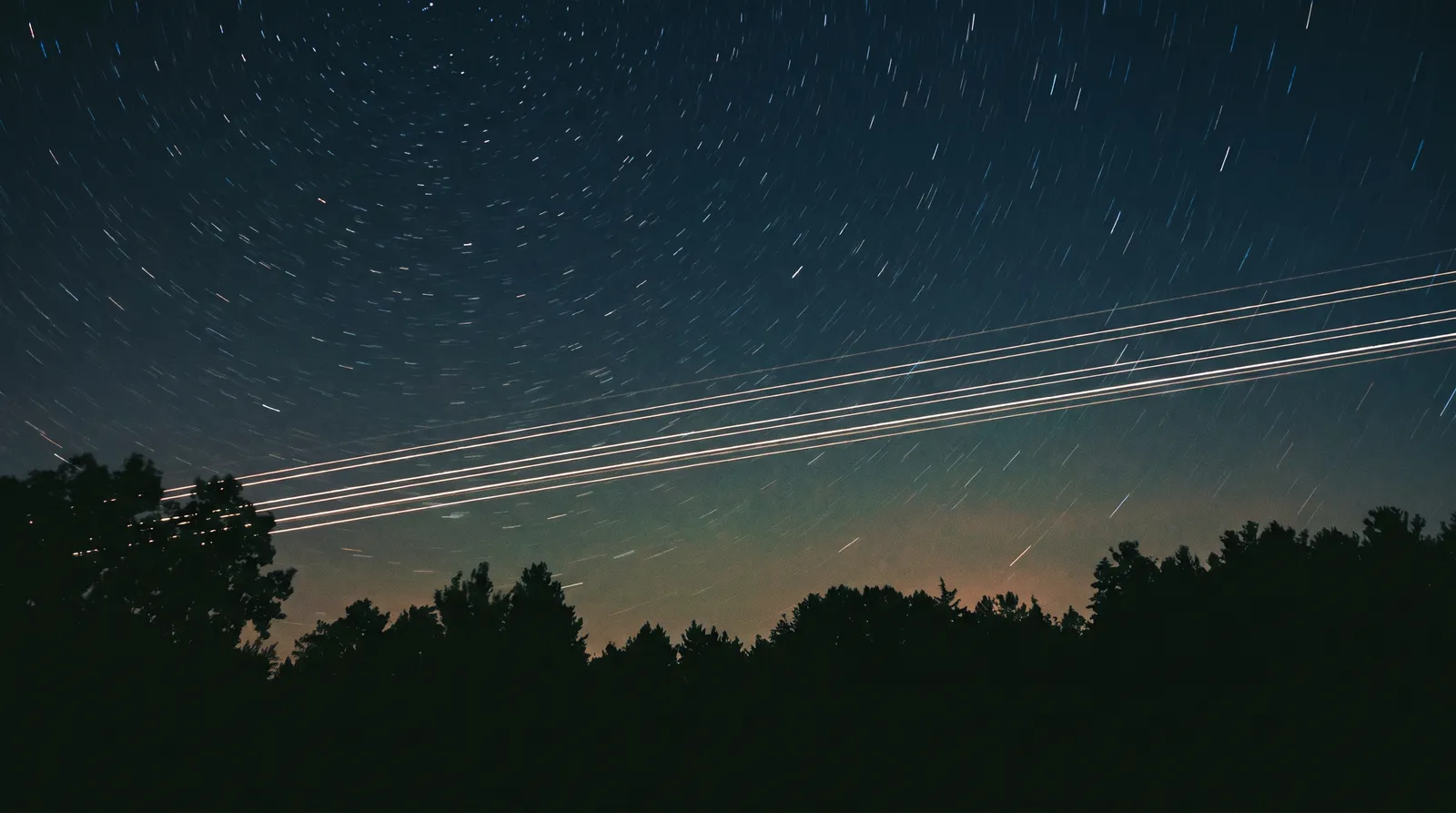
And they are bright. Anthony Mallama, who measures satellite brightness for the International Astronomical Union’s Centre for the Protection of the Dark and Quiet Sky, has catalogued the constellation against a haul of more than a million individual brightness measurements. His finding is blunt: nearly all these spacecraft exceed the magnitude-7 threshold at which they interfere with professional astronomy, and most exceed the magnitude-6 limit at which they become visible to the naked eye and start spoiling the view for everyone else. Starlink’s own VisorSats were clocked around magnitude 6.5 during orbit-raising — comfortably naked-eye — before settling dimmer once on station.
SpaceX has, to its credit, worked the problem: darkening coatings, sunshade “visors”, and in 2026 a programme to lower roughly 4,400 satellites from 550km to about 480km, which cut the number of sunlit satellites visible in images from the Vera Rubin Observatory by almost 60%. But “almost 60% fewer than an enormous number” is still a great many, and a dimmer satellite can still throw a bright specular flare when the geometry is right. The mirrors got quieter. They did not go away.
How AARO tells a flare from a phenomenon
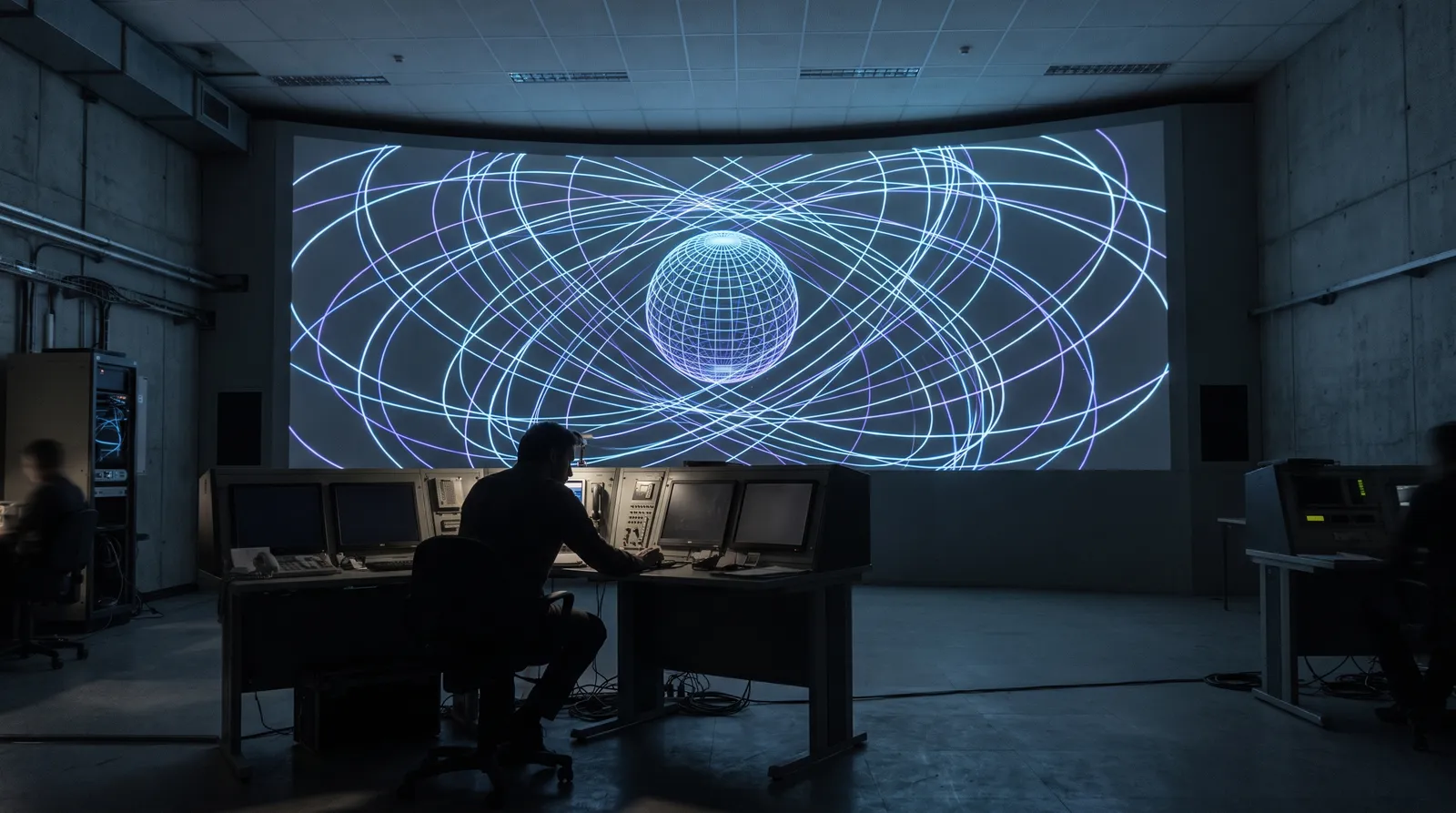
Here is the part that deserves credit rather than suspicion. Resolving a flare is not guesswork — it is arithmetic, and AARO built the capability to do it at scale. Every catalogued satellite has a published orbit, an ephemeris: where it is, precisely, at any given second. Given the time, date and location of a sighting, you can compute exactly which spacecraft were overhead, where the Sun was, and whether the angles between satellite, Sun and observer put a specular beam on that particular patch of ground.
When AARO added that analytic step — cross-referencing reports against satellite ephemerides and modelling the reflection geometry in three dimensions — a large block of its unresolved pile simply dissolved. The office’s own Satellite Flaring information paper, published in April 2025, lays out the mechanism; the FY2025 annual report then applied it and 238 cases fell out at once. The single biggest driver of last year’s resolution rate, in other words, was not a change in the sky but a change in the office.
That is exactly what a functioning investigative body is supposed to do: explain the explicable, and narrow the field of what is left to the genuinely strange.
Why this makes more reports, not fewer
The counterintuitive part is that a sky full of satellites generates more UFO reports even as the phenomenon behind them becomes better understood. A flare hits every visual trigger at once: sudden appearance, extreme brightness, a hard stop. Put thousands of potential mirrors overhead every clear night and you manufacture a steady supply of sincere, well-meaning sightings by people who saw something genuinely inexplicable — to them, in that moment, without an ephemeris to hand.
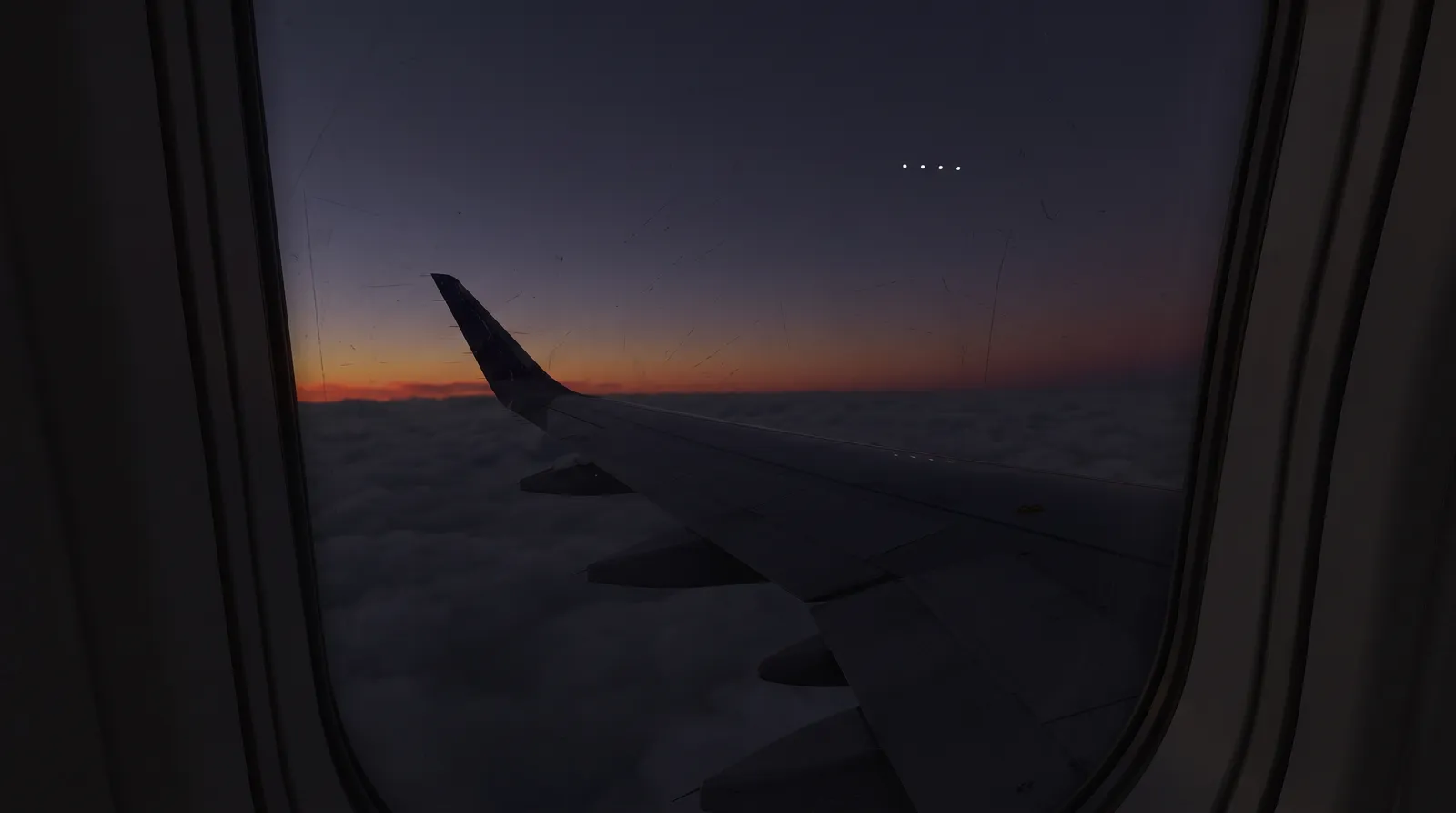
It is not only the public. Airline crews sit above the murk with an unobstructed view of exactly the twilight sky where freshly launched satellites, still in tight post-deployment “trains”, flare most readily — one reason pilot sightings have climbed without the underlying rate of anything truly anomalous climbing with them. A Starlink train catching the sun looks, to a reasonable observer at 38,000 feet, remarkably like a formation of lights moving in deliberate concert. It is a formation of lights moving in deliberate concert. It is also just Tuesday’s launch.
The sceptic’s trap
Now the cold water, aimed this time at the sceptics rather than the believers — because a debunking this powerful invites its own overreach.
Satellite flaring is real, measured, and officially documented, and it plainly accounts for a large slice of the reporting pile. What it does not do is explain everything, and the temptation to let it is strong precisely because it is so satisfying. A filter that resolves 238 cases in a batch can quietly be mistaken for a filter that resolves all cases, and it is not.
A flare is a brief, stationary point of light seen from the ground on a clear evening. It is not a solid object tracked simultaneously on military radar and infrared, holding a hard-edged shape, at a range and altitude no catalogued satellite occupies. It cannot account for a daylight radar-visual case, and it says nothing about the genuine ways a sensor can be fooled at the hardware level, which are a separate problem with separate answers. The honest position is the one AARO’s own numbers support: most reports have prosaic explanations, satellite flares are now a big one, and a stubborn residue survives all of it. “It’s all satellites” is as lazy as “it’s all aliens” — it just happens to be lazy in the respectable direction.
There is also a measurement point worth holding onto. The reason a flare can be resolved is that a satellite has a known position and a known orbit; the geometry is checkable. The frustrating cases are precisely the ones where no such anchor exists — where, as two scientists recently showed, the released government videos lack the range data to pin down speed or distance at all. Satellites are easy because they come with coordinates. The hard cases are hard because they don’t.
The UAP Times take
This one earns a Well-sourced rating, five out of five on our scale, and it earns it comfortably: the mechanism is textbook optics, the scale is measured in peer-reviewed brightness surveys, the resolution method is described in AARO’s own published information paper, and the case count comes from the annual report. There is nothing here to take on faith.
What it means is a useful, slightly deflating truth about this whole subject. A large and growing share of what people sincerely report as UFOs is the entirely explicable consequence of having quietly filled low orbit with ten thousand mirrors, and the government now has the arithmetic to prove it case by case. That is real progress, and it should be said plainly.
But the same honesty that credits the satellite explanation has to mark its edge. It dissolves the easy cases — the ones with a time, a place, and a catalogued object overhead — and leaves the hard ones exactly as hard as they were. The sky is fuller of false UFOs than it has ever been. That is not the same as the sky being empty of real ones.
Further reading: what the 2026 Pentagon UAP report actually found, and why radar sees ghosts that aren’t there.
Follow the file
Every new dispatch from the UAP desk, in your inbox. Sourced, sceptical, and no more than one email a week.