
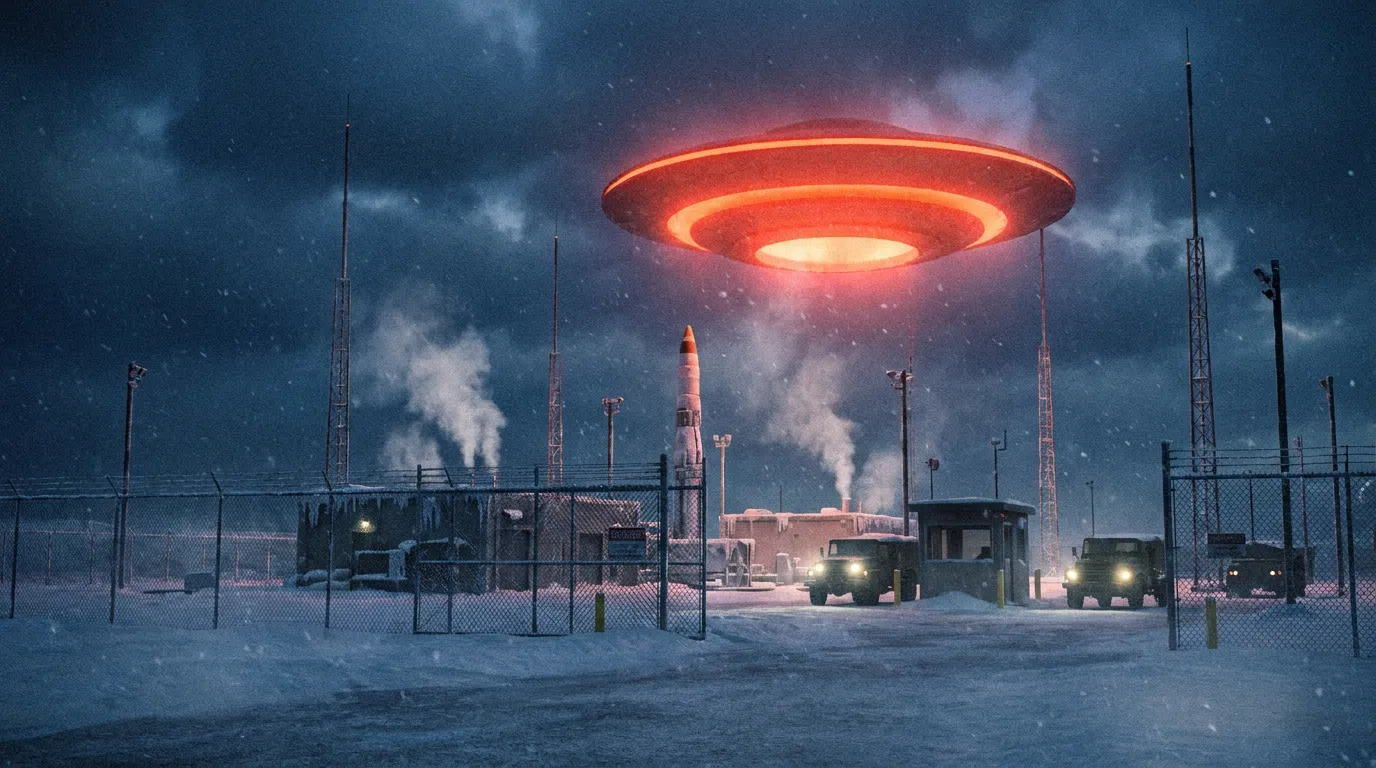
Most UFO cases ask you to weigh what someone saw. Malmstrom asks something harder: it pairs a witnessed object with a documented, high-consequence malfunction in the United States nuclear deterrent, and asks whether the two are connected. That combination — trained military officers, a glowing craft, and a flight of intercontinental ballistic missiles dropping off alert within seconds — is why the case has never gone quiet, and why the men who were underground that morning have spent their lives insisting it deserves a serious answer.
An ordinary shift, an extraordinary morning
In March 1967, at Malmstrom Air Force Base in Montana, the 341st Strategic Missile Wing ran its Minuteman I fields the way it always did: two-officer crews sealed in hardened underground launch control capsules, each responsible for a flight of ten nuclear missiles sitting in silos spread across the surrounding countryside. On the morning in question, Deputy Missile Combat Crew Commander Robert Salas was on duty underground when he received a call from a security guard on the surface, agitated, reporting strange lights in the sky above the launch control facility.
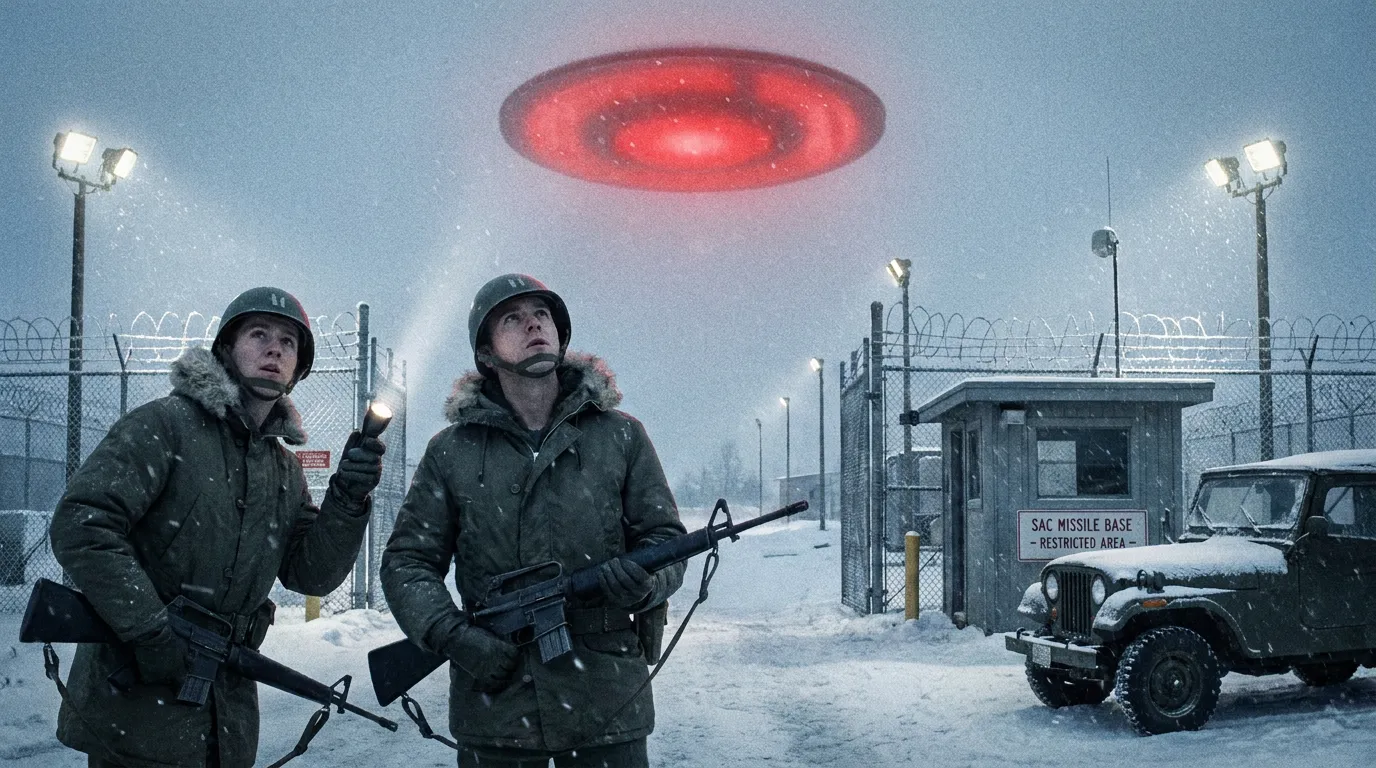
Salas, by his account, told the guard to keep him posted and thought little of it — until a second, far more alarmed call came moments later: a glowing red object was hovering right over the front gate, and the guards were frightened.
The missiles drop offline
Then, Salas says, the missiles began to fail. Within a very short span — seconds — one after another of the flight’s ten Minuteman missiles dropped from “alert” status into “no-go,” effectively taken off the board and rendered unlaunchable, their guidance and control systems faulting out.
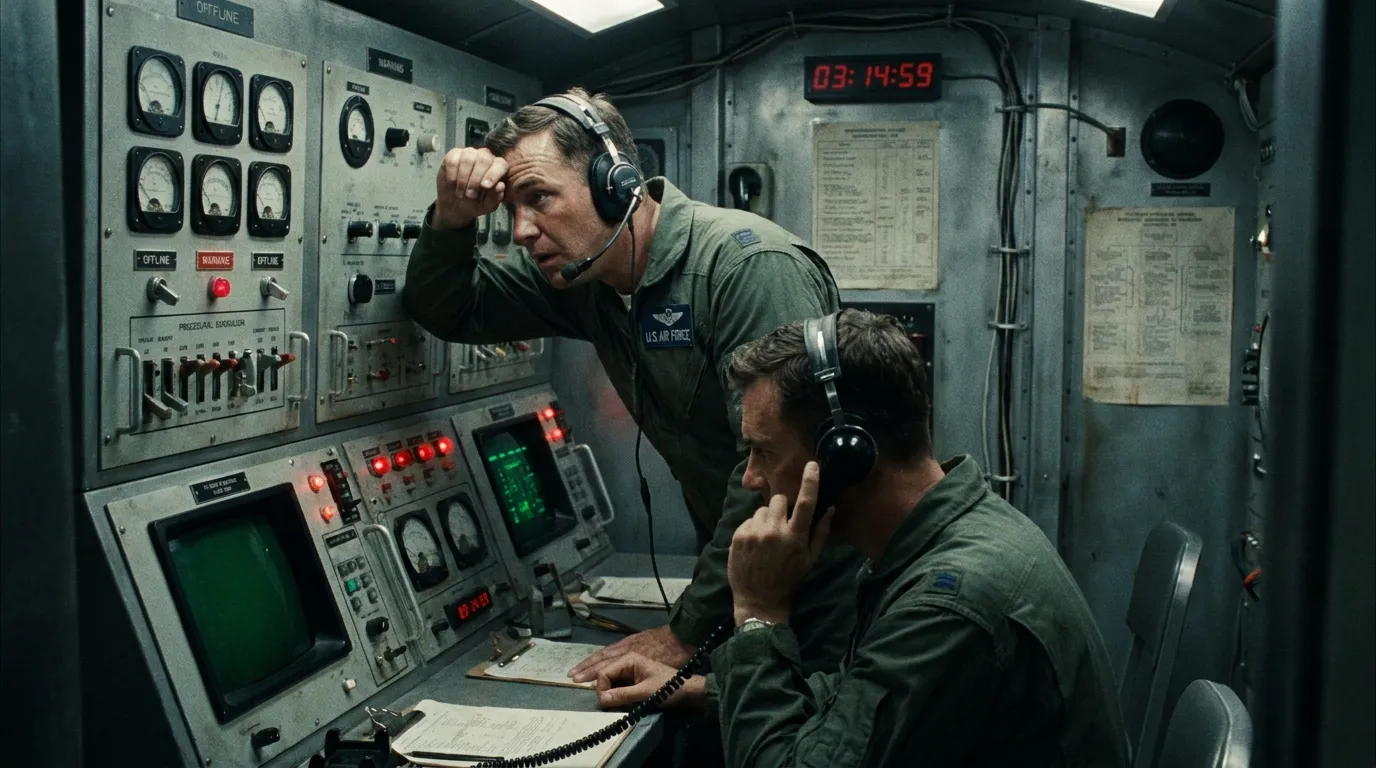
For a crew whose entire purpose was to keep those weapons ready, this was close to unthinkable. A single missile going down for maintenance was routine; most of a flight failing near-simultaneously, in seconds, was not something the system was supposed to be able to do. The commander, Frederick Meiwald, was on the same crew and, over the years, has corroborated the essentials of the account.
What the record says — and doesn’t
Here the case splits into two threads that sceptics and proponents pull in opposite directions. On one hand, a mass missile shutdown at Malmstrom in March 1967 unquestionably happened and was investigated at length. On the other, the official explanation for it focused on an electrical cause, and Air Force documentation does not link the malfunction to any object in the sky.
Untangling this properly means separating two events that are almost always discussed as one. There is a documented incident, and there is an undocumented one, and nearly every argument about Malmstrom is really an argument about which of them Robert Salas was sitting in.
Echo Flight, on paper
The documented event is Echo Flight. At 08:45 on 16 March 1967, all ten missiles of Echo Flight went off alert with no-go indications in a matter of seconds. This is not testimony. It appears in the 341st Strategic Missile Wing’s own unit history and in contemporaneous message traffic up the chain of command, and it has been in the public domain for a quarter of a century.
That is largely thanks to freedom-of-information work rather than voluntary disclosure. The researcher James Klotz filed the requests that first surfaced the Echo Flight material, and in 2001 John Greenewald obtained five quarterly histories of the 341st covering January 1967 to March 1968, which put the wing’s own account of the incident and its aftermath on the record.
Read those documents and what strikes you is not mystery but alarm. A strategic missile wing had just lost an entire flight of nuclear weapons from alert status, at once, for no reason it could immediately name. The paperwork is the paperwork of an organisation that is badly rattled and wants an engineering answer quickly.
What Boeing found
It got one, eventually. The failure was worked at three levels: at Malmstrom itself, at the Ogden Air Materiel Area, and at the Boeing plant in Seattle, where the Minuteman guidance and control hardware had been built.
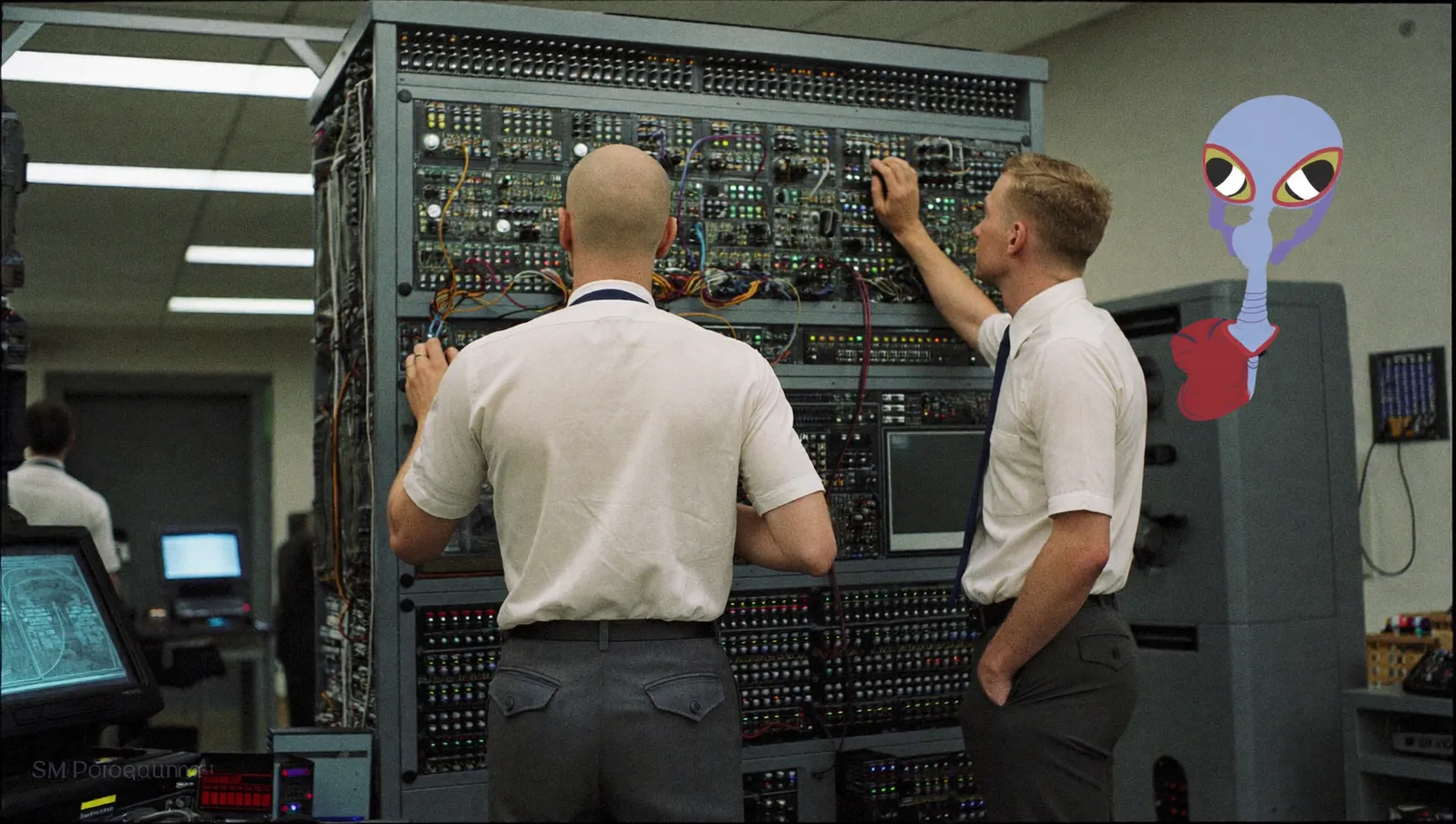
The conclusion the investigation reached was that an electronic noise pulse had entered the logic coupler inside the launch control centre and shut the launch facilities down from that one central point. The component identified as vulnerable was the C-53P logic coupler, which could be triggered by spurious noise on the Self-Test Command line; the pulse propagated through the interconnecting network and produced simultaneous no-go indications across the flight.
This is a genuinely satisfying explanation, and it is the strongest card in the sceptical hand. It is specific, it names a part, it identifies a signal path, and it was arrived at by engineers with access to the hardware rather than by anyone arguing about the sky.
It is not, however, quite as tidy as it is usually presented. Message traffic from the Space and Missile Systems Organization in July 1967 — four months on — was still telling Ogden that a singular cause had not yet been determined. The noise-pulse finding is the answer the system converged on, not an answer it had on day one, and the Air Force never publicly identified what generated the pulse.
The Oscar Flight problem
The undocumented event is Oscar Flight, and this is where the case becomes difficult.
When Robert Salas first went public in the 1990s, he placed his experience at Echo Flight on 16 March. Later, working with the researcher Robert Hastings and after tracking down Frederick Meiwald and reconstructing the timeline, he revised that: he had not been at Echo at all, he concluded, but at Oscar Flight, roughly eight days later — the incident is generally now placed on the night of 24 or 25 March 1967, a period when Montana newspapers were also carrying civilian UFO reports from the Belt area and elsewhere in the state.
Proponents present the correction as exactly what an honest witness does: he misremembered a flight designation across thirty years, found a colleague, and fixed it. Sceptics present it as the moment the case detached from its evidence, because the revision moves the claim from the one shutdown that is documented to a night for which no shutdown is documented at all.
And that is the crux. There is no unit history entry, no message traffic, no maintenance record and no FOIA return describing a mass failure at Oscar Flight in March 1967. Hastings has argued that the Air Force had every institutional reason to keep such an event out of the paperwork, and that the Echo Flight material only exists because the failure was too large to hide from the engineering chain. That is a coherent argument. It is also unfalsifiable, which is a problem when the entire Oscar Flight case now rests on it.
The sceptical case at its strongest
The most detailed rebuttal has come from James Carlson, whose father Eric Carlson commanded the Echo Flight crew on 16 March. Carlson has written at length — a manuscript running to several hundred pages — arguing that the UFO element of the Malmstrom story is an accretion with no basis in the records, that the engineering cause is sufficient, and that the case has grown by repetition rather than by evidence.
His strongest material is testimonial rather than documentary. Carlson has quoted Walter Figel, the deputy commander on duty at Echo Flight that morning, disputing Hastings’s account in detail and rejecting a UFO connection. Hastings, for his part, has released recorded interviews with Figel and Meiwald that he says support the opposite reading.
You should find that genuinely troubling, and not only if you are a believer. When the same named witness is cited by both sides of an argument fifty years after the fact, the honest conclusion is not that one camp is lying. It is that recollection at this distance cannot bear the weight either camp wants to put on it.
Put at its strongest, then, the sceptical case runs like this. One flight of missiles failed, for a reason engineers identified. Montana had a UFO flap that same month, as it had had before. Two true things happening in the same state in the same weeks is not a causal relationship, and the only version of the story in which an object disables nuclear weapons is the version for which no paperwork exists.
Why the case will not go away
It endures anyway, and not purely through stubbornness.
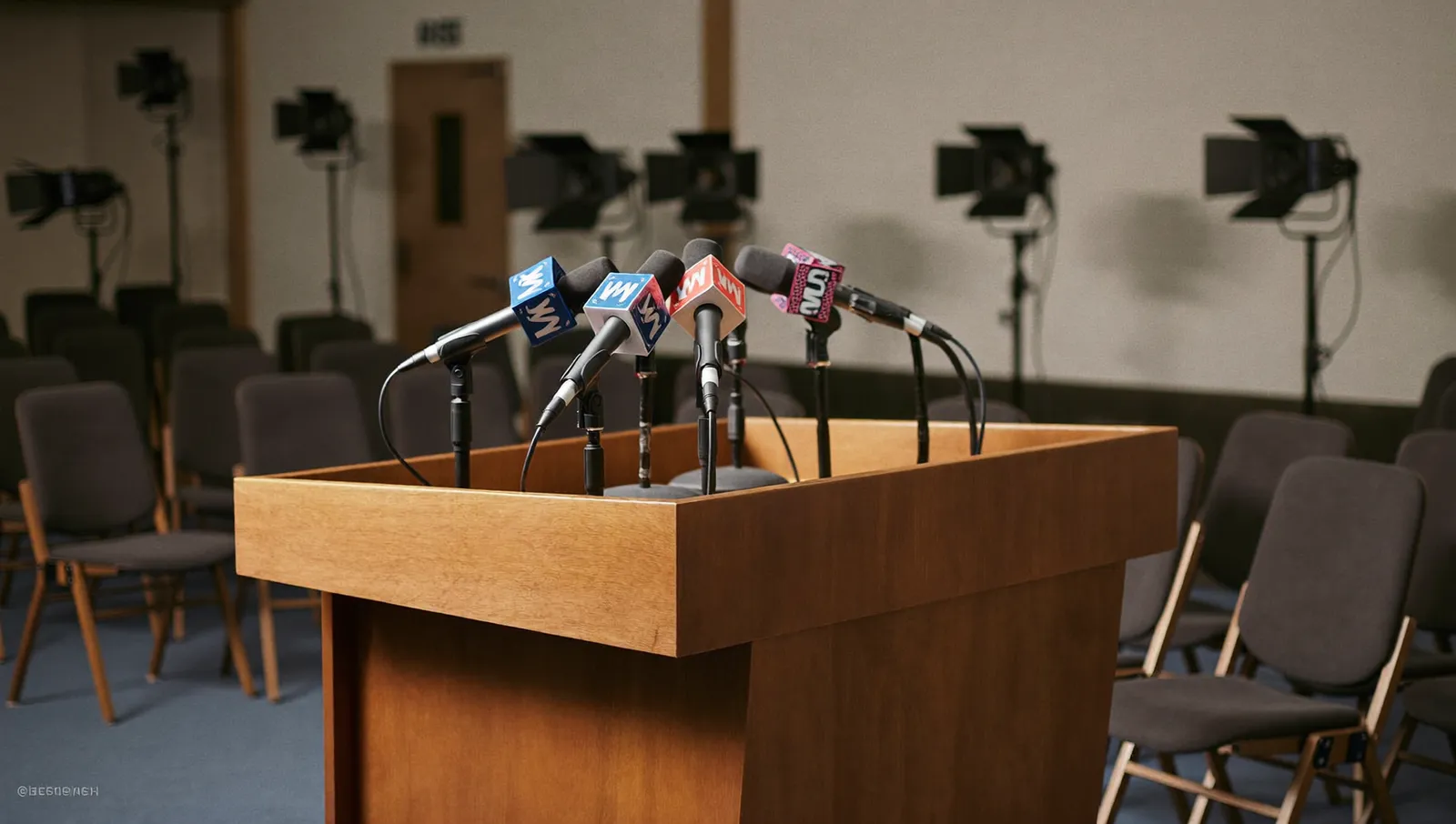
On 27 September 2010, Robert Hastings convened a press conference at the National Press Club in Washington at which six former US Air Force officers and one former enlisted man described UFO activity at nuclear weapons sites during the Cold War. Salas was among them. CNN carried it live. Hastings has said his work draws on interviews with more than 120 former or retired military personnel across multiple bases and decades.
Quantity of testimony is not quality of evidence, and a press conference is not a hearing. But the pattern claim — that unexplained objects have repeatedly appeared over nuclear weapons infrastructure — is not confined to believers any more. It is the same pattern that produces, in the present day, security incidents at defence installations that nobody has authority to investigate properly, which is the gap Congress has been circling for years. Malmstrom is the case that made that a question worth asking.
The UAP Times take
Malmstrom earns a Credible rating, four out of five on our scale, and we would ask you to read that rating narrowly. It reflects the calibre of the witnesses and the reality of the underlying event, not an endorsement of the causal claim.
Its strength is that a documented, high-consequence malfunction genuinely occurred: Echo Flight is a matter of record, investigated by Boeing and the Air Force, and its cause was never fully traced beyond a noise pulse of unidentified origin. Its weakness is the join. The Echo Flight paperwork exists and says nothing about a UFO; the Oscar Flight account says a great deal about one and has no paperwork at all. Those two facts are the whole case, and no amount of retelling reconciles them.
Our reading is that Malmstrom is one of the most consequential cases in the field precisely because of what it touches, and one of the most over-claimed because of the same thing. Strip it to the defensible core and you still have something worth an official answer: credible, security-cleared officers reporting unexplained objects over nuclear missile facilities in a month when a flight of those missiles came off alert for reasons the Air Force took four months to name. Whether anything in the sky caused the shutdown is not established and, on the surviving documents, probably cannot be.
What the case really indicts is the record-keeping. Fifty-nine years on, the argument still turns on which filing cabinet a piece of paper did or did not go into — and that, rather than folklore, is the honest argument for disclosure.
Further reading: for another case where trained military witnesses met an unexplained object, see The Tehran Dogfight, where jets’ weapons systems failed near the craft. The objects-over-nuclear-sites pattern runs back further than Malmstrom — to the green fireballs over Los Alamos in 1949, whose conference transcript was declassified this month — and forward to the 2015 lockdown at the Pantex warhead plant, where security officers chased an object they could not identify. For the unresolved question of who is actually responsible for investigating incursions over defence sites, see the authority gap. Malmstrom’s object was reported as a glowing sphere / orb; it’s on the sightings map.
Source: Testimony of Robert Salas and other missile officers; Air Force records; researcher Robert Hastings' interviews
Follow the file
Every new dispatch from the UAP desk, in your inbox. Sourced, sceptical, and no more than one email a week.