
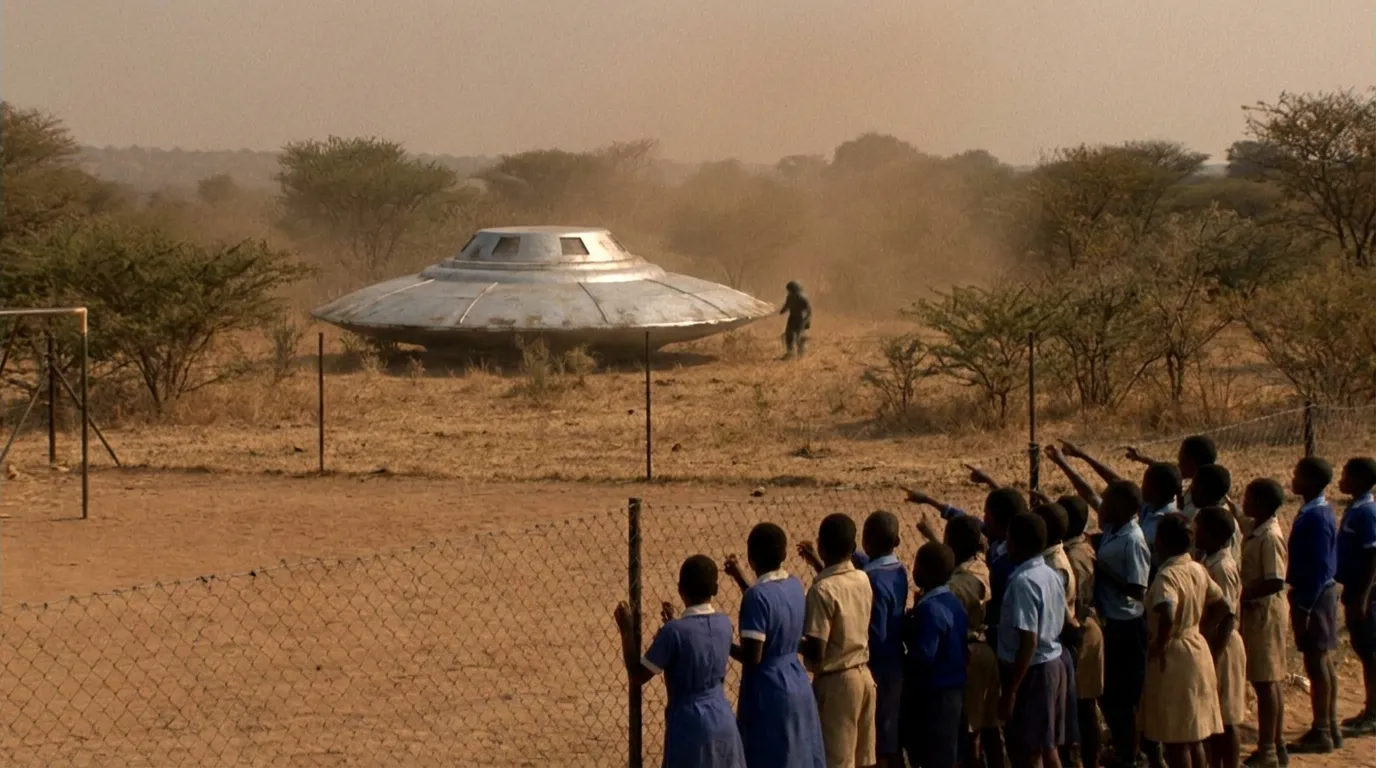
The Ariel School case is the one that unsettles even hardened sceptics, and it is worth being clear about why. It is not backed by radar or metal or a photograph. Its entire weight rests on the testimony of children — normally the shakiest foundation there is. And yet the sheer number of them, the consistency of what they independently drew and described, and the calibre of the investigators who questioned them combine into something that is genuinely hard to put down. Whatever happened at Ariel School, the case for something having happened is stronger than its slender physical evidence suggests.
Morning break at Ariel School
On the morning of 16 September 1994, at the Ariel School near Ruwa, on the outskirts of Harare in Zimbabwe, children were outside for their morning break while teachers were in a staff meeting. A number of the pupils — the figure usually given is sixty-two, aged roughly six to twelve, though some accounts run higher — reported seeing one or more objects in the sky, and then a craft that came down near the edge of the school grounds, by a scrubby, rocky area beyond the playground.
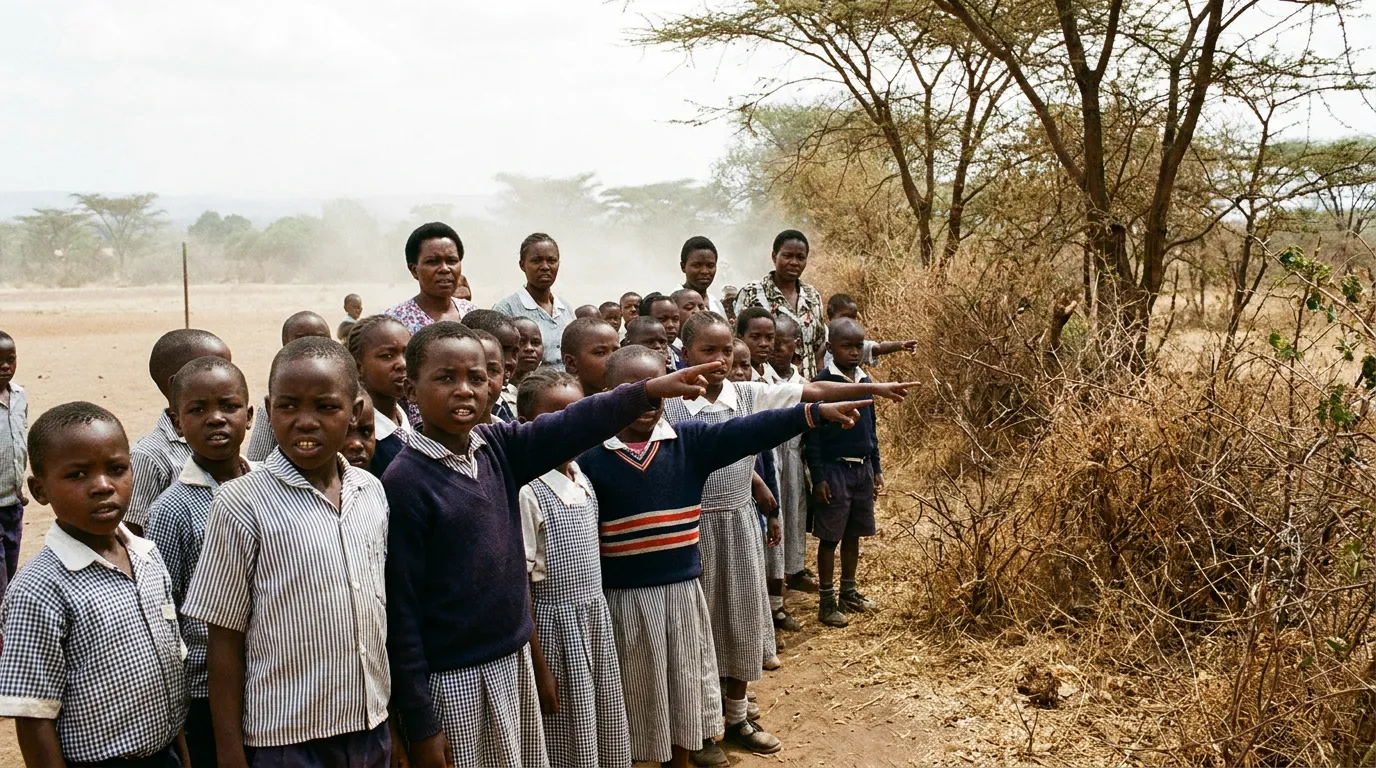
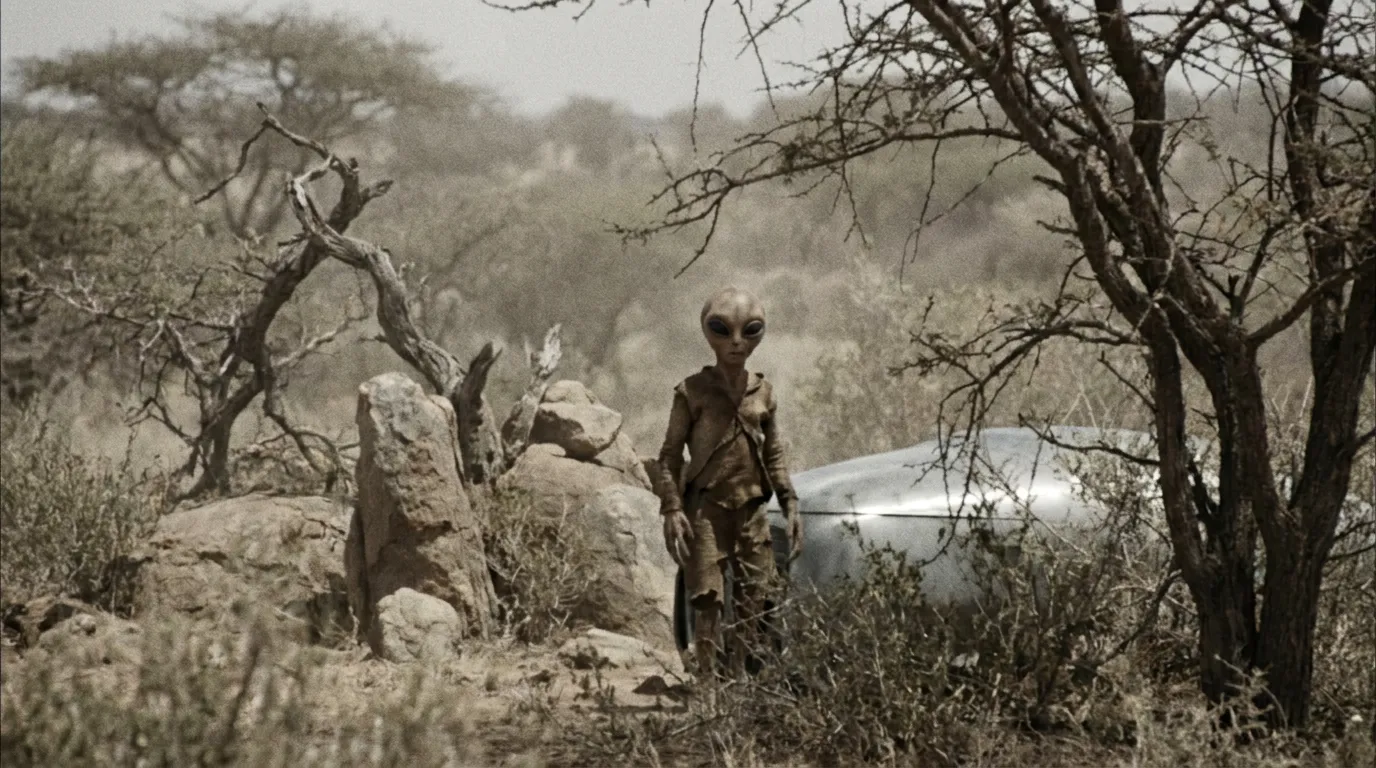
The children who went closer, or who saw most clearly, described a figure near the craft: small, with a large head and enormous dark eyes, dressed in a tight dark suit. Some described it moving in an odd way; several said, strikingly, that they felt it communicated something to them — a wordless sense of a message, often remembered as a warning about harm to the Earth.
The adults were absent for the whole of it. That is a genuine evidential problem and also the reason the case exists at all: no teacher saw anything, so there is no adult account to anchor or contradict the children’s, and the first questions any of them were asked came from grown-ups who already knew what the children were claiming.
The sky was already full
Context matters here more than in almost any other case on the file, and it is routinely left out. In the nights immediately before 16 September, people across Zimbabwe, Zambia, Botswana and South Africa watched a brilliant, slow-moving light track silently across the sky, breaking into fragments as it went. It was seen by an enormous number of people. Zimbabwe’s national broadcaster, ZBC, invited listeners to phone in and describe it, and they did, in volume.
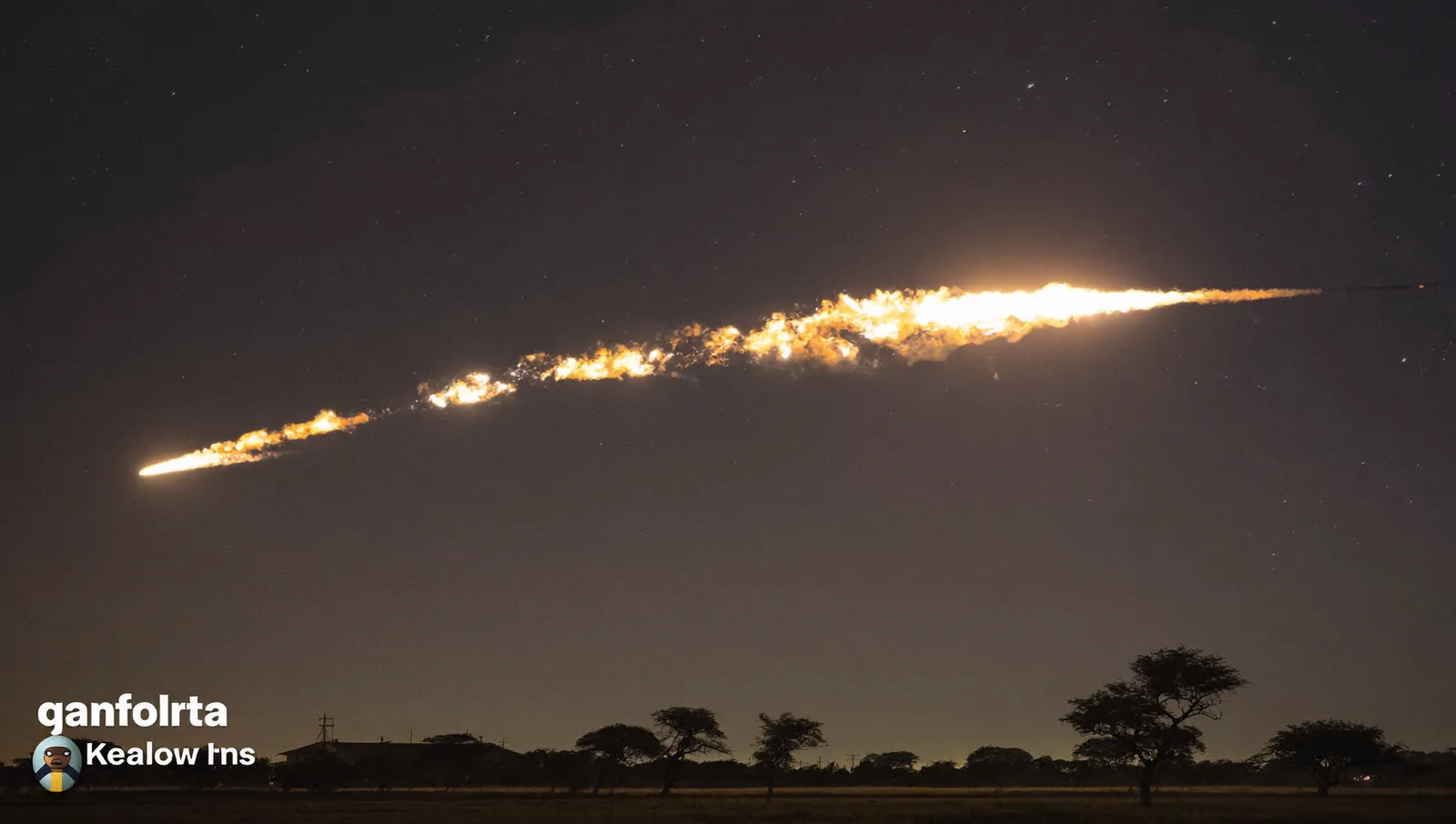
It was not a spacecraft in the interesting sense. The sceptic Brian Dunning identifies it as the re-entry of a Zenit-2 booster from the Cosmos 2290 satellite launch — a large piece of Soviet-designed hardware burning up and shedding pieces over several minutes, which is exactly what a slow, silent, fragmenting fireball looks like.
So the children at Ariel School were not a blank slate. They went out to break in a country that had spent two days talking about lights in the sky, in a media environment actively soliciting UFO stories. That does not explain what they reported. It does explain why the region was primed to hear it, and why researchers arrived within days rather than months.
The being by the craft
The telepathic element is the sort of thing that ought to trip every sceptical alarm, and it should be weighed carefully — not least because, as we will see, it is the part of the account that arrived latest. But the physical description — the proportions, the eyes, the suit — recurred across many separate children who, in the immediate aftermath, had limited opportunity to coordinate a single polished story.
The event caused an immediate stir. The headmaster, initially sceptical, found the children genuinely shaken and consistent. Parents were called. Some children were frightened enough that they did not want to go back out to the field. Within days the story had reached ZBC radio, and from there two investigators who would define everything that followed.
The investigators, and the drawings
The first outsider to record the accounts was Tim Leach, then the BBC’s correspondent in Zimbabwe, who interviewed children on 19 September — three days after the event. The Zimbabwean UFO researcher Cynthia Hind, the most experienced investigator on the continent, followed on 20 September, questioned the pupils and asked them to draw what they had seen. Hind’s argument for taking them seriously was straightforward: these were rural Zimbabwean children in 1994, with limited exposure to the imagery of Western alien films.
The figure who made Ariel School internationally known arrived later. Dr John Mack, a Pulitzer Prize-winning professor of psychiatry at Harvard who had become deeply — and controversially — interested in accounts of alien encounters, travelled to Zimbabwe around two months after the event and spent two days at the school, interviewing children and staff on film.
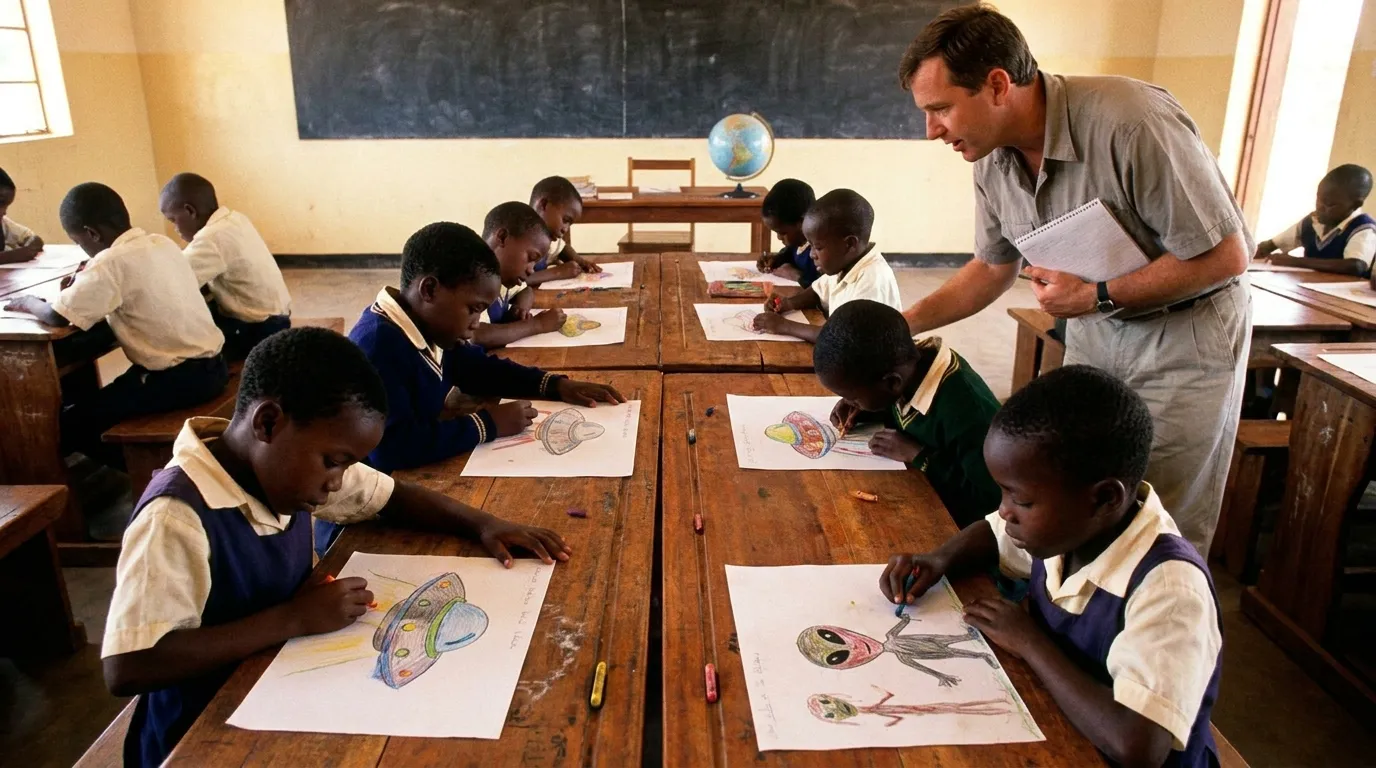
The drawings are the case’s quiet centre of gravity: dozens of children, rendering in crayon the same domed craft and the same wide-eyed figure. They were collected early, by Hind, before Mack was ever involved — which is the single strongest fact in the case’s favour and the one defenders are right to keep pointing at.
What Mack added, and what it cost
Mack’s footage is what most people have actually seen of Ariel School, and it is genuinely affecting: small children, on camera, describing something they clearly believe, some of them close to tears. It is also the source of the case’s most serious methodological problem.
The criticism is specific. The environmental message — the sense that the being had warned them about what humans were doing to the planet — appears clearly in Mack’s interviews two months on, and not in the earliest group sessions Hind conducted three and four days after the event. Critics argue that Mack asked leading questions, and that the material he elicited happened to align neatly with his own long-standing convictions about the meaning of contact experiences. Sympathetic reviewers of the same tapes say his questions were largely open and that he let the children set the terms.
Both readings can be watched by anyone. What is not really in dispute is the sequencing: the ecological warning is a late addition to a story whose core was recorded early. That is precisely the pattern you would expect if adult interest were shaping the account — and it is also, inconveniently, what you would expect if frightened eight-year-olds only volunteered the strangest part of their experience once someone patient and unhurried finally asked.
The sceptic’s case, at its strongest
Take the sceptical argument in its best form and it is not “children lie.” It is that children are unusually good at converging on a shared account without anyone intending deception.
The mechanism is well documented in the psychological literature on eyewitness memory: a vivid initial claim from one or two confident children, repeated across a playground in minutes; adults arriving with questions that carry their own assumptions; group interviews in which each child hears the others’ answers before giving their own; and a regional news environment already saturated with UFO talk after the Cosmos re-entry. Each step is small. Together they can manufacture a consistent, sincerely held collective memory in days.
The big-headed, black-eyed figure is also the single most reproduced non-human image of the twentieth century — a form that had been circulating through film, television and paperback covers for decades before 1994, and that traces its cultural lineage back through the whole post-Roswell imaginarium. Hind’s “these children had no exposure” defence is weaker than it sounds. Ruwa is a satellite town of a capital city, not a remote homestead.
There is also a direct challenge. In the 2023 Netflix series Encounters, a man who had been a pupil at the school, identified as Dallyn, said on camera that he had made the whole thing up. The claim is not independently verified, and one adult’s retrospective account carries no more automatic weight than another’s. But a case whose defence is “none of them ever recanted” has to reckon with the fact that one of them now says he did.
Thirty years on
The case has been kept alive largely by the witnesses themselves. Randall Nickerson’s documentary Ariel Phenomenon, released in 2022 after many years in production, tracks down former pupils — among them Emily Trim, Salma Siddick and Lisil Field — and sets their filmed testimony as children against their accounts as adults. Several have spoken publicly and repeatedly, at some personal cost, and none of them reads as someone enjoying the attention.
Be careful about what that consistency proves. “They still tell the same story thirty years later” measures the stability of a memory, not its accuracy. Deeply held false memories are famously durable, and a memory that has been recounted on camera, in documentaries and to journalists for three decades has been rehearsed into permanence whether or not it was ever true. Longevity is evidence of sincerity. It is not evidence of aliens.
What it does foreclose is the simplest dismissal. This was not a passing prank that a few children found funny; the people who were there have carried it, in some cases unhappily, for most of their lives.
The UAP Times take
Ariel School earns an Unconfirmed rating — three out of five on our scale. Its strengths are unusual and real: a large number of witnesses, close-range and in daylight, whose accounts and drawings converged remarkably, with the crucial drawings collected by Cynthia Hind within four days and independently of John Mack.
Its weaknesses are equally real, and they compound. The witnesses were children. There is no physical trace, no photograph, no adult corroboration. The region had just spent two nights watching a rocket booster burn up. The most quoted element of the story — the telepathic warning — surfaces two months late, in interviews conducted by a man who believed in it before he arrived. And one former pupil now says the whole thing was invented.
Something happened at that school. Almost everything about what it was has been shaped by adults since.
Our reading is that Ariel School cannot be proven and cannot be honestly dismissed, and that anyone confident in either direction is not looking hard enough. The filmed testimony is too coherent and too emotionally genuine to wave off as a simple prank; the chain of custody on the story is too compromised to build anything on. What keeps the case alive, decades on, is the drawings and the faces — and what keeps it unresolved is that nobody thought to interview sixty-two children separately, on the day, before the grown-ups arrived with theories.
Further reading: for another beloved but evidence-thin encounter, see The Varginha Case. For the mass daylight sighting with adult witnesses, see Westall 1966. For the origin of the imagery the children were accused of borrowing, see Roswell. For the 1961 case that wrote the abduction narrative these children inherited, see Betty and Barney Hill. For a case that turns on adult testimony and a contested polygraph rather than children’s drawings, see Travis Walton, 1975. Ariel School is on the sightings map.
Source: Investigations by Cynthia Hind and Dr John Mack (Harvard); filmed interviews with the children
Follow the file
Every new dispatch from the UAP desk, in your inbox. Sourced, sceptical, and no more than one email a week.