
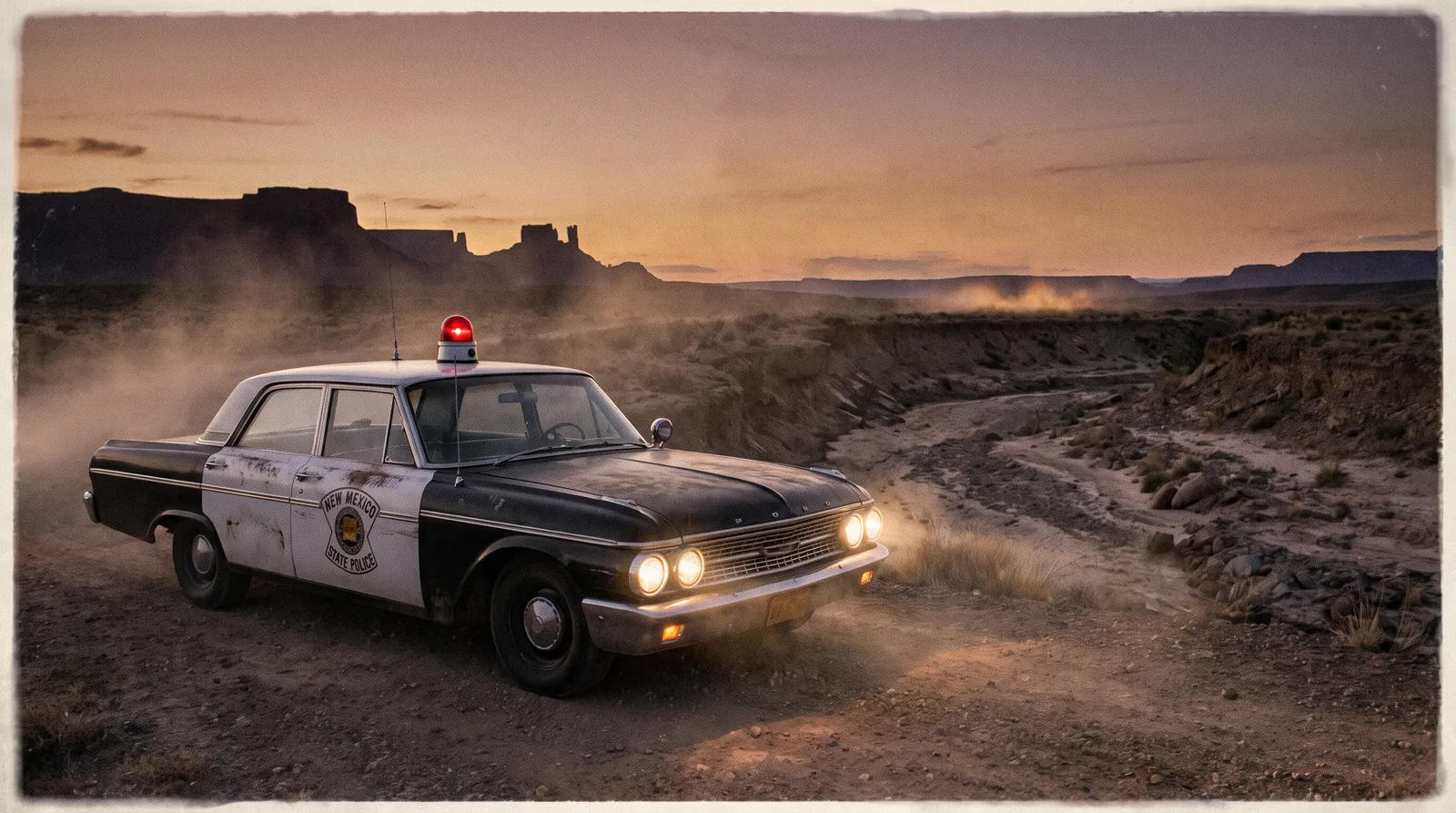
Most UFO cases fall apart the moment you ask who, specifically, is vouching for them. Socorro is the case that doesn’t, quite. The witness was an on-duty police officer chasing a speeding car. What he reported instead was so strange, and so quickly backed by physical marks in the dirt, that the United States Air Force’s own UFO-debunking project spent months on it and still closed the file marked “unidentified.” Sixty-two years later, nobody has closed it any harder than that.
A speeding car and an explosion that wasn’t
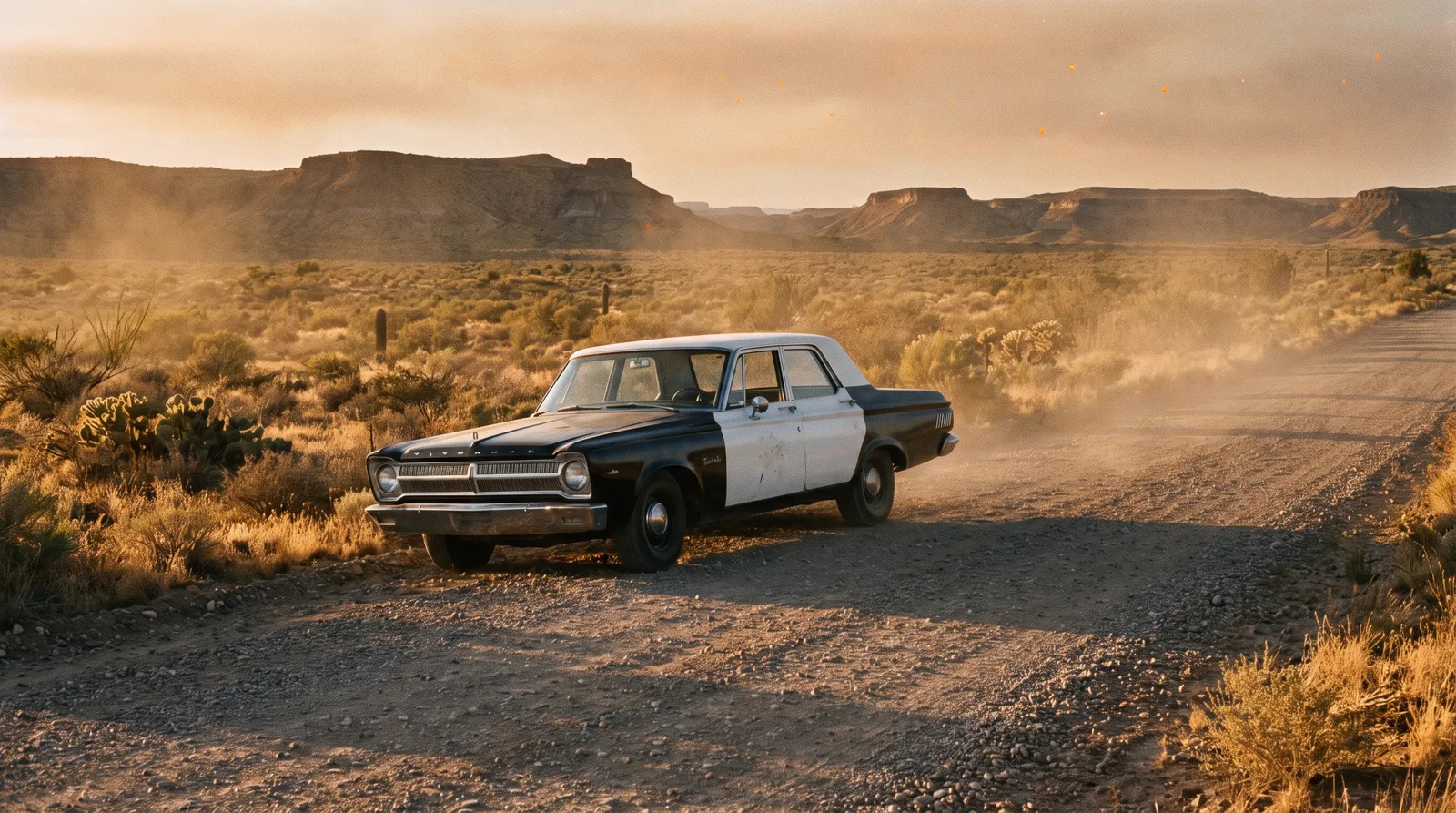
At around 5:45pm on Friday 24 April 1964, Socorro police sergeant Lonnie Zamora was chasing a black Chevrolet doing well over the speed limit south out of town, in the high desert of central New Mexico. He heard a roar and saw a flame in the sky to the southwest, in the direction of a dynamite shack used by a local company. Reasoning it might be the shack going up, and knowing a colleague was in that area, he broke off the chase and drove towards it.
His car struggled on the loose gravel of the access road — three attempts to get up a hill, by his own account — which is a small detail worth keeping in mind, because it is the kind of unglamorous friction a fabricated story rarely bothers to include.
What Zamora says he saw
Cresting the rise, Zamora reported a shiny, aluminium-white object in a gully below him, oval or egg-shaped, standing roughly on end, with no windows or doors he could make out and a red insignia or symbol on its side. Beside it stood two small figures in what looked like white coveralls; one of them, he said, appeared to react to his arrival.
He radioed Socorro’s dispatcher, Nep Lopez, to say he was checking on a car in the arroyo, then called back and asked Lopez to look outside for anything unusual, describing what he could see as looking “like a balloon.” Getting out of his patrol car, he heard a loud roar and saw a blue-and-orange flame beneath the object as it began to rise. He ran, knocking his glasses off against his car, believing the thing was about to explode.
It didn’t. It climbed, levelled off, and departed low over the desert to the southwest — silently, once the initial roar had stopped, and without the sonic boom a jet would have left behind.
The marks that were still warm
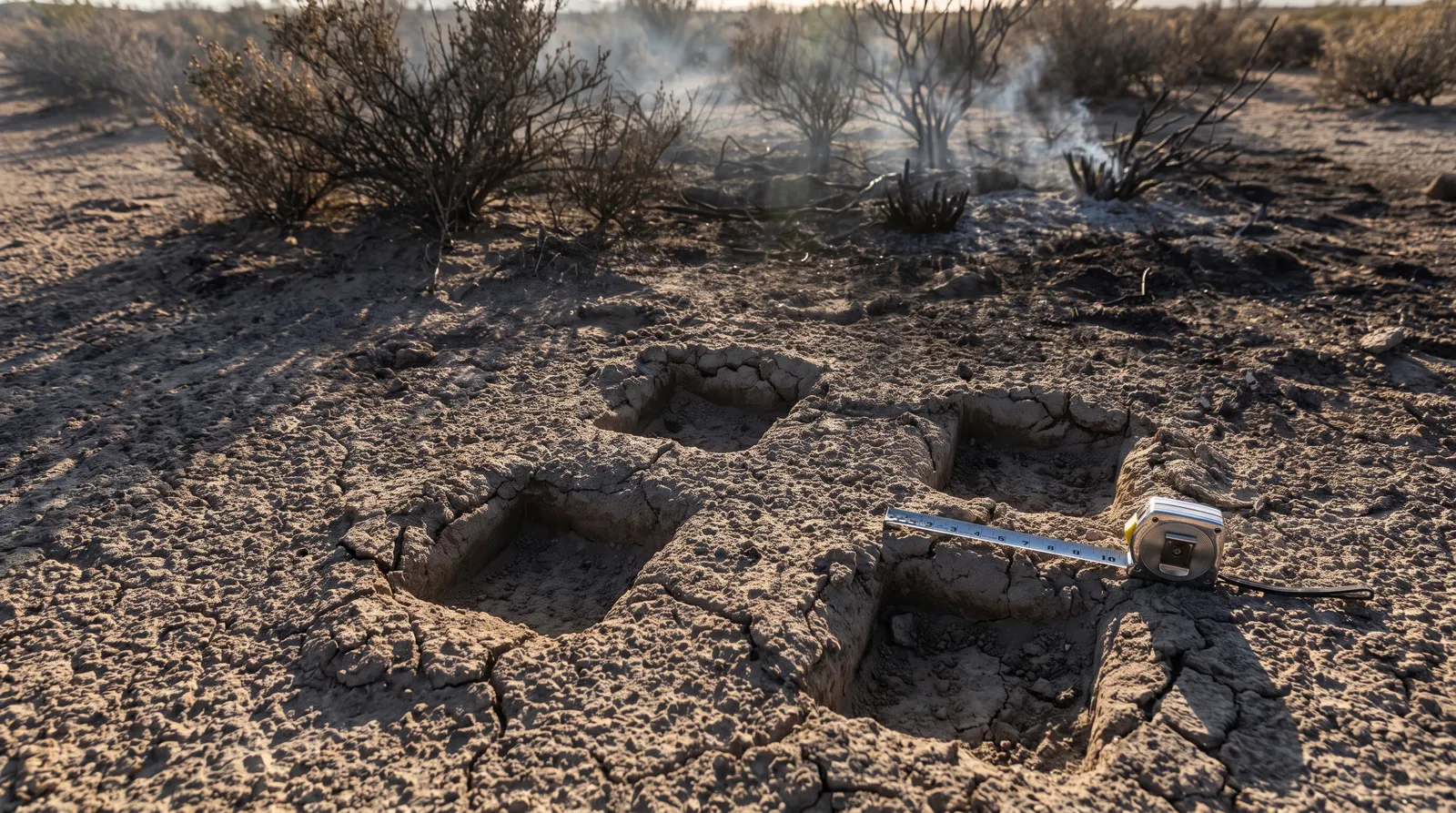
New Mexico State Police sergeant Sam Chavez reached the site within minutes of Zamora’s call. He found Zamora shaken, and found something else: patches of greasewood brush still smouldering, and four rectangular impressions pressed into the sandy soil, each around ten centimetres by twenty and several centimetres deep, arranged in a pattern whose diagonals crossed at a right angle.
That timing matters more than almost anything else in the file. This was not a landing site examined days or weeks later by investigators working from a witness’s memory, the way most “trace” cases go. Chavez, and the other officers who converged on the gully soon after, saw the ground itself corroborating Zamora’s story while it was still hot.
Word reached Project Blue Book, the Air Force’s public UFO-investigation office, fast. So did the FBI — an agent based in Albuquerque, Arthur Byrnes, happened to be in the Socorro police station on unrelated business when Zamora radioed in, and ended up at the site that same evening. The bureau’s file on the case, since declassified, records the marks, the burned brush and the bureau’s own inability to offer an explanation.
Hynek changes his mind
J. Allen Hynek, the Ohio astronomer who served as Blue Book’s scientific consultant, flew out within days. He had spent a decade as the programme’s most reliable source of mundane explanations — Venus, weather balloons, temperature inversions — and his colleagues expected more of the same.
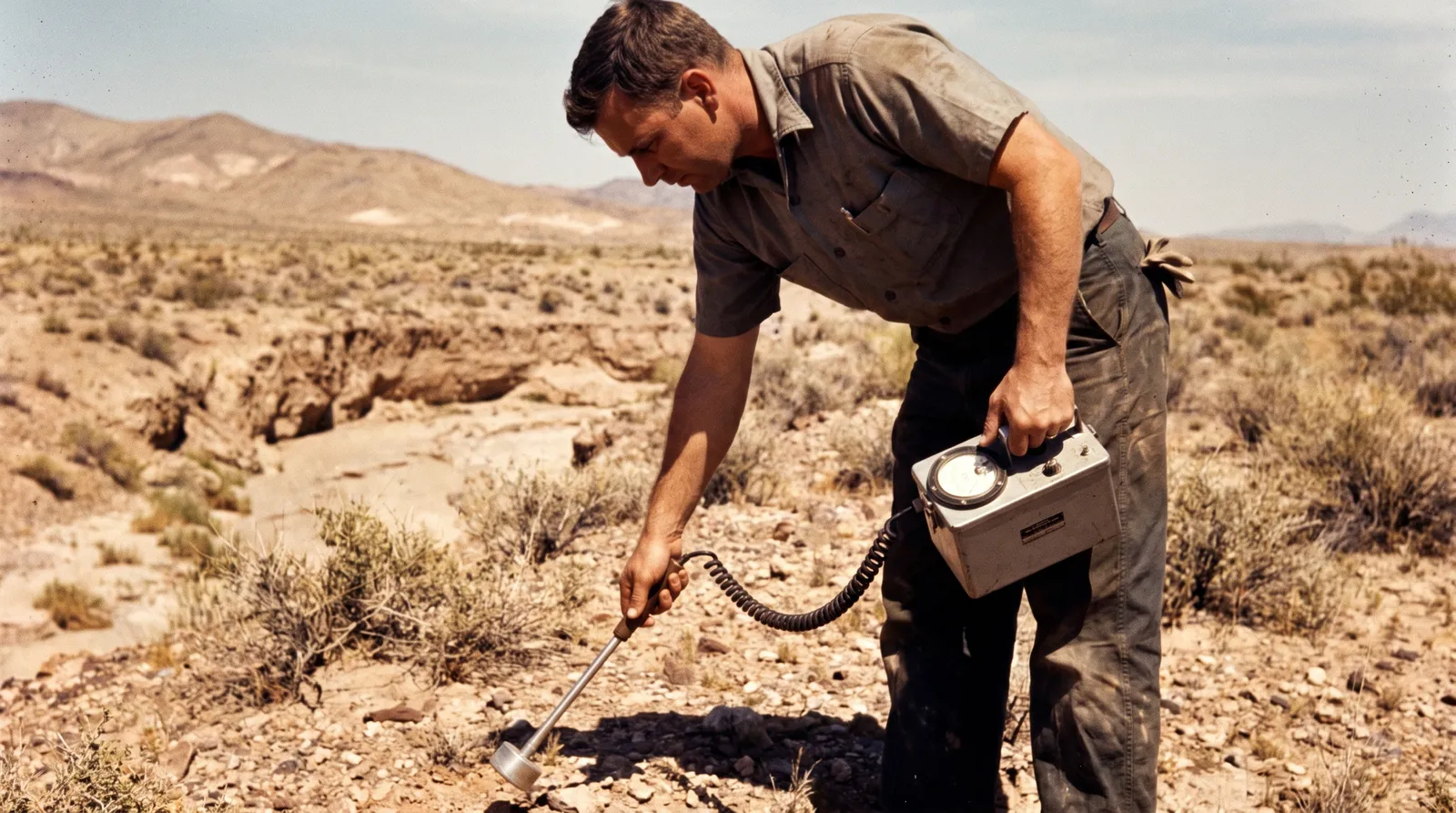
Instead, Hynek came back convinced there was nothing to debunk. He interviewed Zamora at length, judged him a stable, credible witness with nothing to gain from the story, and walked the ground himself. Writing privately to the Harvard astronomer Donald Menzel — his era’s most committed UFO sceptic — that autumn, Hynek called Socorro a case that might prove to be a “Rosetta stone,” and said he had never encountered so strong an account from so unimpeachable a witness. He later described it in print as one of the classic cases in the whole UFO literature, and returned to Socorro that August with a magnetometer and Geiger counter for a fuller physical survey.
Blue Book’s own chief at the time, Hector Quintanilla, went further in an unguarded moment: briefing a CIA audience some years afterwards, he called Socorro the most puzzling case he personally investigated in his years running the programme. Blue Book’s official file lists it as “unidentified” — one of a small handful of cases the project never managed to close with an ordinary explanation.
What the Condon Report did with it
When the Air Force wound down Blue Book in 1969, it did so on the strength of an independent review it had commissioned from the University of Colorado, published as the Condon Report. That report’s stated purpose was to show the scientific community there was nothing left to investigate — and, notoriously, its own summary recommended winding UFO research down even though a substantial share of its own case studies came back unexplained.
Socorro was one of them. The Colorado team’s field investigator, physicist Roy Craig, visited Socorro, interviewed Zamora and the other witnesses, and came away — by his own later account — persuaded the case was not a hoax, even as the report’s overall conclusions steered public and institutional attention away from the subject entirely. A case a Blue Book scientific consultant called his career’s most credible sighting sat, unresolved, inside the very document used to justify shutting the whole inquiry down.
The hoax theories, and why they don’t quite land
Two separate sceptical theories have circulated for sixty years, and it’s worth keeping them apart, because they’re not the same claim.
The first, argued at length by the aviation writer Philip J. Klass in his 1968 book UFOs Explained, was civic: that Socorro’s business community, keen to put the town on the map, had a hand in staging the sighting. Klass also queried the physics of the landing-gear marks, arguing their asymmetric spacing was a poor fit for any real vehicle’s undercarriage. It’s a theory built on motive rather than evidence, and no participant, town official or investigator ever produced anything to support it.
The second is more specific and more troubling for believers. In a 1968 letter to the Nobel laureate Linus Pauling, who had written in asking about the case, the president of the New Mexico Institute of Mining and Technology — the technical college a few miles from the sighting site — wrote that he had “a good indication of the student who engineered the hoax,” adding only that the student in question had since left. Other figures in the college’s small community dropped similar hints over the years. Nobody has ever named a suspect publicly, produced a device, or explained how a college prank could reproduce a blue-orange flame, a retreating roar with no sonic boom, and consistent burn patterns across genuinely dispersed brush. A letter asserting private knowledge of a hoaxer is a serious claim; it is not the same thing as a demonstrated hoax.
Set against both theories: teenagers’ footprints were indeed found near the site by investigators in the days afterwards — Socorro is a small town, and a landing site a few hundred yards off a highway drew a crowd fast — but proximity of footprints left after the fact is not evidence anyone was there beforehand. Some later analysts have also floated a discarded weather balloon or an experimental lunar-lander test flown out of nearby White Sands Missile Range as prosaic candidates; neither has ever been matched to a documented flight or launch on the day in question.
What actually corroborates what
Strip the case back to what different people directly observed, rather than what any one of them concluded, and the structure is this: Zamora alone saw the object and the two figures. Chavez and the officers who followed him saw the marks and the smouldering brush minutes later, while they were still fresh — corroboration of the aftermath, not of the sighting itself. The FBI, Blue Book and the Condon investigators all examined the same physical evidence independently and none of them produced an innocent explanation that fit it.
That is a genuinely unusual evidential shape. It is not a multi-witness case in the way the Tehran dogfight is, where several separate crews and a ground radar operator all reported the same object converging from different vantage points. It is closer in structure to Falcon Lake or Trans-en-Provence — a single primary witness, with the strength of the case resting almost entirely on how fast, and how seriously, the physical traces were examined afterwards. Socorro’s traces were examined faster than almost any other case on record: minutes, not weeks.
The UAP Times take
Socorro earns an Unconfirmed rating, three out of five on our scale. The pull towards a higher mark is real: a trained, on-duty observer with no history of fabrication; ground evidence documented by a second officer while it was still smoking; and a chief investigator — Blue Book’s own sceptic-in-residence — who went in expecting to debunk it and came out calling it the most credible case he’d ever handled. What holds it at three rather than four is the same thing that holds every single-primary-witness case there: everything traces back to one man’s ten minutes in a gully, and a university president’s letter asserting private knowledge of a named hoaxer, however unproven, is not nothing.
Blue Book’s own chief called it the most puzzling case of his career. The file still says unidentified.
Our reading is that Socorro is genuinely one of the best-investigated close encounters in the American record, not because it proves anything about the object’s nature, but because of how quickly and how officially the physical evidence got locked in. Sixty years of trying have not produced a documented flight, a named prankster, a matched weather balloon or a workable account of how a student hoax could fake a retreating flame with no sonic boom. Nor have sixty years produced a craft. Both of those are still true at once, and that tension is the whole case.
Further reading: for the American benchmark case with multiple independent sensors and crews, see the Tehran dogfight. For another single-witness physical-trace landing given the full forensic treatment, see Falcon Lake and Trans-en-Provence. Zamora’s object was a classic egg / ovoid. For the same era’s other landmark case — testimony recovered under hypnosis rather than an officer’s own eyes — see Betty and Barney Hill.
Follow the file
Every new dispatch from the UAP desk, in your inbox. Sourced, sceptical, and no more than one email a week.