

A man goes missing from a forest for five days. Six of his co-workers swear, that same night, that a flying object took him. He turns up alive at a payphone, tells a story about an operating table and small bald beings, and then submits to seven separate polygraph tests over the following eighteen years — which return three different verdicts. Fifty years on, Travis Walton has never once changed his story, and nobody has ever proven he’s lying. Nobody has ever proven he isn’t, either.
Turkey Springs, 5 November 1975
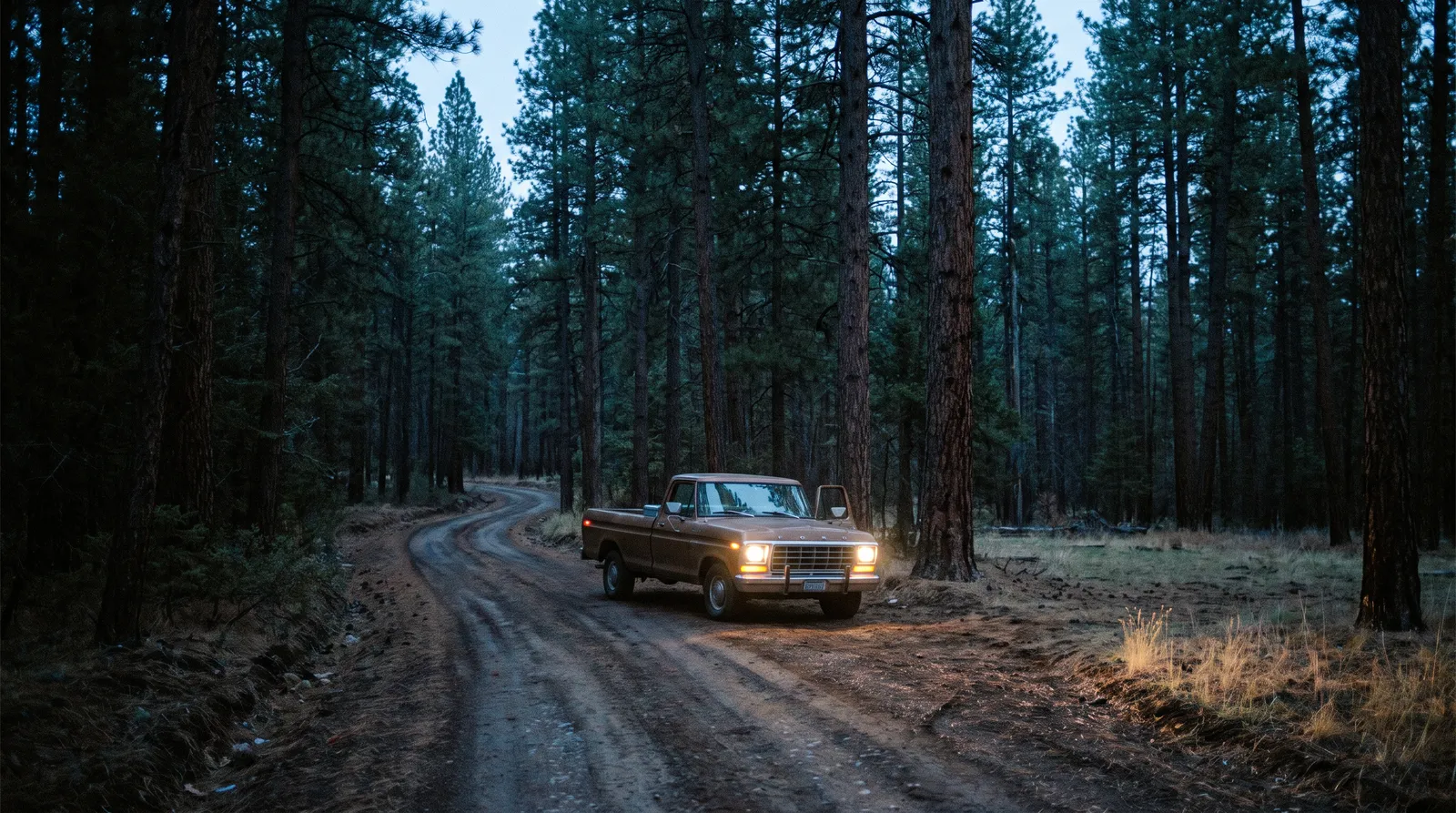
Just after 6pm on Wednesday 5 November 1975, a seven-man Forest Service thinning crew was driving out of the Apache-Sitgreaves National Forest near Turkey Springs, north-east of Heber, Arizona, in a pickup truck belonging to crew chief Mike Rogers. With Rogers and 22-year-old Travis Walton that evening were Ken Peterson, John Goulette, Steve Pierce, Allen Dalis and Dwayne Smith.
As the truck rounded a bend, the crew say they saw a glowing, disc-shaped object hovering above a clearing off the logging road. Rogers stopped the truck. Against the others’ shouted warnings, Walton got out and walked toward it. What every one of the six other men agreed on, that same night and ever since, is that a beam of blue-white light shot from the object and struck Walton, throwing him backward. Rogers panicked and drove off; when the crew composed themselves and returned minutes later, Walton and the object were both gone.
A five-day search, and a community that suspected murder
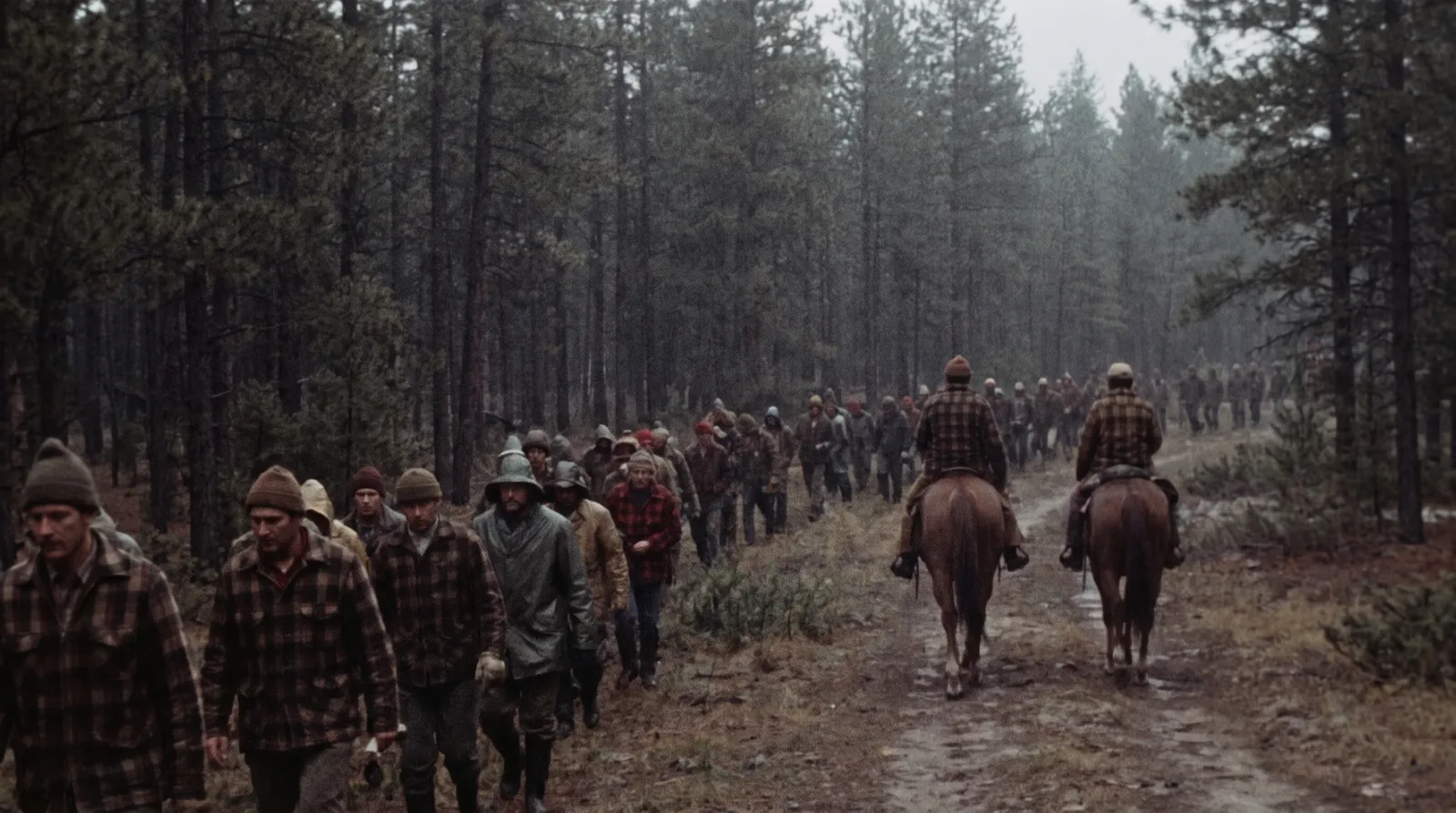
The crew drove straight to the Navajo County Sheriff’s Office in Holbrook. Deputies took statements that night, and Sheriff Marlin Gillespie organised search parties — sheriff’s deputies, Forest Service staff, family and volunteers on foot, on horseback and eventually by helicopter — that combed the Turkey Springs area for five days without finding so much as a footprint.
The absence of a body cut both ways in the small logging towns around Snowflake and Heber. Some residents assumed a UFO story was cover for a workplace accident or worse, and Rogers and the crew were subjected to informal, and at times openly hostile, suspicion of having killed Walton. That suspicion is the reason the case has a polygraph record at all: on 10 November, examiner Cy Gilson — an operator regularly used by Arizona law enforcement — tested the six remaining crew members on whether they had harmed or concealed Walton and whether they had genuinely seen an unusual aerial object. Five were judged truthful; the sixth, Allen Dalis, came back inconclusive, which Gilson attributed to poor cooperation with the test rather than deception.
The return: a payphone call before dawn
In the early hours of 11 November, Walton called his sister’s home from a payphone outside a filling station in Heber. Family who drove out found him at the phone box, disoriented, dehydrated and roughly ten pounds lighter than when he’d vanished, with several days’ stubble that — oddly, given his usual growth rate — looked more like one or two days’. A local physician, Dr Howard Kandell, examined him at home rather than admit him to hospital, and found him shaken and underweight but without obvious injury.
Walton’s own account was that his last clear memory before the payphone was waking on a highway near where he’d been struck, watching a light rise away into the night sky. Between the beam hitting him and that moment, by his own telling, lay five days he could not account for.
What Walton says happened aboard
Coral Lorenzen of the Aerial Phenomena Research Organization (APRO) was contacted within days and arranged for Walton to be examined further and, at APRO’s urging, for the family to work with the National Enquirer, which paid expenses in exchange for exclusive rights to the story. APRO’s director of research, Dr James Harder — a Berkeley engineering professor who had investigated UFO cases for over a decade — hypnotised Walton in an attempt to recover more of the missing time.
Under hypnosis, Walton described waking on a table in a small, brightly lit room, surrounded by three short beings — around five feet tall, hairless, with oversized domed heads and large, dark, unblinking eyes — that he said he fought off in a panic. He then described wandering the craft alone until a taller, entirely human-looking man in a blue flight suit led him through it, followed by two more human-presenting figures who walked him to a chair, fitted a clear mask over his face, and put him under. His next memory was the highway. Harder reported that Walton’s hypnotic recall matched what he’d already said consciously, almost word for word — but that hypnosis extended his accessible memory by only around two hours, not the missing five days. The 1993 Paramount film based on the case, Fire in the Sky, invented a far more graphic examination sequence that Walton has repeatedly said bears little resemblance to what he actually described — a distinction worth keeping in mind, since it’s the film, not the testimony, that most people now picture.
Seven polygraphs, three verdicts
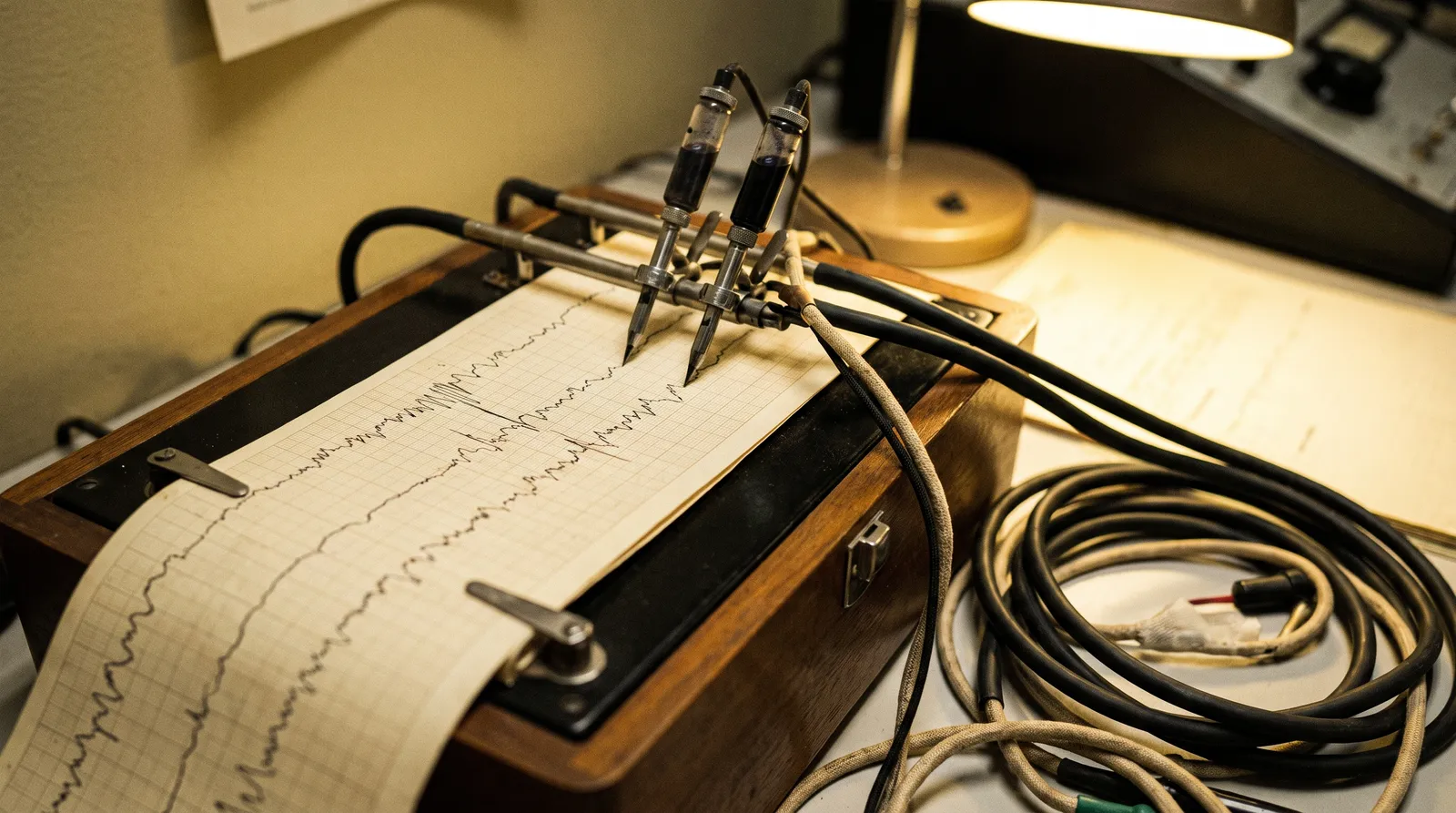
The polygraph record is where this case either falls apart or holds together, depending on which test you weight most. Nine days after Walton’s return, the Enquirer commissioned John J. McCarthy — described at the time as Arizona’s senior polygraph operator — to test Walton directly. McCarthy’s report concluded Walton was practising “gross deception.” The Enquirer did not publish it, and it stayed unpublished until 1976, when sceptical investigator Philip J. Klass obtained a copy. Days after McCarthy’s test, the Enquirer arranged a second examination, this one conducted by George J. Pfeifer, whose verdict was that Walton showed no deception. It was the Pfeifer result the paper publicised, and on its strength the Enquirer awarded Walton and the crew its $5,000 “Best UFO Case of the Year” prize for 1975 — the same prize money Klass would later cite as the case’s real motive.
In 1993, around the film’s release, Walton and two of his original crewmates sat for further polygraph examinations, arranged independently of the Enquirer, and again passed. Supporters count six passed examinations against one failed one across eighteen years; sceptics note that the single failure was also the earliest test, administered closest to the event, before anyone’s story had had years to settle into a rehearsed shape — and that polygraphy has never been reliable enough, in either direction, to settle a case like this on its own.
The deadline Philip Klass found
Klass’s scepticism didn’t stop at the McCarthy test. He built a specific, checkable financial-motive theory: Rogers’ Forest Service thinning contract carried a completion deadline of 10 November 1975, with a $2,500 penalty and disqualification from future federal bidding for missing it — a clause that exempted delays caused by an “Act of God.” Walton reappeared on the morning of the 11th, one day after that deadline passed. Klass argued the whole episode was staged to give a struggling contractor an unimpeachable excuse, and pointed to Walton’s prior conviction for cheque forgery and to brother Duane Walton’s already-established enthusiasm for UFO literature as evidence the family had both the motive and the interest to pull it off.
It’s a tidy theory, and the deadline coincidence is real and documented — Klass built comparably specific paper-trail cases against other claimants, and it’s usually the specificity that makes his arguments hold up better than most debunking. What it doesn’t explain cleanly is why six men would risk perjury and public ridicule to protect one contractor’s $2,500, or why Dalis — the one crew member whose test came back inconclusive rather than passing — was never treated by Klass as evidence the story was coordinated poorly rather than well.
The defenders’ case
Mike Rogers has never wavered from the account in fifty years, and neither has any other member of the crew, even as several drifted away from Walton and out of the public eye entirely. Filmmaker Jennifer Stein’s 2015 documentary, made explicitly to counter renewed debunking attempts, revisited surviving crew members and found the story unchanged. Walton, now in his seventies and still living near Snowflake, marked the incident’s fiftieth anniversary in 2025 telling Arizona public radio station KJZZ he was tired of having to keep defending a story he’d told the same way since 1975. Consistency over five decades is not proof of anything by itself — deeply held accounts, true or false, tend to stay consistent once rehearsed — but it is the strongest thing the case has going for it that a spreadsheet of polygraph scores can’t capture.
The UAP Times take
This case earns a Thin rating — two out of five on our scale. Seven men reported the same core event to a sheriff’s office the same night, which rules out the laziest dismissal; and the crew’s initial polygraphs, five passes against one inconclusive result, are a genuine piece of contemporaneous evidence most cases this age can’t produce. But there is no independent instrumentation anywhere in this file — no radar, no photograph, no second-hand physical trace — and the one detail Klass actually verified against outside records, the logging contract’s Act-of-God deadline landing the day before Walton reappeared, is a specific, documented motive that most contested cases don’t have. Layer on a paid tabloid deal, a suppressed failed polygraph, and an abduction narrative recovered under hypnosis — the same evidential category that undercuts Betty and Barney Hill’s star map — and the case rests on testimony that is admirably consistent but essentially unverifiable either way, much like the claims at the centre of the Bob Lazar file.
Seven men agree on what they saw. What any of them actually saw is exactly as unresolved now as it was in 1975.
The honest position is that Walton’s account has survived fifty years of hostile scrutiny without collapsing into contradiction, which is unusual for a hoax and unremarkable for a sincerely held false memory alike. Compare that to a case built on physical instrumentation, like a lone patrolman’s account backed by scorched ground and a government geiger-counter reading at Socorro in 1964, and the gap in evidential weight is stark. Testimony this consistent deserves to be recorded seriously. It does not, on its own, deserve to be believed.
Further reading: for the case that gave abduction testimony its hypnosis-recovered template, see Betty and Barney Hill. For a contemporaneous case anchored in physical trace evidence rather than recovered memory, see Socorro 1964.
Follow the file
Every new dispatch from the UAP desk, in your inbox. Sourced, sceptical, and no more than one email a week.