
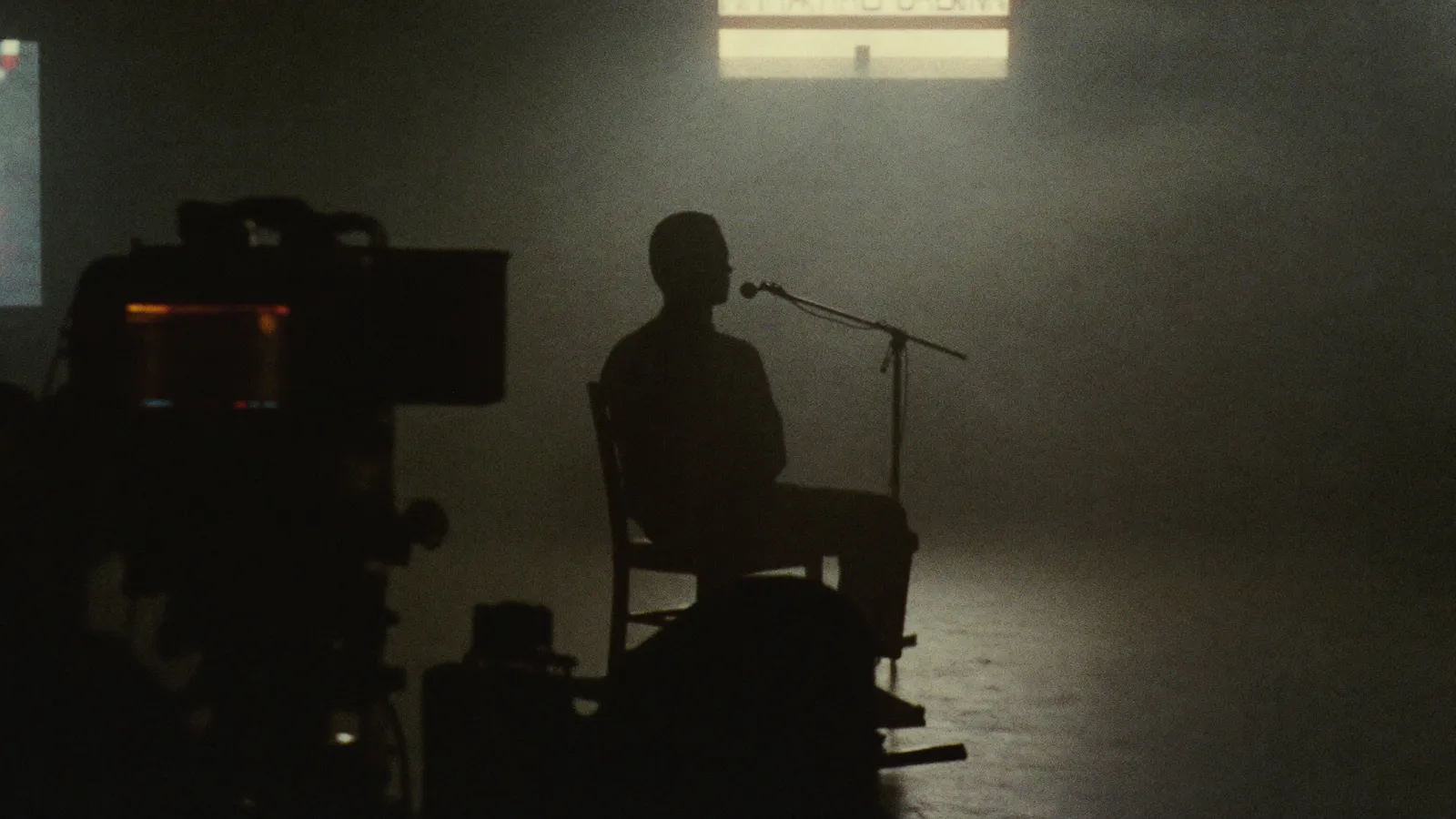
No single person did more to build the modern mythology of Area 51 than Bob Lazar, and no single person in this field is harder to pin down. This profile is about the man — where he came from, what happened to him, and why, thirty-seven years on, he is still here. For the forensic version — every claim he has made, tested against the record — see our full Bob Lazar evidence file, which reaches a verdict this page deliberately leaves to it. What follows is the life around the legend.
A bright kid from Coral Gables
Robert Scott Lazar was born in January 1959 in Coral Gables, Florida, and raised on Long Island — a technically-minded boy who built things, took them apart, and by his own account was happiest with a soldering iron. The verifiable thread of his education runs through Pierce Junior College in Los Angeles, where he took electronics courses; the elite degrees he would later claim, a master’s from MIT and another from Caltech, have never been found by anyone who went looking, and the nuclear physicist Stanton Friedman spent much of the 1990s establishing that they aren’t there. What is real is a capable, self-taught technician with a genuine flair for hardware.
That flair produced his first brush with the press. In June 1982 the Los Alamos Monitor put him on its front page over a jet-powered car he had bolted together — describing him, on his own say-so, as “a physicist at the Los Alamos Meson Physics Facility”. He really was around Los Alamos, listed in a 1982 phone directory; the directory also records him as a Kirk-Mayer contractor, which is a real job at a real laboratory and a fundamentally humbler one than the headline. The pattern of the whole Lazar story is already visible in that first clipping: the location checks out, the title does not.
1989: the man in the shadows
Lazar became Lazar in the spring of 1989. Station KLAS-TV in Las Vegas aired an interview, conducted by the investigative journalist George Knapp, with a man in silhouette calling himself “Dennis”. The silhouette said the US government held flying saucers, and that he had been hired to help work out how one of them flew. By November he had dropped the disguise and told the story under his own name and face.
It made two things at once. It made Area 51 — until then an obscure patch of restricted Nevada desert — into the most famous secret base on Earth. And it made Lazar’s entire account depend on Lazar, because he arrived with no documents, no photographs and no colleagues, only the story. Knapp, a serious and decorated journalist, found him an audience and has defended his basic honesty for three decades; almost everything supportive we know about the case still arrives through that one channel.
The story he told
His account, remarkably consistent ever since, was that in late 1988 he was hired for occasional work at a facility called S-4, dug into a mountainside south of the main Groom Lake base, where nine flying saucers sat in camouflaged hangar bays. He worked on one — the “Sport Model” — trying to understand a reactor fuelled by a stable isotope of element 115, an element that in 1989 did not officially exist. Then, in the spring of 1989, base security caught him showing friends the night sky off Groom Lake Road, and it ended.
Whether any of that happened is the subject of the evidence file, not this page. What matters to the portrait is the shape of the man’s claim: unusually detailed, unusually checkable, and — where it can be checked — unusually good at putting him near real institutions while never quite delivering the extraordinary part. He was demonstrably around Los Alamos; the security stop off Groom Lake Road really happened. The saucers, the reactor and the machinable alien metal rest on his word alone.
The wilderness years
Fame did not go smoothly. In June 1990, his fifteen minutes still fresh, Lazar pleaded guilty to felony pandering in Las Vegas, connected to an illegal brothel; he took probation. He drifted out of the spotlight, and by the 2000s was running United Nuclear Scientific, a mail-order scientific-supply company, first in Nevada and then in Michigan. In 2006 the company was raided over sales of restricted chemicals and later pleaded guilty; a 2017 FBI visit that his admirers cast as a hunt for smuggled element 115 turned out, on the police records, to be an ordinary thallium-poisoning inquiry in which Lazar was not a suspect. For most of two decades he sold lab supplies, gave interviews reluctantly, and seemed visibly tired of the whole thing.
The resurrection
What brought him back was the era, not new evidence. The 2017 New York Times revelations about Pentagon UAP programmes cracked the stigma around the subject, and into that opening stepped the filmmaker Jeremy Corbell with Bob Lazar: Area 51 & Flying Saucers (2018), narrated by Mickey Rourke, followed in 2019 by a two-and-a-half-hour appearance on The Joe Rogan Experience that reached tens of millions. A new generation met the legend — calm, technical, weary — mostly without the 1990s homework that had picked the story apart. It is a strange kind of second act: the man himself unchanged, the culture around him transformed.
The person, as he presents
Part of what keeps Lazar alive as a question is his manner. Unlike most figures in this genre, he has never escalated: no channelled aliens, no fresh revelations, no annual conference circuit. He has told materially the same story for thirty-seven years, declined the easy embellishments that would have paid, and spent much of that time looking bored of telling it at all. Serial fabricators usually gild; he hasn’t. That steadiness is genuinely unusual, and it is the strongest thing his defenders have — not proof of the tale, but a real feature of the teller, and the reason serious people have been reluctant to throw him away.
The UAP Times take
As a person, Bob Lazar is one of the most interesting the subject owns: a bright, underemployed technician with real proximity to real classified places, a documented brush with base security, and a story he has carried, unaltered, across four decades. That is enough to explain why he endures and why a journalist as careful as George Knapp has never quite let go of him. But a portrait is not a verdict, and the verdict on the claims — the saucers, the reactor, the vanishing degrees, the element that behaves nothing like his story needs — belongs to the full evidence file, which finds them wanting. Read as a man, he is a five-decade masterclass in how far proximity, consistency and one loyal reporter can carry an unproven story. Read as evidence, he is the cautionary tale the rest of this section keeps circling back to — the reason the field has learned, slowly, to ask for a document rather than adjudicate a personality.
Sources and citations
For readers who want the person in more detail:
- Tom Mahood’s Robert Lazar timeline, the most rigorous independent chronology of his life and claims.
- George Knapp’s original KLAS-TV reporting (May and November 1989) and his decades of follow-up.
- Stanton Friedman’s credential investigation, summarised at RationalWiki’s Lazar entry.
- Our own full assessment of the claims, Bob Lazar’s Credibility: The Complete Evidence File.
Further reading: the other figures in the file — Luis Elizondo, the insider whose credentials are real and whose title is disputed; David Grusch, who took the crash-retrieval claim to Congress under oath; and Dr Steven Greer, who summons craft by meditation.
Follow the file
Every new dispatch from the UAP desk, in your inbox. Sourced, sceptical, and no more than one email a week.