
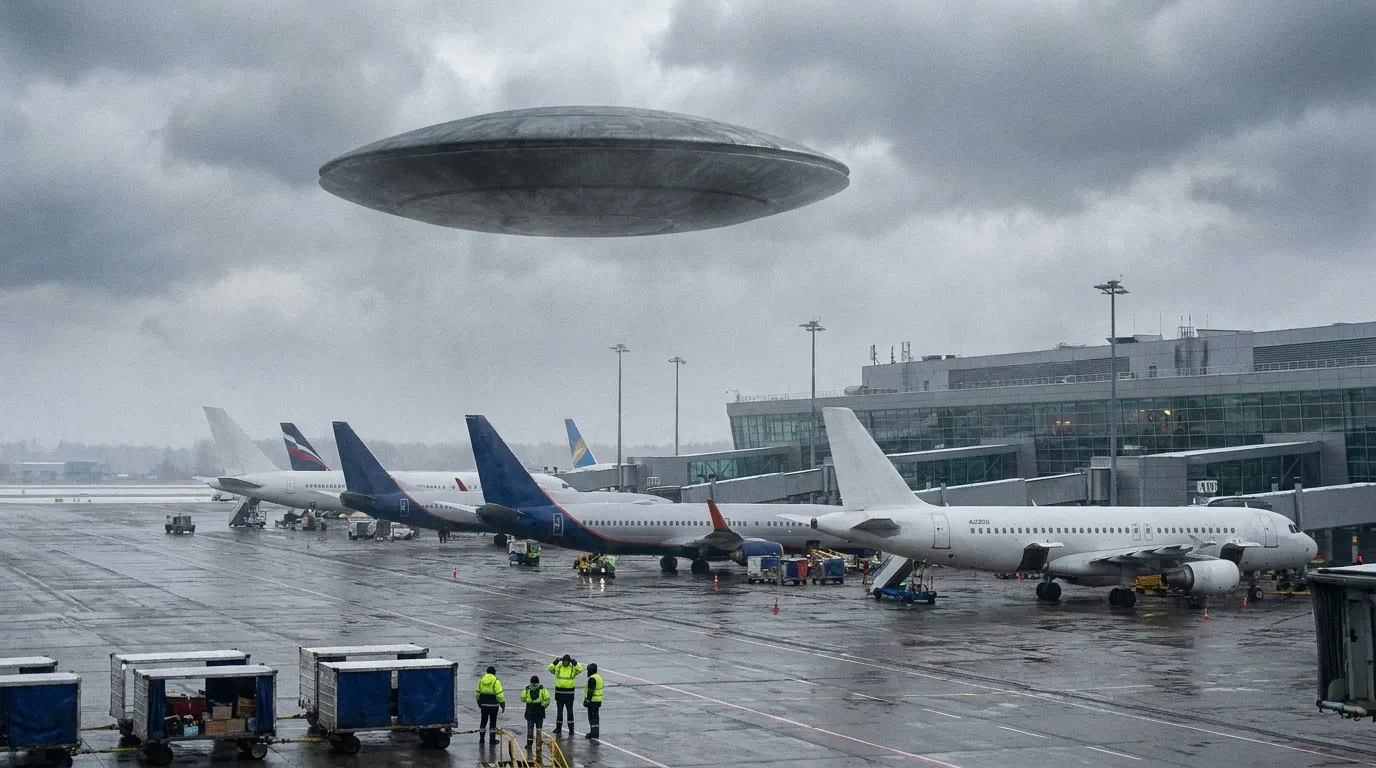
The O’Hare case has a quality most sightings lack: the witnesses were aviation professionals, on the clock, at one of the busiest airports on Earth. Pilots, mechanics and ramp staff are the last people who mistake an aircraft for something strange, because identifying things in the sky is literally their job. That is what makes the O’Hare disc worth taking seriously — and what makes the official non-response so frustrating.
A disc over Gate C17
It was the afternoon of 7 November 2006, around 16:15 local time, in Terminal 1 at Chicago O’Hare. The weather was the flat grey Chicago speciality: a solid overcast with a ceiling somewhere around 1,800 feet, the kind of sky that turns an airport into a low-lit box.
A ramp employee was pushing back United Airlines Flight 446, bound for Charlotte, North Carolina, when he looked up and saw something sitting motionless above the aircraft. He put it out on the radio. Within a minute or two, other United staff around Concourse C were looking at the same thing over Gate C17.
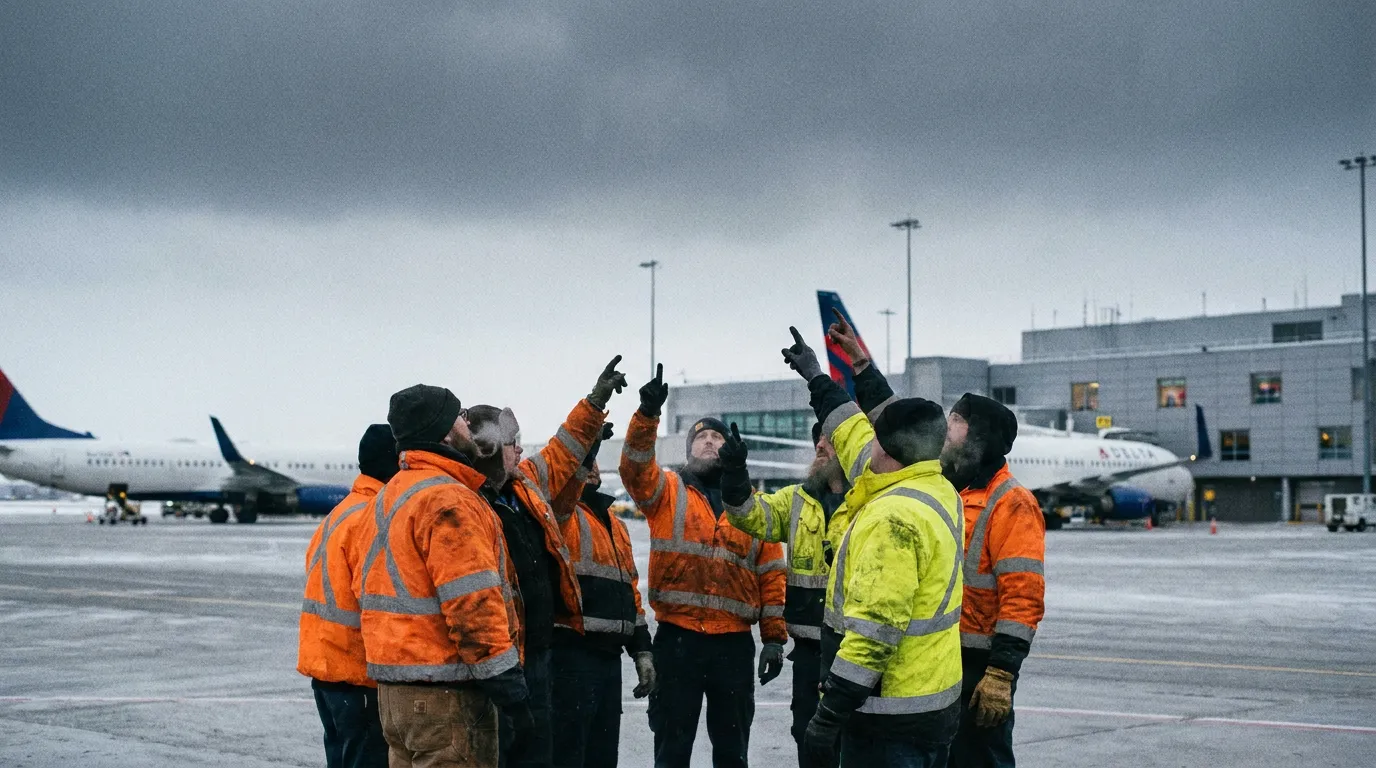
The descriptions converged on the same thing: a dark, grey, solid, saucer-shaped object, hanging silently below the cloud base. Size estimates ran from roughly six to twenty-four feet across, which tells you mostly that nobody could judge its distance; several witnesses reached instead for the honest measure of apparent size, describing something about as big as a US quarter held at arm’s length.
Who was standing where
The witness roster is the strongest thing about this case, and it is worth being precise about it rather than waving at “a dozen employees”. They were not one crowd looking one way. They were scattered across an active apron, doing different jobs, at different angles.
Ramp workers on the pushback saw it from directly beneath. Two aviation mechanics taxiing an empty airliner saw it from a moving cockpit, one of them putting it something like 100 to 200 feet below the cloud deck. Flight crew reported it. So did United management, which is the detail that eventually mattered most, because managers file things.
That spread matters. A single vantage point produces a single kind of error; a dozen people at different bearings, several of them trained to estimate height and distance for a living, is a harder pattern to write off. What none of them produced — at an airport carrying tens of thousands of camera-equipped passengers a day — was a photograph. That absence is the case’s permanent wound, and no amount of witness quality repairs it.
The exit that left a mark
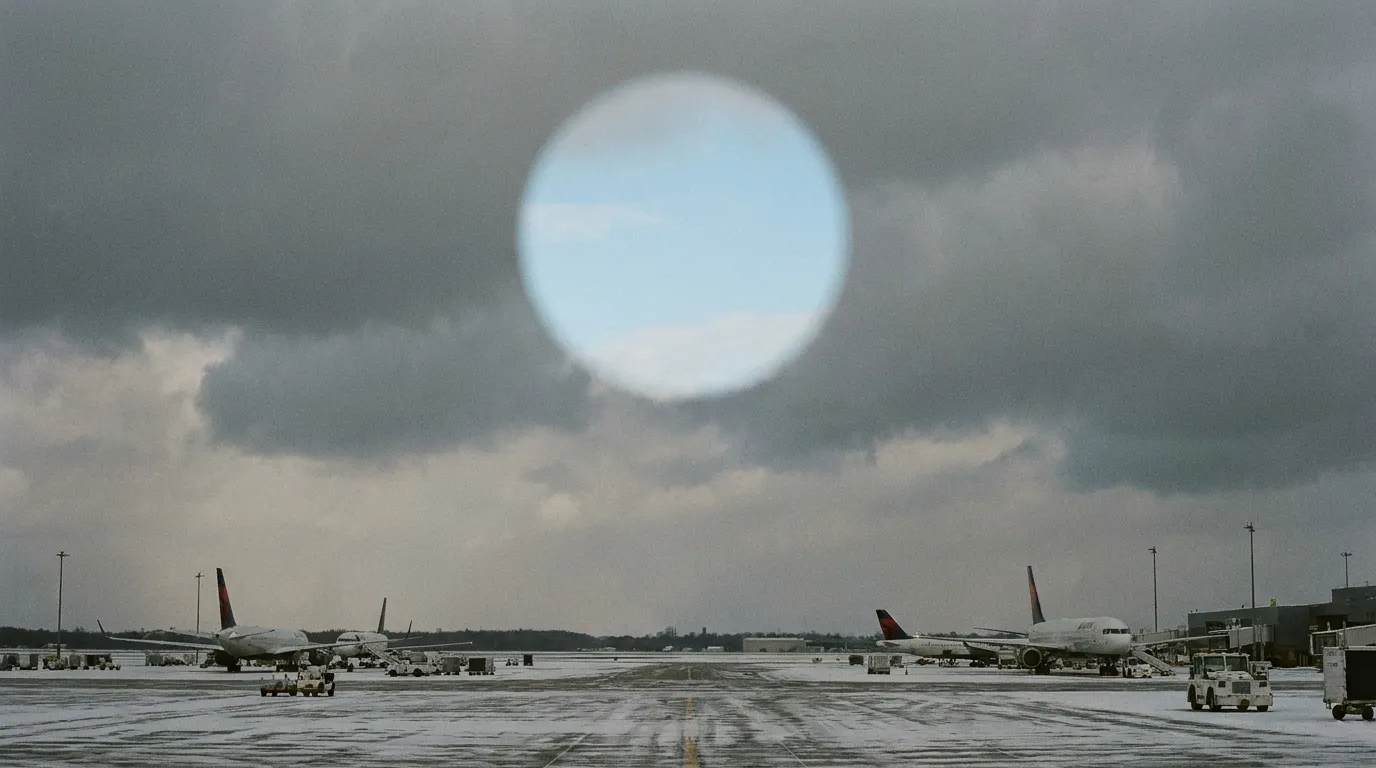
Then came the detail that made the case famous. After roughly five minutes of motionless hovering, the object, witnesses said, shot vertically upward at high speed — punching a clean, round hole straight through the solid deck of cloud above the airport, leaving a brief blue gap where it had passed before the wind closed it again.
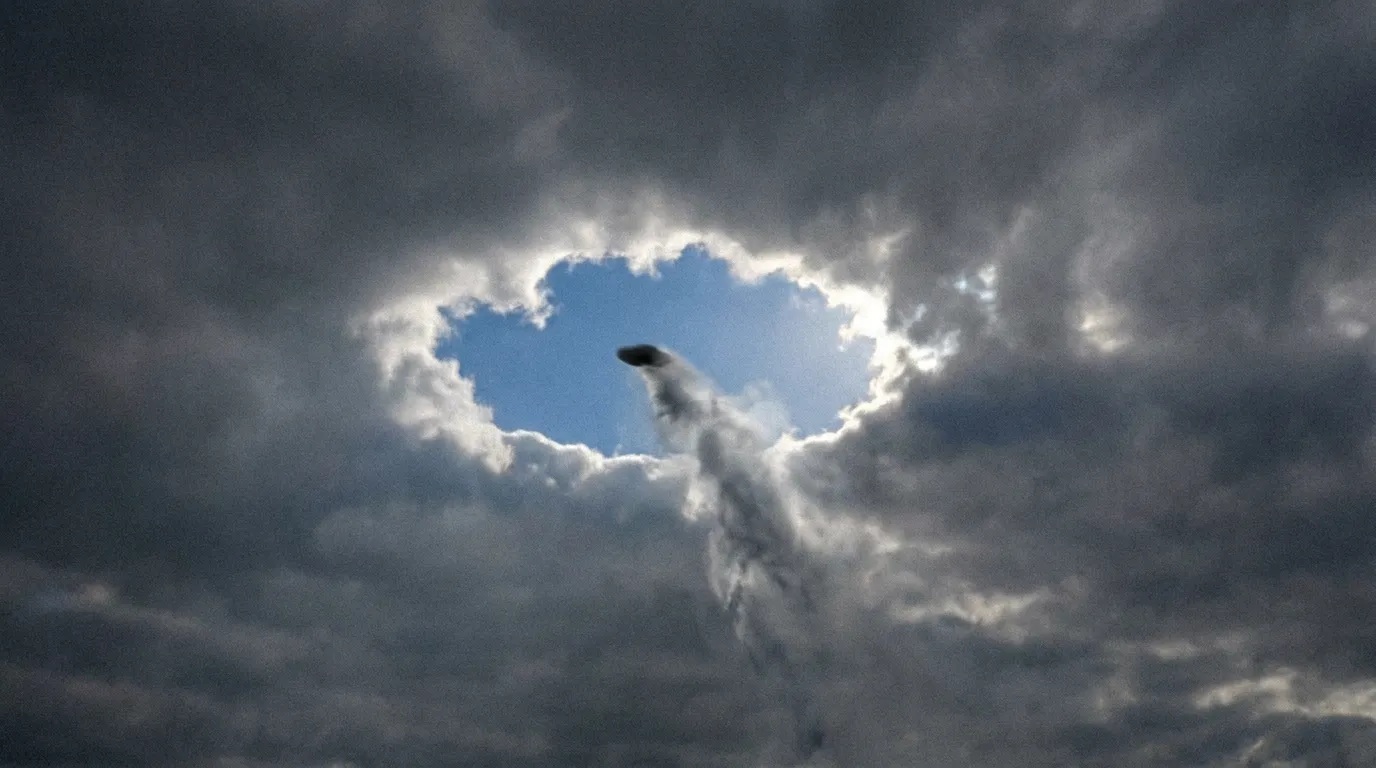
It is a vivid, specific, testable claim — and it is also where the sceptical account gets its foothold, because “hole-punch clouds” are a real, documented meteorological phenomenon with a well-understood cause.
The official shrug
Neither United nor the FAA showed any appetite to look into it. In December 2006, United spokeswoman Megan McCarthy told the Chicago Tribune there was nothing in the duty manager log — the book used precisely for reporting unusual incidents — and no record of anything at all. FAA spokespeople told the same reporter they had no information about any unusual object over O’Hare on 7 November.
The reporter was Jon Hilkevitch, the Tribune’s transportation writer, and he did the obvious thing: he filed a freedom-of-information request. His story ran on 1 January 2007 under the headline “In the Sky! A Bird? A Plane? A … UFO?” and became one of the most-read pieces the paper had put online.
What the paperwork actually showed
The FOIA return did not produce a saucer. It produced something more useful — evidence that the “no record” answers had been wrong. The released material showed telephone contact from the United ramp tower to the FAA tower about the object, and a written notation of the incident in the FAA tower’s own daily record.
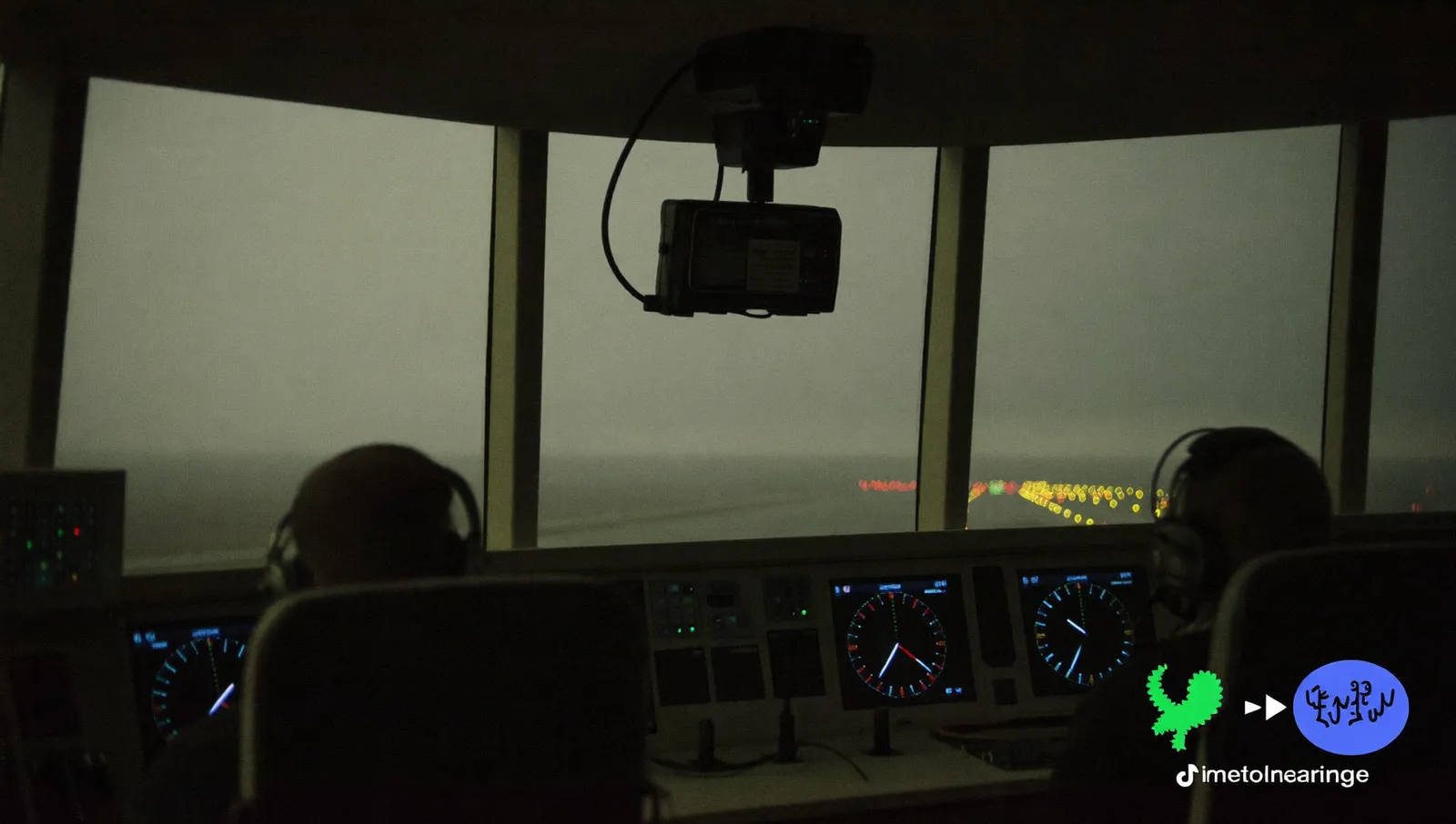
The recorded tower audio is the part that sticks. On it, one voice asks whether a colleague has seen “a flying disc out by C-17”, and gets back a flat, slightly weary confirmation that this is what the pilot and the ramp staff are saying. Nobody on the tape sounds excited. They sound like people at work, handling an odd radio call.
That is the whole shape of the documentary record: real, contemporaneous, unglamorous, and entirely about reports of an object rather than the object itself. It establishes beyond argument that something was reported at the time and that the initial denials were inaccurate. It establishes nothing whatever about what was overhead.
The hole-punch cloud, at its strongest
The sceptical case deserves to be put properly, because it is better than its reputation. In early 2007 the FAA settled on a weather explanation, and the specific mechanism offered was a fallstreak hole — the “hole-punch cloud” — with FAA spokeswoman Elizabeth Isham Cory summarising the agency’s position as the theory that this had been a weather phenomenon. Astronomer Mark Hammergren pointed out that the day’s conditions were right for one.
The physics is genuine and unremarkable. A thin layer of supercooled cloud — water droplets still liquid below freezing — is metastable. An aircraft climbing or descending through it can seed ice crystals, which grow, fall out, and leave a clean circular gap that spreads for a while before closing. Airports generate these constantly, because airports generate aircraft climbing through cloud layers.
So the exit is well covered. What the weather answer never addresses is the five minutes before it: a solid, dark, stationary object that a dozen aviation workers say they watched hang over a gate in daylight. You can argue those people misread something — a reflection, a balloon, a plastic bag on a thermal, a trick of the flat grey light — but the fallstreak mechanism is not that argument. It explains the hole. The disc is left standing on the apron.
The radar that never saw it
Under pressure from the coverage, the FAA did agree to review its radar data for that afternoon. The result was nothing: no controller had seen the object visually, and the review found no unexplained return over the terminal.
Sceptics treat this as decisive, and it does real work. Believers treat it as meaningless, and that is too quick in the other direction. The honest reading sits in between, and it is technical. Terminal radar is not a camera pointed at the sky; it is optimised to see cooperative aircraft with transponders, at altitude, moving. A small, slow or stationary object a few hundred feet up, effectively parked among terminal buildings and ground clutter, is close to the worst-case target for that system.
So “no radar return” is weak evidence of absence here — but it is still the absence of the one independent measurement that could have settled the case. It is also, unavoidably, an argument that cuts both ways: a genuinely radar-invisible craft is an extraordinary claim, and a small mundane object that never registered is an ordinary one.
The safety report nobody had to answer
The most substantial investigation of O’Hare was done by people with no authority whatsoever. In March 2007, the National Aviation Reporting Center on Anomalous Phenomena — NARCAP, a small civilian group focused on aviation-safety reporting rather than on aliens — published Technical Report 10, “Report of an Unidentified Aerial Phenomenon and its Safety Implications at O’Hare International Airport on November 7, 2006”.
It ran to well over a hundred pages with appendices, and it was led by Richard F. Haines, a former NASA research scientist and NARCAP’s chief scientist, with co-authors including Martin Shough and Ted Roe; MUFON’s Illinois state director Sam Maranto conducted witness interviews that fed into it. It compiled the testimony, the weather data, the tower communications and the radar question in one place — which is more than any agency did.
NARCAP’s framing is the useful part, and it is deliberately boring. Their argument was never that a spacecraft visited Chicago. It was that an unidentified physical object reported below the cloud base in Class B airspace at a hub handling nearly a million movements a year is, by definition, an aviation-safety matter, and that the regulator’s job was to establish what it was. Mark Rodeghier, scientific director of the Center for UFO Studies, made much the same point in less institutional language: the thing was worth investigating.
Why the case keeps coming back
O’Hare endures for two reasons, and only one of them is respectable. The respectable one is the witness profile — this is the case people reach for when they want to make the argument that trained aviation observers report these things and are ignored, an argument the recent surge in commercial pilot reporting has given fresh weight.
The less respectable one is the cloud hole, which is dramatic, visual, and has since attracted theorising well beyond the evidence — including a 2021 exercise by the Applied Physics group arguing that a warp-drive-style propulsion bubble would produce exactly such a gap. That is speculative modelling asked to explain an anecdote, not analysis of data, and it should be read as the former.
What has changed since 2006 is the paperwork culture, not the answer. The FAA now has a formal channel for pilots reporting anomalies, and radar retention has become its own argument — today the raw data is routinely deleted after 45 days, which is roughly the window Hilkevitch needed to get his FOIA in.
The UAP Times take
O’Hare earns an Unconfirmed rating, three out of five on our scale, and it is a case defined less by what was seen than by what was never done. The witnesses are unusually good: trained, numerous, professional, spread across different vantage points, with no obvious motive to invent a story that could only cause them workplace grief. Against that: no photograph at a camera-saturated airport, no radar, and a dramatic finale with a plausible mundane label.
The documentary record proves two narrow things and no more. Something was reported in real time, by people whose job is to report things. And the first official answers — no log entry, no information, no record — were wrong, corrected only because a newspaper filed a request.
Our reading is that O’Hare is a genuinely tantalising case fatally under-investigated. An object over a major airport, reported by a dozen aviation workers, is exactly the sort of thing a safety regulator should have run to ground within a week — and instead it was labelled “weather” and shelved, leaving the only serious write-up to a volunteer group with no subpoena power and no standing. The lasting lesson of O’Hare isn’t that a saucer visited Chicago. It’s how easily a well-witnessed anomaly can be made to disappear, not by explaining it, but by declining to look.
Further reading: for the disc that started it all, see Roswell 1947. For another daylight mass sighting that got an official shrug, see Westall 1966. The O’Hare object was a textbook disc / saucer; it’s on the sightings map.
Source: FAA statements; Chicago Tribune reporting; United Airlines employee accounts
Follow the file
Every new dispatch from the UAP desk, in your inbox. Sourced, sceptical, and no more than one email a week.